She Danced With the Lonely Duke to Make Her Ex Jealous—Then He Whispered, “Marry Me”
She Danced With the Lonely Duke to Make Her Ex Jealous—Then He Whispered, “Marry Me”
Whispers move through a ballroom faster than a plague. Tonight, the contagion carried a single name.
Diana Waverly. Standing by the punchbowl, she watched the man who promised her forever slip a sapphire onto another woman’s finger.
Teeing staires practically burned through her silk gown. She had two choices. Retreat to the shadows and become a cautionary tale or find the most dangerous man in the room and make him hers.
She chose the latter. The heat inside the Langden ballroom was offensive. 200 bodies crammed into a space built for half that, all radiating the smells of melting beeswax, damp wool, and wilted liies.
Diana Waverly stood near a towering arrangement of white roses, her spine rigid against the velvet wallpaper, her corset dug violently into her ribs with every shallow breath.
Across the room, Vic, Count Simon Rexford laughed. It was the same laugh he used to reserve for her.
Low, rumbling, a sound that implied a shared secret. Now he was directing it at Miss Lydia Montrose.
Lydia with her father’s shipping fortune, her nervous birdlike flutter, and the enormous newly acquired sapphire weighing down her left hand.
“Do not look at them,” Penelopey whispered, her hand hovering over Diana’s elbow. “Let us go to the carriage.
I will claim a migraine. No one will question it. If I leave now, Penn, I might as well wear a sign declaring myself ruined,” Diana said.
Her voice sounded thin, metallic, like a cheap coin dropped on pavement. Diana, please. I am fine.
She was not fine. She was 23 years old, an age that, in this ruthless market, made her stale goods.
She had spent three seasons turning a blind eye to respectable, boring suitors, because Simon had told her to wait, just until the estate is settled.
He had whispered in the damp shadows of her father’s garden last August, just until my father’s debts are cleared.
You belong to me, Diana, she believed him. [clears throat] That was the truly humiliating part.
Not that he had married for money. Half the room had done that. The humiliation was that she had trusted him.
She had saved her dances, guarded her reputation, and faded into the background. All to be a perfect, patient bride for a man who was quietly negotiating a marriage contract with a merchant’s daughter.
She found out an hour ago. Not from Simon, from a daager who had cornered her in the powder room with a cruel smile disguised as concern.
Have you heard the joyous news, Miss Waverly? We are so delighted for the Viccount.
Diana tightened her grip on her ivory fan. [clears throat] The thin wooden staves cracked under the pressure.
A tiny sharp sound lost in the den of the orchestra tuning their strings. She looked across the sea of bobbing feathers and silk crevats.
Simon’s eyes met hers. There was no guilt in his gaze, not a shred of remorse.
Instead, he looked at her with a heavy, suffocating pity. He gave her a slight, patronizing nod, as if to say, “Be a good girl and take this quietly.”
He expected her to cry. He expected her to run. He expected to enjoy the quiet triumph of being a man so deeply loved that his abandonment broke a woman in half.
A slow, cold fury settled into the pit of Diana’s stomach. It pushed past the grief, pushed past the urge to vomit and locked her knees into place.
She wasn’t going to cry, and she wasn’t going to leave, but standing by the wall was a slow execution.
The whispers were already circling. Daagers leaned behind their painted fans, their eyes darting toward her, and then back to the new couple.
Young debutants gave her wide, fearful glances, recognizing her as a ghost of their own potential futures.
If she stayed on the fringes, she would be branded a pathetic, discarded thing for the rest of her life.
She needed a shield. No, she needed a weapon. She needed someone whose sheer presence would overshadow Simon’s pathetic little engagement announcement.
She needed a man whose attention would turn the pity of the room into burning insatiable envy.
Diana’s gaze swept the perimeter of the ballroom, dismissing the giggling cornets, the drunken baronets, the married lords hunting for mistresses.
Then she saw him. Standing in the darkest corner of the room near the open terrace doors was Benedict, Duke of Rothwell.
He did not belong here. Rothell despised London. He despised the season, the gossip, and the people.
He was 32, notoriously ruthless in Parliament, and carried a reputation built on ruined rivals and cold efficiency.
If he was not handsome in the classical sense. His jaw was too sharp, his nose possessed a slight bump from an old break, and his eyes were a flat, unreadable gray.
He looked like a man who had walked into a slaughter house, and found the smell tedious.
No one was talking to him. The [clears throat] invisible boundary of fear kept the social climbers at least 3 ft away.
Diana looked back at Simon. He was kissing Lydia’s knuckles, but his eyes were darting toward Diana, checking to see if she was still watching his performance.
“Watch this, Simon,” she thought. “Hold my drink, pen,” Diana said, shoving her crystal glass into her friend’s hand.
“Diana, what are you doing?” Penelopey hissed. Surviving. Walking across a crowded ballroom when you are the subject of the evening scandal requires a specific kind of dissociation.
[clears throat] Diana fixed her eyes on the heavy velvet curtains behind the Duke of Rothwell and put one satin slipper in front of the other.
She felt the shift in the room’s atmosphere. Conversations died and restarted in rushed muted tones as she passed.
She kept her chin parallel to the floor, her shoulders pressed back, ignoring the physical ache in her chest.
As she approached the terrace doors, the air grew cooler. The stifling smell of perfume gave way to the sharp, clean scent of the night air mixed with tobacco and something faintly metallic.
Rothewell was leaning against the door frame, a [clears throat] glass of amber liquid in his hand.
He was watching the dancers with an expression of profound exhaustion. When Diana stopped 2 ft away from him, he didn’t adjust his posture.
He merely shifted his gaze, pinning her under a stair so heavy it made her want to step backward.
She didn’t. Your grace, she said. Her voice was steady, surprising them both. He looked her up and down.
It wasn’t an appraisal of her figure, but an assessment of a threat. Miss Waverly.
He knew her name. That threw her, but only for a fraction of a second.
I was unaware you attended such trivial gatherings. I was coerced. A matter of business regarding a stubborn railway investor who refuses to take meetings in daylight, Rothwell replied.
His voice was a low, grally baritone that vibrated in the small space between them.
“What is your excuse?” “I am currently serving as the evening’s entertainment,” Diana said flatly.
Rothewell took a slow sip of his drink. His gray eyes drifted over her shoulder, finding the knot of people congratulating Simon and Lydia.
He connected the dots with brutal speed. “Ah,” he murmured. The Vic Count Rexford. I heard he finally secured the Montro shipping lines.
It came attached to a rather tedious girl, I see. He looked back at Diana.
And you are the collateral damage. He didn’t dress it up in polite sympathy. He stated it like a fact on a ledger.
Diana found it incredibly refreshing. I am, she admitted. And in about 5 minutes, when the orchestra plays the next waltz, the entire room is going to watch me to see if I weep or flee.
“My money is on fleeing,” Rothell said, turning his attention back to the dance floor.
“You look pale enough to faint.” “I never faint,” she snapped. He raised an eyebrow, finally turning his full attention to her.
The sheer intensity of his focus made her skin prickle. Then what do you want from me, Miss Waverly?
I do not offer handkerchiefs, and I certainly do not offer comfort. I don’t want comfort.
I want a dance. Silence hung between them. A patron passing by gave them a wide birth, shooting a startled look at Diana for daring to corner the Duke.
Rothewell let out a short, harsh breath that might have been a laugh. No, one waltz, she pressed, stepping half an inch closer.
Just one. I do not dance. You have two functioning legs and a rudimentary understanding of rhythm.
You are perfectly capable of dancing. Capability and willingness are entirely different beasts. Go find a sympathetic cousin, Miss Waverly.
A sympathetic cousin makes me look pathetic, Diana said, the desperation finally bleeding into her voice.
She forced it back down, grounding herself. If I dance with a pitying friend, I am the tragic victim.
If I dance with you, “You are what?” He prompted, his eyes narrowing. “A woman who has moved on to better things,” she said, holding his gaze.
A woman who isn’t crying over a VI count because she has the attention of a duke.
Rothewell stared at her. He didn’t blink. The silence stretched tight as a drawn bow string.
You want to use me to make a mediocre man jealous, he stated. It wasn’t an accusation.
It was an analysis. Yes, she didn’t flinch. There was no point in lying to a man like him.
>> [clears throat] >> It is a transparent, childish ploy. It is a highly effective, necessary tactic to salvage my social standing, Diana countered.
You hate these people, your grace. I have watched you scowl at this room for the last 10 minutes.
You despise their whispers, their rules, their smug little hierarchies. Dance with me. And we insult every single one of them.
>> [clears throat] >> We robbed them of their tragedy. Rothewell’s jaw tightened. He looked at her not as a woman in a silk dress, but as an opponent across a chessboard.
He saw the calculation in her eyes. The sheer stubborn refusal to be broken. The orchestra finished tuning.
The conductor tapped his baton. The opening notes of a waltz drifted through the oppressive air.
He will hate it,” Rothell murmured almost to himself. “He will be furious,” Diana confirmed.
Rothewell set his glass down on a nearby silver tray with a sharp clink. He turned to her, his posture straightening to his full imposing height.
He offered his left arm. “Do not step on my boots, Miss Waverly.” Diana placed her gloved hand on his sleeve.
The muscle beneath the fine black wool was hard as iron. I make no promises, your grace.
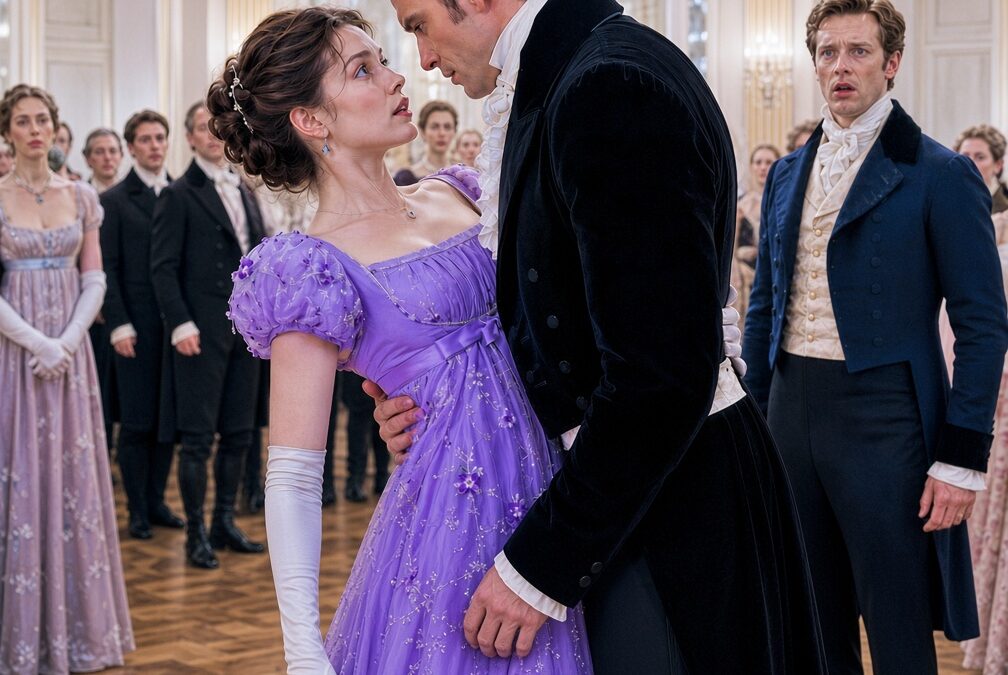
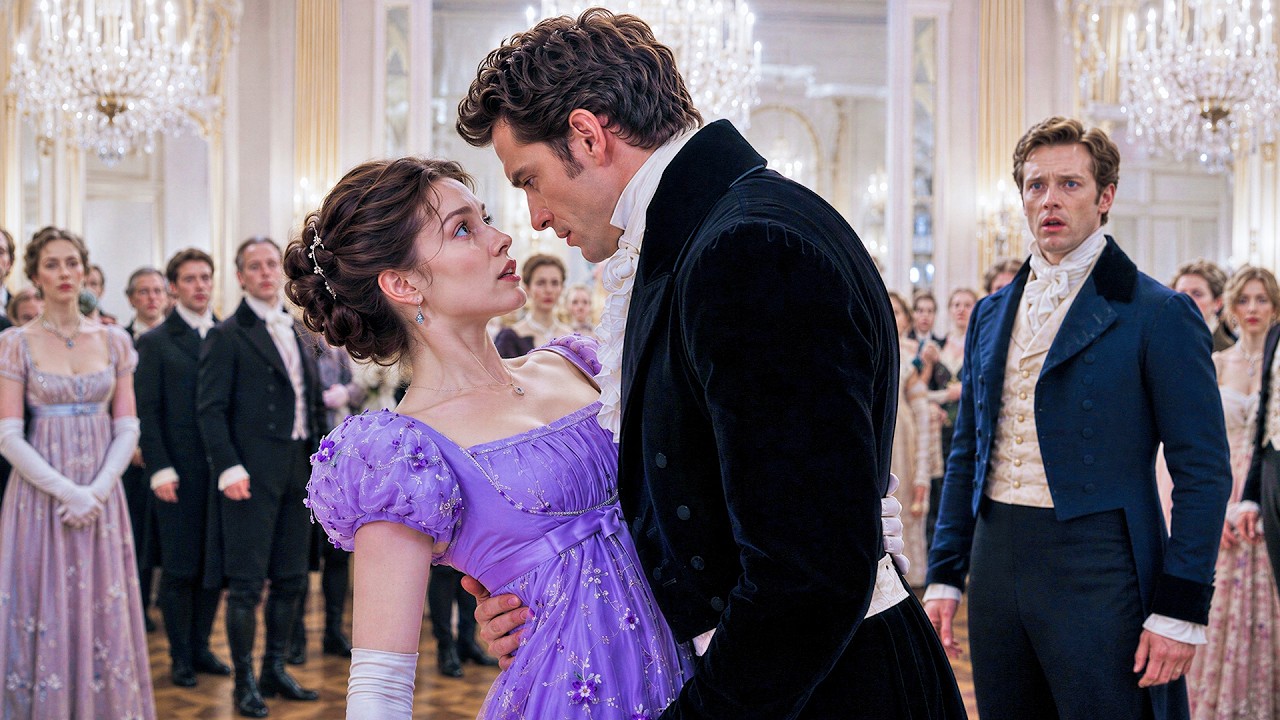
The moment they stepped out of the shadows and onto the polished oak of the dance floor, the room reacted.
It was not a subtle shift. It was a physical, audible ripple. Dozens of heads snapped in their direction.
Conversations were cut off mid-sentence. The sea of pastel gowns and dark coats parted before them, as if Rothell carried a contagion far deadlier than scandal.
Diana kept her eyes locked on Rothell’s crevat. Her heart was beating so violently, she was certain he could feel it through his sleeve.
They reached the center of the floor. Rothewell turned to face her. He didn’t wait for the polite introductory boughs.
He simply placed one large, warm hand on her waist and took her right hand in his left.
His grip was not the light, barely there touch of polite society. His hand on her waist was firm, authoritative, rooting her to the floor.
His fingers engulfed hers. It was a grip that said, “We are doing this, and you will not falter.”
They stepped into the turn just as the music swelled. Breathe, Miss Waverly, Rothell muttered, stepping smoothly around a startled couple.
If you pass out, you ruin the entire effect. I told you I do not faint, she managed to say.
Her voice was breathy, betraying her. You are holding your breath like you’re preparing for a firing squad.
It feels rather like one. Rothewell steered her firmly into the outer circle of dancers.
He was an aggressive dancer, moving with long, predatory strides that forced the other couples to yield space.
He didn’t look at the crowd. He looked exclusively at her. “Look at me,” he commanded softly.
“If you look at the floor, you look ashamed. If you look at the room, you look defensive.
Look only at me. Let them wonder what I am saying to you. Diana forced her gaze up.
His gray eyes were intense, analyzing her every flinch. The heat of him was seeping through the layers of her gown.
There was a faint scent of sandalwood and old paper clinging to his coat. “What are you saying to me then?”
She asked, falling into the rhythm of his steps. I am currently calculating the odds of Vikcount Rexford challenging me to a duel, Rothwell said dryly.
Diana’s heart gave a vicious leap. She risked a microscopic glance to the side. Simon was standing at the edge of the floor.
He was no longer smiling. The smug, pitying expression was entirely gone, replaced by a dark, ugly flush of disbelief.
Lydia was tugging at his sleeve, but he wasn’t looking at her. He was staring dead at Diana.
His jaw clamped so tight she could see the muscle jumping beneath his skin. A fierce, jagged spike of satisfaction drove straight through Diana’s chest.
It didn’t cure the pain of his betrayal, but it gave her breath. It gave her leverage.
He looks, Rothwell observed, spinning her expertly past a glaring dowagger, like a man who has just realized he threw away a diamond to pick up a rather dull rock.
“A very wealthy rock,” Diana corrected, though a genuine, involuntary smile touched the corners of her mouth.
Rothewell saw it. Something in his harsh face shifted. Not a smile, but a subtle loosening of the severe lines around his eyes.
You are a very pragmatic woman, Miss Waverly. I am a survivor, your grace. Pragmatism is a requirement.
Indeed. They danced in silence for a minute. The physical reality of the walts became allconsuming.
The dizzying spin, the blur of the candle light, the solid, unyielding strength of Rothewell’s frame guiding her.
He didn’t treat her like spun glass. He spun her hard, caught her firmly, demanded she keep up with his pace.
It forced her to stay entirely in her body, pulling her out of the wreckage of her own mind.
She realized with a jolt that she felt safe. Not the safety of a locked room, but the safety of standing behind a fortress wall while arrows rained down outside.
No one would dare pity her right now. No one would dare speak a word against her while the Duke of Rothell held her.
The music reached its crescendo. Rothewell slowed their steps. He didn’t look at the room.
[clears throat] He was looking at her mouth, then up to her eyes. His brain was working, the gears grinding behind those flat gray eyes.
He had come to London to find a wife, a requirement placed upon him by the vast empty estates that needed an heir.
He had dreaded the prospect. He hated the sering debutants, the false modesty, the romantic illusions that crumbled the moment reality set in.
He needed a woman with a spine of steel, a woman who understood transactions, a woman who looked at a burning bridge and calculated the warmth of the fire.
The final note of the cello dragged out, resonant and deep. The dancers stopped. Polite applause pattered around them.
Rothewell didn’t step back. He kept his hand firmly on Diana’s waist. The heat of his palm burned through her silk gown.
She looked up at him, her chest heaving slightly against her tight corset. The triumph of the moment was fading, the adrenaline crashing.
She had won the battle, but she still had to walk off this floor, go home, and face the reality of being a spinster with a ruined heart.
“Thank you, your grace,” she whispered, moving to step away. His fingers tightened, halting her retreat.
The silence around them was absolute. The entire ballroom was holding its collective breath, watching the Duke of Rothell refuse to release the disgraced Miss Waverly.
Rothewell leaned down. His face was mere inches from hers, brushing the delicate feathers in her hair.
“You require a permanent shield,” he said. His voice was so low it barely reached her ears, a dark rumble intended for her alone.
“And I require a wife who does not bore me to death. Diana froze. Her blood turned to ice water, then to fire.
What? Rothell didn’t flinch. His eyes locked onto hers, burning with cold absolute certainty. Marry me.
The words did not register as a romantic declaration. They hit Diana like a physical blow, sharp and disorienting.
Marry me. For 3 seconds she simply stared at the rough texture of Benedict’s crevat.
The ballroom around them had begun to hum again, the polite applause dissolving into a low, frantic buzzing as the guests realized the Duke and the disgraced spinster were still locked in an embrace.
She looked up into his gray eyes. They were devoid of warmth, devoid of affection, and entirely devoid of jest.
You are mad,” she whispered. “I am remarkably sane,” Benedict replied, his voice maintaining that low, steady cadence.
“I require a duchess. My estate in Northumberland is vast, isolating, and severely lacking a mistress.
I despise London. I despise the the women it produces. They are trained to expect poetry, grand declarations, and constant exhausting attention.
I have neither the time nor the inclination for any of it. His thumb pressed slightly into the silk at her waist.
A grounded anchoring touch. You, he continued, are currently standing in the wreckage of your own life, refusing to burn.
You have a spine. You understand that the world is a transaction. I will give you a title, unprecedented wealth and the satisfaction of grinding Viccount Rexford’s pride into dust.
In exchange, you will run my household. You will not expect me to court you, and eventually you will provide an heir.”
It was a contract delivered in the middle of a crowded dance floor, surrounded by 200 people who were desperate to know what was being said.
Diana’s chest rose and fell rapidly. Her mind raced, calculating the terrifying, dizzying mathematics of his offer.
If she walked away now, she would go home a pariah. Tomorrow the morning calls would be full of fake sympathy.
Her mother would weep. Her father would look at her with that heavy, silent disappointment.
She would be shipped off to a country cousin in Bath, doomed to wear muted colors and mind someone else’s children.
Or she could be a duchess. She would be bound to a cold, ruthless man she did not know, a man who explicitly stated he would never love her, but he would respect her and he would arm her.
Diana. The voice cut through the space behind them. It was a familiar smooth baritone, entirely stripped of its usual confidence.
Benedict did not release her. He merely shifted his stance, turning them both slightly, so they faced the intruder as a united front.
Simon stood there, his face was flushed, his eyes darting frantically between Diana’s rigid posture and Benedict’s massive hand resting intimately on her waist.
Behind him, hovering anxiously near a marble pillar, was Lydia Montro, looking like a frightened bird.
“Rexford,” Benedict said. The name tasted like dirt in his mouth. “Are you lost?” Simon ignored the Duke, fixing his gaze on Diana.
He tried to muster a look of gentle patronization. The look he had used to string her along for 3 years.
Diana, what is the meaning of this? You are making a spectacle. Let me escort you to your carriage.
Penelope is looking for you.” The sheer audacity of it left a copper taste in Diana’s mouth.
He had humiliated her, discarded her, and now he wanted to manage her exit to ensure his own evening remained unblenmished.
“Miss Waverly is not leaving,” Benedict said, his voice dropping an octave. “She is currently engaged in a conversation with me.
You are interrupting,” Simon bristled. “Your grace, with respect, Miss Waverly and I are old friends.
She is clearly distressed. I am simply trying to protect her reputation. Her reputation? Benedict echoed softly.
It was a dangerous sound. You abandoned her for a shipping ays less than 2 hours ago.
Rexford, do not dress your cowardice up as chivalry. It is insulting to my intelligence, and it is entirely insulting to my future wife.
The word dropped into the space between them like an anvil. Simon physically recoiled, his eyes widened, the blood draining from his face, leaving his skin a sickly, muddled gray.
“Your what, wife?” Diana said, the word clawed its way out of her throat before she could second guessess it.
She looked at Simon, the man she had thought she loved. He looked small, stripped of his charming smiles and empty promises.
He was just a desperate man in a tight waste coat, terrified of scandal. “I have accepted the Duke’s proposal,” Diana said.
Her voice was remarkably steady. It rang out clear and sharp, carrying to the nearest row of onlookers.
“We are to be married,” Simon’s mouth opened, but no sound came out. He looked at Diana, then at the towering, immovable bulk of the Duke, and finally realized he was entirely outmatched.
He took a stumbling step backward, muttered something incoherent, and practically fled back toward the safety of his wealthy, trembling fiance.
Diana watched him go. The satisfaction she had expected didn’t come. Instead, she felt a hollow, echoing emptiness.
The game was over. She had won and she had just sold her life to a stranger to do it.
Benedict looked down at her. He offered his arm. Let us leave, Miss Waverly. We have settlements to draft.
She placed her hand on his sleeve. They walked toward the exit, the sea of aristocrats parting before them in stunned absolute silence.
The Waverly Townhouse on Chester Street smelled of boiled cabbage and old wax. It was a respectable home, but aggressively modest.
The rugs were worn thin near the doorways, and the upholstery in the parlor had been skillfully patched by Diana’s mother more than once.
At 10:00 the following morning, Benedict, Duke of Rothwell, sat in the center of the cramped room.
He looked absurdly out of place. A wolf forced into a bird cage. Across from him sat Mr.
Finch, a solicitor with inkstained fingers who looked terrified to breathe too loudly. Diana sat on the edge of the sofa, her hands folded in her lap.
She wore a simple navy day dress, her hair pulled back severely. She hadn’t slept.
Every time she closed her eyes, she saw Simon’s face, followed immediately by the cold, flat stare of the man sitting across from her.
Her mother, Martha Waverly, was pacing in the hallway, oscillating between ecstatic triumph and sheer terror.
Her father, a quiet man who spent his life studying antiquities, had simply signed the necessary papers, shaken the Duke’s hand, and retreated to his study.
Entirely overwhelmed. The settlements are exceptionally generous, your grace, Mr. Finch mumbled, adjusting his spectacles.
An allowance of £3,000 peranom for the duchess’s personal use. The Daer House in Kent fully staffed should heaven forbid she be widowed and the immediate clearance of Mr.
Waverly’s outstanding debts. Diana flinched. She hadn’t known Benedict was clearing her father’s debts. Benedict leaned back in the fragile armchair.
It groaned under his weight. Are the terms acceptable to you, Miss Waverly? He wasn’t asking the solicitor.
He was asking her. They are beyond acceptable, your grace. They are entirely disproportionate to what I bring to this arrangement.
You bring exactly what I require, Benedict said. Sanity, competence, a complete lack of hysterics.
He stood up. The room instantly felt smaller. Mr. Finch, leave the documents. We will sign them now.
I have procured a special license from the archbishop this morning. Diana’s head snapped up.
A special license? We are marrying today. Is there a reason to wait? Benedict asked, his gaze pinning her to the sofa.
Do you require time to order a white lace gown? Do you wish to parade down the aisle of St.
Georgees, while the ton watches and whispers about whether you are mourning Rexford, the blunt cruelty of the truth stung, but she couldn’t deny it.
A prolonged engagement would be a nightmare of gossip. “No,” she said quietly. “Today is fine.
Good. Pack whatever you need. We leave for Felburn immediately after the ceremony. It is a 4-day journey north.”
2 hours later, Diana stood in a freezing, empty chapel in Mayfair. There were no flowers.
There was no choir. The only witnesses were a shivering clark and her bewildered parents.
She wore a heavy gray traveling gown, practical and entirely devoid of joy. Benedict stood beside her in a dark wool coat, staring straight ahead at the altar.
When the vicar asked for the rings, Benedict produced a heavy gold band set with a square cut emerald.
It was ancient, heavy, and cold as he slid it onto her finger. With this ring, I wed.
His voice was a low mechanical rumble. He did not look at her when he said it.
When it was over, there was no kiss. The vicar looked uncomfortable, expecting some show of affection, but Benedict merely turned on his heel, signed the register with sharp, aggressive strokes of the quill, and waited by the heavy oak doors.
Diana hugged her mother, who was crying tears of relief and anxiety. “You are a duchess, Diana,” Martha whispered fiercely into her daughter’s ear.
“Do not let him frighten you. You are his equal now.” Diana looked past her mother’s shoulder at her new husband.
He was staring out the chapel window at the gray London sky, looking impatient. She did not feel like his equal.
She felt like property that had just been successfully transferred from one ledger to another.
“I will write to you, mother,” Diana said, pulling away. She walked down the short aisle, the heavy fabric of her skirt brushing against the stone floor.
Benedict opened the door for her. The cold wind bit into her cheeks immediately. A massive black traveling carriage with the Rothell crest waited at the curb, drawn by four massive, restless gray horses.
He handed her up into the dark interior. As she settled onto the velvet squabs, the reality of her decision settled over her like a heavy, suffocating shroud.
She was entirely alone. The inside of the carriage smelled of rich leather, damp wool, and the faint, sharp tang of peppermint.
For the first 4 hours of the journey, neither of them spoke. The carriage rattled and swayed over the ruted roads leading out of London, the rain drumming a relentless, depressing rhythm against the roof.
Diana sat huddled in her corner, staring out the window at the blurred, gray countryside.
Her mind mind kept looping back to the ballroom to Simon’s face to the heavy emerald dragging down her left hand.
It felt like a manacle. Across from her, Benedict sat with one ankle resting on his knee.
He was not looking out the window. He was reading a dense leather-bound ledger, using a silver pencil to make sharp, aggressive corrections in the margins.
He seemed entirely unbothered by the silence or by her presence. The carriage hit a deep pothole.
Diana was thrown sideways, her shoulder slamming into the lacquered wood of the doorframe. She let out a sharp gasp of pain.
Benedict didn’t look up from his ledger. Hold on to the leather strap above your head.
The roads only worsened from here. Diana gritted her teeth, rubbing her bruised shoulder. She reached up and gripped the strap.
Are we traveling all the way to Yorkshire today? We are traveling until the horses require rest or until the roads become impassible, he replied smoothly.
He flipped a page. Whichever comes first. You are a remarkably accommodating travel companion. The sarcasm slipped out before she could stop it.
It was a defense mechanism, a remnant of her days fencing with the sharp tongues of the London tongue.
Benedict paused. He slowly lowered the pencil. He closed the ledger and set it on the seat beside him.
[clears throat] He looked across the small confined space of the carriage, his gray eyes fixing on her with a heavy unsettling focus.
“Let us establish a rule, Diana,” he said. It was the first time he had used her given name.
It sounded harsh in his mouth. I do not play games. I do not engage in polite, passive aggressive banter.
If you are uncomfortable, say so. If you are angry, say so. But do not waste my time with sarcasm.
Diana met his gaze. Her pulse thumped in her throat, but she refused to look away.
Very well. I am uncomfortable. It is freezing in here. My shoulder throbs, and I have just married a man who treats me with the warmth of a tax collector.
Is that direct enough for you? Silence hung in the carriage, punctuated only by the rhythmic thud of the horse’s hooves.
Then something extraordinary happened. The corner of Benedict’s mouth twitched. It was a tiny microscopic movement, but in the bleak landscape of his face, it was practically a shout.
He reached beneath his seat and pulled out a heavy fur carriage rug. He tossed it across the space between them.
It landed heavily over her lap, smelling of cedar and animal heat. “Felburn is cold,” he said, picking his ledger back up.
“You will need to adjust. And as for my warmth, I told you what I was before you agreed to this.
You wanted a weapon against Rexford. You have it. A sword is meant to be sharp, not comforting.
Diana pulled the heavy fur up to her chest. The heat began to seep into her shivering bones.
I suppose that is true. It is. The tension in the carriage shifted. It didn’t vanish, but it changed from a jagged, hostile silence into a heavy working truce.
The journey took four agonizing days. They stopped at nondescript coaching ins. Benedict secured private parlors and separate bed chambers without asking her preference, handling the inkeepers with a quiet, terrifying authority that ensured they were never bothered.
They ate in silence. They rode in silence. Diana learned small things about him in that confined space.
He drank his tea black. He did not read for pleasure. His briefcases were filled with agricultural reports, mining yields and parliamentary drafts.
He had a faint jagged scar running along his jawline that disappeared into his crevat.
And he learned things about her. He noted that she did not complain when the food was stale.
He noticed that she did not weep even when she stared out the window for hours, her expression hollow and distant.
On the afternoon of the fourth day, the rain stopped. The heavy clouds parted, revealing a rugged, violent landscape.
The gentle green hills of the south had been replaced by jagged moors, dark patches of heather, and massive looming crags of gray stone.
It was a beautiful, unforgiving place. The carriage slowed, turning off the main road onto a wide gravel drive lined with ancient twisted oak trees.
“Look,” Benedict said. Diana leaned forward. Through the trees, a massive structure came into view.
Felburn Castle. It wasn’t a modern, airy estate. It was a fortress built of dark, rough huneed stone.
It sat on the edge of a cliff overlooking a deep shadowed valley. Turrets flanked a central keep, and rows of narrow windows stared out at the moors like black, unblinking eyes.
It looked incredibly old, incredibly strong, and completely isolated from the rest of the world.
“It is imposing,” Diana murmured, her breath fogging the glass. “It is defensible,” Benedict corrected.
“My ancestors built it to keep the Scots out. I maintain it to keep London out.”
The carriage rumbled into the main courtyard and rolled to a halt. Footman rushed out, pulling open the doors and letting down the steps.
Benedict stepped out first. The wind whipped his dark coat around his legs. He turned and offered her his hand.
Diana hesitated for a fraction of a second. She looked at the massive stone walls of her new home.
It was a prison, but it was a prison where Simon Rexford could never reach her, where the whispers of the ton would never echo.
She placed her gloved hand in Benedict’s. He pulled her down, his grip firm and steady.
A line of staff stood on the front steps, shivering in the cold wind. At the front was an older woman with a severe face and a ring of heavy keys hanging from her waist.
Benedict did not introduce Diana with a grand flourish. He did not smile. He led her up the stone steps and stopped in front of the housekeeper.
Mrs. Higgins, Benedict said, his voice carrying easily over the howling wind. This is the Duchess of Rothwell.
You will answer to her on all domestic matters. Her word is absolute. He looked at the rest of the staff, his gray eyes sweeping over them.
She is the master of this house as surely as I am, he stated. See that she is treated as such.
He released Diana’s hand and walked through the heavy oak doors into the dark interior of the castle, leaving her standing on the steps.
The undisputed queen of a very cold, very lonely kingdom. Felburn Castle did not welcome occupants.
It merely tolerated them. For the first month, Diana felt as though she were living inside a dormant volcano.
The stone walls leeched the heat from the hearths within minutes. The corridors echoed with the sound of the wind screaming off the moors.
A relentless, punishing noise that rattled the iron window frames. The servants moved like shadows, efficient and entirely silent, watching their new mistress with a mixture of skepticism and pity.
They expected her to break. They expected her to demand a return to the soft, civilized south before the first frost.
She did not. Instead, Diana went to war. She started in the kitchens. She audited the pantries, discovering a horrific waste of winter stores due to dampness.
She ordered the grain moved to the higher sellers, and fired a scullery maid caught stealing sugar, replacing her with a local girl from the village, who actually knew how to bake bread that didn’t taste like ash.
She stripped the heavy rotting velvet drapes from the drawing rooms and replaced them with thick bright wool woven by the estate’s own tenants.
She did not wait for Benedict’s permission. She remembered his words on the steps. Her word is absolute.
She tested the boundary of that absolute power every single day. Benedict, for his part, stayed out of her way.
He left the castle before dawn, riding out to inspect the coal mines and tenant farms, and returned long after sunset.
They dined together at opposite ends of a mahogany table that could seat 30. The conversation was sparse, limited to the price of oats, the roof repairs in the east wing, and the weather.
He was a man who lived entirely in his own head, burdened by the immense weight of the land he owned.
He did not seek her company, but he did not avoid it. He simply existed beside her.
A heavy, silent anchor. Then came the first week of November. The temperature plummeted. A bit of frost locked the moors in ice, turning the ground as hard as iron.
Diana was in the library, wrapped in a heavy shawl, pouring over the household accounts.
The ledger from the previous year was a disaster. The previous steward had been skimming funds from the coal shipments.
She had spent 5 hours tracing the false entries, her eyes burning in the dim light of the oil lamp.
The heavy oak door swung open. Benedict walked in. He [clears throat] brought the cold in with him.
His heavy riding coat was dusted with frost, his boots covered in frozen mud. He looked exhausted.
The sharp lines of his face were drawn tight, shadows pooling beneath his gray eyes.
He stopped when he saw her. He had expected the room to be empty. “It is past midnight,” he stated, unbuttoning his coat.
He tossed it over a leather chair. “I am aware of the hour,” Diana replied, not looking up from the ledger.
She dipped her quill into the inkwell. “I’m trying to untangle Mr. Halloway’s creative mathematics regarding the October coal yields.
Benedict walked over to the desk. He leaned over her shoulder. He smelled of horse, cold air, and that faint, sharp scent of sandalwood.
His physical proximity was suddenly overwhelming in the quiet room. He was inflating the transport costs, Benedict said, his voice a low rumble near her ear.
And pocketing the difference. I sacked him for it two months ago. You don’t need to balance that ledger, Diana.
It’s a lost cause. It is not a lost cause if I can determine exactly how much he stole.
We can withhold it from his severance pension. Benedict paused. He looked down at the neat, aggressive columns of numbers she had written.
Then he looked at her. You have been working on this all day. I have.
Why? Diana set the quill down. She finally looked up at him. His face was inches from hers.
There was no mockery in his eyes, only genuine curiosity. Because you told the staff I was the master of this house, she said evenly.
If I allow a thief’s ledger to remain unbalanced, I am not a master. I am a figurehead, and I have no intention of being a figurehead in my own home, Benedict.
It was the first time she had used his given name. It slipped out naturally, a product of the late hour and the quiet intimacy of the room.
Benedict did not flinch, his gaze dropped to her mouth for a fraction of a second, then back to her eyes.
He reached out, his large, calloused hand brushing over the ledger. His fingers grazed hers.
The contact was brief, but it sent a sharp, involuntary jolt up her arm. [clears throat] You have changed the drapes in the drawing room.
He observed softly. They were rotting. They smelled of mildew. You fired the scullery maid.
She was stealing sugar. I tolerate many things, but I do not tolerate thieves. A heavy silence stretched between them.
It was not the cold, hostile silence of their carriage ride from London. It was a thick pulling tension.
The transactional nature of their marriage felt suddenly very fragile, a thin sheet of glass resting over something deep and dangerous.
Benedict slowly pulled a chair up beside the desk. He sat down, stretching his long legs out toward the hearth.
“Show me,” he said. Diana blinked. Show you what? Show me where he hid the transport costs.
If we are going to dock his pension, I want to know exactly how much to take.
For the next two hours they worked side by side in the dim light. They did not speak of the ton.
They did not speak of the scandal that had brought them together. They spoke of numbers, of coal, of winter stores, and the survival of the estate.
When Diana finally closed the ledger, her neck was stiff, but a strange, quiet satisfaction settled in her chest.
She looked at Benedict. He was watching her, the firelight catching the sharp angles of his face.
The exhaustion was still there, but the harsh defensive edge was gone. You are a terrifyingly competent woman, Diana, he murmured.
Is that a compliment, your grace? It is a fact. He stood up, towering over the desk.
He reached out and lightly touched the edge of her shawl, pulling it closer around her shoulders.
The gesture was shockingly gentle for a man so rough. Go to sleep. The coal can wait until morning.
As he walked out of the library, Diana touched the spot on her shoulder where his hand had rested.
It was warm. For the first time since she had arrived at Felburn, she did not feel like a prisoner.
She felt like she belonged. Winter hit Northland with the force of a hammer in late December.
Snow buried the moors, cutting Felburn off from the surrounding villages. The isolation was absolute.
And yet Diana thrived. She managed the staff. She organized the winter rationing. And she sat by the fire in the evenings reading while Benedict worked silently at his desk.
They had settled into a rhythm. It was not a romance. There were no grand declarations, no physical intimacy beyond a brushed hand or a lingering look.
But there was a profound quiet respect, a mutual reliance that felt stronger than the frantic, desperate infatuation she had once mistaken for love.
Then the outside world violently intruded. It happened on a Tuesday afternoon. A massive blizzard had rolled in from the coast.
Diana was in the great hall directing two footmen to drag extra logs to the hearth when the heavy front doors were thrown open.
Snow whipped into the hall. A group of travelers stumbled over the threshold, shouting over the roar of the wind.
Diana stepped forward, her authority settling over her like a heavy cloak. Close those doors before you freeze the entire house.
She snapped. The footman rushed to obey. The travelers stood in the center of the hall, shivering, covered in snow, and looking entirely out of place.
There were four of them. A coachman, a maid, a woman in a ruined velvet traveling cloak, and a man whose expensive beaver hat was crushed in his hands.
Our carriage slipped off the road 2 mi south. The man gasped, shivering violently. The axle is shattered.
We saw the lights of the castle. We need shelter. The voice hit Diana like a physical blow to the stomach.
She stopped walking. The heavy iron keys at her waist clinkedked against her skirt. The man wiped the melting snow from his eyes and looked up.
He froze. The color drained from his already pale face, leaving him looking like a corpse.
It was Simon Rexford. And clinging to his arm, shivering and whimpering, was his wife, Lydia.
For 3 seconds, the only sound in the great hall was the crackle of the fire and the howling wind outside.
Diana stared at the man who had broken her heart, humiliated her in front of London society, and indirectly forced her into the arms of a cold, terrifying duke.
She expected to feel rage. She expected to feel a sharp, agonizing twist of old pain.
Instead, she felt nothing but a dull, detached annoyance. They were tracking snow onto her clean floors.
“Viccount Rexford,” Diana said. Her voice was flat, carrying easily across the stone room. “Simon’s mouth opened and closed.
He looked at her. Truly looked at her. She was not the desperate clinging girl in the Langden ballroom.
She stood tall, dressed in dark, rich wool, the heavy keys of the estate at her waist.
She looked formidable. She looked like a duchess. “Diana,” he whispered. “Good God, I didn’t realize.
I didn’t know this was Rothwell’s land.” “It is,” she said smoothly. “Mrs. Higgins, the housekeeper, materialized from the shadows.
Yes, your grace. Take the Viccount staff to the kitchens and give them hot tea.
Prepare the blue guest chambers in the east wing for Lord and Lady Rexford. They will be staying until the storm passes.
Yes, your grace. Lydia finally looked up, her teeth chattering. Diana, is that you? It is freezing in this horrible place.
Tell your servants to draw a bath immediately. The absolute entitlement of the demand grated on Diana’s nerves, but she did not let it show.
The servants will attend to you, Lady Rexford. Follow Mrs. Higgins. Lydia scured after the housekeeper, dragging her maid with her.
Simon did not move. He stood in the center of the hall, staring at Diana with a mixture of awe and regret.
You look, he swallowed hard. You look well, Diana. I am well, Lord Rexford. I suggest you go warm yourself.
The East Wing is drafty, but it is better than dying on the moors. She turned to walk away.
Wait. Simon stepped forward, reaching out as if to grab her arm. He didn’t make it.
Touch my wife, Rexford, and I will throw you back out into the snow myself.
The voice came from the top of the grand staircase. It was low, lethal, and vibrated with a dark, violent promise.
Simon jumped back as if he had been burned. Benedict descended the stairs. He was not wearing his coat.
He wore only a white linen shirt, open at the throat, and dark trousers. He looked massive, predatory, and entirely unbothered by the cold.
His gray eyes were locked onto Simon with a stare that promised absolute destruction. He reached the bottom of the stairs and walked directly to Diana.
He did not look at her. He positioned himself slightly in front of her, a physical barrier between her and her past.
Your grace, Simon stammered, shrinking back. We our carriage broke. We were traveling to Edinburgh.
I swear I did not know this was your estate. It is, Benedict said. The words dropped like stones.
You are under my roof. You will eat my food. You will sleep in my beds.
But if you speak to my wife without her express permission, if you look at her for too long, or if you ever attempt to touch her again, I will have my gamekeeper hunt you for sport.
Do you understand me? Simon nodded frantically, entirely stripped of his Mayfair arrogance. Yes, of course.
Forgive me. He practically ran down the corridor after his wife and the housekeeper. Benedict watched him go until he disappeared around the corner.
The tension rolling off his broad shoulders was palpable. He was a tightly coiled spring, ready to snap.
Diana looked at his back. The urge to touch him, to soothe that sudden, violent protective instinct, was overwhelming.
She reached out and placed her hand flat against his back, right between his shoulder blades.
The muscle flinched under her palm. “I was managing him perfectly well, Benedict,” she said softly.
He turned around. His eyes dropped to her face. The lethal anger was still there, but it fractured as he looked at her, revealing something entirely different underneath.
Something desperate. “I know you were,” he said, his voice dropping to a rough rasp.
“That is not why I intervened.” “Then why did you?” Benedict stepped closer, the heat radiating from his body cut through the chill of the hall.
He looked down at her, searching her eyes for any lingering trace of grief, any residual affection for the pathetic man who had just stood in their hall.
He found none. Because I do not like him looking at what belongs to me, Benedict stated.
It wasn’t a romantic declaration. It was a territorial claim. Diana’s [clears throat] breath caught in her throat.
The heavy emerald on her left hand suddenly felt very warm. I am not a piece of land, Benedict.
I am not one of your coal mines. I am well aware of what you are, Diana,” he said, his voice dropping to a near whisper.
His hand came up, his thumb brushing a stray lock of hair away from her cheek.
The touch was agonizingly gentle, a stark contrast to his harsh words. You are the only thing in this godforsaken world that I actually want to keep.
He didn’t wait for her to respond. He pulled his hand back, turned on his heel, and walked down the corridor toward his study, leaving her standing by the fire, her heart pounding a frantic, entirely new rhythm against her ribs.
The Rexford stayed for 2 days. It was a miserable 48 hours. Lydia complained incessantly about the cold, the food, and the lack of proper society.
Simonson spent the entire time looking like a man marching toward the gallows. He watched Diana with a sick, desperate regret.
He saw the way the servants deferred to her. He saw the sharp, unquestionable authority she wielded, and most agonizingly for him, [clears throat] he saw the way the Duke of Rothwell looked at her.
Benedict did not play the part of a loving husband. He was simply present. When they sat in the drawing room after dinner, Benedict did not sit across the room as was customary.
He sat in the chair directly beside Diana’s. He handed her tea. He listened when she spoke.
He commanded the space around her, creating an invisible, impenetrable fortress that Simon could not cross.
On the morning of the third day, the roads were cleared enough for the carriage to be repaired.
Diana stood on the front steps, wrapped in her heavy fur cloak, watching the footman load the Rexford’s trunks.
Simon lingered near the door. Lydia was already huddled inside the carriage, complaining about the draft.
“Diana,” Simon said, his voice low, glancing nervously at the heavy oak doors behind her.
I must speak with you just for a moment. Make it brief, Lord Rexford. It is freezing, she said, pulling her cloak tighter.
Simon looked down at his boots, then back up at her. He looked older. The charming, easy confidence he had worn in London was entirely gone, replaced by the tired reality of a man who had married a nagging, spoiled woman for money he quickly realized wasn’t worth the misery.
I made a mistake, he whispered. The admission cost him dearly. I see that now.
You are magnificent. I was a fool. He expected a reaction. He expected her to soften, to offer a tragic smile, to acknowledge the grand lost love they had shared.
Diana looked at him, the man she had thought she would die for, the man she had sold herself to a stranger to escape.
She looked at his weak chin, his [clears throat] nervous hands, his desperate need for validation.
“You did not make a mistake, Simon,” she said. Her voice was calm, devoid of any malice.
It was just the truth. You made a choice. You chose comfort. You chose ease.
You are exactly where you belong. Simon flinched as if she had slapped him. And I, Diana continued, her eyes drifting toward the heavy stone walls of Felburn.
Am exactly where I belong. She didn’t wait for his response. She turned and walked back inside, letting the heavy doors close behind her with a definitive booming thud.
The carriage rolled away a few minutes later. Diana didn’t watch it go. She walked straight to Benedict’s study.
She didn’t knock. She pushed the door open. Benedict was standing by the window, a glass of whiskey in his hand.
He was watching the carriage disappear down the long winding drive. He turned when she entered, his expression unreadable.
They are gone, she announced, closing the door behind her. I see that. He set the glass down on his desk.
He looked at her, his eyes tracing the rigid line of her posture. Did he beg for your forgiveness?
He tried and I told him he was exactly where he belonged. Benedict’s jaw tightened.
He walked slowly around the edge of the desk, stopping a few feet away from her.
The space between them crackled with an electric, unbearable tension. The ghost was gone. The audience was gone.
There was no one left to perform for, no scandal left to avoid. It was just the two of them standing in the wreckage of a transactional marriage that neither of them knew how to navigate anymore.
The contract is fulfilled. Diana, Benedict said quietly. His voice was rough, carefully controlled. You used me to humiliate him.
You have done it. He is a broken man chained to a nightmare. And you are the Duchess of Rothwell.
Have your victory. Diana stepped forward. Is that what you think this is? A victory?
Isn’t it? No. She closed the distance between them, stopping mere inches from his chest.
She tilted her head back to look him in the eye. A victory implies a game has ended.
I am not playing a game anymore, Benedict. Are you? He stared down at her, the careful, cold control he wore like armor began to fracture.
He could see the pulse beating wildly at the base of her throat. He could smell the cold air clinging to her skin.
I told you on the day we married, he rasped, his hands clenching into fists at his sides, fighting the urge to touch her.
I do not offer poetry. I do not offer grand declarations. I am a hard man, Diana.
I live in a hard place. I do not know how to be the husband you wanted.
I don’t want the husband I wanted, Diana said fiercely. She reached out and grabbed the lapels of his coat, her small hands gripping the dark wool tightly.
I wanted a liar who wrote bad poetry and abandoned me the moment it was convenient.
I don’t want that. I want a man who clears my father’s debts without asking for gratitude.
I want a man who sits beside me in the dark to balance a ledger.
I want the man who threatened to have his gamekeeper hunt a Vic count for looking at me.
Benedict sucked in a sharp ragged breath. His hands came up, grabbing her wrists, but he didn’t pull her hands away.
He held them against his chest right over the heavy, frantic beating of his heart.
I proposed a transaction, he warned her, his voice dropping to a dangerous, desperate rumble.
An arrangement of convenience. It is no longer convenient, Diana fired back, her eyes burning.
Because I respect you, because I trust you, and because if you don’t kiss me right now, I am going to lose my mind.
Benedict broke. The iron control shattered entirely. He let go of her wrists and framed her face with his large, rough hands.
He didn’t kiss her gently. He kissed her like a man who had been starving and was finally offered a feast.
It was demanding, possessive, and entirely real. Diana gasped into his mouth, her hand sliding up his chest to grip his shoulders.
The heat of him engulfed her. It erased the cold stone walls, erased the memory of the London ballroom, erased the last lingering ghost of the girl she used to be.
She met his intensity with her own, kissing him back with a fierce, claming hunger.
He backed her up against the heavy mahogany desk, his body pressing her flush against the wood.
He broke the kiss just long enough for them to drag in oxygen. He rested his forehead against hers, his chest heaving, his hands tangled in her hair, pulling the pins loose so it tumbled down her back.
You are not collateral damage, Diana. He whispered fiercely against her mouth. You are not a weapon.
You are my wife. Mine. Yours, she agreed breathlessly, pulling him back down to her.
They did not speak of contracts again. They did not speak of the ton or of the past.
The transaction was [clears throat] dead. In its place stood a partnership forged in cold stone and quiet respect.
An unbreakable fortress built by two people who had looked at the wreckage of their lives and decided to build an empire out of it.
The Duke of Rothwell had married a disgraced spinster to secure an heir and spite a rival.
He had accidentally found a queen. And Diana Waverly, who had once stood against a ballroom wall waiting to be ruined, found that the most dangerous man in the room was the only place she was ever truly safe.
Did Diana make the ultimate power move, or did Benedict secretly orchestrate the perfect match?








