She Signed A Contract To Be His Duchess—Then The Cruel Duke Demanded A Real Heir Tonight
She Signed A Contract To Be His Duchess—Then The Cruel Duke Demanded A Real Heir Tonight

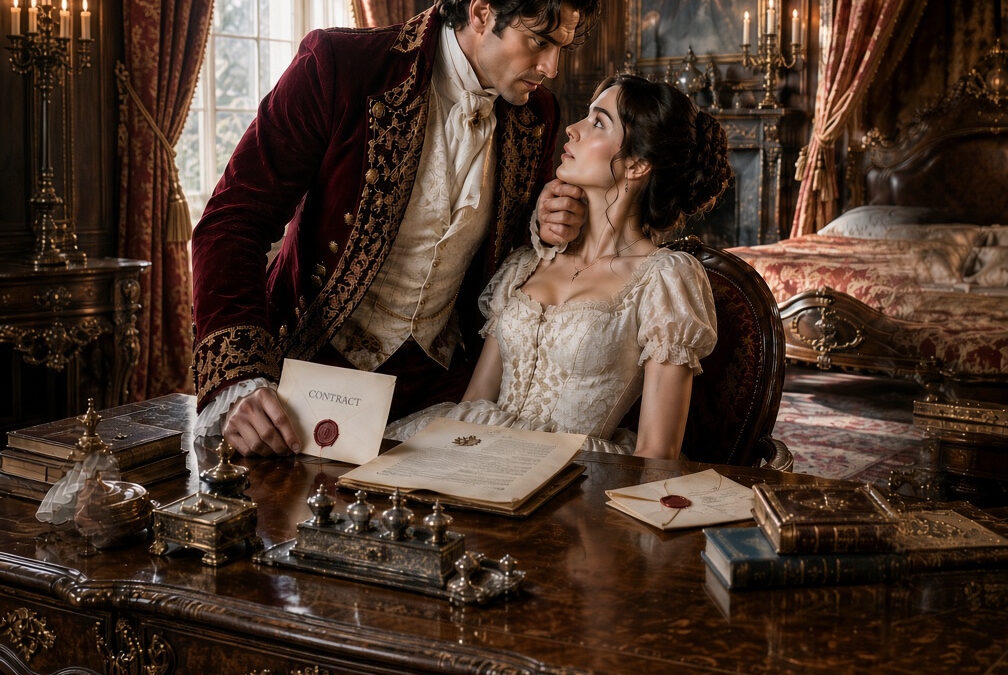
He slid the heavy iron key across the mahogany desk, locking the bedroom door. The contract clearly stated separate lives and no intimacy.
But as the Duke unbuttoned his waistcoat, his eyes dark with desperate cruelty, he whispered, “The terms have changed, my Duchess.
I need an heir.” Tonight, the year was 1847, a time when London’s high society operated on a currency of bloodlines, reputation, and immense untouchable wealth.
For the Huntington family, that currency had entirely run out. Adelaide Huntington stood in the center of her family’s Mayfair drawing room, watching as the bailiffs systematically stripped the house of its grandeur.
The silver candelabras, the imported Persian rugs, the portrait of her late mother, all of it was being cataloged and carried out into the damp London fog.
Her father, Lord William Huntington, had made a disastrous series of investments in the burgeoning railway expansion, trusting the wrong syndicates.
When the market collapsed, the debts were instantly called in by Coutts’ bank. In a matter of weeks, the Huntingtons were reduced from respected aristocracy to social pariahs facing the grim reality of the Fleet Debtors’ Prison.
At 23, Adelaide was considered past her prime for a highly advantageous match, especially now that she possessed a dowry consisting solely of scandal and debt.
She had resigned herself to a life as a governess to spare her younger sisters the horrors of the workhouse.
That was until a crisp vellum envelope bearing a wax seal of a soaring falcon arrived at their stripped-bare townhouse.
The seal belonged to the Duke of Windham, Sebastian Harrington. The Duke of Wyndham was a man whose reputation preceded him like a bitter winter frost.
At 32, he was known in the halls of Parliament and the gentlemen’s clubs of Pall Mall as a ruthless, calculating force of nature.
He was staggeringly wealthy, relentlessly ambitious, and famously adverse to the institution of marriage. He viewed women of the ton as frivolous, grasping creatures and had publicly sworn off taking a Duchess.
Yet here, Adelaide [clears throat] was sitting opposite him in the dimly lit, leather-scented library of his imposing Grosvenor Square mansion.
“I do not deal in sentimentality, Miss Huntington.” Sebastian began, his voice a low, resonant baritone that commanded the room.
He did not offer her tea. He did not offer her a polite smile. He merely slid a thick legal document across the table.
“I deal in mutual benefit. Your father is currently £50,000 in debt to Coutts Bank.
By tomorrow evening, he will be arrested. I am prepared to clear that debt entirely and provide a generous annuity for your sisters.”
Adelaide stared at the aristocrat. He was undeniably striking, sharp jawline, piercing slate gray eyes, and a rigid, almost military posture.
But there was a coldness to him that made her shiver. “And in return, your grace In return, you will sign that paper and become my wife.”
The bluntness of his proposal hung in the heavy air. Adelaide glanced at the solicitor standing quietly in the corner, a Mr.
Josiah Abernathy of Lincoln’s Inn, whose face remained a mask of professional indifference. “Why me?”
She asked, her voice surprisingly steady despite the rapid of her heart. “You could have any heiress in England.”
Sebastian leaned forward, steepling his long fingers. “Because an heiress comes with a meddlesome family, expectations of affection, and demands upon my time.
You, Miss Huntington, are in no position to demand anything. My late grandfather, a paranoid and spiteful man, left a perilous stipulation in the ducal entailment.
If I am not married by my 33rd birthday, which falls exactly 3 weeks from today, control of the unentailed Wyndham fortune and properties reverts to a trust managed by my cousin, Lord Percival Harrington.
Adelaide knew of Percival. He was a notorious gambler, a man of vicious temper and loose morals, who had been banned from Boodles Club for cheating at cards.
To hand him the Wyndham fortune would be to hand a torch to an arsonist.
The contract is simple. Sebastian continued tapping the parchment. “We marry. We make the necessary public appearances to satisfy the gossips and the House of Lords.
We will reside under the same roof when in London, but you will have your own wing.
When I travel to the country estate, you may remain here or vice versa. There will be no expectations of the marital bed.
No physical intimacy. You will have your title, your financial security, and your freedom. I will have my estate secured.
After 5 years, we may live entirely separate lives under the guise of health retreats.”
Adelaide pulled the contract toward her. Her eyes scanned the dense legal jargon crafted meticulously by Mr.
Abernathy. It was all there. Article 4, section B, explicitly detailed the boundaries of their personal lives.
It was a business transaction. She would sell her name and her freedom to buy her family’s survival.
A loveless, empty sham of a marriage, Adelaide murmured, looking up to meet his unyielding gaze.
A highly practical and mutually profitable arrangement, Sebastian corrected coldly. Do we have a deal, or shall I let the bailiffs escort your father to the fleet?
Adelaide reached for the brass quill pen. She dipped it into the inkwell, the scratch of the nib loud in the silent room.
With a steady hand, she signed her life away. Adelaide Huntington, soon to be her grace, the Duchess of Windham.
The wedding took place a fortnight later at St. George’s Hanover Square. It was the social event of the season, not for its romance, but for its sheer shock value.
The pews were packed with the elite of London, their whispers buzzing like a hive of vicious bees.
Lady Jersey herself was seen behind her fan, loudly speculating on what dark blackmail the bankrupt Huntington girl must have used to trap the ice duke.
Adelaide wore a gown of heavy ivory silk, beautiful but stiff as armor. Beside her at the altar, Sebastian was a pillar of rigid perfection in his charcoal tailcoat.
When the archbishop instructed them to join hands, his touch was brief and entirely devoid of warmth.
When he was told to kiss the bride, he merely brushed his lips against her cold cheek.
It was a performance flawlessly executed and utterly devoid of soul. As they walked down the aisle and into the awaiting carriage, Sebastian turned to her.
“You played your part adequately today, madam. See that you continue to do so.” Six months later, the scandal of their sudden union had faded into yesterday’s news, replaced by newer, juicier gossip.
Adelaide had found a surprising rhythm in her new life. True to his word, Sebastian left her entirely alone.
Shortly after the wedding, he departed for the continent on diplomatic business, leaving Adelaide to reign over Oakhaven, the duke’s sprawling, isolated country estate in the wild moors of Yorkshire.
Oakhaven was a magnificent, brooding fortress of dark stone and ancient oaks. Here, Adelaide discovered a strange kind of peace.
She had unlimited funds to restore the neglected gardens, a massive library to lose herself in, and a staff that treated her with profound respect.
She was safe. Her family was financially secure. She had convinced herself that the cold, hollow ache in her chest was merely the chill of the Yorkshire winds, and not the deep loneliness of a 23-year-old woman trapped in a ghost marriage.
Then came the storm of November 14th. It was near midnight. The wind howled against the mullioned windows of the drawing room, where Adelaide sat reading by the fire.
Suddenly, the heavy oak doors of the manor flew open with a resounding crash. The household was instantly in an uproar.
Footmen rushed forward, and the housekeeper, Mrs. Higgins, gasped as a figure strode into the entrance hall, dripping wet and radiating pure, unadulterated fury.
It was the duke. Sebastian shrugged off his soaked greatcoat, throwing it at a terrified footman.
His normally immaculate cravat was undone, his hair plastered to his forehead, and his slate-gray eyes burned with a dark, manic intensity.
“Leave us.” He barked at the staff, his voice slicing through the noise of the storm.
He locked his gaze on Adelaide. “Now.” The servants scattered like frightened mice, leaving Adelaide alone with her husband for the first time in half a year.
She stood up, her heart suddenly hammering against her ribs. The man before her was not the cold, controlled aristocrat who had drafted a bloodless contract.
He looked like a cornered predator. “Sebastian.” “What has happened?” She asked, using his given name for the first time.
He crossed the distance between them in three long strides, stopping just inches from her.
The smell of rain, damp wool, and fine brandy clung to him. He reached into the inner pocket of his waistcoat and pulled out a crumpled, rain-spattered legal document, slamming it down onto the mahogany side table.
“My dear cousin Percival.” Sebastian spat the name, a curse on his lips. “It seems he was not content to lose the fortune gracefully.
He has been digging through my grandfather’s private archives at the House of Lords. He found a codicil.
A hidden, sealed addendum to the entailment ratified by the Committee for Privileges decades ago.”
Adelaide looked at the crumpled paper, a knot of dread tightening in her stomach. “A codicil stating what?”
Sebastian’s jaw clenched so tightly she thought his teeth might shatter. He stepped closer, crowding her into the warmth of the fireplace.
“Stating that a marriage of convenience is insufficient to secure the line. My grandfather despised weakness and he anticipated loopholes.
The addendum dictates that not only must the Duke be married, but he must produce a living legitimate heir within the first 18 months of the union.
If the Duchess is not at least with child by the end of the first year, the marriage is deemed unconsummated and void for the purposes of inheritance.
The estate, the wealth, the properties all of it falls to Percival. The room seems to tilt beneath Adelaide’s feet.
She did the mental arithmetic in a panic. They had been married for 6 months, but the contract Adelaide stammered, stepping back only to find her shoulders pressed against the mantelpiece.
Article 4. You swore. You swore there would be no expectations of the marital bed.
The contract is worthless. Sebastian roared, his composure finally shattering. He slammed his hand against the stone mantle beside her head, trapping her.
A private agreement drawn up by Abernathy means absolutely nothing against a legally binding ducal entailment backed by the House of Lords.
If we do not conceive an heir, I lose everything. And if I lose everything, Adelaide, so do you.
The annuity paying for your father’s debts, the roof over your sister’s heads, Percival will cut it all off the moment he takes power.
He will ruin us both out of pure spite. Adelaide stared up at him, her breath catching in her throat.
The terror in his eyes was real. The Ice Duke was melting under the heat of imminent ruin.
He wasn’t just demanding her compliance. He was fighting for his survival. You expect me to just She swallowed hard, her voice trembling.
To just submit to this? After 6 months of being treated like a ghost in your house?
Sebastian looked down at her. The anger in his face began to fracture, replaced by something far more dangerous, a raw, desperate hunger mixed with a profound vulnerability he had never shown another living soul.
His eyes dropped to her lips, then back to her eyes. The space between them crackled with an electric, undeniable tension that had nothing to do with contracts or entails.
For all his coldness, he was a fiercely passionate man forced into a corner, and she was a deeply lonely woman standing in his space.
I do not want your submission, Adelaide. He said, his voice dropping to a gravelly whisper.
The harshness bled out of him, leaving only a dark, simmering intensity. He slowly raised his hand, his long fingers trembling slightly as he brushed a stray lock of hair from her cheek.
His touch sent a jolt of fire straight down her spine. I am begging for your partnership.
I am begging you to save my legacy. Adelaide’s mind raced. The parameters of her entire reality were collapsing.
She had sold herself to this man for safety, expecting a life of quiet solitude.
Now he was demanding the most intimate, vulnerable part of her. But as she looked into his desperate eyes, she realized she held all the power.
The Duke of Windham, the most ruthless man in London, was completely at her mercy.
She lifted her chin, her fear transforming into a sudden, fierce resolve. If she was going to be pulled into the fire, she would not burn alone.
If I do this, Adelaide said her voice steady and clear cutting through the sound of the storm outside.
If I break our contract and give you an heir, the terms of our marriage change permanently.
I will no longer be a ghost in your country house. I want a seat at the table.
I want equal say in the management of Okehaven. And I want the deed to my father’s Mayfair property legally transferred to my name alone so my family can never be threatened again.
Sebastian [clears throat] looked at her truly looking at her for the first time. He saw the iron beneath the silk, the brilliant strategic mind he had completely underestimated.
A slow almost predatory smile curved the edges of his mouth. He realized in that moment that he had not just married a pawn.
He had married a queen. Done, he whispered his gaze dropping to her mouth again.
Whatever you want, Duchess. It is yours. He stepped back and held out his hand to her.
The air in the drawing room felt impossibly thick. The timeline is against us, Adelaide.
Sebastian said his eyes darkening with a promise that made her pulse thunder in her ears.
We have 6 months to prove the gossips, the House of Lords, and my cousin wrong.
Adelaide looked at his extended hand. There were no solicitors here, no wax seals, or brass quills.
Only a man, a storm, and a desperate necessity. She placed her trembling hand in his.
His grip was firm, warm, and entirely possessive. Without another word, Sebastian led her out of the drawing room and up the grand sweeping staircase.
The heavy mahogany doors of the master suite loomed at the end of the corridor.
As they stepped inside the shadows of the room, dancing in the firelight, Sebastian reached into his pocket.
He slid the heavy iron key into the lock, turning it with a definitive, echoing click.
“The old contract is dead, Adelaide.” He murmured, pulling her flush against his chest, the heat of his body seeping through her gown.
“We write the new one tonight.” The morning after the storm, the Yorkshire sun broke through the heavy clouds, casting a harsh, unforgiving light on the grand stone facade of Oakhaven.
Inside the master suite, the atmosphere was entirely transformed. The invisible wall that had separated Adelaide and Sebastian for 6 months lay in ruins on the bedroom floor.
Their nights became a secret, feverish world of desperate whispers and tangled silk sheets. Sebastian, the man who had treated their wedding day like a hostile corporate merger, proved to be an intensely observant and passionate lover.
He learned the exact cadence of her breathing, the precise curve of her spine, and the quickest way to make her abandon her aristocratic composure.
Yet, when the sun rose, they were thrust back into the terrifying reality of their waking lives.
The clock was ticking. They had a singular, desperate mission to secure the Wyndham legacy before Percival could tear it away.
By January of 1848, the pressure was suffocating. The political landscape in London was fracturing with Chartist protests filling the streets, but inside Oakhaven, a different kind of warfare was being waged.
Adelaide’s monthly courses had not ceased. Every failure was a heavy blow, a silent, echoing reminder of the looming deadline.
Sebastian’s temper grew volatile. He spent his days in the library, firing off aggressive letters to his political allies in the House of Lords, desperately searching for a legal precedent to challenge his grandfather’s draconian codicil.
Then, in early March, a delicate, fluttering nausea settled deep in Adelaide’s stomach. Sebastian wasted no time.
He [clears throat] bypassed the local physicians entirely and sent his fastest carriage to London, demanding the presence of Dr.
Charles Locock, the very same esteemed obstetrician who attended Queen Victoria. When Dr. Locock emerged from Adelaide’s bedchamber, his spectacles pushed up on his forehead, he offered the Duke a rare, measured smile.
“Her Grace is with child, Your Grace,” the doctor confirmed. “Approximately 2 months along. The timing is precise.
You will have your heir before the autumn winds return.” The relief that washed over Sebastian was so profound, it physically staggered him.
He leaned against the heavy oak paneling of the hallway, closing his eyes as a ragged breath escaped his chest.
Against all odds, they had done it, but the victory was perilously fragile. Word of the Duchess’s delicate condition inevitably leaked from the walls of Oak Haven, traveling swiftly to the dark, smoke-filled card rooms of White’s Club in London, where Lord Percival Harrington sat drowning his impending ruin in gin.
Percival knew that a pregnant Duchess was not a guarantee. The infant had to be born alive and the mother had to survive.
The first sign of danger appeared in late April. Adelaide, confined to the manor’s sunroom by Sebastian’s fiercely protective orders, had developed a habit of drinking a specific blend of imported Ceylon tea every afternoon.
One rainy Tuesday, a new housemaid, a nervous girl named Mary, who had only been hired weeks prior, brought in the silver tray.
Adelaide lifted the porcelain cup to her lips, but the scent made her pause. Beneath the fragrant bergamot lay a faint, sharp odor.
It smelled distinctly of bitter almonds. A chilling realization clamped around her heart. She set the cup down carefully, her hands trembling.
“Mary.” She called out, her voice dangerously calm. “Who prepared this tray?” The maid turned pale, stammering about the kitchens and the head cook, but Adelaide didn’t wait to hear the lies.
She stood up, knocking the tray to the floor. The porcelain shattered, the dark liquid seeping into the Persian rug.
The rug almost immediately began to discolor, the heavy chemical nature of the poison burning through the delicate woven threads.
Cyanide. When Sebastian was summoned and saw the ruined rug, his reaction was not one of panic, but of pure, terrifying, ice-cold wrath.
The cruel duke had returned, but this time his cruelty was not directed at his wife.
It was weaponized to protect her. He dragged the truth out of the terrified maid in less than 10 minutes.
Percival had paid off Mary’s impoverished family in Cheapside, promising them a small fortune if the duchess were to suffer a tragic miscarriage.
Sebastian locked down Oak Haven like a military fortress. Every servant was interrogated. Half the staff was dismissed before nightfall.
He brought in his own personal guards, rough men from his mining estates in Cornwall, to patrol the grounds with loaded muskets.
No food or water touched Adelaide’s lips unless Sebastian himself had tasted it first. “He will not touch you.”
Sebastian whispered fiercely that night, sitting on the edge of her bed, his hand resting securely over the growing swell of her stomach.
His eyes were dark, burning with a lethal promise. “I will dismantle Percival’s life brick by brick.
I will make him a ghost.” Sebastian was a man of his word. He did not challenge his cousin to a duel.
That would be too quick, too honorable. Instead, the Duke of Windham utilized the full terrifying weight of his wealth and influence.
Within a month, Sebastian had systematically destroyed Percival. He called in every favor, bribed every magistrate, and leveraged his connections with the powerful Rothschild banking family to buy up every single one of Percival’s astronomical gambling debts.
Suddenly, Percival owed his entire existence to Sebastian. When the cousin attempted to flee to France, Sebastian’s men intercepted him at Dover.
Percival was thrown into the Fleet prison, the very same debtors’ hell he had gleefully hoped Adelaide’s father would rot in.
With the threat neutralized, the summer months stretched into a tense, heavy wait. The deadline mandated by the grandfather’s codicil was October 1st.
On the evening of September 18th, 2 weeks before the Windham fortune was due to revert to the trust, Adelaide’s water broke.
The labor was grueling, a brutal battle fought in the dimly lit master suite. The storm outside seemed to mirror the agony within, rain lashing against the glass as Adelaide gripped the bedposts, her knuckles white.
Despite the strict societal conventions that dictated a husband must remain far away from the birthing room, Sebastian refused to leave her side.
He discarded his tailcoat, his shirt sleeves rolled up, holding her hand so tightly it ached, anchoring her to the living world.
“Breathe, Adelaide. Stay with me.” He commanded, his voice cracking with an emotion he could no longer hide.
“You are stronger than this. You are a Huntington. You are a Windham.” For 14 agonizing hours, the balance of life and death hung in the suffocating air of the bedchamber.
Dr. Locock worked tirelessly, his face grim, as Adelaide’s strength began to wane. The shadow of mortality, so common in childbirth during the 19th century, crept into the corners of the room.
Sebastian watched the woman he had bought with a contract fight for her life, and he realized with devastating clarity that the estate, the title, and the unentailed fortune meant absolutely nothing without her.
He would burn Okehaven to the ground if it meant keeping her alive. Finally, just as the dawn broke, painting the Yorkshire moors in brilliant shades of gold and bruised purple, a sharp, piercing cry shattered the silence.
“A son, your grace.” Dr. Locock announced, his shoulders slumping with exhaustion, as he held up the squalling, blood-slicked infant.
“A healthy, living heir.” Adelaide collapsed back against the pillows, gasping for air, her face pale, but radiant.
Sebastian didn’t look at the child. He fell to his knees beside the bed, pressing his forehead against Adelaide’s damp knuckles, his shoulders shaking as the crushing weight of the last year finally broke him.
“You did it.” He whispered, pressing fervent, desperate kisses to her skin. “My brilliant, beautiful wife.
You saved us.” A week later, Mr. Josiah Abernathy arrived at Okehaven. He was ushered into the drawing room, where the atmosphere was vastly different from the cold, calculating day the marriage contract had been signed.
A warm fire blazed in the hearth. Adelaide sat in a plush armchair looking glowing and recovered, cradling the newly minted Earl of Ashbourne, little baby Edward in her arms.
Sebastian stood by the mantelpiece. He held out his hand to the solicitor. “The codicil, Abernathy.”
The solicitor handed over the heavy parchment bearing the seals of the House of Lords.
The legacy was secured. The unentailed fortune was Sebastian’s forever. The entailment satisfied by the living, breathing proof currently sleeping against Adelaide’s chest.
Sebastian took the codicil. Then, to the solicitor’s absolute horror, he reached into his inner pocket and pulled out their original marriage contract, the document that had bound Adelaide to a life of separate wings and loveless duty.
Without a word, Sebastian tossed both the codicil and the marriage contract directly into the roaring fire.
The parchment curled, blackened, and burst into bright flames. Adelaide watched the ashes float up the chimney, her heart swelling.
“The terms have changed, Your Grace?” She asked softly, a teasing smile playing on her lips.
Sebastian crossed the room, dismissing the bewildered solicitor with a sharp flick of his wrist.
He knelt beside chair, wrapping one large arm around her waist and using his other hand to gently stroke his sleeping son’s head.
He looked up at his duchess. His slate gray eyes entirely devoid of cruelty, filled only with profound, consuming devotion.
“There are no terms anymore, Adelaide.” He murmured, leaning in to capture her lips in in slow, reverent kiss.








