She was told to watch the ball from the balcony—until one waltz changed her life

She was told to watch the ball from the balcony—until one waltz changed her life
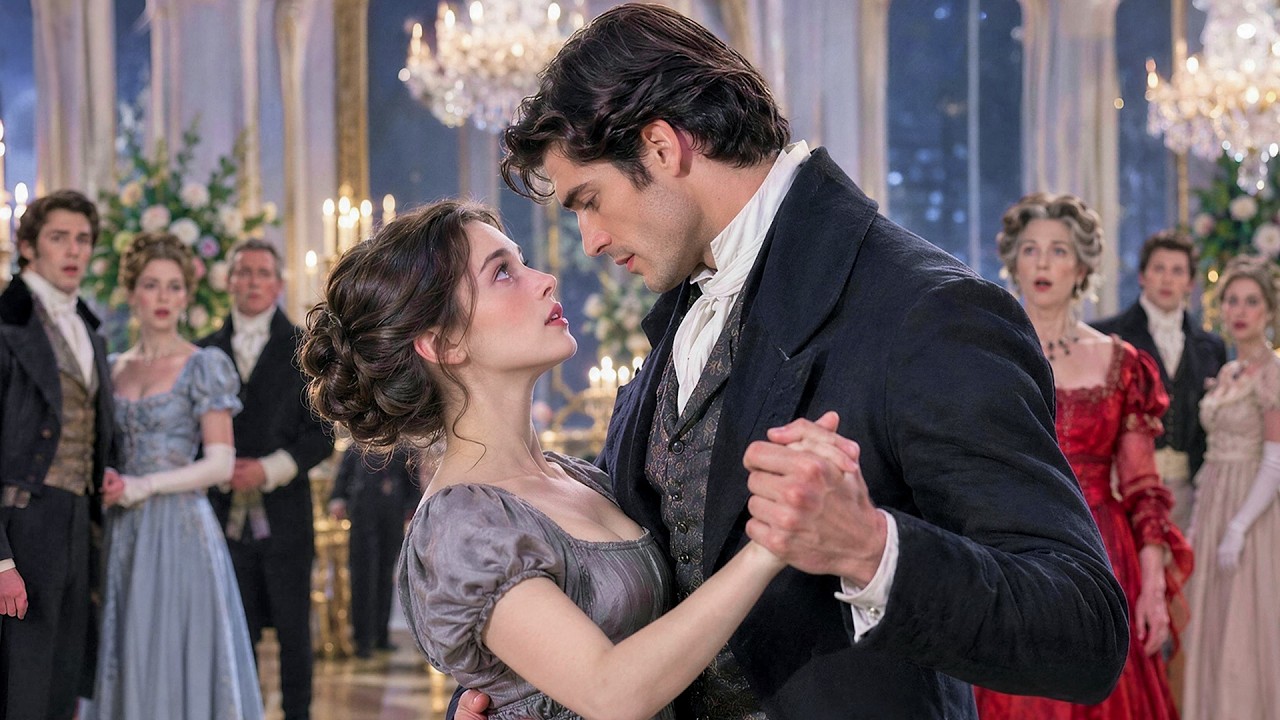
The instruction was simple. Stay out of sight. Keep to the shadows of the upper gallery so the eligible lords wouldn’t be distracted by the family’s aging, unmarketable spinster.
So Beatatrice stayed on the balcony. She watched the silk, the sweat, and the desperate ambition swirling on the ballroom floor below.
It was a perfect cynical viewing point until the Duke of Rothay looked up until he walked up the stairs.
Until one waltz shattered the quiet life she had accepted. The heat of a London ballroom always rose to the ceiling.
Beatrice felt it baking into the soles of her worn satin slippers. It was a thick cloying warmth heavy with the scent of melting beeswax, wilted lavender, and the collective anxiety of 300 desperate people.
She leaned against the cool plaster of the balcony column, pressing her cheek to the stone.
It offered a brief biting relief. Stay entirely out of the way, Beatrice. Her aunt Genevieve had ordered earlier that evening, her voice sharp enough to cut glass.
Claraara has a genuine prospect tonight, Lord Hastings heir. I will not have him distracted by the grim reality of her older unmarried sister hovering like a spectre of future’s past.
Watch from the gallery, or better yet, wait in the carriage. Beatrice had chosen the gallery.
The carriage was freezing, and despite her absolute disdain for the marriage mart, she had a cynical fondness for watching the theater of it all.
At 26 she was firmly on the shelf. She had no dowy, a sharp tongue that terrified young men looking for compliant broodmares, and a pragmatism born of balancing her aunts shrinking household ledgers.
She did not mind being a spectre. Specters didn’t have to wear corsets laced so tightly their ribs bruised, and specters didn’t have to feain interest in the weather in Yorkshire.
Below her, the Earl of Harrington’s ballroom was a sea of pastel silk and dark tailcoats.
To the untrained eye, it was a beautiful, chaotic swirl of high society. To Beatrice, it was a slaughter house.
She rested her chin on her hands, watching the floor. There was Claraara, sweet terrified Claraara, wearing a gown of pale blue that cost more than their winter cold supply.
Claraara was currently being circled by Lord Hastings air, a man whose chin receded so sharply into his neck, it was a wonder he could swallow.
But he had 50,000 a year. Claraara smiled, a tight, panicked pulling of her lips, and snapped her fan open just as Aunt Genevieve had drilled into her.
Beatric exhaled a long breath. “Survival,” she thought. “It all comes down to survival. Her gaze drifted past her sister, moving toward the grand entrance.
A shift in the crowd caught her attention. It wasn’t a sudden parting of the seas, but a subtle ripple-like movement as chaperones sat up straighter, and young women suddenly found reasons to laugh musically.
Arthur Pendleton, the Duke of Roth, had arrived. Beatatrice had never seen him in person, but she knew the rumors.
He had spent the last decade in the army, returning only because his elder brother had broken his neck in a drunken steeplechase.
Arthur had inherited a dukedom, a ruined estate, and the absolute obsession of every matchmaking mother in London.
He did not look like a duke. He looked like a man who had been dragged out of a comfortable bed and forced into a starched crevat at gunpoint.
He was tall, broadshouldered, and moved with a heavy, deliberate grace that spoke of muddy battlefields rather than polished floors.
His face was not handsome in the delicate aristocratic way favored by the tongue. His nose looked as though it had been broken and set poorly, and his jaw was shadowed with the threat of stubble despite a clearly recent shave.
Aunt Genevieve was instantly in motion, attempting to drag Claraara into his trajectory. Beatatrice winced in sympathy.
Roth stopped near the edge of the dance floor. He was immediately flanked by three matrons.
Beatatrice watched him endure it. He didn’t smile. He gave short tur nods. He looked entirely, utterly miserable.
Beatrice shifted her weight. Her foot bumped a stray champagne flute left by a previous occupant of the balcony.
It tipped over, rolling with a loud clinking sound against the iron ballastrade before dropping over the edge.
It didn’t hit anyone, shattering harmlessly against a potted fern below, but the noise cut through the ambient hum of that specific corner.
Roth stopped midnatric froze. The balcony was draped in shadows, but the chandelier hung just low enough to illuminate her face.
He stared at her. Beatatrice didn’t flinch. She didn’t hide behind a fan or drop her gaze in feigned modesty.
She simply looked back, her expression flat, unapologetic and weary. Yes, her look said. I am hiding up here.
And yes, it is exactly as awful as it looks down there. For a fraction of a second, the heavy, tired lines around the Duke’s mouth twitched.
It wasn’t quite a smile. It was a recognition. Then Aunt Genevieve stepped into his line of sight, shoving Claraara forward.
Rothay’s attention snapped back to the floor. Beatatrice exhaled, sinking deeper into the plaster column.
It was just a glance, a momentary collision of two people who hated the room they were in.
She turned her back to the railing. It was time to find a darker corner.
10 minutes later, the frantic waving of a white lace handkerchief from the archway below caught her eye.
It was Claraara’s maid, Mary, looking frantic. Beatric sighed, pushing off the pillar. A frantic Mary meant Claraara had either ripped a seam, lost a hairpin, or was actively having a panic attack in the retiring room.
Grabbing the small velvet reticule she always carried, stuffed not with smelling salts but with heavyduty thread, sewing shears and safety pins, Beatatrice made for the servants stairs.
The back staircase was narrow, drafty, and smelled faintly of floor wax and roasted onions from the kitchens.
It was a relief. She took the stairs quickly, her dull gray gown making no noise on the wooden treads.
She slipped through the heavy oak door on the ground floor, intending to cross the small library that connected to the lady’s withdrawing room.
The library was dark, save for the embers of a dying fire in the hearth.
Beatrices stepped inside, letting the door click shut behind her. If you are going to ambush me, do it quickly.
A deep, rough voice grated from the shadows. I am out of pleasantries. Beatrice stopped dead.
Sitting in a wing back chair by the fire, entirely swallowed by the gloom, was the Duke of Roth.
He had discarded his tailored coat. It lay in a heap on the floor. His crevat was untied, hanging loosely around his neck, and he was nursing a crystal tumbler of amber liquid.
“I assure you, your grace, I have no interest in ambushing you,” Beatatrice said, her voice even.
I am merely passing through to salvage my sister’s hem before she trips and ruins her chances of a decent marriage.
Arthur slowly leaned forward. The dying fire light caught the harsh plains of his face.
He squinted at her. You, me, the ghost in the gallery. I prefer to think of myself as the gargoyle, Beatatrice replied dryly, clutching her reticule.
Ghosts imply a tragic past. I’m simply part of the architecture tonight. Arthur took a long swallow of his drink.
He didn’t laugh, but the tight tension in his shoulders seemed to drop an inch.
Why are you part of the architecture? Most women in this house are currently plotting my murder or my matrimony.
Often both. Because I am 26, impoverished and notoriously illtempered, Beatatrice said. She didn’t know why she was speaking to him like this.
Perhaps it was the darkness of the room, or the fact that he was half undressed and looked ready to punch a wall.
My aunt placed me upstairs so I wouldn’t frighten away a Vic count who is currently contemplating buying my sister.
Buying? Arthur’s brow furrowed. Blunt. Accurate. Beatatrice countered. She needs money. He needs a pretty compliant girl to breed heirs.
It is a transaction. I just wish they wouldn’t dress it up in so much toul and bad poetry.
Arthur stared at her. The silence stretched. It wasn’t an uncomfortable silence. It was the quiet of two soldiers meeting in a trench, assessing each other’s armor.
“You don’t dress it up in poetry, then?” He asked quietly. “I don’t dress it up at all, your grace.
Now, if you will excuse me, Claraara is likely hyperventilating in the water closet.” She took a step toward the opposite door.
“Wait.” Arthur set his glass down on a small side table. The thud was loud in the quiet room.
He stood up. He was much taller than she had realized from the balcony. He filled the space, moving with that heavy, deliberate grace.
Fix the dress. Then come back here. Beatrice frowned. Why? Because if I stay in this room alone for another 10 minutes, I am going to climb out the window and walk back to Mayfair.
And it is raining. Then take a carriage. My carriage is blocked in by 60 others.
He dragged a hand through his hair, destroying whatever careful styling his valet had achieved.
Just come back, please. The please was clumsy. It sounded rusty, as if he rarely used the word.
Beatrice looked at him. Really looked at him. He was a duke, yes, but right now he was just an exhausted man hiding in the dark.
5 minutes, she said. If she needs a corset string replaced, it will be 10.
She slipped out the door. She found Claraara crying over a torn flounce. Beatrice fixed it with sharp, practiced stitches, murmured brutal but effective words of encouragement, shoved Claraara back toward the ballroom, and returned to the library.
Arthur was standing exactly where she had left him. He had tied his crevat though badly and picked up his coat.
“Did she survive?” He asked. “She will live to smile vacantly another day.” Beatatrice stood by the door.
“Are you retreating your grace?” “No,” Arthur said. He shrugged into his coat, adjusting the heavy wool.
“I am advancing. I realized something while you were gone. Oh, if I go back out there alone, they will descend upon me like locusts.
But if I am occupied, they are forced by the rules of polite society to maintain a perimeter.
Beatatrice narrowed her eyes. You want me to act as a human shield? I want to dance with you.
The absurdity of the statement hung in the air. Beatrice let out a harsh bark of a laugh.
Absolutely not. Why? Because I am a gargoyle and you are the Duke of Rothay.
If we walk onto that floor, it it will be an event. My aunt will have a genuine apoplelexi.
I will be gossiped about for weeks. I do not have the social standing to survive scandal your grace.
I require obscurity. You require a walk, Arthur corrected, stepping closer. He didn’t loom, but his present was undeniable.
He smelled of rain, wool, and sharp whiskey. You were hiding on a balcony, watching people live.
Come down and live for 3 minutes. Then you can go back to the shadows.
I swear it. Beatric looked at his outstretched hand. It was scarred across the knuckles.
It wasn’t the soft, manicured hand of a gentleman. It was real. “This is a terrible idea,” she muttered.
“I’ve made a career of terrible ideas,” Arthur replied. “Shall we?” The music bleeding through the heavy doors shifted.
The upbeat structured notes of a country dance faded, replaced by the sweeping, scandalous, soaring opening cords of a waltz.
Beatatrice swallowed hard. The waltz? It required touching. It required an intimacy that polite society was still struggling to sanitize.
She looked at his hand again. She thought of the cold balcony. She thought of Aunt Genevieve sneer.
She placed her gloved hand in his, his fingers closed around hers. His grip was warm, firm, and entirely grounding.
Arthur kicked the library door open with the toe of his boot. The transition from the dim quiet of the back hall to the blazing light of the ballroom was violent.
Hundreds of wax candles threw glaring light over the throngs of people. Arthur did not hesitate.
He didn’t stick to the edges of the room. He pulled her directly into the light, navigating the perimeter of the dance floor with singleminded purpose.
The reaction was instantaneous. It started as a ripple. The matrons closest to the door stopped speaking.
Their eyes dropped to the joined hands. Then the silence spread. It was a physical thing, a wave of shock rolling across the room.
Fans stopped fluttering. Glasses paused halfway to mouths. Beatatrice felt a cold sweat break out on the back of her neck.
She saw Aunt Genevieve on the far side of the room. Her aunt’s mouth was open, her face draining of color.
“They are staring,” Beatatric hissed, keeping her head rigid. “Let them,” Arthur murmured. He stopped at the edge of the polished floor.
The other couples were already taking their places, eyeing them with a mixture of horror and fascination.
Arthur turned to face her. He stepped into her space. It was not a gentle, swooning approach.
It was a claim of territory. He placed his right hand squarely on her waist.
The heat of his palm bled instantly through the thin cheap silk of her gray dress, pressing against the stiff whale bone of her stays.
Beatrice gasped softly, stepping forward to close the gap. She placed her hand on his shoulder.
Underneath the fine wool of his coat, his muscle was hard and tense. “Look at me,” he commanded softly, his voice barely carrying over the opening swell of the violins.
Beatrice snapped her eyes up to his. “Not at them,” Arthur said, his gaze locked on hers.
“Just mere.” The music swelled, and he pulled her into the current. It was not a fairy tale.
Beatric did not feel as though she were floating on a cloud. The reality of the walts was heavy and intensely physical.
She could hear the scrape of their leather souls against the polished wood. She could could feel the flex of his back muscles under her fingers every time he turned her.
On the third measure, he misjudged a pivot and stepped squarely on the toe of her slipper.
Beatrice stumbled slightly. Arthur’s arm banded tighter around her waist, catching her weight effortlessly, lifting her half an inch off the floor to correct their momentum.
My apologies,” he grunted, a flush rising on his scarred cheek. “You turn like a gun carriage, your grace,” Beatatrice shot back, her heart hammering wildly against her ribs.
A sharp, barking laugh tore out of Arthur’s throat. “It was a real sound, rough and unpracticed, and it echoed over the music.
The shocked whispers of the ton grew louder at the sound of it, but Arthur didn’t look at them.
He looked at Beatatrice. The heavy, miserable set of his jaw was gone. His eyes, a sharp, dark brown, were bright.
He pulled her a fraction of an inch closer. It was a scandalous breach of distance.
Their knees brushed. The scent of him, wood, smoke, whiskey, and the metallic tang of sweat enveloped her completely.
You said I was a gargoyle, Arthur murmured as they spun past the orchestra. Gargoyles are supposed to protect the fortress.
I am protecting you, Beatatrice said, her breath coming a little faster as the tempo of the music increased.
The centrifugal force was pulling at her, but his hand on her waist was an absolute anchor.
I am absorbing the shock and horror of polite society so you don’t have to.
You are doing a miserable job of fading into the architecture, miss. He paused. I don’t even know your name.
Hayes, she said. Beatatrice Hayes. Well, Beatatrice Hayes, Arthur said, his voice dropping an octave, slipping beneath the music meant only for her.
I think you have completely ruined your chances of a quiet life. They spun again.
Beatrice looked at his face. The ballroom blurred around them. The silk, the ambition, the sneering aunt, the desperate sister.
It all washed away into a dizzying smear of light. All that remained was the hard floor beneath her feet, the burning grip on her waist, and the sudden terrifying realization that for the first time in her life, she was exactly where she wanted to be.
The music stopped, but the silence that followed was deafening. Arthur bowed. It was a stiff military inclination of his head, entirely lacking the fluid grace of a courtier.
Beatrice dropped into a shallow, peruncter curtsy. When she rose, his hand lingered near hers for a fraction of a second before dropping to his side.
He didn’t offer to escort her off the floor. He didn’t need to. The damage was thoroughly, irrevocably done.
Beatatrice turned and walked toward the edge of the room. The crowd parted for her.
It wasn’t an act of respect. It was the instinctive recoiling from a newly minted pariah.
She found Aunt Genevieve near the refreshment tables. The older woman’s face was mottling into an ugly bruised purple.
Claraara stood slightly behind her, her knuckles white as she gripped a glass of watered down punch.
“Get your cloak,” Genevie hissed, her voice barely a thread of sound, yet sharp enough to sever bone.
We are leaving now. The carriage ride back to their rented townhouse on a less than fashionable edge of Bloomsbury was agonizing.
The interior of the hired hackne smelled of damp wool and old onions. The wooden wheels hammered against the cobblestones, rattling Beatric’s teeth.
For the first 10 minutes, no one spoke. The only sound was Claraara’s stifled rhythmic sniffing in the dark.
Then Genevieve snapped. She did not yell. Yelling was for the lower classes. She leaned forward, the meager light from the passing street lamps illuminating the rigid lines of her fury.
“You vindictive, selfish creature,” she spat. “You could not bear it, could you? You could not bear to sit in the shadows for one single evening while your sister secured her future.
I was not trying to ruin Claraara’s evening aunt. Beatrice replied flatly, staring out the window at the passing brick facads.
She felt oddly detached, as if the woman in the gray silk dress who had danced with a duke was a stranger she had briefly possessed.
Or do not lie to me. Genevieve’s hand shot out, her gloved fingers digging into Beatatric’s knee.
You deliberately orchestrated a spectacle, the Duke of Rothay, a man who hasn’t spoken a civil word to a woman in three weeks, and you parade him out for a waltz like a prize pony.
Do you know what Lady Jersey whispered to me as we left? She asked if you were quite well, or if a sudden fever had driven you mad.
Perhaps it has,” Beatatrice said, pulling her knee out of her aunt’s grip. Lord Hastings left the room before the dance ended.
Claraara whispered, her voice cracking. He didn’t even say goodbye. Beatatrice closed her eyes. A heavy cold stone dropped in her stomach.
Claraara, I am sorry. I did not mean to drive him away. Intent does not butter the bread, Beatatrice.
Genevie snapped. You are 26. You are a spinster with the charm of a rusty gate.
You cannot afford scandal. And now you have draped your ruin over your sister’s shoulders.
Who will look at her tomorrow? The sister of the harlot who threw herself at the Duke of Rothsay.
I hardly threw myself, Beatatrice countered, her pragmatism finally breaking through the numbness. We danced.
We barely spoke. By tomorrow afternoon, he will have forgotten my name, and the ton will have found a new scandal.
Perhaps Lord Byron will adopt a bear. “We can only hope. You will not leave the house for a month,” Genevieve decreed, sitting back against the worn squabs.
“You will so you will balance the books, and you will pray that our creditors do not hear of this night.
You are entirely completely invisible from this moment forward. Beatrice looked back out the window.
The rain had started again, smearing the gas lights into long, weeping streaks on the glass, invisible.
She pressed her thumb against her waist, right where Arthur’s hand had rested. The heat was gone, replaced by the chill of the damp carriage, but the pressure felt imprinted on her ribs.
She was a gargoyle again. But for 3 minutes she had flown. Morning came with the metallic clatter of coal being delivered to the cellar and the smell of burnt toast.
Beatrice was awake long before the maids. She sat at the small scarred oak desk in the corner of the dining room.
A wool shawl wrapped tightly around her shoulders. The fire hadn’t been lit yet to save on fuel.
Before her lay the household ledgers, a small pot of ink, and a stack of bills that seemed to multiply in the dark.
The butcher was threatening to cut off their credit. The grosser required half payment by Tuesday.
The rent was due in 3 weeks, and the margin between their available funds and the absolute requirement was terrifyingly thin.
She dipped her pen, her handwriting tight and cramped as she moved numbers from one column to another, trying to squeeze water from a stone.
The dining room door opened. Mary, the maid of all work, shuffled in, carrying a tray with a single lukewarm cup of tea and a piece of the aforementioned burnt toast.
“Morning, Miss Beatatrice,” Mary muttered, setting the tray down. She looked exhausted, her apron already smudged with soot.
“Thank you, Mary. Is my aunt awake?” “No, miss. Miss Claraara is still asleep, too.
Cried herself into a proper headache last night.” She did. Beatrice winced, taking a bite of the dry toast.
It tasted of ash and regret. She chewed methodically, forcing it down. She had to fix this.
She would write to her mother’s cousin in bath today. Perhaps there was a as a companion available.
If she removed herself from the household, there would be one less mouth to feed, and the scandal might fade faster if the subject was exiled.
She was halfway through a draft of a deeply humiliating letter when the heavy iron knocker on the front door sounded.
It was not a tentative tap. It was three loud commanding blows that echoed through the small house like cannon fire.
Beatrice frowned, checking the mantle clock. It was barely 10:00 in the morning, far too early for polite calls.
Even the debt collectors usually waited until noon. She heard Mary’s heavy footsteps in the hall, the groan of the front door hinges, and then the low rumble of a male voice.
Beatrice stood up, wiping ink from her fingers onto a scrap of blotting paper. She stepped out into the narrow hallway.
Standing in the cramped vestibule, making the space look ridiculously small, was the Duke of Rothsay.
He was dressed for riding, wearing dark leather boots splashed with fresh London mud. Tight buff britches and a dark green coat that fit his broad shoulders perfectly.
He held a riding crop in one hand and a battered beaver hat in the other.
He did not look like a man who had come to apologize. He looked like a man preparing for a siege.
Mary stood frozen, clutching a silver salva to her chest like a shield. Arthur looked past the maid and saw Beatatrice, his dark eyes locked onto hers.
He didn’t smile, but that same tense, heavy energy from the night before radiated from him.
“Miss Hayes,” he said, his voice filling the tiny hall. Beatrice stared at him. She was wearing a faded muslin dayd dress that was at least four seasons old, and her hair was pinned up in a haphazard knot.
She had ink on her fingers. Your grace,” she managed, her voice remarkably steady despite the sudden violent hammering of her heart.
“Are you lost?” Mayfair is several miles west. “I know exactly where I am,” Arthur said, stepping past the paralyzed maid and into the hallway.
He didn’t wait for an invitation. “I need a word.” Before Beatatrice could answer, the floorboards above them creaked violently.
A door slammed and Aunt Genevieve appeared at the top of the stairs, clutching a silk wrapper around her throat, her hair tied in rags.
Mary, what is that infernal racket? Genevie froze midstep. She looked down at the mud splattered duke in her hallway.
Her jaw went slack, her eyes darted from Arthur to Beatatrice, and the gears of her mind audibly ground together, reversing course at a terrifying speed.
Your grace,” Genevieve shrieked, instantly attempting a curtsy on the stairs, nearly pitching forward in the process.
“What an unexpected, what an absolute honor. Please forgive our state. We were not expecting callers.”
“Evidently,” Arthur said dryly, watching the older woman scramble down the stairs. “I apologize for the hour.
I require a few moments of your niece’s time.” Genevieve reached the bottom of the stairs, panting slightly.
She looked at Beatatrice with an expression of ferocious manic hope. Yesterday’s harlot was today’s salvation.
Of course, yes, entirely, Genevieve stammered, ushering him toward the drawing room with frantic motions.
Beatatrice, take his grace into the parlor. I shall ring for fresh tea and cakes.
Mary, run to the baker. Go, girl. Mary bolted. Beatrice stood rooted to the spot.
Aunt, I do not think. Do not think, Beatatrice. Genevie hissed, gripping Beatric’s arm with agonizing force, her voice dropping to a vicious whisper.
“Just smile and close the door.” Genevieve shoved her into the drawing room and practically pulled Arthur in behind her, shutting the door with a firm, decisive click.
They were alone. The drawing room was a testament to gentile poverty. The upholstery on the sofa was worn thin on the arms.
The rug was strategically placed to cover a burn mark, and the curtain smelled faintly of dust.
Arthur stood in the center of the room. He didn’t sit. He looked entirely out of place, like a mastiff locked in a bird cage.
Beatatrice walked over to the cold fireplace, putting the length of the worn rug between them.
She crossed her arms over her chest. “You have a muddy footprint on the rug, your grace,” she pointed out, her tone devoid of difference.
Arthur looked down. He didn’t bother to wipe it. He looked back up at her.
“You left before I could speak to you last night,” he said. His voice was rough, scraping against the quiet of the room.
“I retreated,” Beatatrice corrected. “As gargoyles are won’t to do when the sun comes up.”
“Though I did not expect the fortress to follow me home, the fortress is tired of being besieged,” Arthur said, tossing his hat onto a delicate side chair.
The chair wobbled ominously under the weight. I spent the remainder of the evening fielding thinly veiled questions about my sanity and my intentions.
“And what are your intentions?” Beatatrice asked, raising a brow. “Because walking into a spinster’s house at 10:00 in the morning, unshaperoned, is generally considered a declaration of either matrimony or madness.”
“Which is it today?” Arthur took a step forward. Practicality. Beatrice let out a harsh laugh.
There is nothing practical about you being here. My aunt is currently trying to figure out how to pay for a wedding breakfast, and my sister is likely writing to Lord Hastings to tell him the scandal is abated because I am to be made a duchess.
You are pouring gasoline on a fire, your grace. Stop calling me your grace. In that tone, he snapped, a flash of irritation breaking through his rigid control.
You say it like it’s an insult. It is a fact, Beatatrice retorted, dropping her arms and facing him squarely.
You are a duke. I am Beatrice Hayes. I patch my own pettic coats. I balance the butcher’s ledger.
And I am entirely unsuited for your world. The waltz was a rebellion, a momentary lapse in judgment for both of us.
It is over. No, it isn’t. He crossed the room. He didn’t ask for permission.
He closed the distance until he was standing a foot away from her. Beatrice had to tilt her head up to maintain eye contact.
“Look at me, Beatrice,” he said quietly, dropping the title, dropping the formalities. “I am looking at you,” she said, her voice dropping to match his.
She refused to back away even as the heat radiating from him seeped into her cold skin.
“I spent 10 years in Spain and Portugal,” Arthur said, his eyes darkening, looking at a point just over her shoulder before snapping back to her face.
“I slept in mud. I watched men die over lines on a map. I came back to a title I never wanted.
An estate drowning in debt and a society that looks at me as nothing more than a breeding stallion with a thick wallet.
Beatrice didn’t interrupt. The raw jagged honesty in his voice was arresting. I hate them, he continued, his jaw clenching.
I hate the silk. I hate the sering. And I hate the absolute suffocating falsity of it all.
If I marry one of those terrified, fragile girls your aunt was parading around last night, I will break her, or she will bore me to death.
It would be a slow, miserable execution for us both. “And you think I will not bore you?”
Beatatrice asked, a cynical smirk touching the corner of her mouth. You dropped a glass on my head to get my attention, insulted my dancing, and are currently berating me for tracking mud onto your carpet,” Arthur pointed out.
A genuine, albeit small, smile breaking through the harsh lines of his face. “I don’t think I could be bored by you if I tried.”
Beatrice felt a dangerous, terrifying spark of warmth in her chest. She ruthlessly smothered it.
You are asking for a companion in your misery. I am not a martyr. I am asking for an ally.
Arthur corrected. He reached into his coat pocket and pulled out a heavy cream colored envelope.
He held it out to her. Beatrice looked at it but didn’t take it. What is that?
An invitation to ride in Hyde Park at the prominard hour today. A public exhibition, Beatrice noted, her stomach twisting.
A strategic strike, Arthur said, his eyes burning with a dark, intense light. If we ride together today, the tongue will realize last night was not a fluke.
They will realize I have made my choice, and the siege will break. The mothers will back off.
The invitations to terrible poetry readings will stop. And what do I get out of this strategic strike?”
Beatatrice asked, finally taking the envelope. The paper was thick, expensive, and sealed with red wax.
Arthur looked at her, his gaze dropping briefly to her inkstained fingers, to the frayed cuffs of her cheap dress, and back to her defiant eyes.
“Protection,” he said softly. You become untouchable. Your sister’s Lord Hastings will come crawling back the moment he realizes Claraara is connected to me.
Your butcher’s bills will vanish, and you will never have to sit in the shadows of a gallery again, unless you choose to.
Beatric traced the wax seal with her thumb. It was a cold, transactional offer. It was exactly the kind of unromantic, pragmatic arrangement she had always told herself she wanted.
There were no declarations of love, no poetry, no illusions, just survival. I don’t have a riding habit, she said quietly, staring at the envelope.
I have already sent my sister’s modist to the back door with three trunks, Arthur said smoothly.
She will alter whatever you choose by noon. Beatrice looked up at him. You were very confident I would say yes.
I was confident you wouldn’t turn down a fight. Arthur corrected, stepping back, giving her space to breathe.
He picked up his hat. I will return at 2:00. Have your aunt Chaperonus in my open carriage to the park.
The horses will be waiting there. He walked to the door, placing his hand on the brass knob.
He paused, looking back at her over his shoulder. “Betress?” “Yes, for what it is worth,” he said, his voice softer than she had heard it yet.
“I am not asking you to be my shield today. I am asking you to stand next to me.”
He opened the door and walked out. A moment later, the front door clicked shut.
Beatrice stood alone in the cold drawing room, holding the heavy cream envelope. The air in the room felt different.
It tasted of mud, rain, and a terrifying, undeniable freedom. She looked down at the burn mark on the rug, then up at the mirror over the mantle.
She saw the tired spinster with ink on her hands. She cracked the red wax seal.
Time to burn the fortress down, she thought. The modista did not knock. She invaded.
Madame Gerard arrived at exactly a quart 12, flanked by three terrified looking assistants carrying leather trunks that looked heavy enough to contain bodies.
Aunt Genevieve practically wept at the sight of the rich fabrics fluttering around the French woman like a starved moth.
Beatrice stood in the center of the cramped bedroom, her arms raised stiffly, feeling entirely like a soldier being strapped into chain mail before a vanguard assault.
There was no pastel pink. There was no delicate lace. Arthur had sent instructions. The riding habit Madame Gerard pulled from the largest trunk was a dark, bruised navy blue.
It was made of heavy, unforgiving wool, tailored with a military severity that left absolutely no room for girish simp.
The silver buttons were stamped with the rothay crest. It was not a dress to attract suitors.
It was a uniform to repel borders. Breathe out, Madmoiselle, the modist commanded around a mouthful of pins, yanking the heavy fabric tight across Beatric’s ribs.
Beatrice exhaled. The wool settled against her. She looked in the cloudy, waters spotted mirror propped against the far wall.
The woman staring back did not look like a spinster. She looked sharp. She looked dangerous.
At exactly 2:00, the heavy iron knocker pounded again. Aunt Genevieve was already waiting by the door, draped in her best, slightly moaten velvet police, smelling violently of rose water.
Claraara hovered at the top of the stairs, biting her nails. Remember, Genevieve hissed, her fingers biting into Beatatric’s arm.
Smile, but do not speak unless spoken to. Let his grace lead. Beatatrice pulled her arm free.
I am not a dog on a leash, aunt. I will speak as I see fit.
She opened the door herself. Arthur stood on the front step. He had changed into formal riding attire, dark coat, pristine linen, and boots polished to a terrifying mirrorlike black.
An open bar waited at the curb, drawn by four massive, perfectly matched black gelings.
A liveried footman stood at attention. A groom held the reinss of two saddle horses trailing behind the carriage.
Arthur’s eyes dragged slowly from the scuffed toes of Beatatric’s boots up the sharp severe lines of the navy wool, lingering for a fraction of a second on the silver crests at her breast before finally meeting her gaze.
The heavy, tense line of his mouth softened. It wasn’t a smile, but it was a profound silent approval.
“Miss Hayes,” he said, extending a hand. “Your grace.” She placed her gloved hand in his.
His grip was tight, an anchor in the sudden, dizzying rush of adrenaline. The ride to Hyde Park was a masterclass in suffocating tension.
Aunt Genevieve sat opposite them in the carriage, chattering with a manic, desperate energy about the weather, the state of the roads, and Claraara’s needlework.
Arthur answered in mono syllables. Beatrice didn’t speak at all. She watched the brick houses of Bloomsbury yield to the grand stone facades of Mayfair.
As they neared the rot iron gates of the park, the traffic thickened. This was the prominard hour.
It was the daily ritual where the elite of London paraded in circles, exchanging nods, cutting enemies, and assessing the marital market value of everyone present.
The carriage slowed, entering the crush of vehicles. The reaction was not immediate. It rippled.
First, a passing caracle slowed, the driver staring openly. Then a group of young ladies walking their spananiels stopped dead in the grass.
By the time Arthur’s carriage reached Rotten Row, the main thoroughare, the ambient noise of the park had dropped by half.
They were staring. Hundreds of them. Beatatrice felt her spine lock. The weight of their gazes was a physical pressure, hot and prickly against her skin.
She saw the whispers behind gloved hands. She saw the snears. She saw Lady Jersey in a passing landau, her eyes widening in an expression of absolute unadulterated shock.
Arthur did not look at the crowd. He looked at Beatatrice. Are you retreating?” He murmured, his voice pitched so only she could hear.
Beatatrice swallowed the copper taste of fear in her mouth. She lifted her chin, staring dead ahead.
“Gargoyless do not retreat. They sit on the wall and wait for the rain.” Arthur gave that short barking laugh again.
It turned heads 50 yards away. “Good, because it is time to ride.” He signaled the driver to stop.
He stepped down effortlessly, ignoring the footman, and turned to offer Beatrice his hand. He didn’t just help her down.
He guided her directly to the waiting saddle horses. The groom hoisted her up, and Beatatrice settled her leg over the pommel of the side saddle.
Arthur swung up onto his own massive black geling. He steered his mount close to hers, their knees nearly brushing.
“Keep your head up,” he ordered quietly. And whatever you do, do not look at them like they matter.
They set off down Rotten Row at a slow, deliberate walk. Aunt Genevieve trailed behind them in the carriage, looking as though she might faint from sheer proximity to power.
It was a public execution of the social order. Arthur rode with a loose, easy grace that belied the tension in his jaw.
Beatrice sat rigid, her hands tight on the res. They look like vultures, she muttered, keeping her eyes fixed between her horse’s ears.
They are vultures, Arthur agreed, waving casually to a stunned looking earl. “But vultures only eat dead things.
So long as we keep moving, they cannot touch us.” “Why are you doing this?”
Beatatrice asked. The question had been burning a hole in her stomach since morning. Truly, you could have retreated to your estate.
You could have ignored them. Why drag me into the center of the ring? Arthur was quiet for a long time.
The rhythmic thud of the horse’s hooves filled the silence. Because when I came back from the peninsula, “I found that I had survived the French artillery only to be slowly suffocated by English politeness,” he said.
His voice flat, devoid of self-pity. They don’t see me, Beatatrice. They see a title.
They see land. When I look at those girls, they throw at me. I see terror.
They are terrified of me. And they are terrified of failing their mothers. It makes me sick.
He turned his head, his dark eyes locking onto hers. The intensity in them made her breath catch.
You aren’t terrified, he said. You looked at me on that balcony and you saw exactly what I am.
A tired, angry man in [clears throat] a room full of sycopants. You didn’t flinch.
You still haven’t. I am terrified of poverty, Beatatrice replied honestly. The cynicism a heavy shield.
I am terrified of my sister ending up a governness. I am not terrified of you because you are just a man with a heavy coat and a bad temper.
I have dealt with worse. A slow, genuine smile spread across Arthur’s face. It changed him entirely, stripping away the harshness, revealing the handsome, bruised man underneath.
“Then we deal with them together,” he said. A rider approached them. It was Lord Hastings, the receding chinned heir, who had abandoned Claraara the night before.
He looked nervous, his eyes darting from Arthur’s imposing frame to Beatric’s severe profile. Your grace.
Hastings stammered, pulling his horse up. “Miss, Miss Hayes, a fine day for a ride.”
Arthur did not smile. The heavy deadeyed stare of a commanding officer dropped over his face like a steel visor.
Hastings, I was surprised not to see you at the conclusion of the walts last night.
Miss Claraara Hayes was quite distressed by your sudden departure. Hastings pald. It was a terrifying thing to watch a duke casually threaten a man’s social standing without raising his voice.
I I felt unwell. Hastings lied poorly, a sudden affliction of the stomach. Please convey my deepest apologies to Miss Claraara.
In fact, I intended to call upon her tomorrow afternoon if if she will receive me.
Arthur looked at Beatatrice. He yielded the floor. Beatrice looked at Hastings. She felt a surge of absolute cold power.
This was what the crest on her jacket bought. She will receive you at 3:00, my lord, Beatatrice said, her voice dripping with ice.
Do not be late. Her schedule is suddenly quite full. Hastings bowed so deeply he nearly fell out of his saddle and spurred his horse away.
Beatrice exhaled a shaky breath. She looked at Arthur. He was watching her, his eyes blazing with a dark, triumphant pride.
Strategic strike successful, he murmured. The siege broke exactly as Arthur had predicted. Within 48 hours, the butcher sent a complimentary side of beef with profound apologies for any misunderstandings regarding their account.
The grosser extended their credit indefinitely. Invitations to balls, suarees, and intimate dinners began arriving in silver salvas, thick as snow drifts.
Aunt Genevieve was practically vibrating with a manic, terrifying joy. Claraara was engaged to Lord Hastings by Friday.
Beatatrice felt like she was standing in the eye of a hurricane. Arthur didn’t vanish.
He called every day. Sometimes they rode. Sometimes he simply sat in the cramped drawing room, drinking terrible tea and reading the newspaper in silence.
While Beatatrice balanced the newly pristine ledgers, he didn’t offer flowery compliments. He didn’t recite poetry.
He fixed a broken hinge on the parlor door, argued with her brutally about the corn laws, and treated her not as a fragile ornament, but as an equal combatant.
It was the most intoxicating thing she had ever experienced. It was also terrifying because Beatatrice knew with cynical certainty that it was temporary.
It was a mutually beneficial arrangement. Eventually, the novelty of her sharp tongue would wear off, and he would require a real duchess, someone with bloodlines and a dowy.
The crack in their fragile alliance happened at a dinner party hosted by the Earl of Harrington, the same house where the walts had occurred.
It was a small exclusive gathering. 14 people seated at a long mahogany table, groaning beneath the weight of silver candalabbras and roasted pheasant.
Beatatrice sat on Arthur’s right. She wore a new gown paid for by a loan Arthur had forced upon Genevieve.
It was deep forest green silk cut low off the shoulders, severe and elegant. Directly across from them sat Lord Vain, a cousin of the previous deceased Duke of Rothsay.
Vain was a man with perfectly styled hair, a viciously sharp wit, and a deep-seated resentment that his cousin’s neck-breaking fall had handed the dukedom to Arthur, the rough soldier, rather than him.
The wine flowed heavily. Vain grew louder. “Tell us, Arthur.” Vain drawled, swirling his clarret, his voice carrying clearly over the polite hum of the table.
“How are you finding civilian life? I imagine the transition from slaughtering peasants in the mud to navigating a salad fork must be dreadfully taxing.”
Silence fell over the table. The kind of absolute breathless silence that precedes a carriage crash.
Arthur slowly set his silver fork down. His face was expressionless, but Beatatrice saw the muscle leaping in his jaw.
His knuckles rested on the white tablecloth, pale and rigid. He was a man who had killed with his hands, being mocked by a man whose greatest triumph was tying a complicated crevat.
It has its challenges, Vain,” Arthur said. His voice a low, dangerous rumble. “I’m sure,” Vain sneered, leaning forward, emboldened by the wine, “Though you seem to have found a rather pragmatic guide to society.”
Vain’s gaze flicked to Beatrice, traveling up and down her frame with undisguised contempt. Miss Hayes, a remarkable ascent from the dusty corners of Bloomsbury to the right hand of a duke in a matter of days.
Tell me, do you charge for your services by the hour, or is it a flat fee for the season?
Someone at the far end of the table gasped. Arthur moved so fast it was a blur.
His hand shot out, wrapping around the neck of his crystal wind dicker. His chair scraped violently against the floorboards.
He was going to shatter the glass over Vain’s head. He was going to kill him right here in the Earl of Harrington’s dining room and ruin himself forever.
Under the table, Beatric’s hand shot out. She grabbed Arthur’s thigh, her fingers dug viciously into the hard muscle, her nails biting through his evening trousers.
Arthur froze. He looked down at her. Beatrice did not look at him. She looked directly at Lord Vain.
She picked up her own glass of water, took a slow, deliberate sip, and set it down.
Her hand did not shake. I find, Lord Vain, Beatatrice said, her voice clear, belllike, and utterly lethal.
The true service cannot be bought. It is freely given to those worthy of it.
She leaned slightly forward, resting her elbows on the table, invading his space without moving an inch.
His grace spent 10 years bleeding into foreign soil so that men like you could sit in warm rooms, drink expensive wine, and cultivate your profound sense of inadequacy.
He does not need a guide to navigate this room, my lord. He requires a translator because he is accustomed to speaking to men of honor and he is struggling to make himself understood to a parasite.
The silence that followed was absolute. It felt as though all oxygen had been sucked from the room.
Lord Vain’s face turned the color of spoiled milk. His mouth opened, but no sound came out.
The Earl of Harrington cleared his throat, a panicked, wet sound, and desperately demanded the footman bring the dessert.
Beatrice released her grip on Arthur’s leg. She picked up her fork and calmly took a bite of her asparagus.
Arthur sat back down slowly. He didn’t speak for the rest of the meal, but beneath the heavy linen tablecloth, his hand found hers.
He laced his scarred fingers through hers, gripping her with a desperate, crushing intensity that lasted until the ladies withdrew.
The carriage ride home was cloaked in darkness and rain. Aunt Genevieve had conveniently stayed behind to comfort Claraara, leaving Beatatrice and Arthur alone in the enclosed cab.
The rhythmic clattering of the wheels over the wet cobblestones was the only sound. Arthur sat on the opposite bench.
He was entirely swallowed by the shadows. “You shouldn’t have done that,” he said finally, his voice rough, scraping the quiet.
“He insulted you,” Beatatrice replied, staring at the rain streaking the glass. “He called me a whore.”
I simply clarified his error. “I could have handled him by beating him to death with a decanter.
Yes, I’m sure that would have done wonders for your reputation. You would have been back in the mud, Arthur.
Exactly where they want you to be. He moved. He didn’t politely ask to change seats.
He crossed the small space in a single violent motion, dropping onto the bench beside her.
The carriage groaned under the sudden shift in weight. He boxed her into the corner, one hand resting on the velvet squabs behind her head, the other resting on the seat beside her hip.
The scent of him, wood smoke, brandy, and adrenaline, was overwhelming. “I don’t care about my reputation,” Arthur breathed, his face inches from hers.
The dim light from a passing street lamp caught the feral, wild look in his eyes.
I care about yours. I brought you into this. I promised to protect you. And I sat there while that rat insulted you.
I protected myself, Beatatrice whispered, her heart hammering against her ribs like a trapped bird.
She couldn’t breathe. The air was too thick, too hot. Not a fragile thing, Arthur.
I told you that. I know. He lifted his hand from the seat. He traced the line of her jaw with his knuckles.
His touch was rough, shaking slightly. God, Beatatrice, I know. He kissed her. It was not gentle.
It was not a tentative exploration. It was a collision. His mouth crashed down on hers, desperate and bruising.
Beatrice gasped, and the sound was instantly swallowed by the heat of him. She didn’t push him away.
The cynical, rational part of her brain shortcircuited. She reached up, her hands tangling in his dark, heavy hair, pulling him closer.
He groaned, a low, guttural sound in the back of his throat, and his arm banded around her waist, dragging her across the seat until she was pressed to flush against his chest.
She tasted clarret and rain and the raw unvarnished reality of a man who had spent his life surviving.
Finally finding something he wanted to keep. They broke apart only when the carriage hit a massive rut, jarring them.
Arthur rested his forehead against hers, both of them panting, the air in the cab thick and heavy.
Tomorrow,” Arthur whispered harshly, his thumb dragging across her swollen lower lip. “I will come for you tomorrow.
We are ending this game.” Beatrice closed her eyes, fear finally piercing the adrenaline. Ending the game.
The transaction was over. The bill was coming due. Beatatrice was packed by dawn. She owned very little.
Two worn day dresses, a few books, her reticule of sewing supplies. She left the green silk gown draped over the back of the chair.
She left the navy riding habit hanging in the armwire. They did not belong to her.
They belonged to the role she had played. She sat at the small kitchen table, nursing a cup of black tea, listening to the house wake up.
She was leaving for bath. She had written to her mother’s cousin in the dead of night, begging for the position of companion.
She had enough coin saved from the household budget to buy a seat on the mail coach that left at 9.
She could not stay. Last night had broken the rules. He had kissed her with a desperate, terrifying passion, but passion was not permanence.
He said he was ending the game. That meant one of two things. He was going to offer her a position as his mistress, or he was going to offer her a marriage of pity and rebellion.
She would accept neither. A mistress was a slave to a man’s fading interest. A marriage born of rebellion would curdle into resentment when he realized he had shackled a duke to a penniless gargoyle.
She loved him. The realization had hit her somewhere between his insult to Lord Vain and the bruising weight of his mouth.
She loved him enough to know that letting him ruin himself for her would destroy them both.
At 8:00, she put on her old faded gray wool cloak. She picked up her single canvas feliz.
She opened the front door. Arthur was standing on the bottom step. He looked terrible.
He was still wearing his evening clothes from the night before. His crevat was gone, his shirt was open at the collar, and his jaw was dark with stubble.
He looked as though he had spent the night walking the streets in the rain.
He looked at the vise in her hand. He didn’t look surprised. He looked furious.
“Where do you think you are going?” He asked, his voice a low, dangerous rasp.
“Bath?” Beatrice said, tightening her grip on the handle. Her knuckles were white. The coach leaves in an hour.
Please step aside your grace. Arthur walked up the steps. He didn’t step aside. He stepped directly into her path, backing her up until she was forced to retreat into the cramped vestibule.
He kicked the front door shut behind him. The sound echoed like a gunshot. Bath,” he repeated, advancing on her until her back hit the hallway wall.
“You let me kiss you like that. You tear Vain apart to defend me, and then you try to run away on a male coach.
The arrangement is concluded,” Beatatrice said, her voice shaking despite her desperate attempt to keep it flat.
“Clara is secure. My aunt’s debts are manageable. You have established your dominance over the tongue.
The strategy was a success. Now I am withdrawing. I didn’t kiss you for strategy.
Arthur snarled, slamming his open palm against the wall beside her head. He leaned in, his chest rising and falling heavily.
I don’t give a damn about Claraara or your aunt or the ton. I care about the fact that you are standing here in that terrible gray cloak trying to ruin my life.
I am trying to save your life,” Beatatrice yelled back, the rigid control finally snapping.
She dropped the Vise. It hit the floorboards with a heavy thud. “Look at me, Arthur.
I am nothing. I have no money. I have no family of consequence. And I have a mouth that will get you ostracized in every drawing room in London.
If you marry me, they will never stop punishing you for it. Let them try, Arthur said softly, the fury draining out of him, replaced by a devastating absolute certainty.
He didn’t touch her. He just stood there, towering over her in the dim hallway, stripping away the last of his armor.
I spent 10 years taking orders from men who didn’t care if I lived or died,” Arthur said, his voice dropping to a rough whisper.
“I came back here and they tried to put me in a new uniform. The polite duke, the breeding stock.
I was dying, Beatrice. I was sitting in the dark in that library, planning to walk into the river until you dropped a glass on my head.”
Beatrice felt the tears she had sworn never to shed, burning the back of her throat.
“You are the only real thing in this entire city,” Arthur continued, finally reaching up to cup her face.
His thumb brushed a stray tear that escaped down her cheek. “You don’t want my money.
You don’t want my title. You just want me. And I am entirely, irrevocably yours.
So you can get on that coach to Bath, but I will ride behind it, and I will stand outside your cousin’s house until you freeze to death, or you marry me.
The choice is yours.” Beatatrice looked into his dark, tired eyes. There was no poetry.
There were no illusions. There was only a muddy, broken soldier offering her the only thing he had left.
You are a deeply stubborn man,” Beatatrice whispered, her voice cracking. “I am a siege engineer.”
Arthur corrected, leaning his forehead against hers. “We don’t know how to quit.” Beatatrice reached up, grabbing the lapels of his ruined evening coat.
She pulled him down, kissing him. It wasn’t the violent, desperate collision of the carriage.
It was a surrender. It was the quiet, profound settling of two ghosts finally finding a place to haunt together.
“I require a very large allowance for books,” she murmured against his mouth. Arthur laughed, pulling her tight against his chest.
“You can have the whole damn library, gargoyle.” The ballroom tried to bury her in the shadows, but Beatrice Hayes proved that a gargoyle can do a lot more than just watch the rain.
She broke the rules, tore down the polite facade of London society, and claimed a broken duke who needed a comrade more than a crown.
Their waltz wasn’t just a dance. It was a declaration of war. And they won.








