The carriage came up the Blackmere drive at the wrong hour on the wrong day carrying a man who believed he owned the ground its wheels were crushing.
The Duke Bought the Wrong Estate — and Found a Quiet Seamstress Living There
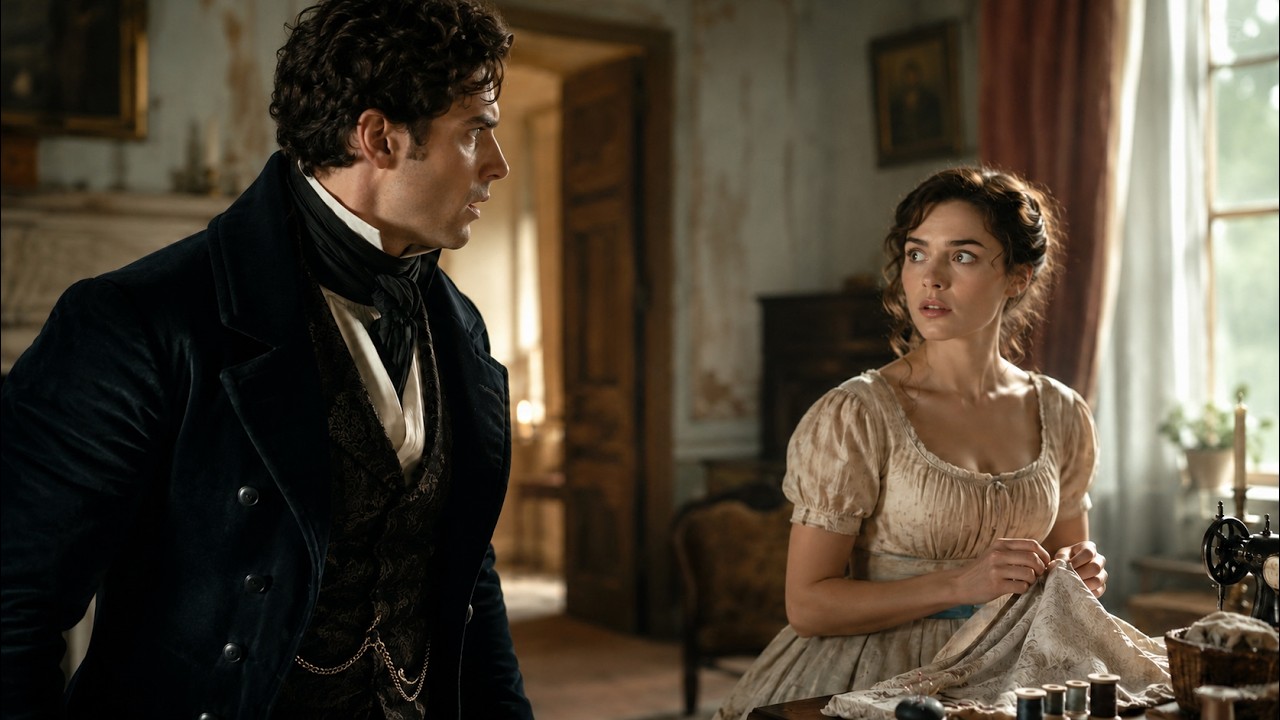
The carriage came up the Blackmere drive at the wrong hour on the wrong day carrying a man who believed he owned the ground its wheels were crushing.
Rosalind Merrow heard it before she saw it. The grind of iron rims over sun-baked gravel, the jingle of a harness too fine for any visitor the Grange had received in three summers.
And her needle stopped a half inch above the ivory silk stretched across her knee.
She was seated in the window bay of the morning room where the light came in clean until noon.
A length of wedding white draped over her lap like fallen snow that refused to melt in the July heat.
A duchess’s commission, though the duchess in question would never know it had been cut and pinned by a quiet seamstress living alone in a house that by every reckoning of the world no longer belonged to anyone at all.
The thimble was warm on her finger. The room smelled of beeswax she had rubbed into the sills herself, and of the lavender drying in bunches from the picture rail.
And beneath both, faintly, of the old dog rose that climbed the south wall and pushed its scent through the open casement whenever the wind turned.
The wind had turned. And the carriage had stopped. Rosalind laid the silk aside with the care of a woman who owned nothing else so fine and rose.
Through the wavering old glass, she watched a footman in dove gray livery hand down a gentleman who did not wait to be handed.
He came out of the carriage the way water comes over a weir, all at once, sure of its direction.
And stood a moment in the drive with his hat in his hand looking up at the honey-colored face of Blackmere Grange as though he were reading a bill he had already paid.
He was young. That was the first wrong thing. She had braced in the half second between the wheels stopping and her own breath catching for a creditor’s man, gray and stooped, or a magistrate with a sheaf of papers.
Instead, here was a broad-shouldered man of perhaps eight and twenty, dark-haired, his indigo coat straining across a back that had plainly done more in its life than sign its name, standing in her drive with the summer sun on him as if the light itself had been told to attend.
Then he started toward the door as though he had every right, and Rosalind stopped bracing and began quietly to be afraid.
She reached the hall as the knocker fell. Three strokes, unhurried. The sound of a man who did not doubt he would be admitted.
There was no one else to answer it. Mrs. Pike had gone down to the village for the week’s flour and would not be back before the church bell rang the hour.
So Rosalind smoothed her gray working gown with two ink-stained hands, lifted the latch, and opened her own front door to the man who meant to take it from her.
Good morning, she said. He looked down at her, and something in his certainty stumbled.
She saw it, the small hitch, the recalculation behind the eyes. He had expected a servant.
He had not expected the servant to have a straight back and a level gaze and a smear of tailor’s chalk along one wrist.
Good morning. He inclined his head, a courtesy so automatic it was almost not one.
Be so good as to tell your master I am arrived. He will not have expected me before Thursday, but the roads were kinder than my steward promised.
There is no master here. Then your mistress. There is no mistress either. Rosalind kept her hand on the door’s edge.
The oak was warm under her palm, warm as a living thing. There has been neither this three years.
Whom did you wish to see? His dark brows drew down. He turned, unhurried, and looked back at the drive, at the carriage, and the two gray horses stamping in the heat, as if to confirm they were still where he had left them, as if the world had briefly failed to match his account of it, and he expected it to correct the error shortly.
“I wished to see my house,” he said, “which is this one.” “I am Wrexham.”
When she did not move, he added, with the patience of a man unused to needing it, “The Duke of Wrexham.
I purchased Blackmere Grange in April, madam. Every stone of it. Now, will you stand aside, or must I go round by the stables and let myself in?”
The name struck the hall like a dropped tray. Rosalind heard it ring out and settle, and in the ringing, she understood two things at once, that he believed absolutely what he had said, and that if it were true, she had until sundown to become a woman with nowhere in the world to be.
She did not stand aside. “You are mistaken, your grace,” she said, and was distantly astonished at how steady her own voice came.
“Blackmere Grange was not for sale in April. It was not for sale at all.
It came to me from the late Mrs. Honoria Fairfax, who lived and stitched in that room behind me for 40 years, and left it to my keeping when she went.
There’s been no purchase because there’s been nothing to purchase. Someone has sold you a house that was never theirs to sell.”
For a moment, he only looked at her. The dog rose scent came between them on the warm air.
Somewhere out in the paddock, a wood pigeon set up its drowsy three-note complaint, and the ordinary summer sound made the whole encounter feel, for one breath, like a thing she might wake from.
“Left to your keeping. The Duke repeated, not unkindly. That was almost worse. By a private lady.
In her will. In her wish. Ah. One syllable, and the whole cathedral of her security cracked down the middle.
A wish. Not a will. She was ill at the end. There was no time to Rosalind stopped herself.
She would not explain her whole life on a doorstep to a stranger who smelled of leather and expensive dust.
Her intention was plain to everyone who knew her. Intentions do not convey land, miss.
He waited. Merrow. Miss Merrow. He said it the way he might note a figure in a ledger to be carried forward.
Deeds convey land, and I’m in possession of the deed to this one. He reached inside his coat.
She watched his hand go, broad and unhurried, to the breast of the indigo cloth, and drew out a folded paper, heavy with the seal she could see even from the doorway, red as a wound, pressed deep.
Blackmere Grange in the county of Devon, with its home farm, its orchards, and its appurtenances.
Signed, sealed, and paid for in full through my agent, Mr. Coldwell, this April past.
I’ve come 3 days early because I could not, in the event, bear to wait longer to see the roses my grandmother wrote of when she was a girl.
Rosalind’s mouth went dry. Roses. She said. She summered here as a child. Before the Fairfaxes, when it was Blackmere still and belonged to her mother’s people.
He turned the deed over in his hands, and for the first time, his certainty seemed to be doing something other than crushing her.
It seemed, briefly, to be holding him up. It is the only reason I bought the wretched place.
Caldwell had a dozen better properties on his list. I chose the one with the roses on the south wall because a woman I loved as a boy once told me she had been happy against that wall, eating them like sweets with the thorns still on.
And there it was, the thing that made her, against every instinct of self-preservation, believe that he believed it.
Because there were roses on the south wall. She had eaten them herself in June, standing on tiptoe in the warm brick angle where the bees came, the petals dissolving on her tongue with the taste of honey and copper.
The old dog rose that even now pushed its scent through the morning room window at the man’s back.
He had described her wall, her wall in her house that she had been promised and never given, sold in April by a man she could not name to a duke who had bought it for a memory that had nothing to do with her.
“May I see the paper?” She said. She had not meant it to sound like a command.
His head came up. For one long beat, the summer stood between them, the pigeon and the lavender, and the far off ring of the village bell beginning the hour.
And Rosalind thought he would fold the deed back into his coat and walk past her into the house that his seal said was his.
Instead, the Duke of Wrexham did a thing that surprised her, and she would think later, surprised him.
He held it out. “You read,” he said. It was not quite a question. “I read four languages, and I keep the accounts of half the parish’s linen.”
Rosalind took the deed from his hand. Their fingers did not touch. He was careful of that, and she noted the care and did not know what to do with it.
The paper was good rag stock, thick and cool, and the ink was black and confident.
And there, at the head, in a clerk’s flourishing copperplate, ran the words that were meant to end her.
She read them. She read them again. And the fear in her chest turned over and became something else.
Something with a hard, bright edge, the way a length of dull cloth turns and catches the light and shows you the nap you missed.
“Your grace,” she said, slowly, “what is the name of the house you meant to buy?”
“I have told you.” “Blackmere Grange.” A flicker of impatience now. “It is written there in your own hands.”
“It is not.” Rosalind lifted her eyes to his, and she watched him see that whatever she had found in the paper had changed the ground under both of them.
“It is written here that you have purchased Blackmere Court in the parish of Nethercoombe with a deer park of 200 acres and a lake and a west lodge.
This is Blackmere Grange in the parish of Coombe Magna. There is no deer park.
There is no lake. There is a duck pond that dries to mud by August and a home farm of 40 acres and a rose against the south wall.”
Her voice did not shake now. It had gone very quiet and very precise. The voice she used for the finest work, when a single wrong stitch would ruin a month’s labor.
“Court, your grace, not Grange. You have bought the wrong estate. You have bought a house 11 miles from this doorstep.
And I’m very much afraid you have never seen it in your life.” The silence that followed had a texture.
She could feel it against her skin, like the change in the air before a summer storm.
That pressure that makes the swifts fly low. The Duke of Rexham took the deed back from her, gently.
Again, that unaccountable care. And read the lines she had read, his lips moving faintly over the clerk’s copper plate.
And she watched the certainty go out of his face, the way color goes out of the sky when a cloud crosses the sun.
Court, he said. Court. Caldwell wrote Grange in every letter. His jaw had set. There was a muscle standing out at the corner of it, and his hand had closed on the deed hard enough to dimple the good rag paper.
Every letter. Blackmere Grange, the roses, the south wall. He described this house to me a hundred times.
He described this house. Rosalind agreed. And sold you another. Or sold you this one under the other’s name, and pocketed the difference in acreage.
A deer park costs a great deal more than a duck pond, your grace. Either way, she stopped.
She heard herself 11 miles from generosity, about to hand this stranger the one thread that might unravel her own last security.
And she thought of Annoria Fairfax’s hands guiding hers over a torn hem 30 years ago, saying, “We do not cut crooked in this house, Rosalind, whatever the world does to us.”
“Either way,” she said, “the fault is not yours, and it is not mine. And it does not change that I have nowhere else to lay my head tonight.
And neither, it seems, have you.” He looked at her then, as if seeing her properly for the first time.
The gray gown, the chalked wrist, the straight back that had not bent through any of it.
The bell finished striking the hour. Out in the drive, one of the gray horses tossed its head and the harness sang.
“You are remarkably calm,” he said. “For a woman who has just told a duke he has been robbed.”
“I’ve had 3 years of practice at losing this house, your grace. You have had 3 minutes.
Forgive me if I have the advantage of you.” Something moved across his face that might, in a less guarded man, have become a smile.
It did not become one. But it left a mark where it had passed. And Rosalind, who read faces the way she read cloth, for the grain, for the give, for the places the tension gathered, filed it away without meaning to.
“May I?” Said the Duke of Wrexham, with the elaborate courtesy of a man reassembling himself from the ground up.
“Come in. It appears I have a great deal to write to Mr. Caldwell about.
And I find I would rather do it sitting down in a house I have paid for, whatever its name proves to be, than standing in a drive being corrected by its seamstress.”
And Rosalind Merrow, who should have barred the door, who should have sent to the magistrate, who should have done a hundred prudent things that her whole careful life had trained her to do, stepped back and let him in.
She would wonder about that step for a long time afterward, whether it had been generosity or exhaustion, or the plain animal relief of not being alone with the wrong hour carriage and the red seal.
She only knew that she moved aside, and the duke ducked his dark head under the low Tudor lintel that had been catching tall men’s crowns since before either of their families had a name, and the shadow of him fell across the flagstones of her hall, and the house that had been silent for 3 years suddenly had a second heartbeat in it.
“Through here,” she said. “The morning room keeps the light, and it has the only chair that will bear your weight without complaint.
You have taken my measure quickly. It is my trade to take measures quickly. She led him past the stair, past the longcase clock that Mrs.
Pike wound every Sunday, into the room where the ivory silk lay pooled across the window seat like something enchanted.
She saw him see it, saw his eyes go to the wedding white and then deliberately away, the way a well-bred man looks away from a thing too intimate.
And she gathered it up in both arms before he could ask, and laid it folded on the sideboard with her back to him.
A asked. For a bride? For a duchess, as it happens. She turned. So you see I’m not quite the destitute you took me for on the step.
I have work. I have a reputation in a small way, from here to Exeter.
Ladies send their finest to Blackmere Grange to be made and mended, because the woman who taught me was the best hand in three counties, and I was her only pupil.
I’m telling you this, she added, because his silence had a question in it, and she preferred to answer questions before they were asked.
So that you will understand I do not intend to be turned out onto the road with a bundle, your grace, whatever your Mr.
Caldwell has done. I have a claim in equity, if not in law, and I have friends who will swear to Mrs.
Fairfax’s intention, and I have She stopped. And you have? Nothing else, she admitted. That is the whole of my army.
A wish, some friends, and a rose against the wall. He had crossed to the window while she spoke.
Now he stood looking out at the south garden, and the brick angle where the dog rose climbed, and the July light lay along the hard clean line of his profile.
And Rosalind watched him reach up, quite unconsciously, she thought, his mind 11 miles away in a parish called Nethercoombe, and touch two fingers to the leaded glass, as though he could touch the roses through it, as though the boy who had wanted them was still somewhere in the man, and had been told, after a long journey, that he could not have them after all.
She read it as the gesture of someone reaching for a thing he had already lost.
She could not have said why it made her want, absurdly, to comfort him. A duke in her house with the deeds to another woman’s future in his coat.
Your grandmother, Rosalind said, the one who ate the roses, is very much alive and will find this whole affair extremely funny.
He let his hand drop. When he turned, his composure was back, buttoned to the throat, but she had seen under it now, and they both knew it.
She is 81 and sharper than Caldwell and me together, which is, I begin to think, not a high wall to clear.
She told me to buy the house with the roses. I told my steward to buy the house with the roses.
Somewhere between his mouth and the clerk’s pen, the roses stayed and the house changed.
He looked round the morning room, at the lavender on the picture rail, the worn turkey rug, the sewing table with its thousand pinpricks in the wood like a field after rain.
And I have bought, it seems, a duck pond and a seamstress. You have bought neither, said Rosalind tartly, until a court of law says so.
And I mean to make that court work harder than it has worked in a generation.
But, she drew a breath, the prudent thing and the honest thing pulled against each other in her chest like two seams badly matched, and she chose, as Annoria had taught her, not to cut crooked.
But you did not do this to me. And you have come a long way, and it is the hottest afternoon of the summer, and your horses are standing in it.
Send your man round to the stable. The water there is good and cold, whatever else has run dry.
And come and sit in the one chair that will bear you, and write your furious letter to Mr.
Caldwell. And I will make tea, because whatever is decided about this house, it is still, until sundown, mine to offer it in.
For a moment, the Duke of Rexham said nothing at all. The pigeon began again in the paddock.
A bee blundered in at the open casement, circled the lavender, and blundered out. Miss Merrow, he said, at last, and now the thing that had been trying to become a smile all through the encounter finally, briefly, arrived.
Not large, and gone almost at once, but real. I came here today to take possession of my house.
I find instead that I have been corrected, out-argued, and invited to tea in it inside a quarter of an hour.
My grandmother would like you enormously. It is the most alarming thing that has happened to me all year.
Then we are matched, Rosalind said. For it is only noon, and it is already the most alarming thing that has happened to me in three.
She went to make the tea. And it was in the passage between the morning room and the kitchen, with the copper kettle already in her hand, and the cold stone of the floor coming up through her thin shoes, that the full shape of it reached her.
Reached her the way the meaning of a letter sometimes reaches you a moment after the words, all at once, in the body before the mind.
If the deed said Court, and the house was Grange, then the sale that had been made in April had been a false one.
And a false sale meant a false seller. And a false seller meant that somewhere out there was a person who had signed away Blackmere Grange.
Her Grange. Honoria’s Grange. For money. Using a name that had no right to it.
Three years after the only woman who could have granted such a right had gone to her rest.
Someone had sold her home out from under her. Not the Duke. The Duke was as galled as she was.
But someone had. And had done it cleverly. Hiding a real theft inside a clerk’s small error.
And that someone had a name. And a hand that had held a pen. And a reason.
The kettle trembled very slightly against the edge of the range. Rosalind steadied it. Through the kitchen window, the south wall blazed in the sun.
And the roses on it hung heavy and open and full. The way they had hung the last June that Honoria had been alive to see them.
And she thought, “They were the bait. Whoever did this described the roses to Caldwell, because the roses were true.
You hide the lie inside the one thing that isn’t one.” And down the passage, in the room with the good light, she heard the Duke of Wrexham draw the sewing chair to the little table and settle his broad weight into it with the creak of old wood that had not borne a man in three long years.
And ask, in a voice pitched to carry just far enough and no farther, whether she took her tea with sugar.
As though the answer mattered. As though he meant to remember it. Rosalind stood with the cold kettle in her hand and the hot afternoon at the glass.
And understood that whichever way the law fell, she could not now let him go back to London and leave the theft of her whole life to lie quiet under a red seal.
Not the two of them together. Not now that they were the only two people in England who knew the wrong estate had been sold to the wrong man.
And that the right question had not yet been asked of anyone at all. >> With sugar.
>> She called back and reached for the good cups. The tea, when she carried it in on the Japan tray that had been Anorias, steadied them both in the way that small ceremonies do.
The clink of the good cups on their saucers, the amber thread of it poured out, the curl of steam rising into a room already thick with lavender and July.
The Duke had drawn the sewing chair to the little table and sat with a sheet of her own writing paper before him, her own pen dipped in her own ink.
And there was something in the sight of a man that broad, hunched over the small tasks of her small desk, that unbalanced her more than his arrival had.
Sugar, she said, and set the cup at his elbow. As you asked. You remembered.
He said it lightly, but his eyes came up. And she understood he had noticed her noticing.
I begin to think nothing is lost on you, Miss Merrow. A great deal is lost on me.
I merely refuse to lose the things within reach. She sat across from him, folded her chalked hands, and watched him write.
His hand was not a gentleman’s ornamental scrawl, but a plain, driving, forward-leaning script. The letters crowding one another as though impatient to have the thing said.
You write to Mr. Caldwell. I write to Mr. Caldwell to ask him three questions, of which the kindest is whether he can read.
The pen stopped. The other two I shall not repeat in a lady’s morning room.
You may. I have kept accounts with drapers from here to Bristol. There is nothing you could call a swindling clerk that I have not heard called worse by woman owed nine shillings.
That drew it out of him again. The near smile arriving and departing in the same breath leaving that faint mark at the corner of his mouth.
He bent back to the letter. Outside, the gray horses have been led away toward the stable at last.
She could hear, faint through the open casement, the ring of a bucket handle and the good deep sound of water going into a trough.
And one of the beasts blowing gratefully into it. The heat pressed the glass. A bee had found the sugar and she waved it gently back toward the lavender.
“I must tell you plainly,” the Duke said without looking up, “because you have dealt plainly with me and I find I have not the patience left today for anything else.”
He laid the pen down. “Whatever Caldwell has done, I am out of very great sum of money.
Not a sum that will trouble my dinner, but a sum that a man does not simply forgive into the air.
Because to forgive it is to invite every agent in England to try the same trick on the next fool with a grandmother and a fondness for roses.”
His gray gaze settled on her, level and not unkind, and all the more difficult for that.
“I will have my money back, Miss Merrow, or I will have the thing it bought.
Whatever the deed proves to say when better men than Caldwell have read it. Do you understand what I’m telling you?”
She did. It went into her like a cold needle through warm cloth. “You are telling me,” Rosalind said slowly, “that if the law finds this house is what your paper truly purchased, Grange for Court, some clerk’s slip made binding, then you will take it.
Because it will be the only thing left standing between you and a loss.” “I am telling you that I do not yet know what I have bought.
He turned the deed over on the table, red seal upward, and pressed one finger to it as though holding it down.
And that until I do, I would be a liar to promise you a roof I may need to claim.
I will not lie to you across your own tea table. It seems a poor return for the sugar.
No. She agreed and was surprised by how much it cost her to keep her voice even, and how she managed it anyway.
It is honest. I would rather the honest thing that wounds than the kind one that traps.
She looked down at her hands, at the pale dusting of chalk along the wrist, and made herself say the rest of it.
Then we want the same thing, your grace, from opposite ends. You want to know what was truly sold.
So do I. For if it was truly sold at all, then someone signed a paper they had no right to sign.
And that someone is the only door through which either of us gets what we are owed.
He was quiet a moment. The clock in the hall ticked its patient way through the silence.
You reason like a barrister, he said. I reason like a woman who has read every lease and indenture in this house because there was no one else to read them to me.
She rose, gathering the empty cup from beside him. Finish your letter. I will find you the parish map.
There is one in the late Mrs. Fairfax’s writing box, drawn by the rector’s own hand, and it will show you plainly that Nether Coombe and Coombe Magna are two parishes with a river and 11 miles between them, whatever your Mr.
Caldwell chose to see. She had reached the sideboard when his voice caught her. >> That silk.
He had turned in the chair. His gaze had gone at last to the folded fall of ivory she had laid there.
“You said a duchess. Which one? I know most of them and none I would wish a wedding on.”
“I was not told.” Rosalind smoothed the folds with the flat of her hand and the silk whispered under her palm like snow settling.
“The order came down from a warehouse in town. The measurements, the pattern book, a length of the cloth and this.”
She lifted from among the pins in her work box a narrow twist of watered ribbon and on it pressed once into a wafer of green wax gone brittle at the edge the ghost of a crest a stag’s head above three small wheat sheaves.
“For the buttons,” they said, “to match the family colors. No name. Ladies of the first sort do not send their names to a country seamstress.
They send their crest and their money and trust the one to explain the other.”
The duke looked at the little seal for a long moment and something crossed his face that she could not read.
Not the near smile now. Something stiller and further back. Then he turned again to his letter.
“A stag and three sheaves,” he said. “How rustic.” “I thought so, too.” “Finish nothing on it,” he said “until you know who wears it.”
And when she looked at him waiting for more he only dipped the pen and wrote and would not meet her eye.
And she filed that away, too in the drawer where she kept the things men did not say.
She was folding the parish map out of the writing box, its creases soft as cloth from 30 years of unfolding when the front door banged and Mrs.
Pike’s voice came down the passage before Mrs. Pike herself did high, breathless, scandalized the voice of a woman who has walked two miles uphill in the heat with news too large for her basket.
“Mrs. Roseland, Mrs. Roseland, there’s a carriage in our drive with a crest on the door and two gray horses in our stable drinking our water.
And Tom Sedge says he handed down a duke, an actual duke, bold as Sunday.”
And I said, “Tom Sedge, you have been at the cider again.” And then I come round the hedge and there it stands.
She arrived in the morning room doorway, red-faced under her bonnet, the flour sack clutched to her bosom, and stopped as though she had run into glass.
The duke rose. He rose the whole considerable way and inclined his head. And the low July light lay along his shoulders.
And Mrs. Pike’s mouth closed with a small, audible click. “Mrs. Pike, I collect,” he said.
“Your water is excellent and your horses, forgive me, my horses, are the better for it.
I am Wrexham. I have been given tea and told several true things I did not wish to hear.
And I am the least dangerous person you will meet today.” Mrs. Pike looked at him.
She looked at Roseland. She looked at the two teacups and the pen and the man in the sewing chair.
And Roseland watched the whole arithmetic of it go through the good, honest face and come out somewhere between terror and delight.
“Well,” said Mrs. Pike faintly, “I’ve brought flour and there’s not cake enough in the house for a duke.”
“Then I shall have bread,” said the duke, “and be grateful, having lately learned I own less than I thought and am owed a great deal more.”
It was, Roseland thought, precisely the right thing to say to Mrs. Pike. And she wondered whether he knew it or whether kindness in him ran deep enough to be unconscious, and then set the wondering aside, because Mrs.
Pike had put down her flower and come close and dropped her voice to the register she kept for calamity.
Miss Rosalind, there’s more in the village. She glanced at the Duke, uncertain, and Rosalind said, “He may hear it.
He is tangled in the same net we are.” And Mrs. Pike nodded and went on, low and quick.
“There’s a gentleman been at the Blue Ram these three days. Come from Exeter, they say, on a state business, asking after the Grange, after this house, Miss Rosalind by name, asking who lives here now and whether the old lady left kin, and was there ever any paper found after she went.”
Her chapped hands worked at her apron. “And when Widow Callow said there was only you, and you had it by Mrs.
Fairfax’s own wish, he stood the whole tap around and laughed and said wishes weren’t worth the breath to make them.
And Miss Rosalind,” she leaned nearer still, “it was Mr. Vane.” The name went through Rosalind like a stitch pulled tight.
She set the parish map down very carefully on the table, edge to edge with the deed, because if she did not put it down, she thought her hand might shake.
“Mr. Vane,” she repeated. “You know the man,” said the Duke. It was not a question.
He had read her face. “I know him.” Her mouth had gone dry as August.
“Mr. Silas Vane, attorney at law of Exeter. He was Mrs. Fairfax’s man of business for the last six years of her life.
He drew her leases. He held her strong box. He came to this house, your grace, and sat in that very chair you are sitting in and drank her tea and called her his dear old friend.
And when she went, he told me he stood in that doorway and told me that there was no will to be found.
That she had left nothing in law that I might stay on out of Christian sufferance while the matter was looked into.
She heard her own voice climbing and made it come down. The matter has been looked into for 3 years.
He said it would be settled. I believed him because there was no one else to believe.
And now, said the Duke softly. He is at the Blue Ram buying rounds. 3 days after a false deed brought me down your drive.
The two of them looked at each other across the small table over the deed and the map and the cooling tea.
And Rosalind felt the whole shape of it lock into place with the awful neatness of a seam falling true.
The man who held the strong box, the will that was never found, the house sold under a lie hidden inside a clerk’s true roses.
He signed it, she said. He sold you the Grange under the court’s name and kept back whatever difference there was.
And he thought he thought he had years yet. That no Duke buys a house sight unseen and comes to look at it in July.
He did not reckon on a grandmother and her roses. No, the Duke agreed grimly.
Men of Mr. Vane’s sort never do reckon on grandmothers. It is their great failing.
He stood and the sewing chair scraped back and all the lightness had gone out of him and left something harder and quieter that she found she trusted more.
Where is the Blue Ram? You are not going to the Blue Ram, Rosalind said.
“I’m going to the Blue Ram to look Mr. Vane in the face and see whether he knows yet that his roses have undone him.”
“And warn him,” she said, “three days early that the wrong estate has been discovered before either of us has a single paper in hand to prove it.”
“No.” She was around the table now, the map forgotten. “He does not yet know we know.
That is the one thread we hold that he does not. And if you walk into a tap room in that coat and ask for him by name, you cut it yourself.
He will be on the Exeter Road within the hour and every paper that could hang him will be ash by nightfall.”
The Duke stopped. She watched the sense of it reach him and watched with a small private astonishment that he let it.
He was a Duke and she was a seamstress and he stood in a room he thought he might own and let her tell him where he might not go and did not color and did not bristle only turned it over the way he had turned the deed.
“Then what?” He said. “Does the barrister seamstress advise?” “That we say nothing. That your horses are watered and go quietly back the way they came to whatever inn you meant to lie at and that you send your man to make quiet inquiry at the registry in Exeter, not for the Grange, never for the Grange, but for Blackmere Court in Nethercombe.
Ask what it is. Ask who owns it and who has owned it and whether it has a deer park and a lake at all or whether it is a name on a page with nothing under it.”
Her mind was moving now the way it moved over a difficult pattern, seeing the whole garment in the flat cloth.
“For if there is no Blackmere Court, if Mr. Vane sold you a house that does not exist under a name he borrowed from the one that does, then your money bought a phantom.
And the phantom is the crime, and no clerk’s slip in the world will save him.
And you? The duke said. While my man is in Exeter chasing phantoms, I will go through every box and drawer in this house, Rosalind said, that Mr.
Vane’s hands ever touched. There was a will. I have believed for 3 years that there was not because a clever man told me so at the worst hour of my life when I had not the wit to doubt him.
But she signed papers the week before she went. Mrs. Pike helped her to the desk, did you not?
I held the inkwell, Mrs. Pike said, and her eyes had filled, and her voice had gone thick.
She signed three sheets. He folded them into his black case, and he thanked her.
And he said she might rest easy now, and it was all in hand. The old woman pressed her knuckles to her mouth.
All in hand. Lord forgive me. I thought it a kindness. It was a theft, said Rosalind, dressed as a kindness, which is the only sort that ever works.
She turned to the duke. So you see we are agreed after all, your grace.
From opposite ends. You want your money or the thing it bought. I want the paper that says this house is mine.
And the same man in the same black case holds the answer to both. And does not yet know that the two of us have met.
For a long moment, the Duke of Wrexham stood looking down at her in the hot bright room.
The lavender stirring on its string in the small breeze from the casement. The dog rose breathing at his back, and whatever he had come up the drive believing that morning had plainly been taken apart, and was being built again into something else behind his eyes.
Miss Merrow, he said at last. “I came to Devon to claim a house and stand in a rose garden my grandmother loved.
Instead, I have been robbed, corrected, fed, and enlisted in a conspiracy against a country attorney before I have finished a single cup of tea.”
The near smile came. And this time it stayed a full second. And it changed his whole hard face while it lasted.
“I find I have not enjoyed a morning so much in years. It is deeply undignified.
My grandmother, when she hears of it, will be insufferable.” “Then do not tell her yet,” said Rosalind.
And to her own surprise, felt the ghost of a smile answer his. “Tell her when we have won.”
“When?” He inclined his head. And for the first time it was a real courtesy and not an automatic one.
“You are very certain of the ending for a woman with a wish and a rose for an army.”
“I have you now as well,” she said. Before she had thought whether to. And heard the words hang in the room a beat too long.
And saw him hear them. And turned quickly to fold the parish map before either of them could decide what she had meant.
“That is to say, I have a defrauded duke, which is a better ally than a rose.
Mrs. Pike, is there bread?” “His Grace is to have bread and be grateful. And then his Grace is to go quietly to his inn.
And we are none of us to say the name of Silas Vane above a whisper until we can say it in a courtroom.”
But even as she said it, even as Mrs. Pike bustled off toward the kitchen and the duke bent to gather the deed back into his coat, Rosalind heard, out on the sun-baked drive, the crunch of a single horse coming up at a walk, unhurried, certain of its welcome.
Not the duke’s carriage. That stood empty at the stable. A single rider and the slow confident tread of a beast whose master had all the time in the world.
She went to the window. Through the wavering old glass, coming up the drive out of the shimmer of the heat with his black case strapped behind his saddle and his hat tipped against the sun, rode a lean, well-made gentleman in a bottle green coat, handsome as a fox is handsome, sitting his horse with the ease of a man arriving at a place he had already decided belonged to him.
Your grace, Rosalind said, and heard her own voice go flat and careful and cold.
It seems we shall not have to whisper his name at all. Mr. Vane has saved us the walk to the Blue Ram, and he does not know you are here.
Behind her, very quietly, the Duke of Rackham set down his hat again on the little sewing table and did not reach for the door.
Then let us, he said, be very glad of the second chair. The second chair stood where the Duke had drawn it, still warm from his weight, and it was to the table that Rosalind went first, turning the deed face down so the red seal lay hidden against the wood.
If he sees a ducal seal on my table, she said, low and fast, he will know, before he has his hat off, that the morning has run ahead of him.
Cover it. And you, she looked up at the whole unmistakable fact of him, the indigo coat, the shoulders that no country gentleman’s tailor had ever cut for.
You cannot pass for nobody. A blind man would take you for somebody in the dark.
I am flattered and unhelped. He moved from the window all the same, unhurried, and set himself easy in the sewing chair with one arm along its back, and something in the set of him changed.
The ducal weight went out of it and left a plainer, watchful man. My name, before there was a Wrexham to it, was Ash.
Let me be Mr. Ash for an hour. Come down from town to look at a house 11 mi off and stopped for tea by an old acquaintance of my late mother’s.
It has the merit of being nearly true. I’m very good at nearly true. It is a family failing.
A gentleman come about the court. Rosalind’s mind turned it over and found the edge in it.
About Blackmere Court in Nethercoombe. Let him hear that name in my parlor before he hears anything else and see what it does to him.
You are enjoying this, said the Duke with the air of a man making a discovery.
I am terrified, she said. And I find the two go together in me. Sit still and let me open my own door.
The knock came. Not three unhurried strokes this time, but a quick, light rattle, familiar, proprietary.
The knock of a man who had knocked on this oak a hundred times and never once waited to be asked.
It went through her like a needle drawn too fast and she felt the old dread rise.
The dread of three years of standing small in her own hall while Silas Vane’s voice told her softly what she did and did not own.
She smoothed the gray gown. She lifted the latch and she opened the door on the man who had folded Honoria Fairfax’s last three sheets into a black case and thanked her for them, Rosamund.
He took his hat off to her, bottle-green coat gone dusty at the shoulders, his lean fox’s face bright with the heat and with something underneath the heat that she had never once let herself name until today.
My dear girl, you grow thinner every summer and I like it not at all.
I was at the Blue Ran and heard the strangest tale. A carriage, grand as an assize judge, come up your drive.
I said to myself, “That will be some agent lost between here and Exeter, and Rosalind alone to send him right.”
And I would not rest until I had seen you were not imposed upon. His eyes went past her into the shadow of the hall.
And here is a gentleman. Well, Mr. Vane. She stepped back because she could not bar him, and because barring him would tell him everything.
You had better come in out of the sun. There is tea. This is Mr.
Ash, who has come down about a property. Mr. Ash, Mr. Silas Vane, attorney of Exeter, who was Mrs.
Fairfax’s man of business these many years. The two men measured one another the way two dogs do in a lane without moving.
And Rosalind stood in the doorway between them and felt the whole balance of the room shift onto a wire.
Ash. Vane came in, and his boots found the flagstones with a confidence that made her jaw ache.
I do not think I know the name in these parts. You are looking at a house, sir?
I am looking at Blackmere Court, said the duke pleasantly, and did not rise. In the parish of Nethercombe.
A deer park, I am given to understand, and a lake, and a west lodge.
My man of business spoke very warmly of it. Do you know it? It was a small thing, what happened in Silas Vane’s face.
Rosalind, who read faces for the grain and the give, saw it, and knew that no one who was not watching would have seen it at all.
A check. A hairline stillness. The flicker of a man walking a familiar stair in the dark and finding one more step than he had counted.
Then it was gone. Papered smooth. “Blackmere Court.” Vane repeated and set his hat on the sideboard an inch from the folded ivory silk.
And Rosalind’s whole body wanted to snatch the cloth away and could not. “There is a court, yes.
A poor tumble-down thing, sir. I would not send my worst client to it. You would do far better to look nearer.
Nearer than you know.” He smiled at her. And the smile was warm. And that was the horror of it.
That it had always been warm. “But we are keeping business standing in a hall.
Rosalind, is there tea for three? I have a great deal to say to you, my dear.
And it is happy news. On my soul, it is. Though it has been long enough coming.”
She led them into the morning room because there was nothing else to do with them.
And the July light lay across the worn Turkey rug and the pinpricked table and the lavender turning slowly on its string.
And she thought, “He sat in that chair. He is looking at that chair now where a duke is sitting and he does not know it.”
The dog rose breathed at the window. She poured a third cup with a hand she made steady by an act of will and set it before Silas Vane and did not sit.
“Happy news.” She said. “The happiest.” He settled himself, drew the black case onto his knees and unbuckled the strap with the little intimate creak of leather she had heard in her sleep for three years.
“The matter of the Grange is settled at last, Rosalind. I have found a purchaser, a gentleman of means, no haggler, no hard bargainer and the sale goes forward within the week.
I know. I know.” He lifted a hand as though to gentle a horse, though she had not moved, had not made a sound.
It is hard to hear a house spoken of so when you have kept it sweet all these years out of love for the old lady.
No one honors that more than I. And you shall not go empty. There is to be an annuity, a genuine kindness on the purchaser’s part.
30 pounds the year, enough for rooms in Exeter and your needle besides. You will be near me.
I shall see you comfortable. I have wanted only that these three years, to see you comfortable and provided when the law would give you nothing at all.
The words fell into the room like water into sand. Rosalind stood by the sideboard with her hand a hand’s breadth from the silk and heard, under the honey of it, the exact machinery of the trap she had lived inside without seeing its walls.
The law would give you nothing. He had said it for three years. And she had believed it because a clever man says a thing gently at the worst hour, and a frightened woman has no strength to ask him for the paper.
30 pounds, she said. And the house sold within the week. Signed on Thursday in my partner’s chambers on the cathedral close.
It wants only the purchaser’s hand and mine. He patted the black case. It is all here, my dear, all in order.
You need trouble your head over none of it. May I see it? She had asked the duke the same 4 hours and a lifetime ago.
And the duke had held the paper out. Silas Vane’s hand closed flat over the leather.
It is dry legal stuff, Rosalind. Conveyances, recitals. It would only distress you. I keep the accounts of half the parish’s linen, Mr.
Vane. I have read a conveyance or two. She heard her own voice go quiet and precise.
The voice for the finest work. You held Mrs. Fairfax’s strongbox. You held her last three sheets.
Mrs. Pike held the inkwell while she signed them the week before she went to her rest.
I have wondered for 3 years what became of them. I should very much like to see what is in your case.
For the first time, the warmth in his face thinned and under it she saw the other thing.
The thing she had felt this morning in the change of the air before storm.
You have been listening to Pike. He said. Pike is a good soul and a great fool.
And she does not know a signature from a shopping list. There were no such sheets, Rosamond.
There was no will. If there had been a will, you would not have spent 3 years on my sufferance, would you?
Use your sense. A man does not keep a woman’s roof over her out of Christian charity and hide her own deed in his pocket.
That is a wicked thing to think and beneath you. And yet, said Mr. Ash from the sewing chair in the mild tone of a man remarking on the weather.
You have just told her the law will give her nothing and offered her 30 pounds not to test it.
That is a great deal of charity to spend on a woman who is owed nothing at all.
In my experience, men do not pay to close doors that are already shut. The room went very still.
Silas Vane turned his fox’s face slowly toward the man in the chair. And Rosaline watched the attorney truly look at him for the first time.
At the coat, at the shoulders, at the plain driving stillness of him. And begin too late to count the steps in the dark.
You take a warm interest, sir. Vane said. For a stranger come about a house 11 miles off.
I do. The Duke set down his cold tea. Tell me, Mr. Vane. This gentleman of means, this purchaser who does not haggle.
Does he know he is buying Blackmere Grange? Or does he think, poor fool, that he is buying Blackmere Court, deer park and lake and West Lodge in the parish of Nethercoombe?
Because that is the name that stands on every letter you sent him. And the price of a deer park is not the price of a duck pond.
And the difference, I should guess, has been going somewhere these 3 years that it ought not.
Silence. A bee blundered in at the casement, circled the lavender, and went out again into the blaze.
And the small, ordinary sound of it was enormous. “Who are you?” Said Silas Vane.
And it was not a question any longer. The Duke rose. He rose the whole considerable way, unhurried, and the low light ran along his shoulders.
And Rosalind saw the plain, watchful mister Ash fold away, and the other man come up through him like the grain rising in cloth held to the light.
“I am the fool,” he said. “I am Wrexham. I bought your court that is a Grange, sight unseen, on the strength of your roses and my grandmother’s memory.
And I paid you for 200 acres of deer park that has never existed outside your clerk’s pen.
I came down 3 days early to stand in a rose garden, Mr. Vane. And I have stood instead in the middle of your fraud.
And I find it does not agree with me.” He let that settle. “Sit down.
You are not going to Exeter tonight. And you are certainly not signing anything on Thursday.
Sit down and let us discuss what you are going to do instead. For a moment, Rosalind thought Vane would bolt.
She saw the wish of it cross him. The flick of the eyes to the door, the shift of weight.
Then he did a worse thing. He sat back and folded his hands upon the black case.
And he smiled. And the smile was the smile of a card player who has just remembered the ace still folded in his sleeve.
Your grace. He inclined his head, a mockery of courtesy smooth as poured cream. Forgive me.
I did not look to be on it. Well, he glanced round the shabby bright room as though pricing it.
This is an awkwardness, I grant you. A clerk’s error, a name miswritten. These things happen and they are the very devil to unpick.
And a great man does not like his name spoken in the same breath as the word fraud, does he?
It sticks. It follows a family. It follows a family, your grace. All the way to the altar.
The duke went very still. You take my meaning, said Vane, pleasantly. You are to be married at Michaelmas.
Lady Grace Cheverell, the Earl of Cheverell’s daughter. A very great match. Drawn up half in my own partner’s chambers.
For the Cheverell lands lie our side of the county and I’ve had the honor of the Earl’s business these many years.
The settlement wants only signing. It is a delicate thing, a marriage settlement, your grace.
It does not care to be jostled. A whisper of a duke bilked of thousands by his own steward’s man.
A duke who cannot keep his own agents honest, who buys phantoms with his grandmother’s memory.
Why, an earl might think twice. A bride’s family might think three times. He spread his hands.
Whereas a quiet correction, a fresh deed, your grace, clean, this grange conveyed to you fair and square, the annuity paid to the woman, my error forgotten, my books balanced, costs you nothing but silence, and buys you a house with your grandmother’s roses on the wall, and a wedding that goes forward smooth as the silk on that sideboard there.
Everyone is served. Everyone, but no one at all. Rosalind did not hear the last of it.
Her eyes had gone to the silk, to the ivory fall of it folded on the sideboard by Vane’s dusty hat, wedding white, a duchess’s commission from a warehouse in town with no name attached, only a crest pressed into green wax on a twist of watered ribbon, a stag’s head above three small wheat sheaves.
She had held it in her lap all the long clean morning while the light came in.
She’d cut it and pinned it. She’d asked him plainly across the tea, and he had looked at the little seal for a long moment with something stiller than the near smile, and he had said, in a voice that would not meet her eye, “Finish nothing on it until you know who wears it.”
He had known who wore it. The Chevreuse arms, a stag and three sheaves. She was making Lady Grace Chevreuse’s wedding gown.
She had been making all this bright morning, the gown in which the Duke of Axsom would be married at Michaelmas, and he had sat at her table and drunk her tea with sugar, and asked the name of the ribbon as though he did not already carry it in his coat, and let her wonder, and said nothing.
“Miss Merrow.” The Duke’s voice reached her from a great distance. “Rosalind.” “You knew.” She turned.
The room had gone strange and bright at the edges, the way cloth goes when you have looked too long at fine white work.
The crest. You knew whose it was when I showed it you this morning. You told me to finish nothing until I knew who wore it, and you knew, and you did not say.
She heard herself and could not stop herself. It is your bride’s gown in my lap all morning, and you sat there and let me tell you I had a reputation from here to Exeter and a claim in equity and a rose for an army, and you let me pour you tea, and you never once said, “Miss Merrow, the white silk you are guarding is for the woman I marry at Michaelmas.”
It changed nothing between us that mattered. It changed everything I knew, she said, which is the only country I have.
Silas Vane watched them both with the bright, unhurried patience of a man whose ace has just walked out into the middle of the table of its own accord.
>> Well, he murmured, this is instructive. >> Be quiet, said the duke without looking at him, and there was something in it that shut the attorney’s mouth.
But he had turned to Rosalind now, and she saw with a cold falling in her chest that his face had gone back to what it had been in the drive that morning.
Buttoned. Ducal. Closed. And that whatever he said next, he had already decided to say before he weighed her hearing it.
Mr. Vane, the duke drew a slow breath. You are cleverer than I gave you credit for on the step.
Let me be as plain as you have been. He did not sit. He stood over the small table with the deed face down under his hand.
A marriage settlement is, as you say, a delicate thing. And a duke does not care to have his name in the same breath as a swindling.
You have measured me exactly. He was quiet a moment. Draw your fresh deed. The Grange, clean, conveyed to me.
Bring it Thursday to your chambers on the close, and I will come to Exeter and read it.
And if it is honest, I will put my hand to it. The woman’s annuity, you will pay from your own pocket.
And you will double it. And you will count yourself let off cheap. The floor went out from under Rosalind Merrow as clean as if the flagstones had been cut cloth.
She did not cry out. She stood by the sideboard with the wedding white of another woman’s gown against her hip, and heard the Duke of Rexham hand her house to the man who had taken it in the same breath, over the same tea, in the room where Annoria had guided her hand across a torn hem, and said, “We do not cut crooked in this house, whatever the world does to us.”
He had chosen the settlement. He had chosen the smooth wedding and the clean name and the roses on the wall.
And he had chosen them out loud to her enemy’s face, with her standing 3 ft from him.
He had weighed a seamstress with a wish against an earl’s daughter and a duke’s clean name.
And the scale had not so much as trembled. “Thursday, then,” said Sinus Vane, and buckled the black case, well pleased, and rose.
“Your grace is wisdom itself. I always said a great man knows what is worth the keeping and what is not.”
He took up his dusty hat from beside the silk. “Rosalind, my dear, you see it comes right as I always promised.
30 lb and rooms in Exeter, and no more cold country winters in a house too big for you.
I shall find you something snug by Michaelmas. You may even, he said, and the warmth came back into his fox’s face like sun onto ice, have the making of Lady Grace’s gown to finish.
There is a neatness in that I quite enjoy. He bowed to the Duke. He nodded to her.
And he went out through the hall, past the longcase clock, and they heard the front door and the crunch of his horse being brought round and the unhurried walk of it going away down the sun-baked drive with all the time in the world.
The morning room was very quiet. Rosalind stood with her back to the man in it and folded the ivory silk once and again, smoothing each crease flat with the flat of her hand, because if she did not give her hands the silk to fold, she did not know what they would do.
The lavender turned on its string. The dog rose breathed at the window, heavy and open and full.
The roses he had bought a false county to stand among. Rosalind. His voice behind her, careful.
Look at me. I am busy, your grace. The silk, the crease. I have a gown to finish.
A wedding gown. It seems I’m to be permitted the making of it out of Christian sufferance, which is the only wage this house has ever paid me.
You will not look at me because you have already decided what you saw. I saw you give him my house.
She turned then. She made herself turn and hold his gray, level gaze and not let her voice climb, though it wanted to break clean off.
I saw you weigh it in front of me. A clean name against a wish.
Thursday, you said. You will go to Exeter and read his honest fraud and put your hand to it and you will marry the stag and the three sheaves at Michaelmas in the gown I am cutting on that table.
And Mrs. Pike and I will pack our two boxes and go and be snug in Exeter within reach of the very man who She stopped.
You let me think this whole bright morning that we wanted the same thing from opposite ends.
And the moment he showed you the one door that let you out clean you walked through it and shut it on me and did not even trouble to lie about it first.
I could almost thank you for that. It is the honest thing that wounds. You told me you preferred it.
Something crossed his face. She could not read it and she was too far gone in the cold falling to try.
He took a step toward her and stopped when she did not yield. There is a great deal, he said slowly, that I did not say in this room just now because there was a man in it with a black case and an earl’s ear and a wedding he could poison with a whisper.
And a whisper travels faster than the truth and cannot be called back. I said what I said so that he would carry it out of this house pleased with himself and go to sleep tonight easy and be exactly where I want him on Thursday with his fraud drawn out fair in his own hand where better men than he can read it.
That is what I said and why. And you, he said, low, chose in the same half minute to believe the worst of me that the room allowed.
You read me like cloth all morning and got every thread of me right. And the one time it mattered, you read me wrong on purpose because it was safer to be betrayed than to be uncertain.
Do not, she said, and her voice did break now, once, tell me what is safe.
You have a name and an earl’s daughter and three houses and I have a wish and a rose.
Do not stand in my morning room and instruct me in what it costs to be uncertain.
They looked at each other across the small table, across the face-down deed and the folded silk and the two cold cups, and the July heat pressed at the glass, and neither of them said the thing that stood in the room breathing between them like a third guest.
Then, out on the drive, faint and unhurried and certain of its welcome, came the crunch of wheels again.
Not a single horse this time, but a carriage coming up at a walk through the shimmer of the heat.
Rosalind’s hand went flat to the cold wood of the table. “He has come back.”
She whispered. “No.” The duke had gone to the window. The light lay along the hard clean line of his profile, and she watched the color change in his face as he looked down the drive, watched the certainty and the anger go out of it together and leave something she had not seen there yet, something that, in a less guarded man, she would have named alarm.
“No. That is not Vane’s horse. That is my own carriage, the one I sent to the inn at noon.”
He turned from the glass and his voice had dropped very low. “And there is a lady handing down from it in gray traveling silk with the Cheverell arms on the door.”
The dog rose breathed at the window. The wedding white lay folded under Rosalind’s stilled hand, and out on the sun-baked gravel, four days before anyone in England had reckoned on her, the woman whose gown she had been cutting all the long bright morning was walking up the drive of Blackmere Grange toward its open door.
Rosalind watched the gray traveling silk come up the drive through the wavering old glass and thought with the strange floating clarity of a woman who has already lost everything and so has nothing left to guard.
She is beautiful. Of course she is beautiful. A stag and three sheeps would not settle for less.
The lady handed herself down without waiting for the footman exactly as the Duke had done that morning and stood a moment in the blaze of the drive looking up at the honey-colored face of the Grange with her head tilted unhurried as though she had all the summer to spend and meant to spend it here.
She wore no bonnet against the heat. Her dark hair was dressed simply and the dust of the road lay pale along the hem of her gown.
And when she started for the door she walked like a woman who had never in her life been kept waiting on a step.
You will let me open it. Rosalind said. It is still until sundown my door.
The Duke said nothing. He had gone very still by the window and she did not look at him because she could not afford just now whatever was in his face.
The knock came. Two strokes light amused. Rosalind smoothed the gray gown over the ache in her chest lifted the latch and opened the front door for the third time that day on the third stranger the wrong hour carriage had brought her.
You will be Miss Merrow said Lady Grace Cheverell before Rosalind had said a word.
Her eyes were dark and quick and they went once comprehensively over Rosalind’s face. The chalked wrist the straight back the thing in the eyes that could not be hidden.
And something in the lady’s own face gentle and sharpened at the same instant. Yes, you will be exactly Miss Mallow.
May I come in out of this appalling sun? I have been 4 days on bad roads, and I have come to ruin a wedding, and I should like to do it sitting down.
Rosalind stepped back. There was nothing else to be done with any of them. Lady Grace came into the hall, drew off her gloves finger by finger, and saw the Duke standing in the morning room doorway.
She stopped. For a moment, the two of them looked at one another across the flagstones, and Rosalind, who read faces for the grain and the give, saw no lovers’ recognition pass between them at all, and knew the ease of two people long acquainted, and under it, in the lady, a bright, hard nerve wound tight.
Julian, said Lady Grace. Grace. The Duke inclined his head. You are 4 days early.
So are you, I hear. By three. We are neither of us where we are meant to be, which is refreshing.
She looked from him to Rosalind and back, and a wry line touched her mouth.
I see I need not have hurried. You have found the rose garden after all.
I have found, said the Duke, and stopped. You have found a great deal, Lady Grace agreed.
I can see it standing in your face like a man who has swallowed a bell.
Miss Mallow, is there tea? I have news that will not keep, and I find I deliver bad news better with something to hold.
They went into the morning room, all three, because there was nowhere else, and Rosalind poured a fourth cup with a hand she no longer troubled to steady, and the July light lay across the worn turkey rug and the pin-pricked table, and the ivory silk folded on the sideboard, the lady’s own gown, though the lady did not yet know it, and the dog rose breathed at the open casement, heavy and full.
Lady Grace took the cup, sat, and set it down untasted. “I will be quick, because kindness dawdles, and I have never had the trick of it.”
She looked at the Duke. “I have come to break our engagement, Julian, and I’ve come to do it before Michaelmas and before the settlement is signed, because if it is signed, I’m told it becomes a matter for solicitors, and I would rather it stayed a matter for us.”
She drew a breath. “I do not love you. You do not love me. We both of us knew it in April and agreed, like sensible people, but fondness and land would do.
And then I spent the spring watching my father’s man of business grow rich, and I began to think that sensible people are the easiest in the world to rob.”
Rosalind’s cup stilled halfway to the sideboard. “Mr. Vane,” she said. Lady Grace’s dark eyes came to her, quick as a needle.
“You know the name?” “He was here an hour since, in that chair you were sitting in.
He has just now ridden away down that drive, well pleased with himself.” “Then I am later than I feared and earlier than I hoped.”
Lady Grace set both hands flat on the table. “Listen to me, both of you, because I have carried this four days and I will say it once.
Silas Vane has had my father’s business three years. He drew the marriage settlement, the Chevreuse lands, the Wrexham lands, the jointure, all of it, half in his own partner’s chambers on the cathedral close.
And in April, when the terms were being drawn, I sat in a corner with my needlework, being decorative, which is a thing men permit a woman to do while they say a great deal they would not say to her face.
Her mouth curved without humor. And I heard Mr. Vane tell my father that the Duke of Rexham was purchasing an estate in the county.
A fine thing, a match of neighbors. A place called Blackmere Court with a deer park and a lake.
200 acres. And I thought nothing of it. Until June, when I rode with my father past Nethercoombe on the way to the Assizes.
And I asked the coachman to show me Blackmere Court. She let the silence stretch one beat.
There is no Blackmere Court, Miss Merrow. There is a field and a fallen gate post.
And a name on the old tithe map that has had nothing under it these 50 years.
Rosalind sat down. She had not meant to. Her knees did it for her. No court.
She said. A field and a gate post. Lady Grace turned to the Duke. You paid Vane for a phantom, Julian.
And he hid the phantom behind a real house 11 miles off. And he has been selling that real house out from under whoever lives in it and pocketing the whole.
I did not know the second half until I walked into this hall and saw Miss Merrow’s face.
But I knew there was a rot. And I knew it wore Vane’s coat. And I could not stand at an altar 3 months hence knowing the man who drew my marriage lines had built them on a lie.
So I came to tell you the match is off. And to tell you why.
And I find She looked between them once more. And this time the wry line reached her eyes and warmed them.
I find I’ve brought you both a great deal more freedom than I came to offer.
You may thank me at leisure. For a long moment, no one spoke. The wood pigeon set up its drowsy complaint out in the paddock, and a bee blundered in at the casement, circled the lavender, and blundered out into the blaze.
Rosalind looked at the Duke. The Duke was looking at her. “You said,” she managed, “in this room, an hour since, that you would sign his fresh deed on Thursday, that you would marry at Michaelmas in the gown.”
She stopped and would not say it. And saw him understand that she had not said it.
“I said it,” the Duke answered, low. “To a man with a black case and an Earl’s ear, so that he would ride away easy and be exactly where I want him.
I told you that already. You would not have it. His gray gaze did not leave her.
Now the Earl’s daughter herself sits at your table and tells you there is no match to poison, and no altar for him to threaten me from, and a field where he swore there was a deer park.
His whole hold on me was a wedding and a whisper. Grace has just, in one breath, taken both away from him.
He does not know it. He is riding to Exeter to draw fraud in his own honest hand, believing he has bought my silence with a bride I never loved, and a name I care less for than he thinks.”
He leaned forward. “Rosalind, I did not walk through his door and shut it on you.
I held it open and let him walk in first.” The cold that had been falling through her all the long afternoon checked and hung and did not know which way to run.
“You let me believe I let a swindler believe you were merely in the room.
A muscle stood at the corner of his jaw. That was the wrong of it, and it is mine, and I will answer for it.
But I will not have you carry that I chose the settlement, because I did not.
And I will not let it stand between us one hour longer than it has already stood.
It has stood, said Rosalind, for the length of the worst hour I have had since the day he told me there was no will.
Lady Grace, into the silence, picked up her tea at last and drank it. Well, she said, now that we are none of us to be married to the wrong person, may we please discuss how to unmake a fraud?
I have not ruined a betrothal and driven four days through Devon in July to leave the man who did it sitting pretty in Exeter.
Miss Merrow, you said the will. What will? And it was the will that broke it open.
The whole three years of it, all at once, the way a seam gives when you have found at last the single thread that holds it.
She signed three sheets, Rosalind said, and stood, because she could not say this sitting down.
The week before she went to her rest, Mrs. Pike held the inkwell, the rector witnessed, and Silas Vane folded them into his black case and told her to rest easy.
And told me, after, that there was nothing, no will, no paper, nothing in law, and that I might stay on out of his charity.
She was moving now toward the writing box that still stood open on the sideboard where she had taken the parish map from it an hour before.
I believed him for three years. I believed him because he said it gently at the hour I had no strength to doubt anything.
But she was cannier than he knew. She had kept his accounts and read his leases, and she did not, at the last, trust him wholly.
I see it now. I have seen it since noon and would not let myself look.
Her hands were in the writing box, Honoria’s writing box, walnut gone black with handling.
The parish map’s empty place, the twist of ribbon with the Chevreuse seal, the dried nib and the sand shaker.
And beneath, she pressed the base as Honoria had once shown her, laughing, a secret drawer for a girl’s treasures, 30 years gone.
Beneath, the false bottom rose on its old spring with a small, dry click that went through the room like a struck note.
Under it, lay a single folded sheet, cream ragstock, and a line of Honoria Fairfax’s own upright hand across the fold.
For Rosalind, when the lawyer says there is nothing. Rosalind’s breath went out of her.
She knew, she whispered. She knew what he was. She kept a copy and she hid it for me and she wrote, Her voice failed.
She lifted the sheet with both hands and the wax that sealed it was Honoria’s own.
And the rector’s memorandum was pinned beneath in his crabbed clerk’s hand, attesting that on the 14th day of June, he had witnessed the last will of Honoria Fairfax of Blackmere Grange, and that a true copy was retained by the testatrix against need.
Read it, said the duke, very quietly. Aloud. Read it to the room. She broke the wax.
Her hands did not shake now. They had gone past shaking into the stillness she kept for the finest work.
She unfolded the sheet and the July light fell across Honoria’s upright ink and she read, “I, Honoria Fairfax, being sound in mind whatever my body says of the matter, a sound came out of her that was half a sob and half a laugh, and she pressed on.
“Do give and bequeath the whole of Blackmere Grange, its house, its home farm, its orchard, and every rose upon its southern wall to my dear Rosalind Merrow, who has been daughter to me in all but the name, and to whom I leave also the only counsel I have found worth the keeping, that we do not cut crooked in this house, whatever the world does to us.”
The morning room was utterly still. On its string the lavender turned. At the window the dog rose breathed.
“The whole of it,” said Lady Grace softly, “in her own hand, witnessed, and lodged.”
She set down her cup with a small precise click. “Miss Merrow, he does not have a leg to stand upon.
He never had. He sold Julian a house that was never his to sell under the name of a house that does not exist, three years after this good woman left it to you plain as day, and he suppressed the will that says so, and told you to your face it was not there.”
She rose, her gray silk whispering. “There is a word for a man who does that, and it is a word that ends with the assizes.”
“He will burn the sheets he holds the moment he suspects,” Rosalind said. “The forged conveyance, the false recitals, all of it goes into the first great he passes.”
“Then he must not suspect,” said the duke, “until it is too late to reach a great.”
He had risen, too, and the plain driving stillness was on him again. The mister ash of the afternoon rising up through the duke.
“He is drawing the fresh deed to bring me Thursday. Let him draw it. Let him bring it here, not to his own chambers where he is master, but to this house, where he thinks he comes to collect my signature and see the seamstress packed off snug to Exeter.
Let him come with the forced conveyance in one hand and the fresh deed in the other, both of them in his own honest hand, into this room.
He set two fingers on the pin-pricked table, where a duke and an earl’s daughter and the woman he robbed and a will he swore was ashes will all four be waiting for him.
And then we shall see how a card player plays when the whole table has his ace.
Rosalind looked up from Honoria’s sheet and found she was, absurdly, unaccountably, no longer afraid.
“You are enjoying this,” she said. “I am furious,” said the duke, “and I find the two go together in me.
I had it, I think, from you.” Thursday came in hot and white, the swifts flying low over the paddock the way they fly before a storm that the sky has not yet agreed to send.
And Silas Vane’s single horse came up the sun-baked drive at a quarter past noon at an unhurried walk, certain of its welcome, the black case strapped behind the saddle.
Rosalind opened the door to him herself, in the gray working gown, with Honoria’s will folded flat and warm against her stays, where no dust of the road could reach it.
“Rosamond, my dear.” He took off his hat, fox-lean, bright with the heat, and there was, under the brightness, the old warmth that had always been the horror of him.
“You look better already. Rest and a prospect will do it. Is his grace within?
I have his deed drawn fair and a copy of your annuity, doubled, as he was good enough to insist, 40 pounds the year.
You see how a great man’s conscience can be worked upon. Sign today and by Michaelmas you are snug in the close.
He is within, said Rosalind. In the morning room. There is tea. He went in ahead of her, easy, proprietary.
His boots finding the flagstones with the confidence that had made her jaw ache for 3 years.
And she followed him to the doorway and stopped there so that she filled it and watched him walk into the bright, shabby room and see, one by one, the people in it.
The Duke in the sewing chair, unhurried. Lady Grace Cheverel in gray traveling silk by the window, turning from the roses with her dark eyes cool.
And on the little pinpricked table, face up, where an hour ago the deed had lain face down, a single folded sheet, cream rag stock, sealed once in wax and broken.
Silas Vane’s step did not falter. She would give him that. He was a card player to the last.
But she saw the thing go through him that she had seen on the step 3 days before.
The check. The hairline stillness. The man walking a familiar stair in the dark who finds one more step than he has counted.
And this time it did not paper smooth. “Lady Grace,” he said. “This is an honor I did not look for.”
“No,” she agreed. “I don’t suppose you did.” “I am 4 days early. It seems to be the fashion this summer.”
“Sit down, Mr. Vane,” said the Duke and did not rise. “You have brought me a deed.
Set it on the table beside the other one.” The attorney looked at the folded cream sheet and Rosalind watched him decide not to look at it.
He set his black case on his knee, unbuckled the strap with its small, intimate creak, and drew out two papers.
The fresh deed and beneath it a thicker fold the conveyance recitals and all in his own driving copper plate.
He laid them on the table with the ease of a man laying down a winning hand.
There is the Grange your grace conveyed to you clean, he said. And there the annuity for Miss Marrow.
It wants only your hand and hers. A sad business but tidally mended and no one What is the other paper?
Said the Duke. I could not say. Some receipt of the households I imagine. Roslyn keeps everything.
He smiled at her warm and reached quite naturally an old friends easy hand to draw the folded cream sheets toward him and out of the way.
Do not touch it. Said Roslyn. Her voice went across the room quiet and precise.
The voice for the finest work. And his hand stopped an inch above the wax.
It is not the households, she said. It is Mrs. Fairfax’s. Her last will Mr.
Vane signed the 14th day of June witnessed by the rector. A true copy retained by the testatrix against need.
She wrote that upon the fold in her own hand. For Roslyn. When the lawyer says there is nothing.
She did not trust you at the end. She was right not to. She came into the room and picked the sheet up herself and did not give it to him.
It leaves me the whole of Blackmere Grange. House, farm, orchard. And every rose upon the southern wall.
Three years ago you stood in that doorway and told me there was no will.
There was a will. You folded three sheets into that black case and you hid them.
Because a house left plainly to a seamstress cannot be sold twice over to a Duke.
And you meant to sell it. Under the name of a court that is a fallen gatepost in a field at Nethercoombe, where you swore to an earl there was a deer park.
The silence had a texture now. She could feel it against her skin. That pressure before the storm the sky had not yet sent.
“You cannot prove I knew of any will,” said Vane. And the warmth was going out of his face at last, leaving the other thing, the cold quick thing under it.
A copy in a box, a dead woman’s hand, a rector’s memorandum. Any attorney in England will tell you it is nothing.
“It is a will,” said Lady Grace from the window. “Witnessed and lodged. And beside it on that table lies a conveyance in your own hand selling the same house to my to his grace under a false name for a false price.
I sat in a corner with my needlework, Mr. Vane, while you told my father there was a deer park at Blackmere Court.
I have ridden past the field where you said it stood. I am the Earl of Cheverel’s daughter, and I will stand up in any court in this county and say what I heard you say.
Will you tell me, too, that I am nothing? Vane came up out of the chair.
Rosalind saw the wish to bolt cross him, the flick to the door, the shift of weight, and saw the duke rise the whole considerable way to meet it, unhurried, so that the low July light ran along his shoulders, and the doorway behind Rosalind was full of the whole unmistakable fact of him.
And there was nowhere in the small bright room for a lean man in a bottle-green coat to go.
“Sit down, Mr. Vane,” said the duke. “And be very glad it is a magistrate you are going to answer to, and not me.
For I confess I have wanted these 3 days to answer you myself, and my grandmother raised me better than than temper deserves.”
He set his broad hand flat on the two papers, the force conveyance, the fresh deed, and drew them across the table to his own side, out of the attorney’s reach.
And Rosalind understood that the ace had passed, at last, to the table’s other end.
You will make restitution of every penny I paid you for your phantom. You will do it before you leave this county, out of whatever you have not yet spent.
And what you have spent, you will find. Because the alternative is worse. Miss Merrow keeps her house, which was never yours, nor mine, but hers, plainly and in law.
And has been for 3 years while you told her otherwise. And you will stand at the quarter session and answer for the whole.
Because a man who robs a duke may buy his way to mercy, but a man who told a grieving woman there was nothing left to her out of her own guardian’s love.
His voice dropped. And it was the quietest thing in the room, and the hardest.
That man I will see answer, Mr. Vane. If it costs me every hour between here and Michaelmas.
Cyrus Vane looked round the room once. At the will in Rosalind’s hand. At the Earl’s daughter, cool by the window.
At the papers under the Duke’s broad palm. At the field where his deer park had been.
And something went out of his face. And did not come back. He sat. He was a card player to the last.
And he knew, at last, that the table was not his. You will want the constable.
He said, dully, to no one. Mrs. Pike has gone for him, said Rosalind. She left when your horse turned in at the gate.
She has wanted 3 years to make that walk, Mr. Vane. And she went up the hill in the heat like a girl.
It was, in the end, a small and quiet undoing, as such things are. The constable came, red-faced and awed to find a duke in the morning room.
The black case was taken up with all its honest frauds inside it, and Silas Vane went down the sun-baked drive at last on foot, his horse led behind, at a pace that was not unhurried at all.
Rosalind stood in the doorway of her own house and watched him go, and felt the three years lift off her shoulders one by one, like a heavy garment set down, and did not, to her own surprise, feel triumph.
She felt only the clean, strange lightness of a seam at last cut true. Lady Grace stayed to dinner, bread and cold fowl, and Mrs.
Pike’s tears, and Mrs. Pike’s flour turned at last into a cake worth a duke, and left in the cool of the evening, with the whole affair packed neatly into her clever head, well pleased, having ruined one wedding and, she said from the carriage window, quite possibly arranged another, which she counted a fair day’s work and expected to be thanked for at leisure.
>> She is alarming, said the duke, watching the dust of her going settle gold in the last of the light.
>> She is your friend, said Rosalind. She is now yours, which is worse for you.
>> He turned from the drive. The house behind them had gone soft with evening, the honey-colored stone holding the day’s warmth, the swifts screaming high and glad now that the storm had thought better of it.
Rosalind, walk with me. There is a wall I have crossed a county to see, and I’ve not yet been permitted to stand at it, and the light is going.
>> She walked with him round the south side of the house, over the grass gone dry and fragrant with the day’s heat to the brick angle where the dog rose climbed.
The roses hung heavy and open and full in the last of the sun. And the bees had gone home, and the scent of them came up warm and honeyed and faintly of copper.
The scent that had pushed through her morning room window at his back 3 days before when he had touched two fingers to the glass and she had read it as a man reaching for a thing already lost.
He reached up now and touched a rose, the living thing warm from the wall, and did not pick it.
“My grandmother ate these,” he said, “with the thorns still on and was happy against this wall and told me of it so often I bought a county to find it.”
He let his hand fall. “I told you that the first hour when I still thought the place was mine, I did not tell you the rest because I did not know it yet myself.”
He turned to her and the buttoned ducal thing was gone from his face, gone entirely, and what was under it she had no name for and did not need one.
“I came for a wall. I found a woman standing in front of a door with chalk on her wrist who told a duke to his face that he had been robbed and did not stand aside and then made him tea.
I have three houses, Rosamund, and I have never once been at home in any of them.
I have been at home in this one since noon on Monday. And it took me until Vane sat down in that chair to understand it was not the roses.”
“Do not,” she said, and her voice was not steady now, and she let it not be.
“You are a duke and I have a needle and a house I only this afternoon learned was mine.
And there is a whole world that will say let it say.” He took her hand, her right hand, the chalked one, careful of it as he had been careful all along, and this time their fingers did touch, and neither of them drew back.
I’ve spent my whole life being what the world would say. I bought a house to please a memory.
I nearly married an earl’s daughter to please a map. I let you believe the worst of me for the length of your worst hour to please a plan.
I am done pleasing anything but the thing in front of me. And the thing in front of me is you, standing against your own wall in the last of the light.
And I love you, Rosalind Merrow. And I would very much like to eat these roses with you every June that is left to either of us.
The dog rose breathed between them. Somewhere in the house, Mrs. Pike was singing off the tune over the washing up and did not know she could be heard.
“You told me,” Rosalind said, when she could, “that you would not lie to me across my own tea table.”
It seemed a poor return for the sugar. “I remember.” “Then say it once more, in the garden where there is no tea to be a poor return for anything, and I will believe you, because I have read you like a clock since Monday, and got every thread of you right but one.
And I should like to be right about the last one, too.” She lifted her face.
“Julian.” She had never said his name. She had it land in the warm air between them and saw him hear it.
The whole register of it, the last honorific falling away like a pin drawn from a finished seam.
“I love you.” He said again, plainly, in the garden, with no tea in it at all.
“Then that is the last thread,” said Rosalind Merrow, “and it runs true.” And she reached up on her toes into the warm brick angle where the bees came and picked a single rose with the thorns still on it and gave it to him.
And he ate it petal by petal, watching her with the taste she knew of honey and copper and the whole long improbable day.
They were married in the little gray church at Coombe Magna at Michaelmas when the roses had gone over and the orchard was heavy and the first frost was to the fortnight off.
Married quietly by the same rector who had witnessed Honoria’s hand with Mrs. Pike weeping into a handkerchief the size of a tablecloth and Lady Grace Cheverel in the front pew looking insufferably vindicated.
And the Duke’s grandmother, 81 and sharper than a milliner’s scissors, declaring to the whole congregation that she had never in her life been so entertained by a piece of foolishness and that Rosalind was far too good for the boy which everyone, including the boy, agreed was true.
Silas Vane answered at the quarter session and made his restitution to the last penny because the alternative had indeed proved worse and went from the county with nothing but the name he had spent so long lending to houses that were not his.
And no one at Blackmere Grange spoke of him again for there were better things to fill a house with than a fox that had gone to ground.
The ivory silk was finished at last but not for a Cheverel. Rosalind cut it down through a long bright autumn and pinned it and made it new and wore it herself in the little gray church the wedding white she had guarded across the worst summer of her life turned at last onto the one bride it had been meant for all the long though no warehouse in town had known it.
Lady Grace said the neatness of it made her want to lie down. Mrs. Pike said the late Mrs.
Fairfax would have laughed until her stays gave. Rosalind said nothing and only smoothed the folds with the flat of her hand, the way she had smoothed them the first morning, and thought that Honoria had been right.
You do not cut crooked in this house. And the world, in the end, if you make it wait long enough, comes round to being cut true.
She kept her needle. A duchess did not need to stitch for her bread, but ladies from here to Exeter went on sending their finest to Blackmere Grange to be made and mended, because the best hand in three counties lived there still, and had no intention on earth of setting down her thimble for a title.
The morning room kept the light until noon. The lavender dried on its string, and the dog rose climbed the south wall summer after summer.
And every June, the Duke of Rexham was to be found in the warm brick angle where the bees came, eating the roses with the thorns still on, with his wife beside him, and his grandmother in a chair in the shade, telling everyone within earshot that she had arranged the whole thing, which was not true, and which no one troubled to deny, because she was 82 now, and had earned it.
On the first warm afternoon of their first married summer, Rosalind stood at the morning room window in the clean noon light, with the length of some other woman’s happiness draped across her lap, and heard, out on the drive, the grind of iron rims of a sun-baked gravel.
The wrong hour, near enough, and very nearly the wrong day. And her needle stopped a half inch above the cloth.
That will be my grandmother’s carriage, said the Duke, from the sewing chair that had long since given up complaining of his weight.
Come 3 days early, as is the fashion in this family. Shall I send her round by the stables and make her let herself in?
You will not, said Rosalind, laying the silk aside and rising, the thimble warm on her finger, the dog rose, breathing at the open casement.
“I will open my own door. It is the best thing I know how to do.”
And she crossed the hall of the house that was hers, past the longcase clock and the low Tudor lintel, and lifted the latch, and opened it wide to the summer and to whoever the wheels had brought her, unafraid, at home, and glad.
If this story warmed you the way the roses warmed that wall, stay a while by the fire with us.
Subscribe to Adrian’s Fireside, and tell me in the comments which moment you loved best.
The wrong estate on the right morning, or the rose eaten with the thorns still on.
There is always another story waiting, and the kettle is always on. Until next time, rest easy, and be kind.








