The Duke Came to Collect a Debt — The Girl Who Answered the Door Was the Debt
The Duke Came to Collect a Debt — The Girl Who Answered the Door Was the Debt
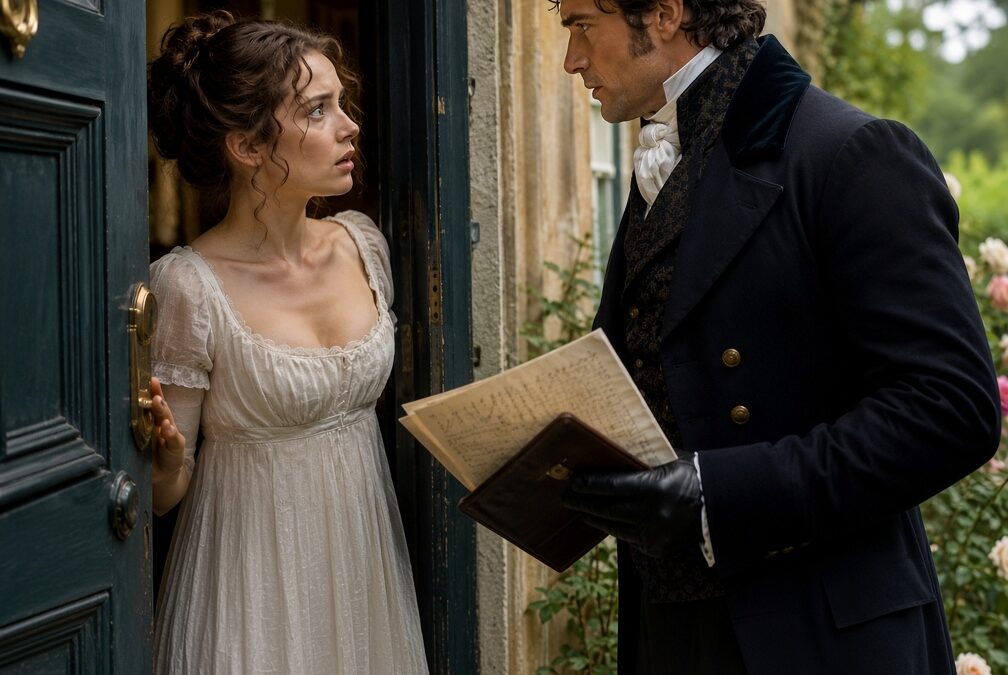
The knock came three times, evenly spaced, the way a man knocks when he has every right to be standing on your step and means for you to know it.
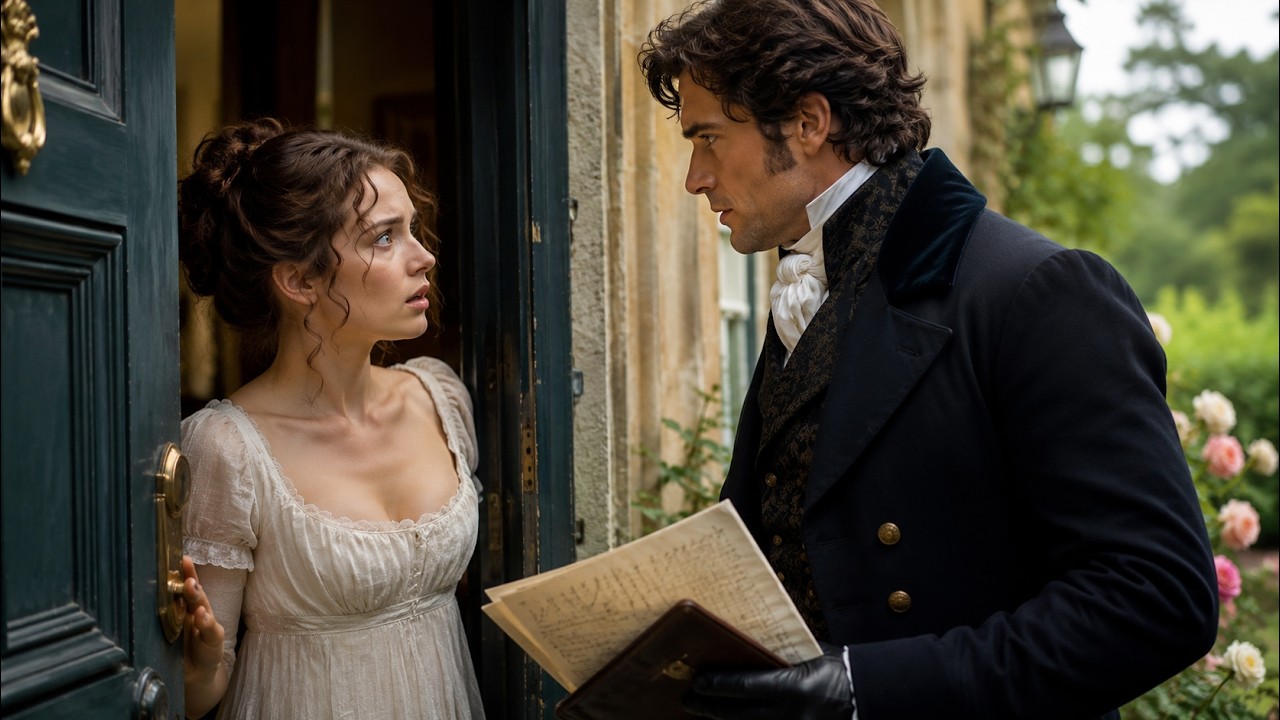
Mary Anne Wickliff set down the inkwell she’d been carrying, crossed the cold hall in her stocking feet, and opened the door of Calder House to the Duke of Ravensmere.
She knew him at once, though she had never met him. The county had described him too many times.
The breadth of him, the dark coat that seemed cut to remind a room how small it was.
The gray eyes that did not warm for anyone. He filled the doorway as though doorways had been an oversight he intended to correct.
Behind him, the carriage steamed in the October cold. The lamps lit early against an afternoon already going to amber and rust.
“I’m here to see Mr. Wickliff.” He said. His voice was lower than the gossip had managed, and far quieter.
“On a matter of debt.” The debt. Of course, it was the debt. There had been nothing else in this house for a year but the debt.
In the letters her father did not open. In the empty squares on the walls where paintings had hung.
In the way the servants had thinned to two, and then to none. “My father is not receiving.”
Mary Anne said. “Then I shall wait until he is.” “You will wait a very long time, your grace.”
“He left for Bath this morning to take the waters for his nerves.” She did not add that his nerves had been considerably soothed by the prospect of being two days journey from this conversation.
“I am his daughter.” “Whatever business you have with him, you may conduct it with me.”
She watched the surprise reach his eyes and stopped there, schooled before it could touch the rest of his face.
He had come expecting a frightened gentleman with his hat in his hands. He had come, she understood, expecting compliance.
He had not expected her. “Madam, this is not a matter for for a woman.”
“I keep my father’s books, your grace.” “I’ve kept them since I was 19.” “I know to the shilling what this house owes you, which is more than I can say for him.”
She stepped back from the threshold, holding the door wide. The cold poured past her into the hall, and she did not flinch from it.
“You may stand on my step and be looked at by every farmer’s wife on the Calder road, or you may come in.”
“I have a fire in the library, and exactly one chair that has not been sold.”
For a moment, he did not move. The gray eyes went over her. The ink on her fingers, the gown that had been good three seasons ago and was good no longer.
The chin she kept level by an act of will she would have suffered torments before naming.
Then the Duke of Ravensmeer stepped over the threshold of the house he was about to own.
And Maryann Wycliffe looked him in the eye and said, “Name your terms.” He did not name them at once.
That was the first thing she learned about him. Standing in the library while the single chair stood between them like a referee.
He was a man who looked before he spoke. And who, having looked, said less than he had looked for.
She used the silence to take her own inventory of him. The way she took inventory of everything.
He was younger than the county made him. Eight and twenty, she would learn. Not the brooding five and thirty the gossip insisted on.
And the youth showed when he forgot to govern it. In the line of his jaw and the unmarked breadth of his hands.
The dark coat was very fine and very plain. The coat of a man who could afford to want no one’s notice.
There was the cold smell of October on him still. Wood smoke and wet wool and the leather of the carriage.
And under it something cleaner. Cedar, perhaps. The scent a careful man chooses precisely because it announces nothing.
He stood the way large men stand who’ve learned not to loom. His weight settled, his stillness deliberate.
And she understood that the looming the doorway had done was the doorway’s doing and not his.
And revised fractionally her first reading of him. The library had been her mother’s favorite room and Marianne had defended it street by street through a year of selling.
The Aubusson carpet had gone in February, the globe in April, the longcase clock in June.
But the books remained. 3,000 of them and the fire and the window that gave onto the parterre where the box hedges had run wild into shaggy green walls.
“You keep the books,” he said. He was looking at the shelves, not at her.
“Your father’s books.” “Both kinds?” She moved to the small writing table by the window where a leather ledger sat closed.
She’d carried it like a saint’s relic for a year. “If you mean the account, it stands at 11,400 pounds plus the interest he stopped paying in the spring, which brings it to something nearer 13.
If you mean the others.” She touched the spine of a Herodotus, gilt worn to brass under her thumb.
“I have read most of them. He has read the spines.” A sound came from the Duke that might, in a man with a less governed face, have been the beginning of a laugh, but it did not finish.
“You are very calm,” he said. “For a woman whose house is forfeit.” “I am very calm because weeping has never once moved a creditor.
And I have tried weeping.” She had not, in fact, wept since the morning the clock was carried out.
And she did not intend to start in front of this man. I find it more efficient to know precisely what I am facing.
So, you hold 13,000 lb of my father’s paper. You have come to collect. Tell me what collection looks like, Your Grace.
And let us neither of us pretend it is a kindness. He turned from the shelves then and looked at her properly.
And she made herself bear it. He had a way of going still that was not the stillness of a slow man, but of a careful one.
The stillness of someone deciding how much of his hand to show. The estate, he said, Caulder House, the home farm, the three tenancies on the Hartmore side, the whole of it, against the debt.
Your father signed the conveyance in escrow eight months ago in exchange for my forbearance.
He has run out my forbearance. I have come to take possession. She had known.
She had read the clause herself in her father’s own foolish hand in a contract he had signed without showing her because he had known what she would say.
She had known. And still the word possession went into her like cold water. Because knowing a thing and hearing a duke say it in your mother’s library are two different countries.
And me? She said. I am not in the conveyance. I am not to chattel, Your Grace, whatever my father may have led you to believe.
No, he agreed. You are not. Then where am I to go? It was the only question she had not answered for herself in a year of answering questions.
And she hated that she had asked it of him. She saw him hear the crack in it.
She saw him decide, very deliberately, not to use it. That, said the Duke of Ravensmere, “is the matter I came to discuss.
And I find I would prefer to discuss it sitting down.” She gave him the chair.
She had meant to give him the chair all along. It was the only courtesy left in the house, and she would spend it like a queen.
She herself sat on the broad sill of the window, her back to the wild garden, and folded her hands on the closed ledger, and waited.
He did not sit comfortably. A man that size never quite did in a room scaled for ordinary people, and she found a small, mean pleasure in watching him fit himself to her mother’s chair.
“My aunt,” he began, “is determined to see me married.” He paused, as though the phrase had surprised him, too.
“That is an understatement. My aunt, the Dowager Countess of Sturton, has informed me that I will be married before the new year, or she will be most displeased.
She has a candidate. I do not care for the candidate.” “My condolences,” Maryanne said.
“I cannot see how it concerns me, unless you have come to ask my opinion of her, in which case I should want her name and her settlement before I commit it.”
This time, the not-quite laugh got further. The corner of his mouth moved and was put back in its place.
“Her name is Lady Augusta Vane. Her settlement is 40,000 pounds, and she would make my life a clean, cold, and perfectly run misery.
My aunt knows this. My aunt does not consider it an objection.” “And so?” “And so,” he said, “I require a wife who is not Lady Augusta Vane.
Someone of decent family. Your father is a baronet’s son, which will do. Who is intelligent enough to manage Ravensmere’s affairs, and possessed of sufficient nerve to stand in my aunt’s drawing room and not be reduced to powder.
He looked at her and for the first time something behind the gray eyes was not entirely cold.
You opened a duke’s letter of foreclosure and demanded his terms before he had got his hat off.
I think you would do. The window sill was hard under her. The fire ticked.
Somewhere in the wild garden a blackbird was making the small indignant noises blackbirds make in October.
And Mary Anne heard all of it with great clarity. The way one does at the hinge of one’s life.
Let me be certain I understand. She said. You are offering to forgive my father’s debt.
To leave me my mother’s house. In exchange for a wife who will keep your books and frighten your aunt.
I am offering you the position of Duchess of Ravensmeer. He said. The debt I will set against the marriage settlement.
Where it will trouble no one. Your father may keep his nerves and his waters.
You may keep your library. It is a transaction Miss Wickliffe. I am told I’m rather good at those.
And love? The word dropped into the room like a coin onto stone. She had not meant to say it.
She had meant to be as cold and clean as he was. And the word had got out past her before she could stop it.
Love, said the duke. Is not part of the conveyance. Good, said Mary Anne, who did not believe him for an instant.
Then we shall deal very well together. She opened the ledger to a clean page, dipped the pen she always carried, and looked up at him with her mother’s gray eyes.
Which were she would learn. Very nearly the color of his. Name your terms your grace.
And then I shall name mine. He had not expected her to have terms. She had read it in his face.
The flicker of something that was almost respect and almost annoyance and entirely unaccustomed. And she had banked it like a coin.
Because a woman selling herself for a house had better know exactly what she was worth.
And she had decided, somewhere in the last 60 seconds, that she was worth a great deal.
“My first term,” she said, “is the library. It does not go to Ravensmere. It stays in this house, and this house is settled on me, not on you.
So that if you tire of your transaction, I’m not turned out of my own rooms by a man I have stopped being useful to.”
“You think I will tire of you?” “I think a wise woman does not sign away her roof on a stranger’s good opinion of himself.”
“The house, Your Grace, in my name. That is the first term.” He inclined his head once.
“A fraction.” “Granted.” “My second term is the truth. Always. I will not be lied to in my own marriage, however convenient the lie.
If your aunt asks whether we are a love match, you will not perjure us both.
You will tell her it is none of her affair and let her make of that what she likes.
I have spent a year in a house built entirely of my father’s lies, and I find I have no further appetite for the architecture.”
Something crossed his face at that. Not annoyance this time. Something nearer to recognition gone before she could read it.
“Granted.” He said again, lower. “My third term,” and here she paused, because the third term was the one she had been building toward and the one she least expected him to grant.
“My father signed the conveyance 8 months ago. You have held it 8 months. A duke does not wait 8 months on 13,000 pounds he could have taken in a week.
You came here today not because his forbearance ran out, but because your aunt set you a deadline.
She said, “Down the pen. I will not be a woman a man married to spite his aunt and discarded when the aunt forgave him.”
So, my third term is this. Three months. We are betrothed for 3 months before any vows are spoken.
And in those 3 months, you will live as much at Calder as at Ravensmere.
And you will let me see precisely the man I am to marry. Not the duke the county describes, the man.
And at the end of 3 months, if either of us wishes to walk away, the debt is still forgiven, and I’m still left my house, and you may marry Lady Augusta with my blessing and considerable pity.
The fire ticked. The blackbird had stopped. The Duke of Ravensmere sat in her mother’s chair, too large for it, and regarded her as though she were a clause he had not anticipated and could not quite find his way around.
“You drive a hard bargain, Miss Wickliffe,” he said at last. “I drive the only bargain available to a woman with no money and a roof full of someone else’s debts.
Hard is all I have. Do you grant it?” For a long moment, she thought he would not.
She watched him weigh it, the cost, the delay, the indignity of being studied like a horse at Tattersalls by a baronet’s penniless granddaughter.
And she made herself sit very still on the hard sill and not breathe. Because if she breathed, she might breathe the wrong way and lose it all.
“Granted,” he said. “All three.” And then, rising, fitting his great frame back into the room, he added, in a voice she had not heard from him yet, dry and very low, “Tell me, do you negotiate everything, Miss Wycliff, or have I simply caught you on a generous day?”
It was so unexpected and so nearly a joke that she laughed before she could stop herself.
A short, startled sound, gone as fast as it came. But he had heard it.
She saw him hear it. Saw the gray eyes register the laugh, the way a man registers an unfamiliar sound in a house he thought he knew.
And she stood up quickly and closed the ledger before he could see what the laugh had done to her face.
“Everything, Your Grace,” she said. “Ask the fishmonger.” And she walked him to the door of her house, which was now, by three terms and a handshake, going to stay her house.
She watched his carriage turn out of the gate into the rusting October light, the lamps small and gold against the failing afternoon, the wheels striking sparks off the frosted gravel of the drive.
And she stood in the cold a moment longer than she needed to, the door open at her back, and the warmth of the one fire bleeding past her into the dark, listening to the wheels fade down the Calder road, before she went back in to begin being, against every plan she had ever made for herself, a duchess.
He came back on the Thursday, and he came alone. This surprised her. She had expected a duke to travel with consequence, a valet, the kind of retinue that turned a country lane into an event.
He came in a plain caracole with a single groom, drove it himself, and arrived at Calder House with mud to the knees and a leather case of papers under his arm, looking less like a man come to court a wife than a man come to audit a farm, which she discovered was exactly what he had come to do.
“Your home farm is being robbed,” he said by way of greeting before he was over the threshold.
“I rode the Hartmore boundary on my way. There are 40 acres of your best pasture fenced into Lord Bramsby’s land, and the fence is not new.”
“I know,” Mary Ann said. He stopped. “You know?” “My father’s steward, Mr. Lomas, sold the grazing rights to Bramsby 3 years ago and pocketed the money.
And when my father found out, he did nothing because Lomas knew about the worst of the gambling, and my father was afraid of him.”
She took the muddy case from him without being asked and set it on the hall table.
“I have the dates, the sums, and Lomas’s own letters because Lomas is a thief, but not a clever one.
I’ve been waiting 3 years for someone with the standing to do something about it.
Welcome to Calder, your grace. You appear to be that someone.” He looked at her.
The mud-spattered duke and the penniless baronet’s granddaughter facing each other across a hall stripped of everything but its echoes.
And something happened in his face that she would spend the next 3 months learning to read.
It was the look of a man who had come prepared to be patient with a silly girl and found, instead, a quartermaster.
“Show me,” he said. She showed him. They sat at the writing table by the library window, the case of papers open between them, and for 2 hours they did not speak of marriage, or aunts, or love, or anything at all but the methodical dismantling of Mr.
Lomas. She had the letters, he had the law. She knew where the bodies were buried, he knew which magistrate to wake and how loudly.
By the time the light went amber over the wild parterre, they had between them constructed something neither could have built alone.
And Mary Anne, looking up from a column of Lammas’s fraudulent figures, found the Duke of Ravensmere watching her with an expression she did not have a ledger line for.
“What?” She said. “Nothing.” He returned his eyes to the page. “You enjoy this.” “I enjoy a thief being caught.
I enjoy a wrong being righted. I have spent a year being able to see exactly what was wrong with this house, and unable to mend a single stone of it because I am a woman and have no money and no standing and no man who will listen.”
She tapped the ledger. “And now there is a man who will listen. And it turns out he is very large and rather frightening and engaged to me.
And I intend to make ruthless use of him while he lasts. Is that an answer, Your Grace?”
He was quiet for a moment. Then, “My name is Adrian,” he said. “If we are to be ruthless together, you may use it.
The ‘Your Grace’ is for my aunt’s drawing room.” Adrian. She tried it. It was a warmer name than she had expected for so cold a man.
“Then you had better call me Mary Anne and not Miss Wickliffe, or your aunt will think you’ve hired me.”
“My aunt,” said Adrian with the dry weariness she was beginning to recognize as the nearest he came to humor, “thinks everyone I bring before her has been hired.
It is her settled opinion that no one would have me otherwise.” He stood, gathering the papers.
“I will see Lammas dealt with within the week. And I will come on Sundays and Thursdays if that suits.
Your 3 months should be spent, I think, and not merely waited out. It suits.
He paused at the library door, the leather case under his arm, the amber light catching the gray at his temple that she had not noticed before, and that made him look, suddenly, younger than the county said, and older than his eight and twenty years, all at once.
You were right, you know, he said, about the eight months. My aunt set me a date.
I had not meant to come at all until then. He looked at her. I’m glad I came early.
And then he was gone, before she could decide whether the warmth in her chest was relief or triumph, or something she had three months and no business at all to give a name.
Mr. Lummus was dealt with on the Monday. Maryanne was not present. A duke confronting a thieving steward was not, Adrian said, a scene for a lady, and she had agreed on the strict condition that she be told every word of it after.
He told her every word of it on the Thursday, sitting in her mother’s chair with a cup of the cheap tea she could afford, and drinking it as though it were the good bohea.
And she laughed three times, properly, before she remembered to be careful. He wept, Adrian said.
He stood in his own front parlor and wept, and told me the gambling was your father’s fault, and the fence was your father’s idea, and the 40 acres had practically walked into Brandsby’s field of their own accord.
And I let him weep until he ran dry. And then I told him I had his letters.
My letters? Your letters. I gave you the credit. I said, “There is a young woman who has been keeping the true accounts of Calda for three years while you robbed it, Mr.
Lummus. And she has been more thorough than my own man of business. And you were caught not by a duke, but by a baronet’s granddaughter with a good memory and a better filing system.
He set down the cup. He went quite gray. I confess I enjoyed it more than was strictly Christian.
You told him it was me. Maryanne was not sure why this undid her so.
She had spent a year being the invisible engine of this house, the one who knew, the one who counted, the one no one credited because no one credits a daughter.
You did not have to. I told him the truth, Adrian said simply. It was your second term.
I am keeping all three. She turned to the window so he would not see her face and looked out at the wild parterre where the first frost had come in the night and silvered the shaggy box hedges into something almost grand.
And she thought, this is the dangerous part. Not the foreclosure, not the marriage, not the aunt.
This. A man who keeps his terms. A man who hands you the credit you earned.
A woman could lose her whole careful self to a man like that. And Maryanne had spent a year and a great deal of will building a self too careful to lose.
The 40 acres come back to Calder. Adrian was saying behind her. Brandsby has agreed.
He had no choice. The fence comes down before the snow. And Lummus has gone into Yorkshire to be a thief in someone else’s parish.
So, a pause. Your home farm is whole again, Maryanne. Your house is whole again.
I have done the thing you wanted done. And I find The pause was longer this time.
I find I should like to do another. And what is that? Walk with me in the garden.
It is a great wild ruin of a garden, and the frost has made it beautiful.
And I have been a duke since Tuesday, and a man of business since this morning.
And I should like, for 1 quarter of an hour, to be neither. She heard him stand.
Unless walking with you must also be negotiated, in which case I withdraw the request, and we shall both pretend I never made it.
She turned around. He was standing by her mother’s chair, with his hands behind his back, very large and very still, and entirely uncertain.
And it was the uncertainty that did it. The discovery that the Duke of Ravensmere, who filled doorways and frightened stewards, and forgave 13,000 lb with a flick of his pen, did not know whether she would walk with him in a garden.
“No negotiation,” Maryanne said. “But you will lend me your arm at the broken steps, because the frost makes them treacherous, and I have only the one pair of good stockings left in the world, and I will not ruin them falling on a duke.”
It was, she thought afterward, the moment it began. Though nothing happened in the garden but two people walking the silvered length of a ruined parterre, talking of box hedges and Herodotus, and an aunt neither of them had met yet.
His arm steady under her hand at the broken steps, the October light going down behind the wild green walls.
Nothing happened, and everything had begun. The library changed after that. Not in any way a stranger would have marked, the same 3,000 books, the same one chair, the same window onto the wild parterre, but Maryanne, who had defended the room street by street through a year of selling, felt it change under her like a tide turning.
For a year, it had been a fortress. She had sat in it alone through the long evenings, the one warm cell in a cold house.
And it had smelled of wood smoke and old paper and the particular dust of a room no one entered.
And the silence in it had been the silence of a held breath. She had loved it the way one loves the last thing one has left to lose.
It had been hers because there was no one else for it to belong to.
Now it smelled on the Thursdays of cedar and cold air and a man’s wet coat steaming by the fire.
Now there were two voices in it instead of one. And the dust got disturbed and the chair was given away each week and reclaimed each night.
And the silence, when it came, was no longer a held breath but the easy shared quiet of two people reading by the same light.
She caught herself on the Wednesdays arranging the room against his coming. A second cup set ready, the better candle saved, the Marcus Aurelius left out where his hand would find it.
And she would catch the arranging and stop and stand in the middle of her fortress with a cup in her hand undone by the discovery that she had begun without deciding to to keep the room for someone else.
“Sundays and Thursdays,” he had said. And Sundays and Thursdays he came. October went out in copper and rain.
And November came in gray. And the rhythm of the weeks built itself around the two days the curricle turned in at the Calder Gate.
Maryanne did not let herself wait for them. She told herself this with great firmness on the Wednesdays and the Saturdays while she swept the library hearth and counted the dwindling tea and read by candlelight in a house that had learned to be quiet.
She did not wait. She simply found on the Thursdays that the house was warmer for two hours and colder afterward.
And she filed the observation away in the part of herself that kept accounts and did not examine it too closely.
The autumn deepened around the house while she did not wait. The leaves came off the great copper beech by the gate and lay in drifts the color of old pennies along the drive.
And the mornings came in white with frost that the thin sun took until noon.
And the smell of the year turning, wood smoke and wet leaf mold and the cold mineral edge of coming winter, got into the very stone of Calder House.
She stacked what wood she could cut. She mended what she could mend. And every second evening, when the curricle did not come, she sat alone in her fortress of books with the fire low and told herself, with the particular firmness of a woman lying to the one person who will always catch her at it, that she did not, in the slightest, mind.
What they did, on the Sundays and Thursdays, was work. That was the strange domestic truth of their betrothal.
The thing no romance the county whispered would ever have credited. The Duke of Ravensmere and his penniless bride spent the autumn bent over a writing table together mending an estate.
There was a great deal to mend. With Lummus gone and the 40 acres come home, the home farm needed a steward.
And Adrian, who could have sent his own man from Ravensmere with a flick of the pen, did not.
He sat instead at the library table while Mary Anne laid out the candidates. The honest, slow man from Hartmore, the clever, quick man from the village who might or might not be another Lummus, the widow’s son who had no experience and every scrap of character.
And he listened to her read them. And he asked her which she would choose.
And when she chose the widow’s son for his character over the clever man for his cleverness.
Adrian only nodded and wrote the offer in his own hand and let her seal it with her father’s ring.
“You did not argue,” she said, watching the wax cool. “You were right.” He set down the pen.
“I have a great many people who argue with me, Marianne. I find I do not need another.
What I have never had is someone who is simply right and quiet about it and lets me come to it in my own time.”
A dry note entered his voice, the one she was learning to listen for. “It is a novel experience.
I’m told novel experiences are good for a man of settled habits. My aunt says so.
She also says I have the settled habits of a parish clock, so I take her commendations with salt.”
Marianne laughed. She had stopped by November trying not to, and the sound of it went up into the 3,000 books and the cold high ceiling and made the room for a moment less of a ruin.
They rode the boundaries together when the weather allowed on the two horses Calder had left, her mother’s old gray mare and a borrowed cob that carried Adrian’s great frame with an air of profound resignation.
He showed her how to read a drainage ditch and she showed him which of the Hart Moor tenants were behind on their rent because the land had failed and which because the man had failed, a distinction her father had never troubled to make and Adrian, to her surprise, had never been taught.
They argued about a hedge. They agreed about a weir. Once, sheltering from a sudden squall under the lee of a stone barn, they stood close in the smell of wet wool and old hay and said nothing at all for a quarter of an hour watching the rain come gray across the home farm and Marianne was intensely, particularly aware of the warmth of him at her shoulder.
And the way his sleeve, where it brushed hers, was the only warm thing in a cold, wet world.
She moved away first. She always moved away first. It was, she told herself, a matter of stockings.
In the evenings, when the work was done and the light gone, they fell into a habit neither had proposed.
Adrian would not leave for Ravensmere until the moon was up. The roads, he said, were safer by moonlight, which was a transparent lie they both maintained.
And so there was an hour, two hours, by the library fire, when the duke and the bookkeeper put down the ledgers and simply talked.
He had read the spines, he confessed. She made him read the books. She gave him the Herodotus, and he gave it back unimpressed.
And she made him try the Marcus Aurelius instead, and found, to her delight, that a duke who governed an estate by system took to a stoic emperor like a man finding his own face in a glass.
He is very like you, she said, the night he finished it. Marcus. He’s forever telling himself to be calm and just and unmoved, which is precisely what a man tells himself when he is none of those things and badly wishes to be.
Adrian looked at her across the fire. He sat on the window sill now, by some treaty neither had signed, and she in her mother’s chair.
And the gray eyes held the firelight. Is that what I am? A man telling himself to be calm?
I think you are a man who was told, very young, that calm was the only thing a duke was permitted to be, and who believed it, and who has been a little lonely inside the belief ever since.
She had not meant to say it. It had simply come, the way the word love had come in October, past the careful gate before she could shut it.
I am sorry. That was forward. You may dock it from term two. Term two is the truth, he said quietly.
You cannot be docked for keeping it. He turned the little book in his hands, his thumb moving over the worn leather.
No one has ever said that to me. That I was lonely. People say a great many things to a duke.
They do not say that. He was silent a moment, then with an effort she could see.
I lost my father when I was 12. I was a duke at 12, Maryanne.
There is a portrait of me at Ravensmere, aged 12, in the full robes, holding a coronet too heavy for me.
And I have hated it for 16 years, and never been able to say why.
You have just said why. It is the portrait of a lonely child being told to be calm.
He set the book down. I think I should like to take it off the wall.
Then take it off the wall. A duke does not simply take his own portrait off his own wall.
A duke, said Maryanne, may do as he pleases, which is the entire point of being one.
And the only reason I can see for the position holding any appeal whatsoever. Take it down.
Put up a landscape. Put up nothing. Put up a portrait of your aunt looking difficult, and tell people it is a deterrent.
The not quite laugh got all the way out that night. A real one, low and surprised, that she felt more than heard across the small warm distance of the fire.
And Maryanne sat very still in her mother’s chair. And understood that she was in a great deal of trouble.
And that the trouble had a name. And that she had granted it all three of her terms.
The weir went in the second week of November in the small hours after 3 days of rain.
Mary Anne woke to the sound of it before she understood what it was. A low changed roar in the dark.
The river speaking in a register it did not use. And under the roar, a thinner sound.
A man’s voice raised against the water and the wet thud of fists on the kitchen door.
She was down the cold stairs and across the flagged hall with a shawl over her nightgown and a candle guttering in her hand before she was wholly awake.
And when she dragged the heavy door open the rain came in sideways and with it the widow’s son.
The new young steward soaked through, his face white in the candlelight. The Harmore weir had given way at the old sluice.
The water was coming down on the three low tenancies, the very three the conveyance had once named.
And if the millpond went after it the cottages would be flooded to the sills before morning.
The winter stores ruined. Three families whole year carried off in the dark by a river her father had never once spent a shilling to mend.
She did not weep. And she did not freeze. And she did not send for a man.
She dressed in the dark in under 2 minutes in the garnet wool because it was warm.
And she went out into the streaming black night with the young steward and a lantern that the wind kept trying to put out.
And for the next 4 hours Mary Anne Wycliffe fought a river. She had no money and no duke and no authority but the authority a person takes who is the only one present who is not afraid.
She roused the home farm. She sent the men to the millpond sluice with the lantern held high so they could see the gate.
The rain running into her eyes and the cold of the water rising past her boots.
Her voice gone hard and clear and carrying over the roar. “Open the upper gate.
Let the pond run to the meadow. Sacrifice the hay and save the cottages. And quickly.”
The water answered the open gate the way water does, all at once and with no gratitude, rushing brown and cold into the lower meadow and leaving the cottages a margin of mud and minutes.
She waded into the flooded yard of the lowest tenancy with her skirts heavy as iron and the cold dragging at her knees and carried out a sack of seed corn on her own shoulder and a second and went back through the freezing dark for the children’s pallets and got the families up the lane to the dry barn with their winter stores about them.
Then she stood in the streaming dark counting heads by lantern light until every soul was accounted for.
Her hands were raw. Her feet had stopped feeling. The garnet wool was black to the waist and would never be the same.
And the cottages stood and the seed corn was dry in the barn and the families were safe.
It was nearly dawn, gray and bitter. The rain at last slackening to a thin cold drizzle when the curricle came tearing down the lane for the young steward had sent a boy to Ravensmuir at the first alarm and Adrian had driven the wet dark hours through to reach her.
He came down into the flooded lane and saw her, soaked to the bone, mud to the waist, the lantern still in her raw hand, standing in the gray light counting her people one last time to be sure.
The garnet wool ruined and her dark hair plastered to her white face and her chin.
Even now, even exhausted, even at the end of a night that would have broken most men of his acquaintance, level.
He did not say anything at first. He simply stood in the rain and looked at her.
And Mary Anne, turning and finding him there, was too tired to put on any face at all.
And so he saw the real one. The bone-deep weariness. The raw competence. The woman who had fought a river alone because there had been no one else, and would have fought it again the next night if the river had come again.
“I sent for you,” she said, “in case the upper went too and we needed more hands.
We did not. I have it. They are all safe, Adrian. Every soul. I counted them.”
“I know you did,” he said. His voice was not quite steady. “I can see that you did.”
He took the guttering lantern out of her raw fingers and set it down and took both her cold hands in both of his great warm ones and stood there in the dawn rain holding them, not speaking, while the feeling came back into them in slow, cruel needles.
And she did not pull away. “Mary Anne, there is not a steward in England, nor a magistrate, nor a duke who would have done what you did tonight.
I have men three times your size who would have stood on the bank and wrung their hands.
You sacrificed the hay to save the corn and the corn to save the children.
And you did it in the dark, in the rain, in two minutes’ thought, alone.”
His grip tightened. “I came to help you. I find there was nothing left to do.
You had already saved the moor.” “The hay is gone,” she said. Her teeth had begun to chatter.
“It was a fair crop. I am sorry for the hay.” “Damn the hay!” It was the first time she had heard him swear and the shock of it, mild as it was, made her laugh.
A cracked, wet, exhausted laugh. The laugh of a woman at the far end of her strength.
And Adrian, hearing it, did something he had never done. He drew her in out of the rain against the warm bulk of him, careful, asking nothing, only sheltering, his coat coming round her soaked shoulders.
And she let him because she had no strength left to move away first. And because, for the first time in a year, she did not want to.
They stood like that in the gray dawn while the rain thinned to nothing, the river going down behind them, the cottages dark and safe along the lane.
And neither of them said the word that was in the air between them because it was not the time.
And there was a fortnight yet of the 3 months. And they had both, in their separate, careful ways, learned to wait.
But he drove her home himself and built up the library fire with his own hands and sat with her until the chattering stopped and the color came back.
And did not leave for Ravensmere until the sun was fully up, abandoning, without a word, the transparent fiction of the moonlight roads.
He took the portrait down. He told her so on the next Thursday with the particular shy gruffness of a man who has done a thing he’s not sure he was allowed to do, and put up in its place, he said, a map, a great old estate map of Ravensmere, all field names and watercourses, which suited him better than robes ever had.
“My aunt is appalled,” he added. “She says I have hung a tradesman’s chart where a Hartley ought to hang.
I told her the field names were 300 years old and a good deal more honest than most of the Hartleys.
She has not forgiven me. She is coming to inspect you, by the way, and I suspect she means to inspect the map as well, and find you both wanting, so that her conscience is clear when she fails to break the match.
You think she will fail to break it? I think, said Adrian, that she would have broken it already if she meant to.
She has had the means since October. She is waiting. He looked at Marianne with the careful directness she had stopped being able to defend against.
I think she is waiting to be made to laugh, though she would suffer torments before admitting it.
It is the family failing. We are none of us able to ask for the things we most want.
We wait instead to be given them, and call it dignity. He picked up his hat.
Do not let her frighten you. She frightens everyone. It is her chief pleasure in widowhood, and she respects nothing she can frighten.
Stand up to her, and she is yours for life. It is, I warn you, a mixed inheritance.
And so, when the coach with the coat of arms came up the Cold Harbour Road three days later, Marianne was ready for it, though nothing she found could have made her entirely ready for the Dowager Countess of Stanton in person.
The Dowager Countess of Stanton came to call the house in November, unannounced, in a coach with a coat of arms on the door, and Marianne, who had been warned, met her on the steps in her three-seasons-old gown, with her chin level, and her hands perfectly still.
So, said the Dowager, descending, this is the bargain. She was a small, exquisite, perfectly preserved woman of 60, with Adrian’s gray eyes set in a face that had clearly been a great beauty, and had decided, somewhere around 40, that beauty was a tool, and not a vanity.
She looked Mary Anne over the way a buyer looks over a horse with a known fault.
Show me the house. I want to see precisely what my nephew has thrown 40,000 pounds away to avoid.
Lady Augusta’s 40,000 was never my nephew’s to throw, madam. Mary Anne said pleasantly, leading her in.
But I take your meaning. This is the hall. We have sold the carpet, the clock, and most of the chairs.
You are welcome to the one chair in the library, which is the only seat in the house fit for a countess.
And I shall stand, as I have grown rather good at it. The dowager stopped in the stripped hall and looked at her for the first time as though she were a person and not a fault.
You are not afraid of me. I am terrified of you, madam. But I have found that being afraid and being reduced to powder are two different things, and I decline the second on principle.
Mary Anne held the library door. Adrian said you would try to frighten me. He said it was your way of taking an inventory.
I thought it only fair to let you see the whole stock at once and save us both an afternoon of skirmishing.
There was a silence. And then the dowager countess of Sturton, who had reduced three generations of debutantes to weeping and one cabinet minister to a stammer, sat down in the one chair in the library and began, very quietly, to laugh.
Adrian, she said when she had recovered, told you a great deal. Adrian keeps his terms, Mary Anne said.
It is, I am learning, the most alarming thing about him. It is the only good thing about him, the dowager corrected.
And I will thank you not to tell him I said so. She accepted the cheap tea without comment, which Mary Anne understood to be a concession of some weight.
And over the course of the afternoon, she examined the books, the ledger, the accounts of the Lummis affair, and Maryanne herself with a thoroughness that left nothing unturned.
The small gray eyes missed nothing. The ink on Maryanne’s fingers, the soiled squares pale on the walls, the single fire, the level chin.
At the end of it, she set down her cup and folded her small, exquisite hands and said, “I came here to break this off.
You understand that. Lady Augusta is a fool, but she is a rich, well-connected, biddable fool.
And a man in Adrian’s position needs a wife he can predict. You are not predictable.
You are the single most inconvenient young woman I have met in 40 years of meeting them.
And if you marry my nephew, you will lead him a dance from here to the grave.”
“Very probably, madam.” “Yes,” said the dowager, and stood. And for one moment, the gray eyes were not cold at all.
“Yes. He needs that rather badly, I think. He has been predictable since he was 12 years old, and it has very nearly turned him to stone.”
She drew on her gloves. “I shall not break it off. I shall instead make myself extraordinarily difficult, so that no one can say I gave in.
And you will manage me because you appear to manage everything, and we shall both pretend the other one.
Do we understand each other?” “Perfectly, madam.” Said Maryanne. And she walked her to the coach and watched it pull away down the colder road into the early November dark, the coat of arms going small, and then gone.
Then she went back into the house and sat down rather suddenly on the broad sill of the library window, because her knees, which had behaved beautifully all afternoon, had decided the afternoon was over.
Adrian came on the Thursday and she told him. And he laughed. Not the not quite laugh.
But a real one. Brief and astonished. That changed his whole face. She laughed. He repeated.
My aunt sat in this room and laughed. Marianne. The last person who made my aunt laugh was my uncle.
And he has been gone 11 years. He stopped hearing himself. And the laugh went away.
But something of it stayed in his eyes. She likes you. She does not like me.
She has decided I am a useful difficulty. There is a difference. Though I grant it is a narrow one.
In my family, Adrian said. It is the only kind of liking there is. He set down the leather case he no longer seemed to need.
He had taken over the weeks to coming with empty hands. Which Marianne had noted and said nothing about.
I have something for you. Not a gift. A gift would be against your terms.
You’d suspect me of softening you up for some clause or other. And you’d be right to.
This is a return. He took from his coat a small flat parcel wrapped in brown paper.
And laid it on the writing table within her reach. And stepped back. The way a careful man steps back from a thing he is not certain of.
She unwrapped it. It was a miniature in a worn gilt frame. A young woman with gray eyes and a level chin.
Painted 40 years ago in a gown the color of garnet. Looking out of the little oval with an expression Marianne knew because she made it herself in mirrors when she thought no one was watching.
My mother. She said. Her voice did something it had not done in front of him before.
This was sold in March to pay the She stopped. To pay the interest, yes.
I found it in a dealer’s in York when I went up after Lammas. He had it in a tray of orphaned miniatures, nameless, for three guineas.
I knew it the moment I saw it. He was watching her very steadily. It has your chin.
I’ve spent a good deal of November looking at your chin, Marianne. I would know it anywhere.
She held the little oval in both hands, her mother’s gray eyes looking up at her out of the worn gilt, and she did not weep because she had promised herself a year ago she would not weep in front of a creditor, and some promises outlive the reason for them.
But she came nearer to it than she had come since the clock went out the door, and Adrian, who saw it, did the kindest thing he had done yet.
He turned away to the window and gave her the parterre to look at. And let her have her face to herself until she had it back.
“Thank you.” She said at last to his broad back. “It is not thanks.” He said without turning.
“It is term, too.” The truth. The truth is that your mother’s portrait was sold to pay a debt I held.
And a debt I held should not have cost you your mother’s face. So I bought it back.
It is not a gift. And it is not love, which is not in the conveyance.
It is only what was owed. He turned then, and the gray eyes were not cold.
Had not, she realized, been truly cold for some weeks now. “I am keeping all three terms, Marianne.
I find I do not want to be the kind of man who only keeps the ones that cost him nothing.
And Marianne, holding her mother’s face in her two hands, understood that the dangerous part she had feared in October had arrived in November without her noticing, and that she had walked into it with her eyes wide open and her terms all granted.
And that there was no clause in any conveyance that could get her out of it now.
She saw Lady Augusta Vane for the first time at the Brandsby’s card party at the end of November, and she saw her before she knew who she was.
It was an evening of the sort Marianne had not attended in two years, a county gathering, candlelit, warm, the first since her father’s ruin, to which the new betrothal had bought her an invitation.
She went on Adrian’s arm in her made-over garnet, braced for the stairs, and got them, and bore them, and was making her slow way through the crowded drawing room toward the supper table when she passed the open door of the Brandsby’s small music room and glanced in, and stopped.
A woman sat alone at the silent pianoforte in the half-dark. She was the most beautiful woman Marianne had ever seen.
Sapphire silk, hair like dark honey, a profile a sculptor would have wept over. And she was not playing.
She was sitting at the keys with the lid closed, and on the closed lid lay a folded paper, and the beautiful woman was looking at the paper, not reading it, only looking, with one fingertip resting on it, the way one rests a hand on something one cannot quite bear to pick up and cannot quite bear to put away.
The candlelight caught the side of her face. There was nothing cold in it at all.
There was only a young woman alone in a music room at the edge of someone else’s party, looking at a folded paper as though it were the last warm thing in a cold house.
Marianne did not know who she was. She felt only the swift, unexpected kinship of one woman recognizing another’s private hour of being unwatched, felt absurdly that she had intruded on something, though she had done nothing but pass a door.
She stepped back from the threshold and walked on toward the supper table. And it was there, a quarter of an hour later, that she heard the name spoken behind a fan.
Lady Augusta, poor creature. And after Ravensmere these two years, and now this. And turned, and understood, too late to unsee it, that the beautiful woman alone with the folded paper had been the rival she was supposed to hate.
She told Adrian none of it. She did not entirely know why, but she carried the image home with her, the sapphire and the closed lid and the one fingertip on the folded paper, and she found she could not make it fit the shape the county had given her, the scheming jilt, the vengeful fool.
And she filed it away, uneasy, in the part of herself that kept accounts and would not let a figure go that did not balance.
December came in cold and clear, and for one bright fortnight before the snow, Maryanne was happy.
She caught herself at it on a Sunday morning, and the catching was itself a kind of shock.
Adrian had come early. He came early often now, the Sundays and Thursdays having quietly annexed the days on either side, and they had ridden out at first light, frost on the home farm, the breath of the horses going up white, and come back glowing and cold to a breakfast of toast and the cheap tea by the library fire.
And Adrian had read aloud to her from the Marcus Aurelius in a low, even voice, while she warmed her hands at the blaze.
And somewhere in the middle of it, Maryanne had looked up at him, the great frame folded into the window sill, the frost still in his dark hair, the gray eyes on the page, and felt, with a clarity that stopped her breath that this was the life.
Not the Duchy, not the rescue from ruin, not the house she had fought for street by street.
This. A cold morning, a warm fire, a man reading to her in a room full of books, and nothing whatever owing between them but the hours.
“Read that again.” She said when he had finished. “The part about the present moment being all a man can lose because it is all he has.”
He read it again. Then he closed the book and looked at her over it.
“You are happy.” He said. He said it the way he said everything, as a fact observed and set down, but there was something underneath it, a kind of wonder, as though happiness in her were a sum he had not expected the books to show.
“I have been watching you be many things since October, Maryanne. Calm and clever and frightening and brave.
I have not, until this morning, watched you be happy. It is He stopped. And for once, the careful man could not find the careful word.
“It is a great deal to be responsible for. I find I want to be responsible for it for a very long time.”
“That is dangerously close to a sentiment, Your Grace.” Maryanne said. Because if she did not make it light, she would weep.
And she had promised herself. “I shall have to dock it from term two for excessive feeling.
Term two is the truth.” He said, as he always said. “And the truth is that when the lilacs come out in the spring, I should like to walk this garden with you and not have it be Sunday or Thursday or a term or a transaction.
I should like it to be only a morning. Ours.” He turned the book in his hands.
“I have never in my life had a thing that was only ours. I should like to begin.
The fire ticked. The cold, clear December light came in across the wild parterre, and Maryanne sat in her mother’s chair and looked at the man she was going to marry.
For she knew it now. Knew it the way she knew the figures in a column.
Knew it past all her terms and clauses and careful defenses. And let herself for one bright fortnight simply be happy.
The way the old emperor had counseled in the only moment a person ever has.
It was the last wholly happy morning before the snow. And she did not know it.
And that was a mercy. Because if she had known, she would have spent it bracing for the loss.
And she did not, for once in her relentlessly guarded life, brace for anything at all.
December came in hard and white. And with the snow came the letters. The first arrived at Ravensmere, and Adrian brought it to her, troubled, on a Thursday.
An anonymous note in a clerk’s disguised hand, addressed to the dowager, suggesting that the Duke of Ravensmere had been entrapped into a degrading marriage by a fortune-hunting woman who had forged her own father’s accounts to manufacture a grievance and snare a title.
“My aunt gave it to me,” Adrian said. “She does not believe a word of it.
But there will be more. Someone wants this match broken and is willing to be ugly about it.”
Maryanne read the note twice, her face very still. “Lady Augusta,” she said, “I do not know.”
“I do.” “£40,000 and a settled understanding. And then a baronet’s penniless granddaughter walks off with the duchy.
A woman does not forgive that. I would not forgive that in her place. I should simply be cleverer about the revenge.
She set the note down. She cannot prove the forgery because there is no forgery.
Lomas’s letters are real and the magistrate has them. So, she will not try to prove.
She will try to suggest. She will whisper at every dinner from here to London that the new Duchess of Ravensmere is a forger and a fortune hunter.
And she will not need to prove a thing. Because a woman is convicted by suggestion in this country and acquitted by nothing at all.
Adrian was quiet. Then, I will stop her. You cannot stop a whisper, Adrian. You can only outlive it.
And you can only do that with a wife so plainly above reproach that the whisper starves.
She looked at him. Which is a problem. Because I am a penniless girl who keeps her own father’s books and demanded a duke’s terms before she’d let him in out of the cold.
I am the easiest woman in England to whisper about. You did not choose a wife above reproach.
You chose a wife with a good filing system. I chose, said Adrian, and stopped.
And she watched him decide to say it. Watched the careful man set down his caution like a glass he had carried too long.
I chose the only woman in England who has ever looked at me and seen a man instead of a Duchy.
Do not tell me what I chose, Maryanne. I was there. The fire ticked. The snow came down past the window onto the white parterre where the box hedges were rounded shapes under their burden.
And Maryanne sat very still in her mother’s chair. She had taken to sitting in it lately and he’d the window cell.
The geography of the room reversed by some agreement neither had spoken. And looked at the Duke of Ravensmere, who had just told her the truth as her second term required, and found she did not know what to do with it.
“That was not in the conveyance,” she said very quietly. “No,” he agreed. “It was not.”
And he came across the room and stood before her chair, very large and entirely without his armor, and held out his hand, not to seal a bargain this time, but only to be taken.
Maryanne looked at the broad, steady hand of the man who had come in October to collect a debt, and had stayed to return a portrait and catch a thief, and tell her the truth.
And she put her ink-stained fingers into it and let him draw her to her feet, and stood close enough to feel the cold of the December morning still on his coat, and the warmth of him underneath it.
He did not kiss her. She understood, even then, that he was waiting. That a man who kept his terms would not take what had not been offered, not for all the snow in England.
And she found, standing there with her hand in his, that the careful self she had spent a year building had no clause for this, no ledger line, no defense at all.
And that she did not, for once, want one. “Three months,” she said. “We agreed three months.”
“We did.” “There is a fortnight left of them.” “There is.” “Then in a fortnight,” Maryanne said, and her voice did not shake, which she counted afterward as the bravest thing she had ever done, “you may ask me again, and I shall not negotiate.”
But the fortnight did not run out the way they they planned, because Lady Augusta Vane did not whisper.
She acted. Marianne learned it from the dowager, who arrived at Calder three days before Christmas in a coach driven too fast over snow.
Her exquisite face, for once, not composed at all. “She has gone to the magistrate,” the dowager said, “the moment she was through the door.
Augusta, she has laid a formal information that your father’s accounts were falsified. Not by the steward, by you.
To defraud my nephew of 13,000 pounds and entrap him into marriage. There is to be a hearing.
Sir Henry Coldicott, the magistrate, is an old friend of Augusta’s father, and he has agreed to hear it on Boxing Day, when half the county is at table and the other half is too snowbound to attend.
So that it will all be done quietly, and the verdict will be against you before anyone who matters has heard there was a question.”
The hall was very cold. Marianne stood in it with her mother’s miniature in the pocket of her gown.
She carried it everywhere now. And felt the old familiar settling of disaster into her bones.
The year of it. The long, cold competence of a woman who has learned that ruin is not a single blow, but a slow accumulation of mornings.
“Where is Adrian?” She said. “In London. I sent for him. He cannot be back before Christmas Eve at the earliest.
And the roads.” The dowager spread her small gloved hands. “The roads may not let him back at all.
The snow is closing the north road behind every coach that runs it.” “Then he must not try,” Marianne heard herself say.
“Tell him not to try, madam. If he comes back to stand beside me at that hearing, every soul in the county will say the duke had to rescue his forging fortune hunter.
And Augusta will have what she wants, whether the verdict goes her way or not.
The whole point of me, the whole point of choosing me, was a wife above reproach.
A wife who needs rescuing is not above reproach. She is exactly the woman the whisper says she is.
Mary Anne, I will go to the hearing alone. She said it the way she had said name your terms, level and cold and absolutely certain, and she felt the year of competence close around her like armor.
She had thought she might be ready to set down and now must take up again.
I have Lomax’s letters. I have the magistrate’s own record of his confession. I have three years of true accounts in my own hand.
I do not need a duke. I have never needed a duke. I needed 13,000 pounds and a man who would listen.
And I’ve had the listening. And now I shall do the rest myself. As I have done everything myself.
Because that is what I am, madam. That is what I have always been. The dowager looked at her for a long moment.
And the marriage? There may be no marriage. Mary Anne’s voice did not break. And she was proud of that.
In the bleak way one is proud of a thing that costs too much. If I stand at that hearing and the county sees a forger acquitted on a technicality, the whisper wins.
And the whisper is right. And Adrian has married a scandal. And if I lose, I’m a forger in law and he cannot marry me at all.
Either way, the conveyance is what was his word? It is broken, madam. He came to collect a debt.
It seems the debt has finally come due. And I am to pay it after all.
She turned to the window. The snow had stopped. The parterre lay white and silent under a low gray sky.
The box hedges rounded shapes. The broken steps where he had given her his arm in October buried now under a foot of new fall.
And Mary Anne stood and looked at it. And believed for the length of one terrible afternoon every word she had just said.
That he had only ever wanted a wife above reproach. That she was not above reproach.
That the man who came to her step in October had come to collect. And that collection in the end was all that it had ever been.
It was the worst reading of every kind thing he had done. And she inhabited it completely.
Because she had built her whole careful self on expecting the worst and being ready for it.
And the worst had come at last. And she was ready. And being ready did not help at all.
The two days before the hearing were the longest of her life and the quietest.
And she spent them almost entirely alone. The dowager had gone back to Stanton to write letters.
To whom she would not say. Only that a countess was not without resources. And Augusta would find the road harder going than she expected.
The servants she had not had for a year were not there to be sent for.
And the silence of the house was complete. The young steward came once with bread and a brace of rabbits and his cap in his hands and the news that the three saved families had sworn to walk to Sir Henry’s themselves and say what the duchess that would be had done in the flood if it would help.
And Mary Anne had thanked him and sent him home. And told him it would not help.
That a magistrate weighed evidence and not gratitude. And had stood in the kitchen doorway afterward watching him trudge away down the white lane.
And felt the loneliness close over her like the snow closing over the parterre. For the snow had come back heavier than before.
It fell all through the first day, steady and soundless, until the world outside the library window was a single unbroken white.
The box edges gone to soft rounded shapes, the broken steps buried, the wild garden where Adrian had given her his arm in October vanished under a foot of new fall.
Then, too, the river was silent under ice. The lane to the road was a faint blue trough between white banks.
No coach could come down it now, from London or anywhere else. And Marianne told herself she was glad that she did not want him to come, that his coming would ruin everything.
And stood at the window in the failing light, watching the snow come down on the place where they had walked, and did not believe herself for a moment.
She did not light the candles until full dark. Candles were dear, and she had three left.
And a woman about to lose everything learns to ration even her own grief. She sat in her mother’s chair by the low fire, with her mother’s miniature in her hands, turning it in the firelight.
The gray-eyed woman in the garnet gown looking out of the worn gilt at the daughter who had her chin.
And she talked to it a little, in the way of people who have run quite out of living listeners.
She told it she had been a fool. She told it she had known better, had built a whole careful self precisely so that she would never be the kind of woman who lost her head over a man who held her father’s paper, and had lost it anyway, completely, in a ruined garden in October, and deserved whatever the snow and the magistrate between them chose to send.
The cold came up through the flagstones in the night. She banked the fire to a red eye, and lay in her narrow bed under every blanket the house still owned, and listened to the great silence of the snow.
And somewhere past midnight, she gave up the pretense at last, and let herself alone in the dark, where no creditor could see, weep.
Not for the house, which she had saved, nor for the hearing, which she would win or lose on the books, but for the bright fortnight of December, for the cold mornings and the warm fire, and the low, even voice reading her the old empress’s counsel about the only moment a person ever has.
She had had it. That was the unbearable part. She had had the thing that was only theirs for one fortnight, and now the snow had it, and she did not see how she was to live in a house full of the rooms where it had happened.
In the morning her eyes were dry and her face was composed and her hands were perfectly steady because a year of practice does not fail a woman when she needs it most, whatever it costs her after.
She rose in the white dawn and broke the ice in her water jug and dressed and made herself eat the steward’s bread and laid out her papers in the leather case one final time, checking each against her memory in the gray light.
Loomis’s letters, the confession, the conveyance, the three years of true accounts, until she knew the case the way she knew the figures in a column, past all doubt, past all feeling, cold and clear and ready.
Then she sat in her mother’s chair and waited for Boxing Day. And the snow stopped in the night and the world held its breath and she held hers with it.
Boxing Day came gray and bitter. Mary Anne dressed alone. There was no maid. There had not been a maid for a year.
In the one gown she had that was fit for a magistrate’s parlor, a deep garnet wool that had been her mother’s and had escaped the selling because no dealer would give a fair price for mourning made over, she pinned her hair without a glass, packed her papers in the leather case, put her mother’s miniature in her pocket, and walked the three frozen miles to Sir Henry Caldecott’s house through a silence so complete she could hear her own breath because the snow had stopped and the world was holding it.
The parlor was full. That was the first wrong thing. Augusta had wanted it quiet, but the county had come, snow or no snow, because nothing in December draws a county like the prospect of a duke’s bride disgraced.
They were ranged on borrowed chairs along the walls, the Bransbys and the Vanes and a dozen families Maryanne knew by their debts to her father.
And at the front, exquisite in sapphire, sat Lady Augusta Vane, who was every bit as beautiful as the gossip said, and who looked at Maryanne as she entered with a small, perfect, pitying smile that said, more clearly than any whisper, “I have already won, and you have only come to watch.”
“Miss Wickliff,” said Sir Henry, a soft, round man who would not meet her eyes.
“You are charged, that is, an information has been laid concerning certain accounts.” “I know the charge, Sir Henry,” Maryanne said.
“I forged my father’s books to manufacture a debt and entrap the Duke of Ravensmere.
May I show you the books?” She did not wait for permission. She had learned in a year that permission is rarely given to women and must usually be taken.
She crossed to the table and laid out the leather case and opened it and began, calmly, methodically, in the flat, clear voice she used for fishmongers and dukes alike, to take the room apart.
She showed them Lammis’s letters in Lammis’s hand, dated and witnessed. She showed them the magistrate’s own record, Sir Henry’s own record, of Lammis’s confession in the matter of the 40 acres.
She showed them 3 years of accounts in her own hand and 3 years of her father’s accounts in his.
And she invited any man in the room who could read to compare the two and tell her which was the forgery, the one that balanced or the one that did not.
She showed them the conveyance her father had signed 8 months before she ever met the Duke.
Proof in his own foolish hand that the debt was real and old and entirely her father’s making and that she had had no more part in it than a daughter has in any of her father’s ruins.
The charge, she said at last into a parlor gone very quiet, is that I invented a debt to trap a Duke.
But the debt was signed before I met him. The accounts that prove it were kept before I met him.
The steward who robbed this house confessed before I met him. To you, Sir Henry, in this room.
I did not invent a thing. I only counted. I have been counting the true cost of my father’s house for 3 years while better connected people looked away.
And I’m charged today not with forgery, but with the unforgivable crime of having been right about my own ruin.
She closed the case. Acquit me or convict me, Sir Henry, but do it on the books, which do not lie, and not on Lady Augusta’s grief, which is real and which I pity and which is not evidence of anything but a settlement she has lost.
The silence held. Sir Henry looked at the books and at Augusta and at the county ranged along his walls who had read every page of Marianne’s shoulder.
And Marianne watched him understand that the quiet hearing had become a public one and that he could not now convict a woman the whole county had just watched prove herself innocent.
Not without his own name going on to a list of men who had been bought.
“I find,” said Sir Henry, very unhappily, “that there is no case to answer.” It was over.
She had won. She gathered her papers in the ringing quiet, and she did not look at Augusta, and she did not look at the county, and she walked out of the parlor and out of the house into the gray and bitter air alone, exactly as she had said she would, having needed no Duke at all.
And she got perhaps a hundred yards down the frozen lane before her competent legs stopped working, and she had to put her hand against a snow-laden hedge and stand there in her mother’s garnet wool, shaking, because winning alone is still alone.
And she had proved her whole case and lost, she was certain, the only thing she had not put in the conveyance.
And then she heard the wheels. A plain carriage driven too fast over snow by a man too large for it came round the bend in the frozen lane with the groom clinging on behind and pulled up so hard that the horse threw its head, and the Duke of Ravensmeer got down into the snow before the wheels had stopped turning.
He had ridden through the night. She could see it on him. The gray face, the snow caked to the knees of his coat, the look of a man who had driven a hundred miles on no sleep, and arrived too late and knew it.
“It’s done,” she said before he could speak. Her voice came out steadier than she had any right to expect.
“There was no case. I am acquitted. You need not have come, Adrian. In fact, you should not have come.
If the county sees you now, they will say the Duke rescued his The county, said Adrian.
May say what it likes. He came toward her through the snow and stopped an arm’s length away.
And she saw that he was not going to touch her. That even now, even gray-faced and frantic and a hundred miles from sleep, he would not take what had not been offered.
I did not come to rescue you. I came because my aunt sent word three days ago and I have not stopped moving since.
And I have had a hundred miles of frozen road to think on exactly one thing.
And I find I must say it to you whether the county is watching or not.
He drew a breath. You told my aunt the marriage might be broken. That the debt had come due and you would pay it.
That I came to collect and collection was all it ever was. I You were wrong.
He said it the way she said, “Name your terms.” Level, cold, absolutely certain. And she understood for the first time how it had sounded to him in October.
That flat, unanswerable conviction. You were wrong, Mary Anne. And I have driven through the night to tell you so.
Because you are the most relentlessly correct woman I have ever known. And you have built your whole self on being right about ruin.
And you are wrong about this. And I will not let you be wrong about this alone in a snowy lane while you decide we are over.
Adrian. I did not come to collect a debt. I came to collect a debt in October, yes.
And then you opened the door and looked me in the eye and named your terms.
And I have not, since that morning, been able to think clearly about anything that was not you.
His voice was not cold at all now. The library, the truth, three months. I granted them all because I thought I was humoring an inconvenient girl.
And somewhere in November, I understood that I had not been humoring you. I had been courted by a penniless woman with a leather ledger who would not let me lie and would not be reduced to powder and made my aunt laugh for the first time in 11 years and looked at me as though a duchy were the least interesting thing about me.
He stopped. The snow came down between them, settling on his sleeve, on the hedge, on the long frozen lane.
I love you. It is not in the conveyance. I have torn up the conveyance.
There is no debt, Mary Anne. There has been no debt since November. I had the paper burned.
Your house is yours and your library is yours and there is nothing whatever owing between us.
And I’m standing in a snowy lane a hundred miles from sleep, asking you to marry who has nothing to offer you but the truth which you required and himself which you did not but which he is giving you anyway because it appears to be entirely yours.
The lane was white and silent. The snow had begun again very softly, settling on his caked coat and her garnet wool and the hedges and the whole gray waiting world.
And Mary Anne Wickliffe stood in it and looked at the Duke of Ravensmere who had driven through the night to tell her she was wrong and found that for once in her relentlessly correct life she had nothing to count no ledger line, no clause no defense and no wish for one.
You burned the paper she said in November before the hearing before you knew whether I would even In November he agreed.
The afternoon I gave you your mother’s face. I went home and I had it burned.
And I did not tell you. Because you would have suspected a clause. And you would have been wrong.
And I’ve been waiting since November for the fortnight to run out. So that I could ask you with nothing owing.
With no power over you at all. So that whatever you answered would be only the truth.
A breath. And then Augusta moved. And the fortnight did not run out. And I’ve driven a hundred miles to ask you anyway.
In the wrong place. At the wrong time. With the whole county about to come out of that house and see me do it.
Mary Anne. I am asking. There is nothing owing. Name your. No. She said. He went very still.
No. Mary Anne said again. And stepped across the arms length of snow that he had so carefully left between and put her ink-stained hands flat against the cold snow-caked front of his coat.
And felt the heart of him going hard and fast underneath it. And looked up into the gray eyes.
That was so nearly the color of her own. No more terms. No more conveyance.
You said it yourself. There is nothing owing. I have spent a year naming terms because terms were all that stood between me and the cold.
And I’m done with the matron. I am done. Her voice did break then. At last.
And she let it. Because some promises outlive the reason for them. And a year of not weeping in front of a creditor had finally gloriously run its course.
I love you. There. It is not in any conveyance. And I have not negotiated it.
And I do not want a single clause to protect me from it. Yes. The answer is yes.
Now kiss me before the entire county comes out of Sir Henry’s parlor and finds the Duke and his forger standing in a snowdrift.
And let them whisper. Let them whisper for 50 years. I find I do not care.
And the Duke of Ravensmere, who kept his terms, kissed her in the falling snow.
And it was the county in the end that did the whispering. And it whispered for many years of the December morning the cold Duke drove 100 miles through the snow to a magistrate’s lane and was refused and accepted in the same breath by the only woman in England who had ever told him no and meant yes.
But the county did not see what came after in the lane when the kiss had ended and the snow had not.
Lady Augusta Vane came out of Sir Henry’s house alone. Mary Anne saw her over Adrian’s shoulder.
The sapphire gown, the perfect face gone uncertain at last, standing on the steps in the falling snow with no settlement and no triumph and no one, the whole county having stayed inside to gossip and left her to her defeat in the cold.
And Mary Anne, who had every reason to enjoy it, found that she did not quite.
Found that she remembered the dowager touching her mother’s miniature, the way a face can hold a grief no ledger counts.
Augusta came down the steps. She stopped a careful distance from them, the way one stops from a fire one is not sure of.
And for a moment no one spoke. And the snow came down between them. “You forged nothing.”
Augusta said. It was not an apology. It was a fact set down at last, the way Maryanne set down facts.
I knew it. I knew it when I laid the information. I told myself the books would not signify, that the county would believe what it wished to believe of a penniless girl who caught a duke.
Her chin, which was very fine, lifted. They did not. You made them count instead.
I did not think a woman could make a room full of men count against their own wish to.
I have been making rooms full of men do as I wish for 10 years.
And I did it with my face. And you did it with a leather case.
And I find The perfect voice wavered once. I find I should have learned the leather case.
It is not too late, Maryanne said. Augusta looked at her. You are gracious in victory.
It is insufferable. I am not gracious. I am tired and cold and engaged. And I have just told a duke the truth in a snowdrift.
And I have nothing left over for hating you. Maryanne stepped out of the circle of Adrian’s arm into the snow, toward the woman who had tried to ruin her.
You wanted a settlement and a title because they were the only things you had ever been taught were worth wanting.
I wanted a roof and a library. And not to be reduced to powder. We are not so different, Lady Augusta.
We were both selling the only thing we had. You sold your face for 10 years.
And I sold my terms in October. And the difference between us is only that I was taught to count, and you were taught to charm.
And counting, it turns out, lasts longer. Augusta was quiet for a long moment. The snow whitening her sapphire shoulders.
Then she drew from her reticule a folded paper and held it out. Not to Adrian, but to Mary Anne.
And Mary Anne took it and unfolded it and read in a clerk’s careful hand the words, “I withdraw without reservation the information laid against Miss Mary Anne Wickliff and acknowledge it to have been laid in malice and without foundation.”
“For Sir Henry’s record,” Augusta said, “so that it cannot be reopened by anyone who comes after me with a longer memory and a smaller conscience.”
“I wrote it this morning before I knew the verdict.” “I do not know why I wrote it.”
Her perfect face did something complicated, the snow whitening her dark honey hair, the sapphire gone gray at the shoulders.
“Perhaps I knew the books would not lie and I wanted, when it was over, to have done one thing that was not malice.”
“It is a poor thing to want.” “It is the only thing I have.” “It is not a poor thing,” Mary Anne said.
“It is a true one.” “I have learned to value those rather highly.” She folded the withdrawal and put it in her pocket beside her mother’s face.
“Thank you, Lady Augusta.” “I shall give it to Sir Henry myself.” Augusta inclined her head, the smallest possible bow from a woman who bowed to no one, and turned and walked alone down the frozen lane toward her own waiting coach, the sapphire going gray under the falling snow.
And Mary Anne watched her go and did not feel triumph, but something quieter and more durable, the thing one feels when an enemy turns out to have been only a person all the long.
“That,” said Adrian behind her, “was not what I expected of this morning.” “No,” said Mary Anne, turning back into his arm.
But I find I’m rather good at mornings that go the wrong way. I’ve had a great deal of practice.
She tucked the two papers deeper into her pocket, the withdrawal and her mother’s gray-eyed face, and let him draw her close against the cold.
Take me home, Your Grace. I am freezing and engaged, and there is exactly one chair in the house, and I should like to sit in it beside you, and watch the snow ruin the parterre, and not negotiate a single thing for the rest of the afternoon.
For the rest of the afternoon, Adrian agreed gravely, handing her up into the curricle as though it were a state coach.
And then? And then, said Maryanne, we shall see. I make no promises past the afternoon, Adrian.
I have learned to count, but I have not learned to count on anything, and a year is not undone in a snowy lane.
No, he agreed, taking up the reins. But it is begun there. I find I’m content to begin.
They were married in March, when the first hawthorn was greening in the Calder hedge rows, in the small parish church where Maryanne’s mother lay, with the Dowager Countess of Stourton in the front pew making herself, as promised, extraordinarily difficult about the flowers.
The wedding was brief. Two sentences, the parson said afterward, would scarcely cover it. The Duke being a man of few words, and the bride having apparently negotiated even the vows down to their essentials.
But the county came, all of it, snow long gone, and it whispered, kindly now, of the garnet-gowned Duchess who had proved her own innocence in a magistrate’s parlor, and refused a Duke in a snowdrift, and the cold Duke who had thawed, against every prediction into something very nearly warm.
There was hawthorn in the hedges along the lane to the church, the first green of it just breaking white, and the air smelled of turned earth and cut grass, and the particular sweetness of an English spring that has decided all at once to commit to itself.
The frost was long out of the ground. The river ran clear and quick over its mended weir, and the small parish church, where Marianne’s mother lay under a plain stone Marianne had at last been able to afford to clean, was warm with candlelight and crowded with the very families who had once owed her father money, and now stood, hats in hand, to watch his daughter become a duchess in her mother’s made-over garnet.
For she would be married in nothing else, she had said, and the Duke, who knew better than to negotiate against her, had not tried.
The winter went out slowly, the way that winter always does, the snow shrinking to gray rags in the lee of the hedges, and then to nothing.
The river loud again and brown with thaw. The lane to the road a churn of mud that dried at last to dust.
Marianne kept the house through it. She had a maid again by February and a cook by March, and the long case clock came back in April.
Adrian found it in the same York dealers where he had found her mother’s face, and said nothing of how, only had it sat in its old place in the hall where the empty rectangle had stood for a year, and wound it himself, and the slow grave tick of it filled the house again like a pulse coming back into a cold hand.
She wept at that, finally, and did not mind that he saw, because by April she had given up minding a great many of the things she had spent a year guarding, and found the world considerably warmer for the surrender.
The library filled again, slowly. Not with the things that had been sold, those were scattered past recovering, but with new things.
And the new things were better because they were chosen and not inherited. A globe again by May, a good chair for him so that there were two, and the long treaty of one chair was at last dissolved.
The Aubusson did not come back, but a plain warm Turkey carpet did. And the cold flagstones of the hall learned to hold heat.
And the house that had thinned to two servants and then to none grew warm and peopled and alive, a little more so each week, the way a garden comes back when someone at last troubles to tend it.
And in June, on the first warm afternoon, the new Duke and Duchess of Ravensmere walked the parterre at Calder House.
For they kept Calder. It was Maryanne’s. It had always been Maryanne’s. That had been the first term, and the first term had held.
And the box hedges that had run wild for a year of selling were clipped now into something between order and abandon, neither the stiff geometry of a duke’s garden nor the green ruin of a ruined one, but a third thing, a managed wildness that suited them both.
The lilacs had come out as he had said they would in great heavy fragrant cones of violet against the warm stone wall.
And the air under them was thick and sweet. And the bees worked the blossom in a low contented drone that was the very sound of an afternoon that belonged to no one but themselves.
At the broken steps, mended now, but they still called them the broken steps, Adrian gave her his arm as he had given it in October, and Maryanne took it as she had taken it then.
And they stood a moment in the warm green light looking down the length of the garden where everything had begun.
In her pocket, she carried her mother’s miniature, as she always did. She took it out and held it up against the afternoon.
The gray-eyed woman in the garnet gown looking out of the worn gilt frame at the daughter who had her chin.
And for a moment, the three of them stood there in the June light. The painted mother, the living daughter, the duke who had found a face in a tray of orphans and known it by its chin.
“She would have liked you.” Mary Ann said. “She would have made you grant terms before she let you in out of the cold.”
“I have no doubt of it,” said Adrian. “It appears to run in the family.”
He looks down at her, the ink still on her fingers, for she kept her own books.
She would always keep her own books. A duchess might do as she pleased, and it pleased her to count.
And the gray eyes that had not been cold in a very long time held something that no conveyance could have named, and no clause could have held.
“I came to collect a debt,” he said. “You did?” Said Mary Ann, and put her mother’s face back in her pocket, and rested her ink-stained hand on the mended gatepost, warm under the June sun.
“And I opened the door.”








