The Duke Had Turned Away a Hundred Women — He Crossed the Room for the One Who Ignored Him
The Duke Had Turned Away a Hundred Women — He Crossed the Room for the One Who Ignored Him
The news reached Grosvenor Street on a cold, bright morning in the middle of the Season, carried by Mrs. Ambrose Feld, who prided herself on always being the first to know and who, on this occasion, was almost right.
She swept into the drawing room of the Dowager Duchess of Kelvin in a rustle of silk and self-importance, and did not so much sit down as collapse into a chair.
Before she had even caught her breath, she announced that it was finally settled.
He was coming.
The new Duke of Kelvin would be in town within a fortnight, would open the great house in Berkeley Square, and, according to everyone, would finally be looking for a wife.
“Every mother in England knows already,” Mrs. Feld said with relish.
“You have never seen such preparations for battle. A duke, barely thirty-five, unmarried and in mourning—which, as you know, only makes them more determined.
“The poor man will be hunted without mercy before Whitsuntide.”
The Dowager Duchess, eighty years old, who had buried a husband and both her sons and was not easily impressed, received this news with a chill that would have withered a less audacious visitor.
“He is my grandson, Amelia,” she said. “I am sufficiently informed of his movements, and I would thank you not to speak of my Marcus’s death as though it were a fortunate opening in the husband-hunting season.”
Mrs. Feld flushed, recovered herself, and changed the subject.
Throughout the remainder of her visit, she never once looked at the young woman sitting quietly by the window with the Dowager’s sewing basket, repairing a torn flounce with small, even stitches.
As a rule, people did not look at Hesper Witgrove.
She had grown accustomed to it.
There had been a time, years ago, when it had mattered very much to her, but that time was gone, and its passing had cost her something she did not often examine too closely.
She was twenty-six.
Once she had been the daughter of a gentleman, with modest expectations and a reasonably promising future.
Then her father had died owing more money than he possessed, the future had followed the money into oblivion, and Hesper had learned the peculiar arithmetic of the genteel poor.
She had no fortune, no protector, and no prospects that any sensible woman would call prospects.
What she did possess was a clear mind, a steady hand, three languages, and a dignity she wore as other women wore fine strings of pearls: simply, every day, and without ever making a display of it.
For two years she had been companion to the Dowager Duchess of Kelvin, which meant that she read aloud to the old lady, wrote her letters, managed her shawls, her moods, and her appointments, for a salary a kitchen maid might have considered insulting.
Hesper did not complain.
The Dowager was sharp, imperious, and frequently unreasonable.
But beneath all that, she was the first person in five years who had taken the trouble to truly see Hesper.
And Hesper had learned to love her with the weary, unspoken affection of a woman who had been taught to expect nothing and had nevertheless been given kindness.
When Mrs. Feld had gone, the Dowager remained silent for a moment, tapping one ringed finger against the arm of her chair.
“You heard all that?”
It was not really a question.
“I could hardly avoid it, ma’am,” Hesper replied.
“Mrs. Feld is not a discreet woman.”
“She is an idiot,” said the Dowager.
“But she is not wrong. They are going to hunt him. He has been Duke for little more than a year, and during that year I have watched every matchmaking mother in the kingdom descend upon him like gulls upon a loaf of bread, and I have watched him become colder and harder than any man of his age ought to be.”
She turned her fierce old eyes upon Hesper.
“He was not always cold.
“You would never believe it to look at him now. He was the second son, you understand.
“Marcus was the heir. Marcus was the Duke. Everett was merely Lord Everett, the clever younger brother no one particularly cared about.
“And he liked it that way. He had his books, his travels, and a modest independence.
“No one hunted him, because a younger son without a title is hardly worth hunting.
“Then Marcus took a fever and died within a week.
“And the entire weight of the title came down upon Everett like a collapsing roof.
“The same women who had ignored Lord Everett for ten years could not throw themselves quickly enough at the Duke of Kelvin Ridge.
“He has not forgiven them for it.
“I am not certain I blame him.”
Hesper said nothing.
It was not her place to have opinions about the Duke of Kelvin Ridge, and in any event she had none.
To her, he was only a name, a rumor, a rich and cold man whom she would probably never meet.
And if she did happen to stand in the same room as he, he would not see her, because nobody saw her, and she had stopped caring about that a long time ago.
She was wrong about this, as events would prove.
But she did not yet know she was wrong, so she returned to her sewing, and the cold, bright morning stretched toward noon.
The next ten days passed as Hesper’s days always passed: quietly, full of small useful tasks that no one but she ever seemed to notice.
She rose before the Dowager and saw to the fires and the post.
She read the newspapers aloud while the old lady drank her chocolate, skipping the columns the Dowager found tedious and lingering over those she enjoyed.
She wrote three letters on the Dowager’s behalf and one in her own name to a former governess in Bath, the last person on earth who still wrote to Hesper for Hesper’s sake.
She went out on the Dowager’s errands—to the lending library, the draper, and the apothecary—moving through the noisy streets of the great city like a foreigner in a country that was never entirely hers, seen by tradesmen as an account to be settled and by no one else at all.
She did not resent it.
That was the thing people never understood about Hesper Witgrove on those rare occasions when they troubled themselves to wonder about her.
She had made a kind of peace with her reduced circumstances, and that peace was real.
It was not the bitter resignation of a woman who had given up.
It was the harder calm of a woman who had looked directly at her life and decided to live it with her head held high.
Once, she had wanted things.
A home of her own.
A kind husband.
Children.
The ordinary, fierce desires of an ordinary young woman.
She had packed those desires away one by one as money vanished and the years passed, the way one folds away the clothes of the dead—with care and without display.
And she kept them folded.
She did not take them out to look at them, because a woman in her position who examined buried hopes too often might not survive the examination.
The one thing she had failed to put away was the Dowager.
She had never meant to love the old woman.
It was a great inconvenience to love one’s employer, and Hesper had arrived in Grosvenor Street two years earlier firmly determined to serve the Dowager Duchess of Kelvin faithfully and feel nothing, as she had served the two disagreeable old ladies before her.
But the Dowager had defeated her.
She was rude, demanding, and entirely without patience.
She was also, when she believed no one was looking, capable of startling and piercing kindness.
And she saw everything.
Within a week she had understood that her new companion was a gently born woman brought low by circumstance, and without ever saying so, she had begun treating her accordingly.
“You will dine with me tonight,” the Dowager had said during that first week, and she had not sent Hesper to eat at the servants’ table.
“You will call me Tabitha when we are alone,” she had said during the first month.
“I am eighty years old. I am tired of being a duchess in my own drawing room, and you are the only creature in this house witty enough to talk to me.”
And Hesper, whom no important person had treated as a person at all in five years, had felt something she believed dead stir painfully back to life.
She had taken great care never to abuse the privilege, and had cherished the fierce old woman all the more because the Dowager never demanded anything in return.
Ten days passed.
On the tenth, the Dowager announced that they would attend Lady Sutherton’s concert and that Hesper would accompany her.
“I do not wish to go,” said the Dowager, when Hesper began gently pointing out that concerts tired her and the Suthertons’ rooms were always overcrowded.
“I wish to have gone.
“There is a difference, and at my age it is the only one that matters.
“My grandson will be there.
“It is his first appearance of the Season. Every harpy in London will be circling, and I want to watch because I am a wicked old woman and it will entertain me.
“You will carry my fan, my vinaigrette, and my opinions.
“You will stand behind my chair and afterward tell me everything I was too proud to appear to notice.
“Wear the gray silk.
“Not the good gray silk. The other one.”
And so Hesper met him at Lady Sutherton’s concert on a warm evening near the middle of the Season, wearing the gray silk that was not the good gray silk.
The concert was crowded.
The great rooms were stifling, the heat oppressive, and the singing, whenever it could be heard over the conversation, mediocre.
Hesper stood behind the Dowager’s chair against the wall, where companions stood, holding the things entrusted to her.
She watched the room as she always watched rooms—from the edge, with the lucid detachment of a person no one watched in return.
She saw the Duke of Kelvin enter because the entire room saw him enter.
The entire room had been waiting for him.
Conversation did not exactly stop.
It changed, the way a field changes when a cloud crosses the sun.
Every fan in the room began moving a little faster, and every unmarried woman under thirty casually turned toward the door.
He was tall and fair-haired, which Hesper had not expected.
His face was handsome, hard, and closed, and his eyes were a clear, cold sea-gray that swept across the room with such profound weariness that Hesper, unexpectedly, felt a flicker of sympathy.
He looked like a man walking into a trap he had already entered a hundred times and expected to enter a hundred times more.
He looked besieged.
Beneath the coldness, he appeared exhausted to the bone.
Then the hunt began, precisely as the Dowager had predicted.
Hesper watched it with the same detachment she brought to everything else.
She watched mothers maneuver their daughters into his path.
She saw Lady Genevieve Castell glide toward him with the serene confidence of a woman who had never been refused anything in her life.
Lady Genevieve was regarded as the most beautiful woman in London that Season, and she had made it known, without ever explicitly saying so, that she considered the position of Duchess of Kelvin as good as hers already.
Hesper watched the Duke receive all these attentions with a cold, formal courtesy that offered them nothing—absolutely nothing—to hold on to.
And she thought, without envy and without much interest, that it must be a strange and lonely thing to be wanted so fiercely and valued so little.
One encounter caught her attention because it took place close enough to the Dowager’s chair for her to hear it.
A formidable-looking mother and her daughter, a pretty and frightened girl of perhaps eighteen, had cornered the Duke near a column.
The mother spoke rapidly and cheerfully about nothing at all—the heat, the music, the disappointing quality of society that Season.
Her daughter stood beside her with lowered eyes and an expression Hesper knew very well.
It was the look of a young creature forced to perform a part she hated.
The Duke of Kelvin Ridge listened to the mother with a stillness that was not politeness but its frozen opposite—a stillness like a closed door.
He answered in single syllables.
Not once did he look at the girl.
The exchange lasted perhaps two minutes before the defeated mother led her mortified daughter away to try her luck elsewhere.
He had not been cruel, precisely.
He had said nothing rude.
But there was a contempt in the perfect economy of his replies that was far worse than rudeness.
Watching him, Hesper thought that the contempt was not really directed at the frightened girl, who had asked for none of this, but at the entire machinery that had pushed her forward.
She thought, too, that no man could pour contempt upon the world, however much the world deserved it, without some portion of that contempt souring inside him and turning upon himself.
Again she felt sorry for him, and then became impatient with herself for doing so.
The private sorrows of dukes were none of the concern of a companion in an altered gown.
Lady Genevieve Castell handled matters better.
Hesper watched her.
Where the other women rushed, Lady Genevieve waited.
Where they talked, she remained serene.
She did not pursue the Duke across the room.
Instead, by some art Hesper could not name, she arranged matters so that the currents of the room carried him toward her.
And when he passed, she offered only a cool inclination of her pretty head and a single remark before letting him go.
Of all the women present, she alone appeared not to want him.
Hesper, an excellent judge of performances after a lifetime spent witnessing them, recognized immediately that this was the most dangerous performance of all.
Lady Genevieve Castell had studied the Duke of Kelvin’s particular weariness, intended to present herself as its cure, and would very probably succeed.
It never occurred to Hesper, watching them, that Lady Genevieve’s calculated indifference and her own genuine indifference might look radically different to a tired man in the middle of a crowded room.
It did not occur to her because nothing concerning the Duke of Kelvin was, or ever could be, her affair.
She did not try to catch his eye.
The idea would never even have entered her head.
She possessed nothing with which to attract him and had no reason to try.
Besides, a companion who made eyes at a duke was a companion who would shortly be looking for another position.
So she attended to the old lady’s comfort, fetched her a lemonade she did not really want, stood quietly against her wall, and remained, so far as she knew or cared, invisible.
She was not invisible.
That was the thing she did not know.
Across the crowded room, the Duke of Kelvin Ridge, surrounded by mothers and daughters and the ceaseless light artillery of the hunt, had accidentally found the only still point in all that restless movement.
A young woman stood against the far wall, plainly dressed, holding an old lady’s fan, watching the whole spectacle with calm gray eyes that wanted absolutely nothing from him.
She made no effort where he was concerned.
She was not even looking at him.
She was the only person in the room who was not.
And to a man who had spent an entire year being stared at by everyone who wanted something, the sight of a person who wanted nothing was like cool water.
He asked his grandmother about her later, after making his way to the Dowager’s corner as much to escape the hunt as to pay his respects.
“Who is that?” he asked quietly, once the formalities were over. “The young woman behind your chair.”
The Dowager did not turn her head.
She had lived eighty years and had not wasted them.
“That,” she said, “is my companion, Mrs. Witgrove. Miss Witgrove, I should say.
“She is unmarried. A gentleman’s daughter, ruined by her father’s debts, entirely without fortune, perfectly respectable, and the most sensible creature I have met in twenty years.
“Why do you ask?”
“No reason,” said the Duke of Kelvin.
It was a lie, and his grandmother knew it.
She said nothing, however, and filed the information away in a corner of her mind.
A quarter of an hour later, he crossed the room toward Hesper.
It should not have been remarkable.
A duke may speak to whomever he pleases.
But the Duke of Kelvin Ridge had spent the entire evening being pursued while granting nothing, refusing with cold courtesy to single out any woman in the room.
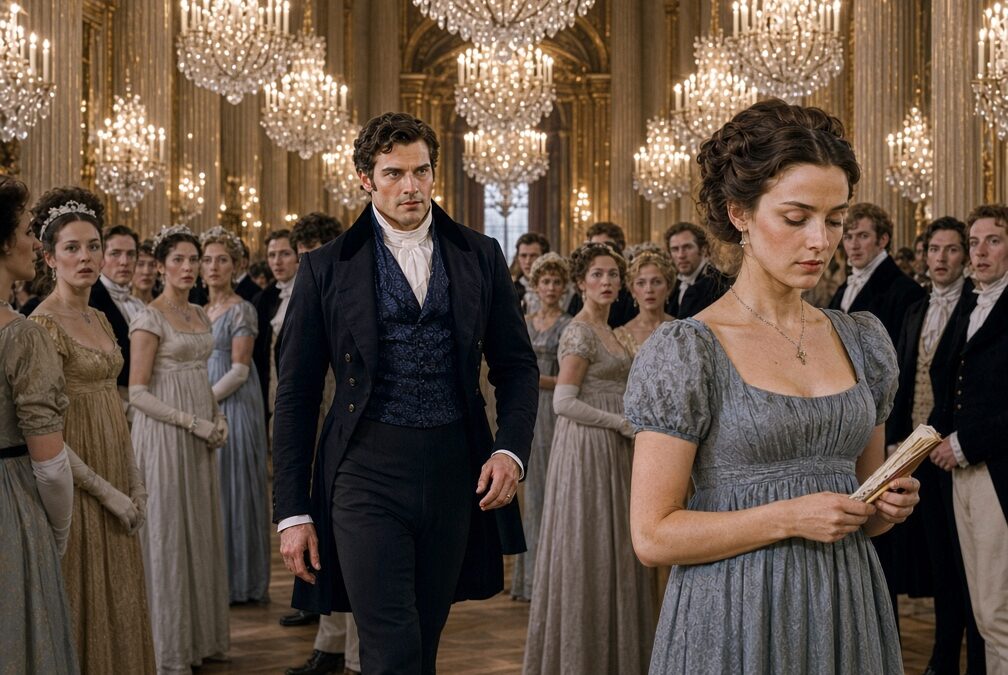
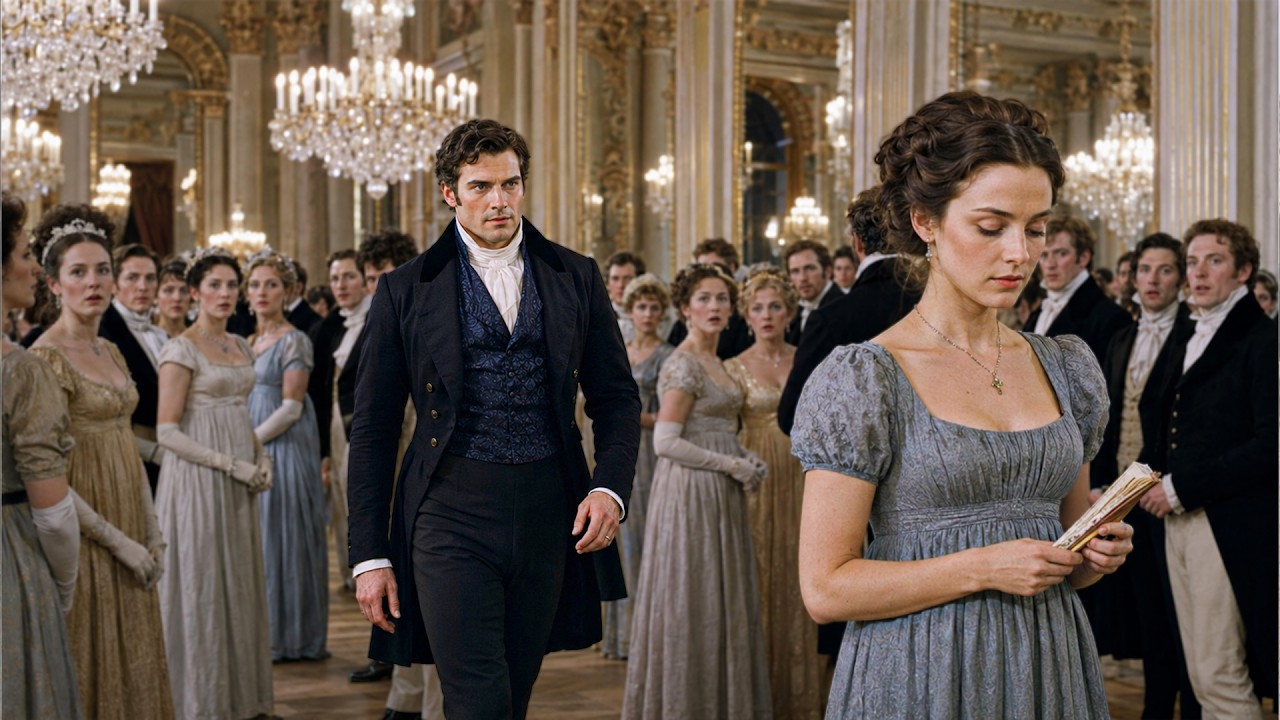
So when he set down his glass and deliberately crossed the full length of Lady Sutherton’s crowded drawing room, passing beauties, heiresses, and Lady Genevieve Castell herself, to stop in front of a penniless companion standing against the wall, the room noticed.
The room noticed very much indeed.
Fans stopped moving.
“Miss Witgrove,” he said.
Hesper was so unused to being addressed by an important person that for a moment she thought he must be speaking to someone behind her.
She glanced around and found only the wall.
Then, with a small jolt, she understood that the Duke of Kelvin was standing before her and had just spoken her name.
“Your Grace,” she said, curtsying.
She did not simper, flutter, or do any of the things the room expected her to do.
She simply waited, her gray eyes upon his, for him to tell her what he wanted, because in her experience important people who addressed her generally wanted something fetched.
“You are the only person in this room,” said the Duke, “who has not looked at me all evening.
“I confess I came to discover why.”
“I had no particular reason to look at you, Your Grace,” Hesper said with complete honesty.
“You are already very much looked at.
“I did not imagine you would notice the absence of one pair of eyes, and I was occupied with the Duchess’s fan.”
She had not meant to be witty.
She was simply answering his question because he had asked it, and answering honestly because she had long ago discovered that honesty prevented a great many complications.
But the Duke of Kelvin Ridge stared at her for a moment as though she had said something extraordinary.
Something moved at the corner of his hard mouth.
Not quite a smile.
Almost.
“No,” he said. “I suppose I would not have expected to notice.”
Then, after a pause, more quietly:
“It is a new sensation, Miss Witgrove, not to be looked at.
“I find I have missed it more than I realized.”
He bowed and walked away, and the evening closed over the moment like water.
But the room had seen.
At the far end of it, Lady Genevieve Castell, who had just watched the Duke of Kelvin cross a crowded room without stopping beside her in order to speak to an unknown woman in a mended gown, smiled a smile that did not reach her eyes.
And she began to think very carefully.
We are taking a very short break. If you do not want to miss the next stories, subscribe to the channel.
What happened next happened quickly, and it happened because Lady Genevieve Castell was not a woman who left important matters to chance.
She had decided some time ago that she would become the Duchess of Kelvin.
In truth, she had made the decision before the present Duke inherited.
When the title had appeared likely to pass to a cousin, she could have managed matters easily enough.
When instead it passed to the cold younger son, she simply transferred her intention to him as one might move a wager to a better horse.
She was beautiful.
She was well born.
She was accomplished.
And in all her life she had never encountered an obstacle that beauty, birth, and patience could not remove.
She did not intend to lose the Duke of Kelvin after an entire Season of coldness, and she certainly did not intend to lose him to a penniless companion he had crossed a room to speak to—an event she had witnessed and had not liked at all.
So Lady Genevieve did what women like her had always done.
She arranged matters.
At the great ball the Duke’s own grandmother gave a fortnight later to open Kelvin Ridge House in Berkeley Square, Lady Genevieve arranged to be discovered.
She let it be suggested, through a whisper here and an implication there, that she had an understanding with the Duke.
Then she arranged the appearance of such an understanding.
She would draw him aside on some pretext into the library, which she knew would be quiet.
She would ensure that certain people—chaperones and gossips of unimpeachable authority—discovered them there alone.
And the Duke of Kelvin Ridge, being a man of honor, would have no choice, once found in compromising privacy with a lady of quality, but to offer for her immediately.
It was cleverly planned.
The same trick had succeeded for subtler women than Lady Genevieve against colder men than the Duke.
It failed because Hesper Witgrove was in the library.
She had gone there to escape.
The Dowager, exhausted and triumphant, had retired early to her rooms and ordered Hesper to go and sit somewhere quietly for an hour.
Hesper, finding the glittering crowd at the ball equally exhausting, had slipped into the one room in the house no one seemed to visit: the library.
She had curled herself into a deep chair with a book in the dimness, perfectly content and entirely absorbed in her reading.
Thus, when the Duke of Kelvin entered the library some time later, lured there by a message whose nature he had already begun to suspect, he did not find the promised empty room.
He found a sleeping companion.
He stopped.
And in stopping, he changed the entire course of the evening.
“Miss Witgrove.”
She woke, mortified, scrambled to her feet, and began apologizing as the book slid from her lap.
“Your Grace, forgive me. I did not mean—Her Grace told me to sit somewhere quiet.
“I shall leave at once.”
“Do not go,” he said.
There was urgency beneath his usual coldness, something she had never heard before.
“Miss Witgrove, I am about to ask you to do something very strange. I have no time to explain fully, and no right to ask it of you.
“In a few moments, several people are going to enter this room. They have been brought here to find me alone with a lady so that I may be forced to marry her.
“It is a trap, and a crude one at that, and I have walked directly into it.
“But I have allowed myself to be caught, and there is only one way out that does not require me to marry a woman I do not want.
“I am ashamed even to suggest it because it treats you very badly.”
Hesper understood more quickly than he had expected.
She was a quick-minded woman who had lived close enough to the intrigues of powerful people to recognize one when it was described to her.
“You want them to find you with me instead,” she said.
“Then the trap catches no one, because there is nothing scandalous in a duke speaking with his grandmother’s companion, and whoever arranged the trap cannot spring it without revealing herself as its author.”
He stared at her.
“You are remarkably quick.”
“I have been obliged to be.”
She thought rapidly and coolly, as she did when managing the Dowager’s accounts.
“It will not help you, Your Grace.
“You are mistaken in thinking there would be no scandal.
“A duke found alone at night in a dark library with an unmarried, penniless woman is every bit as compromised as one found with a lady of high birth.
“More so, perhaps, because the world will always think the worst of the poorer woman.
“If they find us here, they will not say nothing happened.
“They will say that you and I are lovers.
“Or they will say that you must marry me.
“And in either case I am ruined, while you are trapped exactly as you feared—only for a much poorer bargain.
“I am sorry. Your escape uses me without even saving you.”
Voices sounded suddenly in the corridor outside.
Very close.
The Duke of Kelvin looked at her, then at the door, then at the impossible arithmetic of the next ten seconds.
And in that instant he made the decision that changed both their lives.
He did not make it through calculation.
He made it because of something he did not yet have a name for.
“Then we had better be engaged,” he said.
“It is the only version of the story that ruins neither of us.
“Will you allow me to announce it?
“I will release you as soon as the danger has passed.
“You have my word.”
The door opened.
There was no longer time for Hesper to answer with words.
So Hesper Witgrove answered him with the only things she had left: silence, stillness, and the decision not to contradict him, which is a form of language in itself.
She allowed him to take her hand.
She allowed him to turn with her toward the small gathering in the doorway.
The two gossips, with Lady Genevieve behind them, her face composed and her eyes frozen with fury, heard the Duke of Kelvin tell them in a perfectly calm voice that they must congratulate him.
Miss Witgrove had done him the honor of accepting his hand that evening, he said, and he had brought her into the library to propose to her privately, away from the crowd, as any man might do.
It was said with such smoothness and such finality that no one in the doorway dared question it.
One did not question the Duke of Kelvin.
The gossips congratulated him, avid and astonished, already composing the letters they intended to write.
Lady Genevieve Castell congratulated him too, in a voice like sugared ice, and looked at Hesper Witgrove over the Duke’s shoulder with an expression that promised, very calmly and very sincerely, that this was not over.
The Dowager Duchess of Kelvin learned of her grandson’s engagement at breakfast the next morning from the man himself.
He had come to tell her before the gossip could reach her and told her the entire truth, because he had never lied to her before and did not intend to begin.
She listened without interruption.
She sat motionless, a small, fierce old woman in an enormous bed.
She heard everything: the trap, the library, the sleeping companion, the impossible ten seconds, the lie he had invented to save them both.
And when he finished she said only:
“And you mean to release her when the Season ends, once the matter can be quietly smothered?”
“That is what I promised her.”
“I see.”
The Dowager studied her grandson for a long moment.
That cold, shuttered face had not been cold when he was a child.
Those sea-gray eyes had learned during one difficult year to reveal nothing.
“And how do you find the prospect, Everett, of being engaged to Hesper Witgrove for a Season?”
“I find it convenient,” said the Duke.
“It puts an end to the hunt.
“An engaged man is no longer pursued.
“I shall have peace for one Season, which is more than I have had in a year, and she will have my protection and a generous settlement when we part, which should prevent her from having to carry an old woman’s fan for the rest of her life.
“It is a fair bargain for both parties.
“No one is harmed.”
“So you say,” said the Dowager.
She let him go.
Then she lay for a very long time staring at the canopy above her bed and thinking.
For she had seen her grandson’s face when he spoke of this arrangement of convenience.
And she had heard what he had not said—what lived beneath the words.
She had lived eighty years and buried two sons, and she knew as surely as she knew anything that the Duke of Kelvin was already, though he did not know it himself, considerably more than conveniently engaged.
She said nothing.
It was not the sort of thing one could say.
It was the sort of thing one waited for.
But she smiled alone at the canopy, her first genuine smile since Marcus’s death, and resolved to do nothing at all to hasten the breaking of the engagement and a great deal, very discreetly, to prevent it.
For Hesper, the days that followed were the strangest of her life.
She had been invisible for five years.
Overnight she became the most observed woman in London.
She discovered that she did not enjoy it very much, but that she managed it rather well nevertheless.
The Dowager took matters firmly in hand.
There would be no half measures, she declared.
If Hesper was to be the Duke of Kelvin’s fiancée, fiction or otherwise, she would be dressed as one, and Society would simply have to endure it.
So there were dressmakers and gowns in colors Hesper had not worn since girlhood: deep greens and soft grays that were not the colors of a servant but the colors of a woman who had chosen them.
She was given a maid of her own.
And there came the slow, strange process of learning to enter a room as though she belonged there.
Hesper found that it felt less like learning than like remembering something long forgotten.
She had been born into that world before the ruin.
The body never entirely forgets.
She endured the scrutiny with a composure that surprised everyone who had wagered against her.
And there was a great deal of scrutiny.
Society could not make sense of her.
An unknown woman.
A companion.
And the cold Duke had crossed a room for her and proposed to her within a fortnight.
Society did what it always does when faced with something it cannot understand.
It watched.
It whispered.
It waited.
Half hoped she would fail.
The kinder half was secretly delighted.
For there is always some portion of every crowd that loves seeing the overlooked person raised suddenly into the light.
Hesper did not fail.
She was not fashionable and made no attempt to become so.
She was simply herself—plain-spoken, dignified, and nearly impossible to embarrass.
And it turned out that being oneself, when one was a woman of considerable worth, was far more compelling than being fashionable.
The kinder half of Society slowly began to rally around her.
The other half waited for Lady Genevieve to strike.
The whispers reached Hesper, as whispers always do.
During one morning call, she heard two ladies discussing her without troubling to lower their voices.
Apparently they subscribed to the theory that a companion was a species of furniture incapable of hearing.
They wondered aloud what the Duke could possibly see in her.
She was passable enough, they observed, in her quiet sort of way, if one happened to like that sort of thing, though nobody did anymore.
Dark-haired, quiet women were entirely out of fashion.
They speculated, with a delicacy that was itself an insult, about what tricks a penniless nobody must have used to ensnare what the most beautiful women in England had failed to secure.
One of them laughed and said it must surely be witchcraft, because she could think of nothing else that explained it.
The other laughed too.
Hesper sat three feet away with the Dowager’s shawl over her arm, her face perfectly composed, and did not give them the satisfaction of a blush.
She had survived worse.
That was what steadied her through all of it.
She had buried a father in disgrace.
She had been driven from the only home she had ever known.
At twenty-one she had climbed the servants’ steps of a stranger’s house to earn a servant’s wage.
And she had done it all with her head held high.
Beside that, the whispers of idle women were nothing.
Less than nothing.
They were a summer breeze.
Hesper had learned long ago the one lesson those women might never learn because they had never needed it:
The opinions of people who do not know you cannot touch what you truly are unless you give them permission.
And that permission is a choice.
The choice is always yours.
It is the one thing poverty, disgrace, and invisibility can never take away.
So she let them talk.
She carried the Dowager’s shawl.
And though neither woman could have explained how, Hesper remained entirely untouched.
That, more than any gown the Dowager put her into, slowly began to turn the tide.
And the Duke of Kelvin Ridge, who had entered the entire affair for reasons of pure convenience, discovered that the convenience was becoming something he had not anticipated.
They were often together because necessity required it.
An engaged couple had to be seen.
So they rode together in the park, attended the same dinners, danced together at balls, and stood beside one another through endless evenings.
Through all of it, they had to talk.
And conversation was his undoing, just as it had been on the first evening, because Hesper Witgrove spoke to him as no one else did.
She did not flatter him.
She did not fear him.
Above all, she expected nothing from him.
The one thing she might have wanted—the marriage—she knew to be a fiction.
And so she was free with him in a way no other woman in England could be.
Free to be honest.
Free to be sharp.
Free to tell him plainly when he was wrong, which happened sometimes, and to actually say so, which no one had dared do since Marcus died.
He began storing away things to tell her.
At dull dinners he caught himself watching the doorway for her arrival.
He discovered that the cold, weary disgust with which he had regarded the world began to fade in her company like mist lifting.
He could not always account for the lightness that replaced it.
At first, he did not try.
They rode in the park one gray afternoon, because an engaged couple must be seen, and the fashionable hour watched them guide their horses side by side down the long avenue under the eyes of Society.
For a while they said the things one says.
Then, once beyond the crowd, where the avenue thinned and the bare trees seemed to close around them, the Duke fell silent.
Hesper had come to understand his silences and allowed this one to remain.
After a while, he spoke.
Not of anything in particular at first.
Only of the park.
He told her how his brother had taught him to ride less than four hundred yards from where they were now, on a fat pony named Barnabas who bit everyone except Marcus.
He told her how, as boys, they had raced down the same avenue at dawn before fashionable London was awake to be scandalized by it.
“You loved him very much,” Hesper said.
“Everyone loved him.”
The words came out flat, worn thin by repetition.
“I am told that at every dinner table in London.
“What a loss to the world.
“What opportunities his death has opened.”
Silence followed.
“No one asks whether I loved him.
“They ask whether I intend to open the Scottish estate, whether I hunt, and what I think of marrying their daughters.
“They do not speak of Marcus because Marcus is gone and I am what remains, and something finished is of no further use.”
He glanced at her and then looked away.
“You asked on the first night, before you had any reason at all to care about me.
“You asked what he was like.
“No one else has asked me that in a year.”
“Then no one else was paying attention,” Hesper said.
“A man does not become a title on the day his brother dies.
“He becomes a title only in the eyes of people who never regarded him as a man in the first place.”
She kept her eyes upon the path ahead.
“For what it is worth, Your Grace, I did not ask out of kindness.
“I asked because I wanted to know.
“There is a difference.
“Kindness can be performed.
“Curiosity cannot.
“I was curious about the brother you never speak of, because his absence seemed to me like a great sorrowful silence in the middle of a man.
“I have a weakness for truth in people.
“It has cost me dearly in my life, and I have never learned how to cure myself of it.”
The Duke of Kelvin did not answer for a long time.
When he finally did, his voice was very quiet and not cold at all.
“Do not cure yourself of it,” he said.
“I forbid it.
“It is the first interesting thing anyone has said to me since I inherited.”
Hesper laughed before she could stop herself.
A genuine laugh, startled out of her.
The Duke turned toward her as though he had never heard that sound before.
In a sense, he had not.
Something in his hard face opened for just an instant.
Then a rider called to them from the avenue, fashionable Society closed around the moment again, and they returned talking of trivial things.
That night they sat silently in separate rooms of the same great house, each lost in thought.
One evening at the great house in Berkeley Square there was a family dinner: only the Dowager and the two of them, seated at the enormous table in the vast cold dining room where Dukes of Kelvin Ridge had dined in ceremony for two hundred years.
All three were stranded at one end of what seemed like an acre of mahogany.
The footmen stood like statues.
Conversation was stiff.
Hesper watched the Duke sitting rigid and unhappy at the end of the table where his brother ought to have sat.
At the changing of a course, she remarked quietly that it seemed a terrible waste to leave so much space between three people who could perfectly well get along around a smaller table.
If it were her house, she said, she would have the leaves removed, dine more comfortably, and give the mahogany a rest.
The Duke looked at her.
Then he looked at the vast table.
Something changed in his face.
“My mother used to say that,” he said quietly.
“She begged my father to shorten the table.
“He never would.
“He said a Kelvin Ridge dined in state or did not dine at all.”
He was silent for a moment.
“Marcus kept it long after him.
“I kept it long after Marcus.
“I do not know why.
“Habit, I suppose.
“The habit of doing things because they have always been done.”
He signaled to the butler.
“Take out the leaves tomorrow,” he said.
“We shall dine more comfortably.
“The Duchess is quite right.”
The Dowager, seated on his other side, said nothing.
She ate her fish and smiled to herself.
She had begged her son to shorten that table for forty years without success.
A twenty-six-year-old companion had accomplished it in a single sentence.
And the reason she had accomplished it in a single sentence was plainly visible on her grandson’s face to anyone with eyes to see.
The library became their territory.
It was where the whole strange business had begun, and during that curious Season it became the one place where they withdrew from observation.
The Duke possessed a vast library from floor to ceiling, two stories high with a gallery.
Hesper loved it passionately, as she loved all books.
He often found her there.
Then he began going there intentionally.
They spent long, quiet evenings there while the Dowager dozed near the fire: he over his correspondence, Hesper with a book, speaking little, and what little they said coming naturally and without effort.
It was in the library that Hesper stopped.
At some point she could never afterward identify, she stopped being afraid of him.
And it was in the library, one night, that he showed her something he had shown no one.
They had been speaking of his brother.
Hesper had asked him directly because no one else would, and because she had noticed that the Duke never spoke Marcus’s name and that the silence seemed to weigh upon him like a stone.
And the Duke of Kelvin, in the fire-softened quiet with books rising into darkness around them, told her about Marcus.
He told her that Marcus had been the best of men—warm where Everett was cold, easy where Everett was rigid, loved by everyone, born to the title and worthy of carrying it.
He told her that he, Everett, had spent his entire life comfortably in his brother’s shadow and had been glad of it, because that shadow had been freedom.
He had never wanted anything that belonged to Marcus.
Not the title.
Not the burden.
Not the great frozen house.
He told her how quickly it had happened.
A fever.
A weakness.
Not even enough time to send for anyone.
By the time Everett arrived, his brother could no longer speak.
He had sat beside the bed.
He had held a hand that no longer recognized him.
And he had watched the best man he knew die for no reason within seven days.
He admitted that he had not cried.
He had been unable to.
He had risen from the deathbed as the Duke of Kelvin Ridge, the weight of the title crushing down upon his shoulders, and he had never been able to put it aside long enough to mourn his brother.
Because in the instant Marcus died, the world stopped seeing Marcus, whom Everett had loved, and began seeing only the Duke, whom it desired.
And amid that universal hunger, there had been no room left for the simple grief of a younger brother.
“They did not even mourn him,” he said.
His voice shook, and he made no attempt to steady it—something he would have done for anyone else in the world.
“Within a month they were throwing their daughters at me over his grave, as though he had been nothing but a door that had suddenly opened.
“As though the only meaning of his death was that the title was available again.
“And I hated them for it.
“Every one of them.
“Every mother, every daughter, every arranged encounter.
“Because every one of them had come to profit from my brother’s death without even knowing his name.”
He looked at Hesper, his sea-gray eyes shining openly in the firelight.
“You have never asked me for anything since our first evening.
“You are the only person since Marcus died who has looked at me and seen the man rather than the title.
“I do not think you understand what that is worth.”
Hesper did not break the silence.
She had learned the hard way that grief does not ask to be answered.
It asks only to be witnessed.
So she gave him the only thing she had to give.
She sat beside him.
She did not look away.
She did not offer comfort he had not requested.
After a while, she quietly said the only thing that was both true and worth saying.
“He became real to me the moment you spoke about him.
“Marcus.
“Not the late Duke.
“Your brother.
“I never knew him, and I am sorry that I did not.
“And I am glad you told me about him, because a man ought to be allowed to speak his brother’s name in his own house.”
She paused.
“You will grieve him properly one day.
“Not yet, perhaps.
“But the grief has not disappeared merely because you have been unable to reach it.
“It is only waiting.
“It will wait until you are ready.
“And when you are ready, it will come.
“You must let it.
“It will not break you, even though you may believe it will.”
She hesitated.
“Everett.”
It was the first time she had used his name.
She had not intended to.
She heard it settle into the quiet room and did not take it back.
“I think you have been very brave and very lonely for a very long time.
“And I am glad, whatever happens to this strange arrangement of ours, that I was in the library that night.”
The Duke of Kelvin Ridge looked at her for a long time and could not speak.
The moment stretched.
Something passed between them in the firelit stillness.
Neither named it, because it could not yet be named.
But both knew it was there.
Very little escaped the notice of the Dowager Duchess of Kelvin.
She was old.
Her joints hurt.
She slept badly.
And she used the long hours of insomnia as she had always used time: by observing.
For weeks she had watched her grandson and her companion with the particular attention of a woman who had decided to interfere and was merely waiting to determine how.
She saw what neither of them saw because she stood outside it.
She saw Everett, who had returned from his brother’s deathbed like a man locked and bolted shut, being very slowly unlocked.
And the hand upon the key belonged to a penniless twenty-six-year-old woman who had no idea she held it.
She saw the way he watched the dining-room door until Hesper entered.
She saw that he had begun collecting things again—small, dry observations of the kind he had once stored up for Marcus—to produce at dinner and enjoy Hesper’s reaction.
Most of all, she saw that he had begun to laugh again.
Not often.
Not easily.
But finally.
He had not laughed in a year.
And he laughed only at things Hesper said, apparently without realizing it.
The Dowager watched Hesper too.
That was harder, because five years had taught Hesper to reveal nothing, and she continued to reveal nothing.
But the Dowager was eighty.
She had loved enough and lost enough to recognize the signs in another woman even beneath the strictest self-command.
She saw the peculiar stillness that overtook Hesper whenever the Duke entered a room.
The stillness of a woman containing herself by an act of tremendous effort.
She understood.
And her old heart ached for the younger woman because the Dowager knew, though Hesper had not yet admitted it to herself, exactly how this would end if no one intervened.
It would end with Hesper breaking her own heart in the name of honor.
The Dowager had seen it a hundred times.
Good women.
Poor women.
Women who had been trained not to want things.
Women arranging their own quiet destruction out of scrupulous concern for everyone’s dignity except their own.
“Not this one,” the Dowager said aloud in her darkened bedroom at three o’clock in the morning.
“Not if I have anything to say about it, which I generally do.”
And she remained awake for a while longer, plotting, happier than she had been in a year.
Lady Genevieve Castell did not accept defeat.
She was much too well bred to do anything so vulgar as display it.
But she had not surrendered the field for a moment.
She chose her own methods—quiet, patient methods—and aimed with great precision at the only target she believed vulnerable.
Not the Duke.
She could not reach him.
Hesper, however, she could.
Her opportunity came at a ball, in a boudoir where she found Hesper alone and arranged for her to remain so.
For five minutes, Lady Genevieve was grace itself.
She admired Hesper’s gown.
She remarked upon how admirably Hesper endured all of this—the sudden elevation, the staring eyes—when it must be so trying for a woman unused to attracting attention.
She added that she understood perfectly what the Duke found so appealing about Hesper.
Novelty.
A plain, sensible creature after so many sophisticated ones.
Like ordinary bread after too many sweets.
Men eventually tired of sweets.
Then, still smiling, she delivered what she had come to say, gently, as though from kindness.
“I only hope,” said Lady Genevieve, “that you are not becoming too attached.
“It would be natural, of course.
“Any woman would.
“But you are sensible, and you must have seen, as I have, that the Duke is a man who wanted above all else to be left alone this Season.
“An engagement is a wonderfully effective way of being left alone.
“It ends pursuit.
“It gives a man peace.
“I am certain it has given him a great deal of peace.”
She let the words hang between them for a moment.
“Novelty fades, Miss Witgrove.
“Peace, once a man has it, becomes something he takes for granted.
“Then he begins looking around again.
“I tell you this only because no one else will trouble to do so, and because I should hate to see a sensible woman mistake convenience for devotion.
“Forgive me.
“I speak as a friend.”
She pressed Hesper’s hand, gave her the smile that never reached her eyes, and left.
The poison remained exactly where she had intended to place it.
It was cruel.
And it was clever.
Its cleverness lay in the fact that every word Lady Genevieve had spoken was something Hesper had already told herself in darkness.
That was why it struck so deeply.
Lady Genevieve had told her nothing she did not already know.
She had merely said it aloud in daylight, in the voice of a stranger.
There is a particular terror in hearing one’s most secret fears repeated by an enemy, because the repetition makes them sound no longer like fears, but facts.
Hesper went home that night and lay awake for hours, telling herself Lady Genevieve was jealous and dishonest, knowing at the same time that what she had said was true, and being unable to forget a word of it.
The liar had aimed at the truth and hidden herself inside it.
Not long after that night, Hesper Witgrove understood that she was in danger.
She named that danger to herself plainly and alone, as she had always named difficult things, without pretending it was something else.
She was beginning to love him.
It was the most foolish thing she had ever done.
She had done many foolish things in her life, but none so senseless as this.
She was a penniless companion.
He was the Duke of Kelvin.
Their engagement was a fiction they had both agreed would end.
If she allowed herself to forget that, if she allowed the fiction to become hope in the secrecy of her heart, she would be no better than the hundred women he despised.
Those women wanted his title.
Hesper wanted something worse.
She wanted the man.
And the man was not hers.
He had made a bargain with her.
He had promised to set her free.
And a woman of honor did not take an agreement made in a moment of crisis and quietly turn it into the very trap it had been meant to prevent.
So Hesper did what cost her more than anything she had done since her father died.
She decided to release him.
She did not tell him immediately.
She waited for the right moment, which meant she waited until she could find the courage.
And while she waited, the Season moved toward its grand conclusion: the Duke’s midsummer ball.
It was the ball that would finally open Kelvin Ridge House to all of Society and, everyone assumed, formally celebrate the engagement.
As the ball approached, two things happened.
The first was that the Duke of Kelvin, who had spent the Season slowly and unwillingly falling in love with his fictitious fiancée, resolved to make the fiction real.
He did not know how to tell her.
For ten years he had lost the habit of wanting anything he might actually be allowed to have.
The desire frightened him.
For days he circled it like a man circling a fire.
At last he decided he would tell her at the ball.
He would ask her honestly to become his wife.
Truly.
Not as fiction.
And he would do it properly and publicly, if that was what she wished, so the entire world would know he had chosen her.
The second thing that happened was that Lady Genevieve Castell discovered the engagement was a lie.
She discovered it because she was intelligent and patient.
She watched.
And eventually she persuaded a servant in the Berkeley Square household to talk.
Weeks earlier, the servant had overheard a conversation in the library between the Duke and Miss Witgrove in which the words fiction, release, and end of the Season had been clearly spoken.
That was enough.
Lady Genevieve did not require evidence admissible in a court of law.
She needed only enough truth to build a story.
And she had it.
She chose her moment with the care of a woman who had waited an entire Season for revenge.
That moment would be the Duke’s ball.
Hesper found an opportunity to speak to the Duke on the afternoon before it.
She had intended to release him gently and privately before the ball.
She owed him that much, she thought, before the whole world assembled to celebrate something that was not real.
She found him in the library with her speech prepared.
She had scarcely reached her fourth sentence before everything went wrong.
“Your Grace,” she began.
She had deliberately returned to the formal address to put the necessary distance between them.
“The Season is nearly over.
“You have had your peace, and I am glad of it, but I think it is time to end our arrangement as we agreed, before the ball makes matters more difficult.
“I do not want you to feel bound by a promise made in the middle of a crisis.
“I release you from it.
“Whatever people say afterward, whatever gossip follows, I will endure it.
“I have endured worse.
“I would rather endure it than hold you to this ordeal for one moment longer than honor requires.
“You have been more than fair to me.
“I merely wish to be fair to you in return.”
She had rehearsed it a hundred times.
She delivered it steadily.
It was, she thought, reasonably well phrased.
Dignified.
Clear.
Revealing nothing.
When she finished and looked up, expecting relief in his face, she found instead something for which she was entirely unprepared.
He looked as though she had struck him.
“You wish to end it,” he said.
“I wish to release you,” Hesper replied.
“There is a difference.
“This was not a choice you made.
“You reached for the nearest hand in a burning room.
“I have been glad to be that hand, but a man should not be forced to marry the hand he happened to seize.
“And I will not allow this arrangement to become the very trap you were trying to escape.
“That is all.
“It is the only honorable thing to do, and we both know it.”
The Duke of Kelvin Ridge, who had spent three days composing the words with which he intended to ask her to stay, discovered that every one of them had abandoned him.
The woman he loved stood in his library releasing him from the only happy thing that had happened to him in two years.
She was doing it out of honor.
Out of scrupulous concern for his freedom.
Out of the pure, selfless decency that was the very reason he loved her.
And in the wreckage of his carefully prepared speech, he could not find a single word with which to tell her.
So he said the wrong thing.
He spoke stiffly.
Coldly.
Coldness was the armor he put on when he was wounded beyond endurance.
He told her that if this was her wish, he would not oppose it.
They would discuss the details after the ball.
Then he turned toward the window.
And the moment broke.
Hesper, who had come to release him and ended by feeling dismissed, gathered the fragments of her dignity and left the library.
Neither of them had spoken the one true thing that would have repaired everything.
Both were too proud.
Too frightened.
Too certain that they were not wanted to risk saying it.
The ball that night was the most brilliant of the Season.
All London came to the great house in Berkeley Square, finally opened and blazing with light.
Hesper moved through it upon the Duke’s cold, correct arm, offering the smiles expected of her and feeling as though she were made of glass.
They did not speak about what had happened in the library.
They did not, in truth, speak much at all.
Lady Genevieve Castell watched them from across the ballroom.
She noticed the stiffness between them.
She understood that whatever held the Duke and his companion together was already cracking of its own accord.
And she decided to deliver the final blow herself, in front of everyone, and reclaim what she still considered hers.
She acted at the height of the ball, in the great gallery, before the largest audience possible, speaking with the pleasant confidence of a woman who had weighed every word.
She began by cheerfully wishing the Duke and Miss Witgrove every happiness.
Then she laughed lightly and remarked what a beautiful romance it was.
Was it not?
So sudden.
So touching.
The Duke choosing someone so far beneath his station.
And she sincerely hoped dear Miss Witgrove had not been distressed by that absurd rumor circulating through Society—that wicked little story claiming their engagement was merely an arrangement, a fiction invented in a difficult moment and intended to be quietly broken once the Season ended.
Lady Genevieve added that she was quite certain it could not possibly be true.
She spoke in the voice of a woman who was entirely certain that it was.
She addressed the company while watching Hesper’s face with the bright, hungry eyes of a cat watching a mouse hole.
The gallery became utterly silent.
This was much better than anyone had expected.
The kinder half of Society held its breath for the abandoned girl.
The other half leaned forward.
Hesper Witgrove, standing beneath the lights and beneath a hundred watching eyes, felt the whole fragile structure of the Season collapse around her.
With strange calm, she understood that it was over.
The truth had been exposed.
It could not be smothered now.
In another instant she would have to say something.
Whatever she said, the world would know Lady Genevieve had struck home.
Hesper would not lie.
She had never been good at lying.
She opened her mouth to say the only thing left to a woman of honor: a calm, dignified confession that would publicly free the Duke and permanently ruin herself.
She barely had time to draw breath.
She never spoke.
Because the Duke of Kelvin crossed the room.
He crossed it as he had crossed Lady Sutherton’s drawing room three months earlier—deliberately traversing the full length of the great gallery, past beauties, gossips, and Lady Genevieve Castell herself.
This time all London watched him do it.
And this time he did not stop at a polite distance.
He came to Hesper’s side and took her hand.
Her bare, ungloved hand.
Before everyone.
He turned with her to face the room.
Then he broke the heavy silence in a voice of such absolute ducal coldness that no soul in that gallery would ever dare question him again.
“Lady Genevieve is misinformed.
“She tells us there is a story circulating.
“I am grateful for the opportunity to correct it before you all, since you have been kind enough to concern yourselves with my affairs.
“The story claims my engagement to Miss Witgrove is a fiction.
“That it was devised for convenience and intended to end.”
He paused.
One second.
Two.
Three.
He allowed the silence to settle.
“That is not true.
“It was once true.
“I will not lie to you, even to protect myself.
“Miss Witgrove would not wish it, and I have learned to care very much what she wishes.
“When I asked her to permit me to announce our engagement some months ago, it was indeed to escape a difficulty.
“And we did indeed agree that it would end quietly at the conclusion of the Season.”
The gallery seemed to stop breathing.
Lady Genevieve’s smile began, very slightly, to freeze.
“But that was months ago,” said the Duke of Kelvin.
“And I was a colder and more foolish man months ago.
“I did not yet understand what had been given to me.
“I understand now.
“Miss Witgrove came to me this very afternoon and released me from our engagement.
“She did it out of honor, because she believed I did not truly want it, and she refused to hold me to a promise made in a moment of crisis.
“She released me.
“That is the kind of woman she is.
“And I stand here before all of you to tell her, since I was too great a fool to tell her this afternoon, that I do not want to be released.
“I want to be bound by that promise.
“I have never wanted anything more in my life.”
He turned away from the room and toward her.
The coldness had vanished entirely from his face.
Gone as though it had never existed.
There was nothing ducal left in him now.
Only naked, terrified hope.
And he said, softly but not so softly that the room could not hear, because he wanted the room to hear.
He wanted the whole world to hear.
“You once told me I was the only man in the room someone had crossed it to reach.
“It was the other way around, Miss Witgrove.
“You are the only person in the world I have ever wanted to cross a room for.
“And I have now done it twice before half of London, which I hope will persuade you of my sincerity, because I am told I am not always good at saying what I mean.
“I have refused a hundred women who wanted my title.
“I am asking the one woman who never wanted anything from me.
“Not the arrangement.
“Not the fiction.
“Will you have me, Hesper?
“Truly.
“For good.
“Of your own choice—which is the only thing in this entire affair that has ever mattered to me, because I do not want a wife trapped with me any more than I ever wanted to be trapped myself.
“Choose me or refuse me.
“But do it freely.
“And do it now.
“Put an end to my misery, because I cannot endure another moment of uncertainty.”
Hesper Witgrove had come to the ball feeling made of glass.
A moment earlier she had stood upon the edge of ruin.
Now she looked at the Duke of Kelvin Ridge.
Everett.
The man, not the title.
Naked hope shone in his sea-gray eyes.
And she understood that, before everyone, she was being offered the one thing she had spent five invisible years teaching herself never to desire.
It was real.
It was hers.
All she had to do was reach out and take it.
She did not simper.
She did not cry.
She did what she had always done.
She told the bare truth, directly and without ornament.
And she did not give the answer to the room.
She gave it to him, in a clear, steady voice that nevertheless carried to the farthest end of the gallery.
She had decided that if she was going to say it, she would say it in such a way that no one could ever claim she had not been chosen.
Chosen freely.
Chosen first.
“I released you this afternoon,” she said, “because I loved you and because I would not trap the man I loved.
“That is the whole truth of it.
“And I did not tell you because a woman in my position does not say such things to a duke.
“I will say it now, because you have been foolish enough to make it possible.
“I have loved you since the night you trusted me with your brother’s name in the library of this house.
“Not the Duke.
“You.
“Everett.
“I wanted nothing from you.
“That is true.
“And it remains true.
“I want nothing from you.
“Not the title.
“Not the great house.
“Not the income.
“I would take you without any of it.
“I want only you.
“So yes.
“Freely.
“And forever.
“By my own choice.
“Before all London.
“And upon my dignity, and everything I ever believed a woman like me was permitted to hope for—
“Yes.
“I accept you.”
There was a silence of exactly three seconds.
Then the great gallery of Kelvin Ridge House erupted.
Because even the cruelest part of Society cannot, in the end, entirely resist the sight of an overlooked woman being raised so magnificently into the light.
The kinder half was already in tears.
And somewhere in the front row, the Dowager Duchess of Kelvin Ridge could be heard informing no one in particular, in a voice of immense satisfaction, that she had known it since the concert and had merely been waiting for the pair of them to catch up with her.
Before the entire world, the Duke of Kelvin lifted his companion’s bare, simple hand to his lips.
And he did not let it go.
Lady Genevieve Castell left London within the week.
There was nothing left for her there.
She had wagered an entire Season, and a considerable portion of her pride, upon becoming Duchess of Kelvin Ridge.
She had lost.
Worse, she had lost publicly to a penniless companion.
Society, which had once feared her a little, ceased to fear her at all.
And a beauty whom no one fears is a beauty living through her final moments of power.
The following year, she married a baronet of comfortable means and no particular distinction and lived an unremarkable life in a county far from London.
By all accounts she was neither happy nor unhappy.
Merely diminished.
And if there was cruelty in her defeat, there was sadness too.
She had never learned to want anything except victory.
She had built her whole self around winning.
And once victory was gone, she did not know what remained of her underneath.
Hesper, who might have triumphed over her, found herself incapable of doing so.
Sometimes she thought of Lady Genevieve with something that was not quite pity but came close to it.
And she was grateful that her own worth had never been forced to depend upon anything so fragile as being chosen first.
The Duke of Kelvin Ridge married his former companion in the autumn.
The wedding took place quietly at his country estate, with the Dowager in the front row looking as though she had arranged the entire affair—which, in every important respect, she had.
Hesper wore a gown the color of the hills in autumn.
She had chosen it herself.
And no one failed to notice her at her own wedding.
As she walked up the aisle toward the man waiting for her at the end of it, she discovered that the gaze of other people—the thing she had feared and longed for in equal measure for so many years—was the easiest thing in the world to bear when at last it came from the right person.
The great table at Berkeley Square was never lengthened again.
They dined comfortably at one end of it, the two of them close enough to talk.
In time, they became more than two.
And the house, cold for a generation, grew warm.
The library, where the entire strange affair had begun, remained the heart of it.
It was where they withdrew in the evenings to be quiet together while the fire burned low.
The grief came eventually, exactly as Hesper had told him it would.
It came one winter night, more than a year after their marriage.
Vast.
Unexpected.
The entire weight of mourning for Marcus that Everett had never been able to reach.
It came at the worst possible moment.
For a while he believed it would break him.
It did not.
Because she was there, as she had promised she would be.
She did not try to cure him.
She did not hurry him.
She did not fill his silences.
She simply remained so that he would not be alone, holding his hand in the darkness.
By morning, the grief had accomplished its long-delayed work.
At last he could speak his brother’s name without the terrible weight upon his heart.
The loss remained.
It always would.
But he was a man who had finally mourned, which is a very different thing from being a man who has forgotten.
Society, which forgets nothing and forgives anything so long as it is entertaining, eventually declared that it had always known the Duke of Kelvin would make a brilliant choice.
It turned their meeting into a great romance and got most of the details wrong.
In the end, that hardly mattered.
Only two people knew the truth.
And one old woman had guessed it.
They knew that everything had begun with a lie in a room on fire and had become the one sacred truth in both their lives.
They knew that the world had looked straight through them without ever really seeing them.
He had been the younger son no one cared about.
She had been the companion no one noticed.
And they knew they had found one another precisely in that state of erasure.
Two invisible people who, once finally seen, proved to be more real than anyone around them.
On winter evenings in the warm library, the Duke of Kelvin would sometimes look up from his letters and watch his wife sitting by the fire—the woman he had crossed a crowded room to reach on the night she had not even bothered to look at him.
And he would think that of the hundred women who had wanted the Duke, the only one worth having was the one who had wanted only the man.
She had told him so plainly before the whole world.
And from that first cool, gray, indifferent glance to the last, she was the only person who had ever truly seen him.








