The Duke Married Her for an Heir, Never for Love — Until She Collapsed at the Ball.
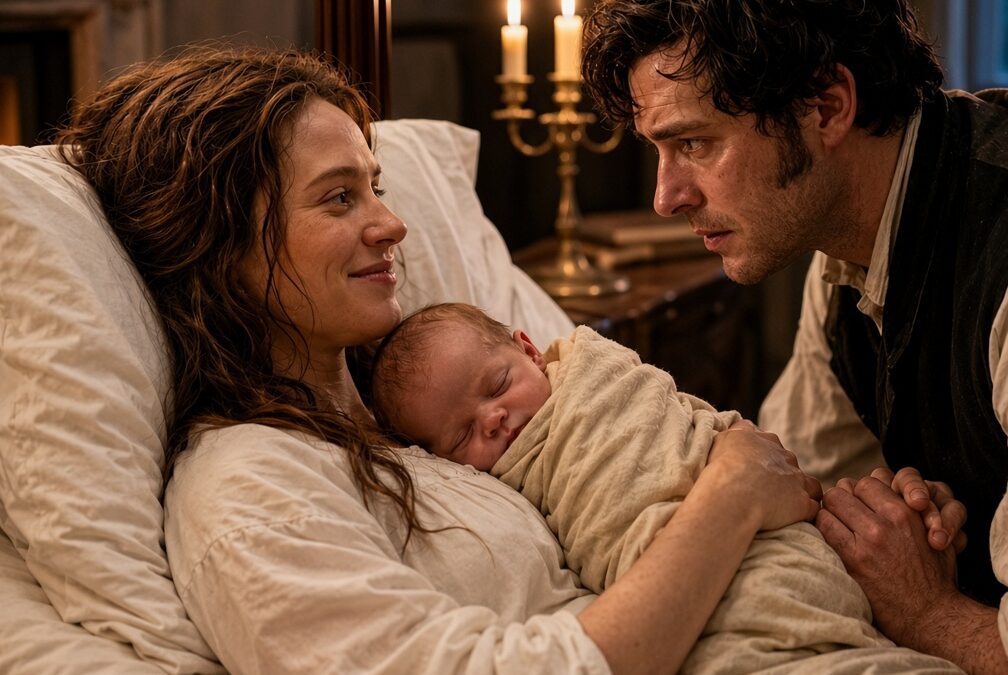
The Duke Married Her for an Heir, Never for Love — Until She Collapsed at the Ball.

They will tell you this is a story about a duke. It is not. The Duke of Coldir married Ellsworth for an heir, and he never once pretended otherwise.
He said it plainly in a cold room in November, with her father’s debts stacked on the table between them like a wall.
And she thanked him for his honesty, because she had been offered a great deal worse by men who lied better.
6 months later, in the cold heat of Lady Haridan’s ballroom, with half of London watching to see whether the bargain had paid, Marianne set her glass down on a passing tray and found that her hand would not let go of it.
The glass turned. The room tipped with it. Somewhere behind her, a woman was saying not quietly because the whole purpose of the remark was that it should be heard that 6 months was a very long time for a house as old as Calderir to be kept waiting on a nursery.
That his grace had been too clever by half, choosing a bankrupts daughter over a healthy one.
That one did wonder what exactly he had bought. Marianne heard every word. She had spent her whole life hearing every word.
Across the room, the Duke of Calderir stopped in the middle of a sentence. Afterwards, half that ballroom would swear to what happened next, and no two of them told it the same way, but they agreed on this much.
The coldest man in England crossed 40 ft of crowded floor in the time it took a wine glass to fall.
He caught his wife before she reached the ground, and the glass broke on the boards exactly where she would have been.
The physician was fetched. The room did not disperse. It arranged itself the way rooms do when they smell a story coming.
He knelt. He was quick. And when he rose, his face wore the careful blankness of a man about to hand a duke a gift.
Your grace, the duchess is with child. There was a sound in that ballroom like a held breath let go.
Somebody laughed with relief. Somebody said, “Congratulations before anyone had asked them to.” And the Duke of Coldir, who had married for this, who had built an entire marriage around this, who had put it in writing and signed his name beneath it, did not ask whether the child was safe.
He said, “Will she live?” Nobody in that room understood the question. 300 people heard it, and every one of them heard something different in it.
And by morning, it was in every drawing room between Groner Square and the river.
Not one of them guessed the truth. His cousin, Lord Ambrose Blackwood, did not stay to hear the answer.
He was already at the doors. To understand that question, the wrong question, the one nobody in that ballroom could decode, you have to go back 6 months to a cold room in November.
To a man who [clears throat] offered a ruined woman everything in the world except love, and to a woman clever enough to negotiate.
So, settle in and get comfortable. Tell me where you’re listening from tonight and how the weather is where you are.
I do like to know who’s out there in the dark with me. And stay to the end because the answer to the question the Duke asked in that ballroom is the reason he gave up Calderir.
The Ellsworths of Pharaoh house had been respectable for 200 years, which is a polite way of saying that nobody had ever managed to make them rich.
By the November Maranne turned 28, they were not respectable either. Her father had spent four years signing things he had not read in rooms where men were kind to him.
And that winter the kindness came due. It was Marianne who found out. It was Marannne who had been finding out since she was 19 when the housekeeper came to her to her, not to her father to ask what was to be done about the butcher.
She sat down that night with the ledgers and did not in 9 years entirely get up again.
She was good at it. That was the trouble. She knew what the coal cost and what the coal ought to cost.
She knew which tenants would pay late, which would not pay at all, and which would send a boy round with an apology and half the sum, and she knew to take the half.
She had let the parlor fire go unlit for three winters, so that Anora could have a second gown, and she never once mentioned it, because mentioning it would have made it a debt, and Marannne did not like to be owed.
“What would we do without you?” Her father said. Most days with real warmth. He meant it kindly.
She had learned somewhere along the way to hear it as a description of her position.
Not we love you, not stay. Simply what would we do without you, which is another way of saying we could not, which is another way of saying you are necessary, which is not the same thing at all, though it can keep a person warm for years if she does not look at it too closely.
Marannne had made a great study of not looking at it too closely. The Duke of Coldir came to Pharaoh house on the 14th of November in the rain without warning.
She knew who he was the way everybody knew who he was. A name in the papers, a fortune in the north, a man who had buried a father and taken up an estate the size of a small county and had not in 9 years once been seen to enjoy any of it.
Cold, they said. Nobody ever said cruel, cold, and exact and impossible to sit beside at dinner.
Her father received him in the good room where the damp did not show and talked for 11 minutes about the weather because he was frightened.
The Duke let him. Then he turned his head and said, “Miss Ellsworth, would you sit down?
This concerns you, and I would rather say it to you than about you.”
She remembered that afterwards, not the proposal, that she sat. She was wearing gloves that had been mended twice at the seam, which is a thing you cannot hide when your hands are in your lap and there is a lamp on the table.
She did not put them out of sight. She had decided long ago that she would not spend her life arranging herself to be less visible.
He laid it out the way a man lays out a map. Calddemir required an heir.
His title, his lands, and the livingings of some 400 people were entailed on a line that presently ran out in him.
He had no wish to marry for affection and no intention of pretending to. He was 35 years old, and he had run out of reasons to put it off.
He would settle her father’s debts entirely. He would give her the position of Duchess of Coldir, the authority of its household, and his public respect without qualification.
He would never bring another woman into her home. He would never lie to her.
He required one thing. You are proposing a transaction. Maranne said, “I am. Then you’ll forgive me if I treat it as one.”
Something moved behind his face and was gone before she could name it. She did not accept.
She negotiated in a voice so level that her father put his glass down to stare at her.
The debts were not enough. She said if they were paid tomorrow, her father would be in the same room with the same men by Lady Day because that was who he was and neither of them was going to change it at 61.
She wanted Pharaoh house settled on her sister Anora outright in Anora’s name. She wanted her father provided for by an annuity, a fixed sum, paid quarterly that could not be sold, assigned, pledged, or borrowed against by him or by anyone acting for him.
She wanted that clause in plain words, and she wanted the lawyer to read it aloud in front of him.
You have thought about this, the Duke said. I have thought about very little else for 4 years.
She wanted a season for Anora, not a grand one, a proper one with a chaperone of Marannne’s choosing because Marannne had opinions about chaperones, and she wanted it guaranteed whether or not the marriage produced anything at all.
Whether or not, she repeated, there is a child. Agreed, said the Duke. All of it.
You might have argued. You were right about the annuity. I dislike arguing with people who are right.
It wastes the evening. He drew his gloves through his hand. And for yourself, I beg your pardon?
You have secured your father, your sister, and a house. You have not asked me for one thing for yourself.
Marianne looked at him with complete composure and gave the answer that would take her 6 months and a great deal of pain to understand.
I’ll be a duchess. That’s a great deal more than I had this morning. He let it go.
He should not have let it go. He thought about that afterwards more often than he thought about almost anything else.
They agreed on the settlement and a date and the number of people who would be told.
And then because she had one question left and no intention of carrying it into a marriage unasked, Marianne said, “And what else do you require from a wife?”
He might have said, “Your company, your patience, your good opinion, your presence at my table for the next 40 years.”
The Duke of Calddemir said nothing. The rain went on against the window. “Thank you,” said Marianne, “for your honesty, and she meant it, and she rose, and she went out into the passage and stood there a while in the cold, with her hand flat against the wall.”
He did not despise her. That was the thing she turned over that night, and could not put down.
He had been courteous and exact, and better than fair. He simply did not want anything from her that she could not do.
She had been useful all her life. She had just at last been paid for it.
They were married in December quietly and went north. Calderir sat in the county of Amberly, 4 days travel and a world away in a fold of hills where the light came late and left early and the wind had opinions.
Marianne saw it first at dusk from the top of the long drive. A great gray house with 60 windows and 11 of them lit.
11, she counted because counting was how she thought. It is larger than it needs to be, the Duke said beside her.
It was the first thing he had volunteered in 2 days. Most things are, said Marianne.
Inside the house was warm where people used it, and cold everywhere else, which is the particular chill of a great house lived in by one man.
There were two dining rooms. She was shown both. The small one where his grace took his meals and the long one which had not been opened since the old duke’s time in which 140 candles waited in the dark for somebody to have a reason.
Mrs. Peele, the housekeeper, was 60 in kind and had the keys of the place on a ring at her waist.
She had been at Coldir since before Marannne was born. She showed her the west wing, the gallery, the linen rooms, the still room, the room where the estate books were kept, and she was warm about all of it.
And when they came to the end of the east corridor, where a door stood at the finish of it with the brass gone dull, Mrs.
Peele walked past without slowing and said, “And that’s the old part, your grace.
We don’t go along there in exactly the voice one uses for a thing that has been said so often.
It has stopped being a sentence. Maryanne looked back once as they went. There was no dust on the floor outside that door.
Somebody swept it. Lord Ambrose Blackwood came to dine on her third night, and Marianne liked him at once, which she would think about a great deal later.
He was 37 and easy and funny, and he had the trick of making a stranger feel long established.
He knew the name of every tenant on the estate and something true about most of them.
He apologized for the north, then defended it, then apologized again. He told her Coldir had eaten three housekeepers and a French chef, and that if she got through her first winter, she could get through anything.
He had, he said cheerfully, spent his whole life expecting to inherit the place, and was frankly relieved to be let off.
Later, when the port came round and Marannne had gone to the far end of the room to look at the pictures, she heard him say to his cousin in the warm voice of a man being kind, “You’ve chosen well, Nathaniel.
Truly, a sensible woman is a great deal safer than one a man might actually love.”
She did not hear a reply. She heard, instead the small sound of a glass being set down before it had been drunk from.
Their marriage was consumated because it had been agreed to and it was done with courtesy and afterwards he did not stay.
He was not unkind. That would have been simpler. He was gentle in the way a man is gentle with something that belongs to someone else.
And when it was over, he stood at the window with his back to the room for a while and then said good night in a voice like a door closing and went.
Marannne lay in the dark of an unfamiliar house and understood that she had married a man who was going to be perfectly good to her forever and that this was going to be much harder than cruelty.
Their days took a shape within a fortnight. They breakfasted separately. He rode out at 8.
She had the household from 9:00. They dined at 7 in the small dining room at a table that seated 14 from opposite ends of it so that a civil remark had to be made twice.
once at conversational volume and then again louder for the room. After the third night, they stopped making civil remarks.
He never touched her in passing. Not once. A husband of 6 weeks will put a hand on his wife’s back going through a door or take her elbow on a stair without either of them noticing.
He did not. He held doors and stood back. There was always 18 in of air.
He wore gloves indoors more often than he needed to. And still, this was the thing she could not fit anywhere.
He was not absent. He answered every question she put to him fully and at once.
He never made her ask twice. When she was wrong, he told her she was wrong, which she found she preferred to being managed.
He was, in every measurable respect, an excellent husband. He simply lived behind 18 in of air, and she could not find the door.
It was in the third week that she stopped believing in his coldness. Mrs. Peele came in at breakfast with a small piece of good news that Sarah Bllye down at Low Fold had had her baby in the night, a boy, and both of them well, and she was pleased and said so.
In the way of a woman who had known the family 30 years. Send the usual, said the Duke, and turned a page.
That was all. It was the correct response given in the correct tone, and Mrs.
Peele went out satisfied, and Marianne sat with her tea going cold in her hand and watched her husband not read a newspaper for 1 minute and 50 seconds.
His hand had stopped on the page, he did not turn it again. And when at last he did, he turned two at once and did not notice.
Marianne put down her cup very quietly. That is not a man who feels nothing, she thought.
That is a man holding something shut with both hands. It should have been a comfort and in a way it was.
She stopped being angry with him from that morning and never really started again. Whatever had been done to the Duke of Coldir had been done long before she arrived.
And she was not going to punish a man for a wound she could not see.
But she was cleareyed and she took the second half of the thought with her too because Marannne Ellsworth had never allowed herself the comfort of half a thought.
It has nothing to do with me. Whatever was behind that door and whatever was behind the man, she was not the key to it.
She was the arrangement. She was the sensible choice. She was the clause in the settlement that came after the annuity.
She had a house to run and she was very good at running houses and she got up and went to run it.
In January, the Duke of Calderir gave instructions that Gideon Ellsworth’s debts be settled in full and handed the business to the person who handled such business for him because that person was family and had never in 9 years given him the slightest cause to look twice.
Lord Ambrose Blackwood paid the creditors, every one of them, promptly, exactly as instructed. He simply did not have the paper cancelled.
He had it assigned instead to a Mr. Sedgley of Chancery Lane, who existed in the sense that a name on a brass plate exists, and who acted entirely on the instructions of Lord Ambrose Blackwood.
So the debts were paid, and the debts were also quietly still owed. You should understand what he had bought because Marianne will not understand it for another 9 months.
And the whole of the middle of this story is her walking about a house not knowing he had not bought money.
He had a great deal of money. He had bought the roof over her father’s head and her sister’s season and the annuity and the settlement and every single thing Marianne Ellsworth had sold herself in November to protect.
He had bought the string. He put it in a drawer in his own house 4 miles away and he did not pull it.
He had been 8 years old when his uncle first told him he would very likely have Calderir one day, and the sentence had gone into him and set like plaster.
He had been shown the rent rolls at 14. He had been walked around the boundary at 20 and told which walls were his responsibility.
Nobody had ever put a word of it in writing. It had never occurred to anyone that it needed writing down.
And then his cousin, at 35, with no warning and no discussion, had gone south in November and come back married.
Lord Ambrose Blackwood shut the drawer and went to dinner at his cousin’s house and was extremely good company.
Coldir had been managed for 9 years by a man who could do arithmetic and could not do anything else.
Marianne found it out slowly, the way you find out a house, by the drafts.
The tenants were attended to on paper and not in person. The roofs at low fold had been surveyed twice and mended never.
There was a school room in the village with a good stove and no coal in it because the coal had been allocated in a column nobody had followed to the end.
41 people on that estate were owed something small, a repair, a decision, a yes or a no, and had been waiting between 4 months and 6 years.
Every one of them had stopped asking because the answer had been his. Grace is not to be troubled for so long that it had hardened into weather.
She started with the names. By February she knew all of them, not the heads of households.
All of them, the children too, and which of the Hollis boys was which, and that old Mrs.
Tunnacliffe at the top cottage was deaf on the left and would nod at anything said into her right ear, so you had to go round.
She got the coal into the school room in 9 days. She went through the estate books herself in the evenings because the evenings were long.
She rebuilt the relief fund so that a family whose roof came off in November did not have to wait for a quarterly meeting in March.
She found Calderir paying £11 a year for candles it did not burn, stopped it, and bought a second stove.
And the Duke of Calderir watched his wife take his estate apart and put it back together better and said nothing and began without any intention of doing it and without admitting for a moment that it was happening to notice her.
He noticed how she took her tea. Nobody had told him. He simply knew by the second week of February and the cup came the way she liked it and neither of them mentioned it.
She said once in passing that she had never read the antiquaryy and supposed she never would.
4 days later it was on the library table uncut with the paper knife laid across it like a coincidence.
He looked at the sky one morning in a way she did not understand. And when she came out at 11 to walk to Lo, the carriage was standing in the yard, and the man on the box said his grace had thought it might come on to rain.
It came on to rain at 20. He noticed when she did not eat. She found this out at a dinner in March when she had been up since 5 with a sick chimney and had pushed everything around her plate for 20 minutes and from the far end of the table.
In a voice with absolutely nothing in it, her husband said, “Marianne, eat something.” And went back to his soup.
It was the first time he had used her name without her title in front of a servant.
And in the last week of February, without a word, her gloves were replaced. She had ruined the mended pair getting a lamb out of a drain.
She put them in the basket to be dealt with. And next morning there were new ones in her room.
Good ones lined the right size, a color she would have chosen. No note, no mention then or ever.
Marianne stood with them in her hands for rather a long time. He does not want anything from me.
He said so. He put it in writing. So why does he know how I take my tea?
The tenants dinner was held in March because Michael had been missed for 9 years and Marianne saw no reason to wait another 6 months to be forgiven for it.
She had the long dining room opened. 140 candles came out of the dark and were lit at last and 41 people who had been waiting between 4 months and 6 years sat down at the Duke of Coldir’s table.
Mrs. Fenow came because Mrs. Fenaw came to everything within 9 mi. She was large and gracious and well-connected, and she had a genius for the sentence that cannot be answered.
She found Marannne beside the fire and took her hand warmly and said how wonderfully she was managing, and how everyone did say what a sensible arrangement it had been, and that Marannne must not mind the talk, because in the end all that mattered, and here she gave the hand a squeeze, was the nursery.
She was sure it would all come right. Had Maranne consulted anybody? The room heard it.
That was the point. Marianne said something perfectly pleasant. She had 30 years of practice at saying something perfectly pleasant.
And then the Duke of Calderir, who had not planned to speak at all that evening, crossed the room and did not look at Mrs.
Fenawike and said, “Maranne, will you pour? It is nothing written down. It is nothing at all.
At a tenants’s dinner in that county in that year, the pouring of the tea was the hostess’s office, and the hostess’s office was a declaration of who ran the house.
41 tenants and one miss. Fennaw watched the Duchess of Coldir take the chair at the head of the table and pour while her husband stood at her shoulder in his gloves, saying nothing for 11 minutes.
Later, when the carriages had gone, Lord Ambrose helped her with the lamps and said, “What a triumph it had been.”
And then, easily, in the middle of something else entirely, “Tell me your father’s creditors.
Were they all settled in the end?” Nathaniel never says, “And I never like to ask him.”
Everyone, said Marianne, in January. Good, said Ambrose warmly. Good. That’s a weight off you.
And he took the last lamp and wished her good night and went whistling down the passage.
The beck at Lo rose on the 11th of April in the night with the Duke of Caldermir 40 mi away at the Ambbleia sizes.
Marianne was woken at 2 by a boy with no coat on. What she did in the next 4 hours was told in that valley for 30 years and most of the telling was wrong because what she actually did was not dramatic.
It was a series of correct decisions taken quickly by somebody who had thought about the relief fund in February.
She opened the estate stores without authority. She sent the two farm carts down the hill empty and had them come back full of people.
She put nine families in the long dining room because the long dining room had 140 candles and a chimney that drew.
And because 140 candles is a great deal of light for a frightened child at 3:00 in the morning.
She sent to the village for the schoolroom stove, the one she had fought nine days for in February, and had it carried up the hill on a hurdle by four men, and lit in the hall, and blankets put round it.
She had bread and milk going by four. She had a list by five, who was in the house, who was down at the rook’s rest on the north road, who was unaccounted for.
There were two names unaccounted for, and she crossed one off at 5 when he walked in with a dog under each arm.
The Duke of Caldermir came up his own drive at 6:00 in the morning, having ridden through the night, and found the doors of his house standing open, his dining room full of tenants, a stove burning a hole in his hall floor, and his wife in the yard in a soaked coat with a list in her hand, giving orders to his steward.
He got down off the horse. Every servant in that yard stopped moving. They had worked for him 9 years.
They knew exactly what he looked like when a thing had been done without him.
Who authorized the stores? I did. On what authority on none at all, said Marianne.
There wasn’t time to invent one. There was a silence in that yard. You could have stood a spoon in.
And the Duke of Calderir pulled off his gloves, pushed them into his pocket, said, “Right,” and walked past her into his own house, and started carrying blankets.
They worked until noon, and then they worked until dark. Somewhere in the middle of it, the thing between them changed, and neither of them noticed at the time, because that is when it happens.
He stopped giving her instructions and started asking her questions. She stopped explaining herself. By the afternoon they had fallen into the short hand of two people doing one job.
The Hollis boy. I know the far cottage done. And once hauling on the same rope in the same freezing water, she looked up and found him already looking at her muddy to the elbow, hair in his eyes.
Neither of them looked away. Then the rope came and there was no more time.
At 6:00, going back over her list by the light of the stove in her own hall, Maryanne came to the second name and stopped.
“Tanicliff m top cottage.” She said it aloud. Somebody said the top cottage was well above the water.
Somebody else said I, but the wall. Marianne was out of the door before the sentence finished because she was the only person in that house who knew that old Mrs.
Tunnicliffe was deaf on the left and would nod pleasantly at absolutely anything said into the wrong ear and had certainly nodded at a boy shouting, “Are you coming?”
Mrs. 12 hours ago and had then sat down again by her fire. She was right.
That is the thing about Marannne Ellsworth. She was right. She had the old woman up and out and halfway down the path when the ground gave not the beck the field above it soden past bearing the drystone wall came down the slope in a slow stupid unhurried way and took the path out from under them.
Marianne got Mrs. Tunnacliffe into the lee of the buyer. She did not get herself there.
She was in the water perhaps 90 seconds. She said afterwards that she was never in real danger, that the men were shouting, that it was all a great deal of fuss.
What the men said afterwards, all four of them, and they were not fanciful men, was that the juke came down that field without stopping and went into the water like something falling.
That when he got hold of her, he made a sound none of them had ever heard a gentleman make.
And that when he had her out on his knees on the ruined path in 6 in of mud, with his hand behind her head and his whole body shaking before he asked whether she was hurt before he asked her anything at all, he said, “Not you.
Two words.” He did not say them to her. That was the strangest part. He said them past her to nobody in the voice of a man losing an argument he had been winning for 20 years.
By 8:00 he was courteous again. By 9 when she came down to the hall he had gone to his study and the door was shut and it stayed shut until morning.
She had gone through her palm on the wall coming down. A clean cut 4 in from the ball of the thumb to the wrist, and she did not notice it for two hours because there had been a great deal to do.
Mrs. Peele found it at 11 and went for the housekeeper’s box. She came back without it because the Duke of Coldir had taken it out of her hands in the passage.
He sat down on the low stool by the library fire, which put him below her, and said, “Give me your hand.”
>> >> And Marianne, who had been managing her own injuries since she was 19, gave him her hand.
He took off his gloves. She had been married to this man for 4 months and had never once touched his bare skin outside a dark room.
And she found she had to look at the fire for a moment. He was careful, extremely careful.
He turned her hand to the light and cleaned the cut without any of the little theatrical winces people perform to show they are being gentle.
And he did not talk and the fire moved and somewhere above them a house full of wet strangers was going to sleep in a long dining room that had been dark for 9 years.
You went back for her, he said at last. Somebody had to. She’s deaf on the left.
Nobody in this house knew that. You do now. He tied off the linen and then he did not let go of her hand.
He sat holding it on a stool below her with the bandage finished and no reason on earth to still be there.
And Marianne looked down at the top of her husband’s head and felt the whole architecture of the last 4 months lean.
“Maryannne,” he said. She had time to think. He has never once said my name looking at me.
And then out in the hall on the other side of the door, Sarah Blie’s baby woke up and began to cry.
It was not a distressing sound. It was the ordinary, healthy, complaining noise of a 4-month-old boy in a strange house who wanted his mother, and his mother was 3 ft away and picked him up, and it stopped within 20 seconds.
The Duke of Calderir let go of her hand as though it had turned over in his.
He stood, he put his gloves back on. He said in a voice sounded perfectly smooth, “Forgive me, it’s late, and you should rest that.”
And he bowed to his own wife in his own library and left the room.
Maranne sat by the fire with her bandaged hand in her lap. There were nine families asleep in her house.
There were four babies among them. He did not come down to breakfast for 6 days.
She asked Mrs. Peele on the seventh day and she asked directly because she had run out of patience with the weather.
Mrs. Peele, what is behind the door in the east corridor? The old woman put down the linen she was folding and folded it again.
And Marianne let her. Her grace’s rooms, she said at last. The Duke’s mother, she died in them.
When his grace was six, Mrs. Peele smoothed the cloth flat with both hands. There was a baby coming.
There isn’t a kind way to say it, so I shan. We lost her in the night, and we lost the little one with her.
And that was the end of that. Maranne sat down. He was six, she said.
He was six and he was in the corridor because nobody had the sense to take him downstairs.
I have thought about it every year since and it does no good. She picked up the linen.
The old juke locked it after the funeral, and it’s been locked 31 years, and he never went along there again, and nor does his grace, and nor do we.
Somebody sweeps it. Mrs. Peele’s chin came up very slightly. I sweep it, she said.
And then, because she was fond of Marianne, and because she had watched four months of this, and could not bear to watch a fifth, she said the kindest and most damaging thing anybody said to Marian Ellsworth in the whole of that year.
Your grace, may I speak plainly. Don’t wait on him. His father was the same after.
Went hollow and stayed hollow. And there wasn’t a woman born who could have got in there.
It isn’t you. It’s the make of them. She patted Marianne’s arm. You’ve got the house and you’ve got the people and you’ve done more good in 4 months than that man has done in 9 years.
Take that. It’s a great deal more than most of us get. Take that.
It’s a great deal more than most of us get. Marianne thanked her and meant it and went upstairs and went along the east corridor and put her hand on the brass.
The key was on the housekeeper’s ring, and the housekeeper had gone down to the still room, and Marianne Ellsworth had been running households since she was 19, and knew exactly where every key in every house she had ever lived in was kept.
The room was cold and clean and completely still. There was a bed with the hangings down.
There was a chair by the window at the angle a woman leaves a chair.
There was a portrait over the mantle, turned to face the wall, with the cord still on the hook and the dust swept from underneath it.
And on the table by the bed, squared to the edge, there was a physician’s day book.
Marianne opened it. The hand was neat and hurried, her grace, second night, times, observations she did not fully understand and understood enough.
The last entry began. At 4:00, I informed his grass and stopped. The pen had gone through the paper.
There was nothing after it. 31 years of nothing after it. Marianne stood in the cold with the book in her hands and understood exactly one thing, and it was not enough, and it was more than she had had that morning.
It is not the make of them. It is not the weather. Something was done to a boy of six in this corridor, and everybody in this house has agreed to call it a temperament.
She put the book back squared to the edge. She left the portrait facing the wall because it was not hers to turn.
She locked the door behind her and put the key back on the ring and told nobody and went down to dinner and sat at the far end of a table that seated 14 and looked at her husband and did not ask.
Marianne found it in April by candle light with a bandaged hand. Not because she was suspicious, because she was thorough.
She had rebuilt the relief fund in February and she wanted to know what the flood had cost and the flood had cost £412 and the fund said 690 and the difference had gone out in three payments to a name she did not know.
She sat back. She did it again in the morning with the older books going back 4 years and the shape came up out of the columns.
She took it to Ambrose because Ambrose was the person one took things to.
He was marvelous about it. He looked at every page. He frowned in the right places.
He said Sedgley was a name he half knew some agent of the Heatherington estate, he thought, and that this had all the hallmarks of the old steward, poor devil, who had died in ’09, owing money everywhere.
And that the honest answer was that Calderir’s books had been a shambble since the old juke’s time, and were only now, thanks to her, being made to behave.
Take it to Nathaniel by all means,” he said warmly. “Only may I say one thing as a friend?
Please, he will not thank you,” Ambrose sat back. “He is not an unkind man.
He is a contained one. He has arranged his life. Forgive me.” As a set of departments, and when a thing steps out of its department, he shuts down.
You have run his house better than it has been run in a century. He will be grateful.
He will pay you the compliment of taking you seriously, and he will not come one inch further towards you than he has already come.
That is not a threat, my dear. It is a kindness. I have known him since he was six.
Since he was six. Once you give him an heir, said Ambrose gently. He will have everything he required, and he is a man of his word.
So he will keep every promise he made you to the letter for 40 years.
He said it kindly. That was the thing about Ambrose. Everything he said was kind, and nothing he said was untrue.
And all of it together was a lie the size of a house. Then he went into his cousin and over the port he was troubled about something and did not want to say it and had to be pressed and at last admitted that he had heard the duchess speaking to the steward about the entail about what a mother’s position at Coldir would be that she had been well thorough very thorough as she was about everything.
She is thorough said the Duke of Calderir. She is remarkable said Ambrose. I only mean one forgets sometimes what she was brought here to do.
She hasn’t forgotten. Why should she? He found her asleep over the ledgers in the estate room at 1:00 in the morning in April with her cheek on four years of accounts and the candle burnt to a stub.
He stood in the doorway a while. Then he took off his coat and put it over her and she woke.
Of course she woke. Nobody has ever successfully put a coat over a sleeping woman.
And for a moment neither of them was armored because it was 1:00 in the morning and there is nobody to perform for at 1:00 in the morning.
“You should be in bed,” he said. “So should you. I don’t sleep much.” “No,” said Marianne.
“I know.” The candle moved. She sat up with his coat round her shoulders and it smelled of horse and cold air and him and she thought quite clearly, I am going to ask him now and I may not have the courage again.
Nathaniel. He went very still. She had used his name perhaps four times in 5 months.
Why me? I beg your pardon. You could have married anyone in England. There were girls of 19 with £40,000 who would have been delivered to your door by Thursday.
And you got into a carriage in November and drove 4 days to a wet house in Barkshire to offer a settlement to a 28-year-old woman with a bankrupt father and mended gloves.
She kept her voice level. You are the most exact man I have ever met.
You do not do things by accident. Why me? And here is what the Duke of Calmir nearly said.
He nearly said, “Three winters ago at a house in Bath I did not want to be in.
I watched a woman I did not know put herself between an old servant and a room full of people who outranked them both and settle it in nine words and go back to her seat and she never once looked round to see who had noticed.
I have been looked at my whole life. I have never in my life been in a room with somebody who did not check.
I asked your name. I have known it for 3 years. He nearly said it.
She saw him nearly say it saw the whole thing come up behind his face and stand there.
Because to say it would be to admit she had mattered before the settlement. And if she had mattered before the settlement, then the settlement was not the reason.
And if the settlement was not the reason, he had no defenses at all, and he had spent 29 years building them.
“You were suitable,” said the Duke of Coldir. Maranne sat quite still for a moment.
Then she said, “Yes, of course.” And gave him back his coat, folded, and thanked him for it, and took her candle and went up.
He stood in the estate room by himself for a long time afterwards with his hand over his mouth.
If you have ever been called suitable, sensible, capable, reliable, a great help by somebody you would have crossed an ocean for, then you already know what Marianne carried up those stairs.
Tell me about it in the comments. I read them and I promise you are not the only one.
Stay with me. It turns. She took him the books anyway. She thought about Ambrose’s kindness for 2 days and then put it aside because Marannne Ellsworth had never been able to know a true thing and sit on it.
She went into the estate room on the last Friday in April with four years of accounts under her arm and said, “Nathaniel, somebody has been stealing from you and I can prove it and you are not going to like where it goes.”
He did not laugh at her. He did not send for the steward to check her.
He did not say, “Are you quite sure?” He said, “Show me.” Cleared the table with his forearm.
And they were there until 3:00 in the morning. He was fast, faster than her on the law of it, slower on the arithmetic, and by midnight he had stopped asking her to explain and started thinking out loud in front of her, which is a thing a man like that does for perhaps four people in his life.
By two, he had gone very quiet. By 3, he had the three Sedgely payments in front of him in a row, and his hands flat on the table on either side of them, and he was looking at the wall.
You knew, said Marianne, before tonight. You knew something. No. A muscle moved in his jaw.
I trusted the wrong man for 9 years and called it family. That’s a different thing.
And it’s worse. He straightened. Halloway comes north tomorrow. Nobody else hears this. Not Peele, not the steward, not anyone.
Do you understand what I am asking you to do? To say nothing to a man I like and dine with him and be pleasant.
Yes. Then yes, said Marianne, and began putting the books straight because it was 3:00 in the morning and there was nothing else useful to be done.
And the Duke of Coldir said, “What do you want?” She looked up. “For this, you have just found something in my house that four men were paid to find and did not name it.
It is not a small thing, and I would rather not be in your debt.”
And Marianne, because she was tired, and because it was 3:00 in the morning, and because it was the only answer she had ever had, said, “Nothing.
It’s my house, too. You said so in the settlement.” Something went across his face that she had never seen there before.
It was not gratitude, and it was not surprise. It looked absurdly like grief. “No,” he said.
“I beg your pardon.” No, not this time. He came round the table. Sit down, Marianne.
I am going to say several things badly, and I would like to get to the end of them.
She sat down. You have run this house better in 5 months than it has been run in a hundred years.
He said, “You know the name of every soul on this land. You put a stove in a school room that four stewards left cold.
You opened a room in this house that has been dark since my father’s time and filled it with tenants at 3:00 in the morning.
You went back up a hill for a deaf woman nobody in my employee had troubled to learn was deaf.
Tonight, you have very likely saved this estate. And I want you to understand that not one moment of any of it is the reason.
Marianne did not move. Three winters ago, I was in Bath at a house I did not wish to be in, waiting for a man who was late.
There was a woman in the next room who was not important and an old servant who had done something clumsy and a great deal of laughter about it and a woman I had never seen got up and stood in front of him and settled the whole thing in nine words and sent him out with his dignity in one piece and sat back down.
He stopped and she did not look round. He said that is what I have never been able to put down.
Everybody looks round. I have been looked at since I was 6 years old. Every room I enter arranges itself around me, and I have never once been in a room with a person who did not check to see who was watching.
You did not check. You did not know I was there. You have never known I was there.
I asked what your name was before I left the house. I have known it for 3 years.
The candle moved on the table between them. You asked me why you, said the Duke of Coldir.
And I told you that you were suitable. And that is the single most cowardly thing I have ever said to another human being.
And I have been standing in that room ever since. You were not suitable. You were the only one.
Marianne discovered that she could not see very well. So no, not nothing. Not from you.
Not anymore. He was not quite steady. And I’ll tell you the rest of it because you should have it.
If you never lifted another ledger, if you never saved this estate a penny, if you never gave this house one more thing as long as you live, I would still want you at that table in the morning.
That is not payment for services. There is nothing to pay for. It is simply the case, and it has been the case for some time, and I have been extremely careful not to say so.
Why? Said Marianne. That he said, I cannot tell you yet. And she let him have it.
That was the extraordinary thing. And she thought about it a great deal afterwards that she looked at a man who had just said the only words she had wanted since she was 19, and who was plainly terrified, and she did not press him.
Then don’t, she said, “Not tonight.” The next evening they dined at 7 in the small dining room at the table that seated 14 and Marianne came in and walked past her own chair at the far end and sat down at the place on his right.
Neither of them said one word about it. The Duke of Calderir passed his wife the salt and asked her opinion of the roof at low fold, and they talked until the candles were low.
If anyone had come in, they would have seen two people at the near end of a very long table, close enough that neither of them had to raise their voice.
That was the 29th of April. The invitation to Lady Haridan’s ball had come from London a week before, and Marianne had accepted it because a Duchess of Calderir, who never went south, would be a story, and Marianne had had enough of being a story.
They left on the 11th of May. You already know what happens in this ballroom.
Watch it again. Anyway, there are three things in it you could not have seen the first time.
The first is Ambrose, who had come south with them, and who spent the first hour of Lady Haridan’s ball being enormously good company to a woman called Lady Otene Vi.
Lady Oteline was 61 and immaculate and celebrated for it. She had made and unmade 11 reputations in that room over 30 years.
And she did it for sport, the way other people did cards. Ambrose did not tell her anything.
He never told anyone anything. He simply mentioned in the middle of an entirely different story that his cousin had been married rather more than 6 months now, and let the sentence lie there like a coin on a table.
Lady Ottoine picked it up within the minute because that is what she was for.
The second thing is Marianne. She had been unwell for 11 days and had told nobody because she had put it down to the flood and then to the traveling and then to the heat of a London May after a northern winter.
She had been so extremely busy being happy that she had not done the one piece of arithmetic she had been doing on her own behalf faithfully without fail for 15 years.
She did it standing under 900 candles with a glass in her hand while a woman she had never met said loudly enough for the room.
6 months my dear and such an old family one does feel for him. I always say a duke who marries for a nursery should at least look at the stock.
And Marianne stood there and counted back. March. She counted again because she did not believe it.
March. She remembered afterwards that the first thing she felt was not joy and it was not fear.
It was a kind of grief so sudden and so exact that it took her breath because she had had for 11 days the only thing she had ever wanted which was to be wanted for nothing at all.
And now she had something to give him. And she knew exactly what a house like that does to a woman the moment she has something to give it.
He said it. She thought he said it before he could possibly have known. Whatever happens now, he said it first.
Hold on to that. Whatever happens, hold on to that. Which is the third thing you could not have seen the first time.
Because when Marianne Ellsworth set down her glass on a passing tray, and started across Lady Haridan’s ballroom towards her husband, through 300 people who thought they were watching a baron duchess make a dignified escape from an insult.
She was going to tell him. She got nine steps. You know the rest. The glass turned.
The room tipped. 40 ft of crowded floor in the time it took a wine glass to fall.
And he caught her and the glass broke where she would have been. It was the second time in 6 weeks that the Duke of Coldir had caught his wife.
Nobody in that room knew about the first. Nobody in that room knew that this man had been on his knees in 6 in of amberly mud, saying, “Not you to the air.”
They only knew that the coldest man in England had moved like something falling and had a woman on the floor in his arms and that his famously uninhabited face was not uninhabited at all.
The physician knelt. He rose. He said, “Your grace, the Duchess is with child.” And the room let out its breath and began delightedly to congratulate him.
And the Duke of Calderir looked down at his wife, white on the boards of a ballroom in a house full of people applauding an heir and saw a locked door at the end of a corridor and a chair by a window at the angle a woman leaves a chair and a physician’s daybook with the last entry stopped halfway through a word.
Will she live? He said 300 people heard the wrong question. You have just heard the right one.
Lord Ambrose Blackwood was already at the doors and he was not distressed and he was not delighted.
He was doing arithmetic. He had been the presumptive heir of Culde for 29 years and he had been in an unpleasant position for 6 months and as of 11:00 that evening he was in a fatal one because everything he had built rested on there being no child and there was now going to be a child and it was going to be born in January.
He had until January, and in a drawer in a house 4 mi from Coldir, there was a string he had not yet pulled.
They went north within the week at a pace that made the coachman unhappy, and Dr.
Ferris came up from London 3 days later at a fee that would have kept the school room in coal for 9 years.
He examined the Duchess of Calderir for an hour and a half. Then he came down to the study and shut the door.
And Marianne, who was upstairs being told to rest by a housekeeper who had waited 31 years for a baby in that house, did not hear one word of what follows.
You will well, said the Duke. She is a healthy woman of 8 and 20, said Dr.
Ferris. And I would say every encouraging thing to you if I did not think you would rather have the truth.
I would rather have the truth than I am not easy. The physician chose his words the way a man crosses a river on stones.
The faintness, the way she carries, one or two things I will not trouble you with.
In four cases out of five, this comes to nothing at all. And she is brought to bed in January.
And you have a fine child, and I look a fool. It is not the four cases that concern me your grace.
It is the fifth. Say it. If it goes badly, it will go badly quickly.
And in that room, at that hour, there is sometimes a choice to be made, and there is no time to make it then.
Whatever answer you would give me at 4:00 in the morning in January, I should like to have it now in daylight in writing so that I am not standing in a doorway looking at your face.
The Duke of Coldir did not answer for a long moment. There is no choice to make.
He said, “Her always her. If it comes to it, you will not even ask me.
Do you understand? You will not come out of that room to ask me. You will save my wife.
Your grace the succession halloway is in the house, said the juke. You will have it in writing before you dine.
And he sent for his solicitor, and he signed it, and it went into the strong box in the estate room.
And he did not tell his wife because he could not say the words if it goes badly out loud to her face.
And because he was 35 years old and 6 years old at the same time, standing in a corridor listening to a door, what Marianne saw was this.
She saw a husband who, from the day the physician came, ceased entirely to be the man who had passed her the salt at the near end of the table.
He canled the London house. He canled the autumn engagements. He stopped her riding, then stopped her walking to the village.
Then after a bad morning in June stopped her going down to Lowold at all.
He had a second physician up from York and did not tell her why. He asked Mrs.
Peele twice a day what the Duchess had eaten. He moved his own room to the one next to hers and slept badly in it.
And he stopped touching her entirely. Not a hand on her back through a door, not her fingers, nothing.
He would come as far as the arm of her chair and stop there as though there were a line drawn on the carpet.
He has what he needed, said a voice in Maranne in the dark in July.
That is all this is. And she fought it because she was not a fool.
And because she had heard him in the estate room in April and had promised herself she would hold on to it whatever happened.
She held on through May. She held on through June. By the end of July, she was holding on the way you hold a rope in cold water.
It broke on a Tuesday over nothing, as these things do, over a shawl. He came into the morning room and put it round her shoulders without a word, the way one covers a piece of furniture, and turned to go.
And Marianne heard herself say, “Do you know you have not looked at me since London?”
He stopped in the doorway. “That is not true. You look at the fire and ask if I am warm.
You look at my plate. You look at the stairs, Nathaniel, as though they had insulted you.
She stood up. You have not looked at me since a physician came out of my bedroom, and I have been telling myself a story about why for 11 weeks, and I am too tired to keep telling it, so tell me a better one.
What is behind that door? And the Duke of Coldir stood with his hand on the frame and told her.
He told her that his mother had died in that room when he was six with a baby that did not live in the second night of it, that he had been in the corridor, that nobody had thought to move him, and he had heard all of it, and that the sound he remembered was not hers.
It was the sound his father made afterwards in the doorway, which was no sound at all.
He told her that his father had been the most cheerful man in Amberly and had loved his wife with an entire lack of dignity that the county found amusing and that on the morning after the funeral he had gone into the library and had not in any way that mattered come out of it for 11 years.
That the man went on being a duke courteous, exact, punctual, hollow until he died of nothing in particular at 52.
And when I was nine, he said, he took me along that corridor once and stood me in front of that door and told me he had made one mistake in his life and that it was not marrying her.
It was letting himself need her. His voice was completely level. Never give anybody that power over you, Nathaniel.
He said it kindly. He thought he was saving me a great deal of trouble.
He was still holding the door frame. He was right about one thing, said the Duke of Coldir.
It does give them the power. She never lifted a finger against him. She simply died on a Tuesday and he was gone for 11 years.
And I have spent 29 of them making absolutely certain that could never be done to me.
Maranne crossed the room. Nathaniel, I am not going to die. And he looked at her at last.
Really looked for the first time in 11 weeks. And she saw with horror that he did not believe her.
No, he said, “Of course not.” And he went out. Dr. Ferris came up again in September, and Mr.
Halloway came with him because Mr. Halloway had by then spent 4 months quietly assembling a case against a man he dined with.
Marianne was working in the estate room most days that autumn. It was the one thing her husband had not taken away from her.
He had stopped her riding and walking and traveling and lifting and had left her the books.
And she thought bitterly on her worst afternoons that of course he had left her the books because the books were useful.
She came down the passage on the 14th of September with a box of papers on her hip and the study door was not quite shut.
She heard four sentences. She stopped because everybody stops. Then I must have it clearly your grace since we are altering the other provisions, Halloway.
And if it comes to a choice, the instruction stands. You are certain. It has stood since June, said her husband, and it will stand in January, and I do not intend to discuss it again.
Marianne walked on down the passage very carefully, the way one walks with a box.
She got as far as the estate room, and set it down, and stood with both hands on the table.
Provisions, instructions since June. Since June, since the week Ferris came, since the day her husband stopped touching her.
She opened the box because the box was work, and work was the last honest thing she had, and she began to sort the Sedgely papers into the order wanted them.
She found it 11 pages down. It was a Clark’s fair copy, folded once, under a seal she knew, as well as her own hand.
It was headed private instruction Calderir dated the 9th of June. And the first three lines were exactly what a private instruction from her husband to his solicitor would sound like.
Then it said this that the safety of the child was paramount and was to be preferred before all other considerations.
That in the event of a live birth, arrangements concerning the duchess might be settled thereafter at his grace’s discretion without her concurrence.
That a separate establishment should be prepared at the Daer House at Wexbridge against that eventuality, that the child should, in no circumstances be removed from Calderir.
Marianne read it four times. She was aware distantly that a person in her position was supposed to feel shock, and she waited politely for it, and it did not come.
She was not shocked at all. She was recognized. This was simply the shape of the thing she had known since she was 19.
You are wanted for what you can do. When the doing is finished, so are you.
Everything else is manners. It has stood since June, said her husband’s voice through a door, and it will stand in January.
She folded the paper and put it in her pocket and went to find him.
She put it on the table in front of him without a word. He read it.
She watched the blood go out of his face and then she watched something else.
Something she had not expected which was rage. Where did you get this? In the sedgely box.
This is not my instruction. He was on his feet. This is my instruction with two clauses turned round.
Marianne, look at me. Somebody has taken a fair copy of a paper I signed in June and reversed it and put it where you would find it.
Whoever did this knew exactly what it would do to you, which means they know you better than I have any comfort in thinking about, and I can tell you the name in one guess.
Then tell me what it says. He stopped. Nathaniel, said Marianne, and she was terribly, dangerously calm.
You say this is your paper with the clauses turned round. Very well, I believe you.
I have never once known you to lie, and I do not think you are lying now.
So tell me what the true one says. And here is the moment. Here is the whole marriage standing on the head of a pin.
All he had to say was, “Ferris does not think you will come through it.
I have instructed that if there is a choice in that room, they are to take you and let the child go.
And I have not been able to touch you since June because every time I do, I have to think about January.
And I would rather cut off my own hand than say that sentence out loud to you.”
9 seconds. That is all it would have taken. And the Duke of Calderir, who had been 6 years old in a corridor, opened his mouth to say a thing that began if it goes badly and could not.
He could not make the sound. It is a private arrangement, he said. And it has nothing to do with you.
Marianne laughed. It was not a good laugh. Nothing to do with me. That is not what I do.
You know what you have done since June? She was not shouting. She never shouted.
It was somehow worse. You have taken the horses. You have taken the village. You have taken the stairs.
You have taken my walking, my traveling, my visiting. And the whole county has been told the Duchess is resting.
You have moved into the room next door so you can listen to me breathe.
You have not touched me in 11 weeks. And when I ask you one plain question about a paper with my own future in it, you tell me it is private.
I am trying to keep you safe. You are trying to keep yourself safe, said Marannne.
And you have decided to do it by managing me because managing things is the one thing you have never been frightened of.
Marianne, that is not protection. I have been protected before. My father protected me from the state of his affairs for 4 years, and I found out from the housekeeper.
Protection you are not permitted to see the terms of is not protection. It is a very well-appointed cage.
I have lived in one my whole life and I know the smell of it.
S and the Duke of Calderir who had spent 9 months being the most careful man in England lost his temper for the first time in 29 years.
And you, he said, you have never asked me for one thing in your life, not one.
In November, you sat in your father’s house and got pharaoh house for your sister and an unassignable annuity for a man who did not deserve it and a chaperone you approved of.
And when I asked what you wanted for yourself, you told me you would be a duchess, and that was more than you had that morning.
You have not asked me for a single thing since. Not a gown, not a horse, not an hour of my time.
You found 6 years of theft in my accounts and I offered you anything in my power and you said nothing.
That is not the same. It is exactly the same. He was white. You made yourself indispensable to this house in 5 months so that you would never have to find out whether you were wanted in it.
You built the cage, Marannne. I only paid for the iron work. The clock went on in the hall.
Yes, said Marannne quietly. I know. And that took the fight out of him faster than anything else could have because she had never in her life defended herself against a true thing.
He came round the table. Ask me now, he said. Ask me for something. Anything.
I will give you anything on this earth. Tell me why you chose me. I told you why I chose you in April.
Every word of it was true. You told me what you noticed, said Marianne. You have never told me why you married it.
And the Duke of Calderir told her the last of it. Standing in his own estate room in September, and it was the worst thing she ever heard.
Because I was certain, he said, that I could never love you. The room did not move.
You were 28. You were sensible and poor and formidable and entirely unlike anything my father ever looked at.
I had watched you for 3 years across a room and admired you the way you admire a good building.
And I had it perfectly worked out that a man could marry a woman like that and respect her enormously and do his duty by her and never once be in the position my father was in on the morning after the funeral.
You were the safe one, Marianne. Out of every woman in England, you were the one I was sure I could survive.
He put his hand on the table because he needed it. And I was wrong within a month.
He said, “I have been wrong every day since. And every day of it has felt exactly like standing in that corridor.
And in January, they are going to take you into a room and shut the door.
And I am going to be 6 years old on the other side of it.
And I love you. I love you so much that I cannot breathe properly in this house.
And it has not helped either of us at all.” Marianne stood with her hand on the back of a chair.
She believed him. That was the thing that finished it. If she had thought for one moment he was lying, she could have fought him.
She was extremely good at fighting. But she looked at that ruined, honest, terrified man and believed every word and understood with the awful clarity that arrives about 90 seconds too late for anybody’s good.
That it changed nothing at all. Do you know? She said that this is the first time you have said any of that where anybody could hear it.
Marianne, there is an instruction that stands since June. You have just told me so twice.
You say the paper in my pocket is a lie, and I believe you, and you still will not tell me what the true one says.
She was very calm. You love me at 3:00 in the morning in an empty study with the candle out.
I have never doubted it since April. But loving me where no one can see it is not the same as choosing me.
And I have been loved that way before, Nathaniel, by people who meant it just as much as you do.
And I have decided quite recently in a ballroom, as it happens, that I am not going to spend the rest of my life being somebody’s private arrangement.
She took her hand off the chair. I am going to Pharaoh house. I am not taking anything from you and I am not taking your child anywhere.
It will be born in this house in January as you require. I am going because I will not live in a cage with a good view.
When you are able to say a true thing in daylight where somebody might hear it, come and find me.
He said her name once. She went out and up, and she was gone by 6 the next morning, and she did not look back at the house because she had a great deal of practice at not looking round to see who had noticed.
Pharaoh house in September was damp and glad to see her and needed her within 4 hours.
Her father wept and then asked with real anxiety whether she had brought anything for the roof.
Honora 19 and about to have the season Marannne had bought with her own life.
Held her a long time and then said carefully that of course Marannne would go back, wouldn’t she?
Because of the money. Everybody in that house needed her by the second day. Nobody in it asked her how she was.
“Well,” thought Marianne, sitting up in the cold parlor with her hand on the shelf of her own belly.
“Here we are again. It was never cold. It has always been every room I have ever walked into.”
And she stayed anyway. That is the part worth having. She stayed herself. She did not go back for the money.
She did not go back because her sister was frightened. She sat in a damp house that needed her and refused to be needed into a cage and it was the hardest thing she ever did and nobody clapped.
On the ninth day a man came to the door about a debt. He was perfectly polite.
He represented, he said, a Mr. Sedgley of Chancery Lane who held certain paper of Mr.
Ellsworth’s. There had been indulgence, of course, given the family’s connection, but the position could not continue indefinitely, and he was sure her grace would wish to.
Say that name again, said Marianne. He said it again. Her father, wretched, explained that the debts had never in fact gone away, that they had been moved, that he had been told in January it was only a formality, and that he was not to trouble his daughter, who had done enough.
Marannne sat down on the stairs of the house she had sold herself to save.
And in the cold and the damp and the ruin of everything, the Duchess of Calderir began very quietly to laugh because she had spent 5 months proving that a man was stealing from Culde and had never once been able to prove why.
And here it was, standing in her father’s hall with a hat in its hands.
He had not stolen money. Money was incidental. He had bought the only thing that could ever have made her go back, and he had been holding it since January, and he had been waiting for the week she left to use it.
She did not weep, and she did not write to her husband. She sent for paper and wrote to Mr.
Halloway, and then she sat down at her father’s kitchen table with everything she had carried out of Coldir in her head four years of relief fund columns she could recite from memory, and began to build it in order.
The way she built everything. It took her 11 days. She was 6 months carrying and she worked most nights until two.
She was still working on the 4th of October when three things happened 240 mi apart.
Mr. Halloway received her second letter and read it twice and sent for a cler in Chancery Lane.
Lord Ambrose Blackwood, who had heard nothing from Pharaoh House and had begun to be frightened, petitioned the trustees of the Calderir entail for a family council on the grounds that his grace’s judgment had become unsound.
And the Duke of Calmir sent for his solicitor and executed a deed settling Pharaoh house upon Anora Ellsworth absolutely and an annuity upon Gideon Ellsworth for life irrevocable free [snorts] of any claim and expressly good whether or not the marriage continued and whether or not any child of it lived.
He told nobody. He did not write to her about it. He had it done [clears throat] and witnessed and put away and then sat in the estate room until the candle went out.
He had worked out somewhere around the fourth night the only thing he had left to give her that whatever she chose next, she must be able to choose it for no reason at all.
They convened on the 11th of October in the long dining room because it was the only room at Coldir that would hold them.
Four trustees, Mr. Halloway, Dr. Ferris, the steward, the bishop’s chancellor, three magistrates of the county, Mr.
Fennaw, and because she had come north for precisely this, and would not have missed it for a barreny Lady Ottoine Vley, 140 candles, the room Marianne had opened for the tenants in March.
Ambrose was very good. He was grave and reluctant, and he never once overstated. He built it the way a man builds a wall.
The accounts in disarray for years, the sudden marriage, the duchess given the run of the books, the flood, the extraordinary conduct in the ballroom, the wife now removed to Berkshire at 6 months carrying.
He was sorry. He was extremely sorry. He had loved his cousin since they were boys.
And then he laid his hand on the table and said he would not have brought any of it.
None of it had he not learned that the Duke of Calddemir had in June given a private written instruction to his solicitor that in the event of difficulty in January, the child of the marriage, the heir of a house 400 years old was to be given up.
The room made a sound. That is a grave thing to say, my lord, said the senior trustee.
It is. I say it because it is true. Mr. Halloway has the paper in this room, and I invite him to produce it.
And Mr. Halloway, who had been waiting 11 days for exactly this, said, “I have it, my lord.
I will read it.” And I should like the room to note that its existence is not in dispute and never has been.
He read it out. In the event that a choice must be made between the life of the Duchess and the life of the child, the Duchess is in all circumstances to be preferred.
No inquiry is to be made of me at the time. I shall not be asked.
Signed Calmir, the 9th of June. Nobody said anything for a moment. Nobody, except a woman standing in the doorway at the far end of the long dining room, who had come 240 mi in 3 days with a box of papers under her arm, and who had arrived in time to hear 31 words she had spent 4 weeks believing, said the opposite.
Marianne did not make a sound. She put her hand flat on the door frame and stood there.
The Duchess is in all circumstances to be preferred. He signed that in June. In June, the week he stopped touching me.
He has been carrying that since June, and he could not say it to my face, and I have spent 4 weeks believing he had a house prepared for me at Wexbridge.
Lady Ottoine Vi put down her glass and afterwards she told this story for 11 years and always told it the same way.
He did it in June, my dears. In June she did not know. Nobody knew.
He signed it in daylight and put it in a box and told no one.
And then he let an entire ballroom think he was a monster who had asked the wrong question.
Ambrose had gone the color of the tablecloth. He had never seen the true document.
He had known only that there was one from a cler at a distance enough to make a fair copy and turned two clauses round for a woman’s benefit, not enough to know what he was walking into.
He had built a wall out of a shape in the fog, and the shape had turned out to be the exact opposite of the thing he needed.
That is not he is choosing a woman over the succession of this house. That is my point.
That is precisely my point. Yes, said Marianne from the doorway. It is. She came down the length of that room past 41 empty chairs and put her box on the table, and she did not sit down, and she said before anything else that she had not come for a reconciliation, and nobody was to imagine that she had.
Then she did it the way she did everything, in order, without adjectives, slowly enough for people to keep up.
The relief fund, the sedgely payments, four years of them, the assignment of her father’s debts in January paid by Calderir, discharged, never moved instead.
The instructions to Sedgley in a hand that a Chancery Lane Clark had identified on the 9th of October.
And last, laid flat on the table beside the paper had just read aloud, a fair copy of the same instruction under the same seal with the same date and two clauses turned round.
My lord, she said to Ambrose without heat, you handled the payment of my father’s debts personally at your cousin’s request in January.
I did as a kindness, and you did not discharge them. That is a clerical.
You have been holding them 9 months, said Marianne. And you sent a man to my father’s door on the 4th of October, 5 days after I left this house to say so, because you needed me to have somewhere to be pushed.
You wanted me bought. You wanted me to go back to my husband as a purchase.
So that when it all came apart, every soul in this county would say, “Of course, the bankrupt’s daughter.
She was always going to be paid for.” The room was entirely silent. And Lord Ambrose Blackwood, who had spent 29 years being the bestliked man in Ambley and 11 months being frightened and 5 days being certain he was finished, heard himself say out loud in front of 13 witnesses.
I was raised in this house to inherit it. He could not stop. I was measured for it.
I was walked around the boundary at 20 and told which walls were mine. I have sat at that table for 37 years being told to make myself useful.
And at 35 he goes south without a word to anybody and comes back with her.
And I am a guest. A guest in the house I was promised. He was shaking.
Nobody ever put it in writing. Do you understand? Nobody ever thought it needed writing down.
No, said the Duke of Calmir. It was the first thing he had said in half an hour.
Nobody did. That was my family’s fault and mine, and I am sorry for it.
It is not a defense for what you did to my wife. It went to the magistrates that afternoon and to the courts in the spring.
Lord Ambrose Blackwood left Amberly in a hired shayes before the month was out, and the paper against Gideon Ellsworth was found and burnt in that same room by Mr.
Halloway with four trustees watching. But before any of that, the Duke of Calderir stood up at his own table.
While this room is sitting, he said, “And while every one of you can hear me, I will say the rest of it, because my wife told me in September that loving her where no one can see it is not the same as choosing her.”
And she was right. And I have had four weeks to find out how right she was.
You have all been very concerned about the heir of Coldir. So let me be exact in daylight in front of witnesses so that nobody has to guess at my meaning ever again.
Dr. Ferris tells me January carries a risk. If it comes to a choice in that room, I have instructed and I instruct again now before all of you that they are to save my wife, not the child, my wife.
And if that ends the direct line of this house, then the direct line of this house ends with me.
And the estate may go where the law sends it, and I will sign anything any of you care to put in front of me this afternoon to that effect.
There have been blackwoods at Cemir for 400 years, and I am told that this is what makes it valuable.
It is not. This house was cold for 31 years, and nobody in it noticed.
And a woman came up that drive in December and opened rooms we had forgotten we had and learned 400 names and put a stove in a school room and pulled a deaf woman off a hill in the dark.
Culde is not valuable because it may one day have an heir. Coldir is valuable because she made it worth keeping.
I will not buy a bloodline with her life. I would rather have neither. He came round the table and in front of four trustees, three magistrates, a bishop’s chancellor, a physician, a solicitor, a steward, and Lady Otterline Vi, the Duke of Coldir, took off his glove and held out his bare hand to his wife and waited.
He did not take her hand. He waited. Marianne looked at it for what several people afterwards described as a very long time.
Then she put her hand in his. They did not speak until the house was empty, which took until 9:00 because Lady Otline VI had questions.
He found her in the small dining room at the near end of the table that seated 14 with her hands round a cup of tea that had gone cold an hour before.
He came in and did not sit down. I want to say this without the room, he said.
The room was necessary. It was not sufficient. No, Marianne agreed. It wasn’t. He put a folded paper on the table and pushed it across.
She opened it and read it, and it was a deed settling pharaoh house upon her sister, and an annuity upon her father, absolute, irrevocable, beyond any claim of his or anyone’s, and expressly good whatever became of the marriage, and whatever became of the child.
It was dated the 4th of October, 5 days after she left, a week before the council, before Sedgley, before the trustees, before he had the faintest idea whether he would ever see her again.
You did this in October, she said. Yes, you didn’t tell me. No, because if I had told you, you would have had a reason.
He was standing very straight in the way of a man holding himself up. You married me for your father and your sister.
I have spent a fortnight making certain you can never have to do it again.
Not for them, not for the child, not for the roof. It is done and it cannot be undone.
And it does not depend on me. Whatever you decide, they are safe. Which means there is now no reason on this earth for you to be in this room.
And that is the only condition under which I have any right to ask you what I am about to ask you.
Marianne set down the deed. Then ask come home, he said, not for Coldir, not for the child.
The child is provided for and will be whatever happens between us. You have my word before witnesses and you have it in writing, not because you are needed.
God knows this house needs you. That is the least interesting thing about you. And I am ashamed of how long it took me to see it.
Come home because I would like to have breakfast with you. That is all. That is the whole of my case.
I would like breakfast and your arguments and your appalling habit of leaving books face down on the arms of chairs and I would like to sit at the near end of that table for the next 40 years being told I am wrong about the roof at low fold.
He stopped. Then he said, “You asked me a question in November in your father’s house, and I gave you the worst answer of my life.
Do you remember it? I have thought about it every day since,” said Marianne. “You asked what else I required from a wife.
You said nothing.” “I was right,” said the Duke of Culde. She looked up. “I require nothing of you, Marianne.
Nothing at all. Not an heir, not a house, not a ledger, not one useful thing between now and the end of my life.
There is nothing to earn here, and there never was. I simply hadn’t the courage to say so.
He came round the table at last. I don’t require anything, he said. I only want you.
It came on the 19th of January, in the night, in the West Wing, in a room that had never in its life been used for anything.
That had been Marannne’s doing in November. She had gone through the whole house with Mrs.
Peele, brisk as a quartermaster, and chosen a room with a good chimney and a south window and no history whatsoever, and said this one, and nobody had argued with her.
It was long. It was very long. Dr. Ferris came out twice, and both times said the same maddening physicians, nothing.
And the Duke of Calddemir did not stand in the corridor. That is the whole of it.
That is the entire measure of the man by the end of this story. And if you take nothing else from tonight, take this.
He was not brave about it. He was gray to the lips. His hands shook so badly at 4:00 in the morning that Mrs.
Peele took the cup away from him. He was 6 years old for 11 straight hours, and everybody in that room could see it.
He stayed anyway. He sat where she could reach him, and she reached him. And at 20 6 on a black January morning, the room filled with the extremely bad temper of a new person who did not care for any of it, a son.
And Dr. Ferris, who had waited 14 hours to say the good sentence, said, “Your grace, she’s well.
She is tired, and she is torn, and she is perfectly well, and you may tell me I fuss.
You fuss, said the Duke of Caldermir, and put his forehead down on the edge of the bed and stayed there.
He did not look at the child. Mrs. Peele offered she had waited 31 years to carry a Blackwood across that landing, and he did not even hear her.
He was holding his wife’s hand in both of his, and counting in the oldest and most useless arithmetic in the world, the rise and fall of her breathing.
It was Marianne who said after some minutes in a voice like a rusted hinge, “Nathaniel, you may look at your son now.”
And only then did the heir of Calderir get handed to anybody. He was handed to both of them at once.
And the Duke of Coldir looked at his mother’s grandson and said in complete astonishment, “He’s furious.”
“So would you be,” said his wife. They called him Thomas after nobody at all.
The first Blackwood in 400 years named after no one. Calmir the following September. The estate books balance which they had not done since 1809.
The roofs at low fold went on in June. There are 31 children in a school room with two stoves and a master paid quarterly and the master is paid on time because the Duchess of Coldir does the accounts on the last Friday of the month and God help anybody who is late.
Anora Ellsworth had her season and did not take. She had, she reports, an absolutely wonderful time not taking and is coming north for the winter to be a nuisance.
Gideon Ellsworth is at Pharaoh house in a house that belongs to his daughter and on an annuity he cannot touch and is perfectly content and still says, “What would we do without you and his daughter these days only laughs at him.”
The door at the end of the east corridor is open. Mrs. Peele unlocked it in the spring.
She would not let anybody else do it. She took the ring off her waist and went along there by herself and put the key in and then came back and said, “Your grace, it wants airing.”
In exactly the voice she used for the linen rooms, and went away to have a very long cry in the still room where nobody could see her.
They went in together. Marianne turned the portrait round at last because by then it was hers to turn and a woman with the Duke of Coldir’s exact eyebrows came back onto that wall after 31 years and has been there ever since.
The chair by the window is used now. Thomas has his afternoon sleep in that room because it gets the best light in the house.
And his father, who took 9 weeks to be able to walk down that corridor without stopping at the turn, goes and stands over him most days and stays longer than he means to.
The long dining room is used twice a year, and the 140 candles are going faster than the household accounts approve of.
And in the top drawer of Marianne’s writing desk, folded in tissue, there is a pair of lady’s gloves mended twice at the seam and ruined past all repair in a drain in Berkshire.
He found them in the spring and asked her quite genuinely why on earth she kept them.
She only smiled and put them back in the drawer, and he never did find out.
And that is her business and none of ours. He still counts her breathing at night.
She woke once in June and felt his hand flat between her shoulder blades and heard him lose count and start again.
And she lay quite still and let him finish. Neither of them has ever mentioned it, and neither of them ever will.
He did not stop being frightened that was never on offer. He simply stopped running the whole of his life from inside it.
And on an ordinary Tuesday in September, at the near end of a table that seats 14, the Duchess of Calderir came down late to breakfast, having done nothing whatever for anybody.
No ledgers, no tenants, no crisis, nothing useful in 11 hours. And she found her husband already there with the paper he was not reading, and the tea made the way she takes it, and no reason on earth for her to be in that room.
There you are, he said. That is all. That is the whole of it. She had spent her entire life being told she was necessary by people who never thought to say anything else.
She had married a man who told her in writing that he required nothing of her but one thing and she had gone north and given it to him.
And she finished her life at the near end of that table. Wanted on the mornings when she gave him nothing at all.
She was not in the end the woman who gave Calderir its heir. She was the woman the Duke of Coldir would have given up Coldir to keep.
If you stayed with me all the way to the end of that, then you already know why I told it.
There is a particular kind of woman this story is for. She is the one everybody relies on.
She is the one who knows where everything is kept and what it costs and who needs what by Thursday.
She is thanked constantly and asked for rarely. And somewhere along the way, she got the idea that being needed and being wanted were the same errand, and that if she stopped being useful for one week, the whole thing might quietly stop.
They are not the same errand. They never were. And it is not too late to be wanted for nothing at all.
Not at 28, not at 58, and not on an ordinary Tuesday in September. So sleep well tonight, dear listener.
You were never invisible, only surrounded by people who forgot to look. Another story is already waiting for you.
If this one warmed you, leave me a comment and tell me where you were listening from and whether you have ever been called suitable by somebody who should have said something better.
I read every one of them. And come back tomorrow night. There is a governness in Ambley who has been left a ruined house and a very great deal of trouble and a duke who is about to discover that she reads Latin.
>> >> Good night.








