The Duke Wed London’s “Plainest” for a Prize Stallion — On the Wedding Night She Locked the Door
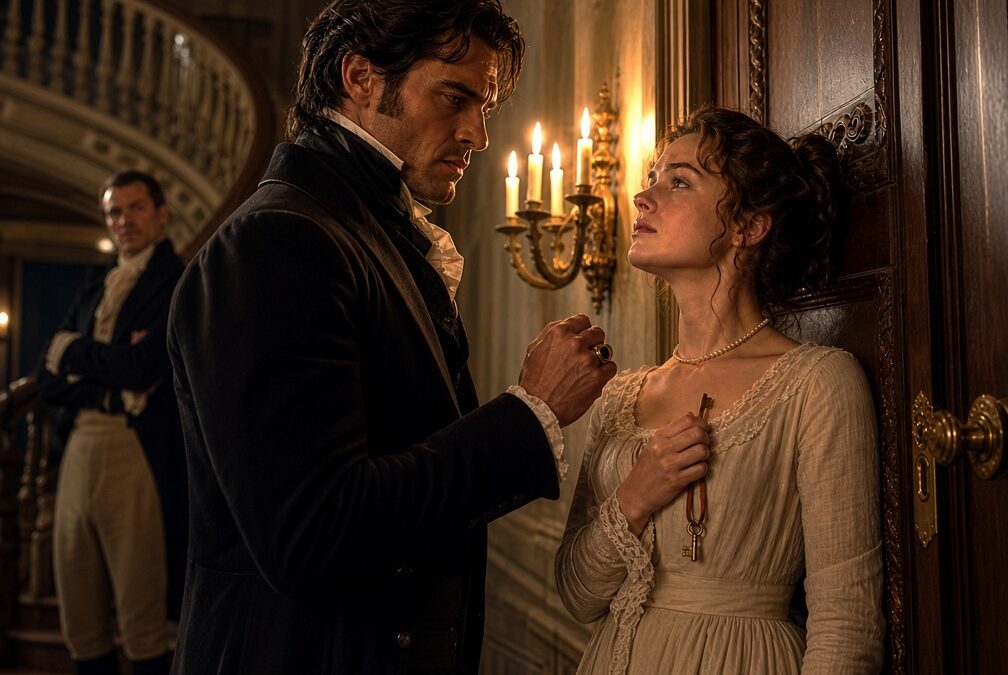
The Duke Wed London’s “Plainest” for a Prize Stallion — On the Wedding Night She Locked the Door

The key turned in the lock with a small deliberate click, and the Duke of Perra found himself standing in his own corridor on his wedding night, barred from his own wife’s chamber.
For a long moment, Cival did not move. He looked at the brass handle at the seam of candle light beneath the door, and listened to the quiet on the other side of it.
Not the frightened quiet of a girl weeping into her pillow, which he might have expected, but a composed silence.
The silence of someone who had done a considered thing and now waited to see what he would make of it.
When he said her name low so it would not carry to the servants. You have locked the door.
I have came the answer perfectly calm from within. It seemed the honest thing to do.
You purchased a horse this morning, your grace. I should be sorry to have you confused the two transactions.
Cvil had been married 4 hours. He had stood in the Greystone Chapel at Perbor and watched a plain young woman in an ivory gown make her vows in a clear unhurried voice.
And he had thought with the cold efficiency that had served him all his life that the thing was done and the stallion ember for was his, and the matter need trouble him no further.
He had not expected to be standing here now in the shifting light of a single sconce, feeling the ground of his own house tilt beneath him.
“Open the door,” he said. No, you are my wife. I am your wife. She agreed, and he could hear maddeningly that she was neither weeping nor trembling.
I made you no promise beyond that, and I mean to keep every promise I made.
But there is a great deal, sir, that the marriage service does not compel, and I find I am not disposed to give it away simply because a bishop stood in a cold church, and a settlement was signed.
You wanted my father’s horse. You have my father’s horse. You wanted a duchess who would not shame you at table and would give the county its hair in time.
Perhaps you shall have that too. But you shall have it because you have earned it, not because you paid for it.
Good night, Cvil. He heard the small sounds of a woman preparing for sleep, the soft collapse of a chair taking a discarded shawl, the whisper of a brush through hair, and understood with an astonishment that bordered on outrage that she had said all she intended to say.
He did not knock again. A duke of Perov did not stand in a corridor and hammer on a door like a drunkard turned out of a tavern.
He stood a moment longer, and then he turned and walked back along the passage to his own apartments.
And it was only when he reached them and stood before his own cold hearth, that he permitted himself to think a thought he had not thought in a very long time, which was that he had entirely misjudged a situation, and that he did not at all know what he felt about it.
He had married her for the horse. There was no use pretending otherwise, and Cvil had never had much patience for Pritans, least of all with himself.
Ember was the finest Stalian bread in England in 20 years. A great dark bay with a white star like a splash of milk on his brow, deep through the girth, clean of leg, with a stride that ate the ground, and an eye that missed nothing.
Half the piridge had tried to buy him. The king’s own stud masteraster had come down Turford with an open person gone away empty-handed.
Old Alden Jervis, whose fortune had bled away over 30 years into bad harvests, and a worse partner in a canal scheme that never dug a yard of canal, had refused every offer.
Because embe was the last thing of worth the Jervis name possessed. And a man who sells his last treasure has confessed to the world that he is finished.
But a man who is finished may yet be saved by a marriage. That was the country’s oldest arithmetic.
Cvil had wanted the horse. The Jervises had wanted deliverance without disgrace. And between the two of them, the lawyers had found the only door that suited everyone.
The Duke of Perborough would take a Jervis daughter to wife and settle the family’s debts and restore the mortgaged acres, and in return would come to Perbero as part of the dowry, and the whole of it could be spoken of at dinner tables as an alliance rather than a rescue.
Nobody would say the word purchase aloud. Everybody would know it. He had assumed when the thing was first proposed that he would be given the beauty.
There was a beauty. Civl had seen her once at a ball. The elder mis Jervis I sold her, a golden creature much admired, and he had supposed without troubling to ask that a beauty was what would be offered, because a beauty was what men in his position were generally offered.
It had not moved him one way or the other. He had buried three years passed the only tenderness he believed himself to possess.
And what remained of him was a well-run estate, a seat in the lords, and a heart he thought of when he thought of it at all, as a room whose furniture had been covered in dust sheets and its shutters closed.
But I sold Jervis it transpired, was already promised a love match, a curate with expectations, the family too soft-hearted to break it, even in their extremity.
And so it was the younger daughter who had come to the altar, Miss Wind Jervis, 4 and 20, whom the drawing rooms of London had christened with the casual cruelty they reserved for women who declined to apologize for their faces, the plainest girl of the season.
He had heard the phrase before he ever met her. A wit at Whites had said it in his hearing that Pubarof was to wed London’s plainest for the sake of a horse, and that it was the best bargain the girl’s family would ever strike, for she’d have gone to her grave a spinster otherwise.
The men had laughed. Cvil had not laughed, but neither had he troubled to correct them, and he found now, standing in the ruin of his wedding night, that his failure to be troubled shamed him more than the gest itself.
He had met her precisely three times before he married her. The first was in her father’s paddock, and he had not known who she was.
He had ridden over from the inn to see the horse before the contracts were drawn, because he trusted no man’s account of a stallion but his own eyes, and he had found a young woman in a mod habit, standing at Emberfall’s shoulder, with her bare hand flat against the great arch of his neck, saying something to the animal too low to hear.
The horse, who had, by every account, half killed two grooms, and would let no stranger near his head, stood for her like a lamb.
Cvil had taken her for a groom’s daughter, some stablebred girl with a gift, and had said, not unkindly, but without much interest, that she had a good seat, no doubt, but he’d thanked her to stand clear while he looked the animal over.
She had looked at him with a pair of steady gray eyes and said, “You may look all you like, your grace, but you’ll not put a hand on his offside unless you have a fancy to lose it, and he’ll not go sweet for you the way he goes for me.
And that is a thing you would do well to remember before you count him bought.”
And then she had ducked under the rail and walked away across the yard. And a stableman had come up beside him and murmured with the wse of a servant delivering bad news that the young lady was Miss Wyn, Mr.
Jervis’s second daughter, and that she had bred the horse herself and reared him from a foe, and there wasn’t a man in three counties could do with Ember the 10th part of what she did.
Cvil had not thought of that warning again. He thought of it now. The second meeting was at the signing in Jervis’s cold library, where she had sat very straight in a plain gray gown, while the men disposed of her future in the language of jointes and rent rolls, and had said nothing at all until the lawyer, an oily man pleased with his own phrasing, referred to the stallion and the bride together as the considerations moving from the jer side.
Then she had lifted her head and said in a voice like the flat of a cold blade, “I am not a consideration, Mr. Pedigrew, the horse is a consideration. I am a person, and I am sitting in the room, and I would take it as a courtesy if the gentleman would remember it.
A dreadful silence had followed. Her father had gone the color of ash. And Cvil, he remembered it clearly, the small event of it, had felt for the first time in 3 years, something stir behind the dust sheets, not tenderness.
He would not have called it tenderness, but an interest sharp and unwilling of the kind a man feels when a thing he had cataloged as dull proves suddenly to have teeth.
The third meeting was at the altar, and they had not spoken but their vows.
Now she had locked her door against him, and Cvil stood before his dead fire and discovered that he was not angry.
That was the strangeness of it. He had every right to be angry. He had been made in some sense a fool of in his own house on his own night, and a younger cival would have been white with it.
But the man he had become received the insult almost with relief, the way a man numbed too long by cold will welcome the pain of returning feeling as proof that he is not, after all quite dead.
She had refused to be bought. She had looked at the whole cynical machinerying, the horse, the debts, the alliance dressed as affection, and she had quietly and with a lock and key declined to let it purchase the one part of the arrangement that could not be written into a settlement.
He respected it. He was surprised to find how much he respected it. He rang for his man and was put to bed in a chamber grown unfamiliar to him.
And he lay along while looking at the canopy and hearing in memory that clear unhurrieded voice through the oak.
You shall have it because you have earned it, not because you paid for it.
No one had required anything of Cal in years. He was a duke. The world arranged itself to require nothing of him, to smooth every path, to press upon him every good thing before, for he had so much expressed a wish for it.
It occurred to him, lying there, that he had forgotten entirely what it was to want, a thing he could not simply have, and that the sensation, now that it had returned, was profoundly uncomfortable, and that he had not felt so awake in a very long time.
In the morning he came down early to the breakfast room, and found her already there.
She was seated at the far end of the long table in a gown of dove gray, her brown hair drawn back plainly, a cup of chocolate before her, and a book open beside it.
And she looked up when he entered with an expression of such perfect untroubled cortisy that a stranger would have thought them married 10 placid years.
She was not a beauty. He observed it dispassionately as he might observe the weather.
Her face was too long, her mouth too wide, her nose without the little tilt the drawing rooms prized.
Her brows were straight and dark and gave her in repose a look of gravity that men mistook for plainness because it did not flatter them.
But her eyes, when she raised them, were a clear gray of rainwater over slate, and there was in them a spark of intelligence so unmistakable, so entirely without apology, that Cvil understood for the first time why the Wits of London had been so eager to call her plain.
They had needed a word to make her small. Plain was the smallest word they had.
“Good morning, your grace,” she said. “I trust you slept indifferently. I am sorry to hear it.”
She did not look sorry. She looked, if anything, faintly amused, and she turned a page of her book with the air of a woman entirely at leia.
The blue chamber has a draw from the north. I noticed it last night and meant to mention it to Mrs.
Hail. I shall have it seen, too. One cannot have the Duke of Perber of taking cold in his own house.
What would the county say? Cvil crossed to the sideboard, lifted the cover from a dish of kidneys he had no appetite for, and set it down again.
You are very composed this morning, madam, for a woman who spent the night barricaded.
I am generally composed, she said. It disappoints people who expect otherwise, but I find I cannot help it.
Would you like me to be distressed? I could attempt it, but I should do it badly, and we should both feel foolish.”
He turned and looked at her down the length of the table. The morning light came through the tall windows and lay along the polished wood between them like a drawn line.
I should like, he said slowly, to understand you. That is all. I am not accustomed to being managed by a lock.
You are not accustomed to being managed at all, she returned, and there was no heat in it, only a plain and rather devastating accuracy.
That is the whole difficulty, sir, and I do not blame you for it. A man is what his circumstances make him, and yours have made you a man before whom doors open.
But I am not a door, Cvil. I am the thing on the other side of it and I have a lock and I have decided to use it and you will find I think that the world does not end.
She closed her book and folded her hands upon it and looked at him with those clear gray eyes in a way that no one had looked at him in years directly without fear without calculation as one whole person looks at another.
I know why you married me. Everyone knows why you married me. There is not a scullery made in Herfordshire who does not know that the Duke of Perborough wed the plainest girl in London to get his hands on a horse.
I have made my peace with it. I have not made my peace with pretending it was anything else.
So let us not pretend. Let us be at the least honest with one another and see where the two honest people cannot contrive to be less wretched than two who lie.
There was a silence somewhere beyond the windows. A groom was leading a horse across the gravel, and the clop of hooves came clear and rhythmic into the room.
Cvil found that he had nothing to say, that everything he might ordinarily have said, the smooth phrases, the ducal deflections had gone from him, and that he was standing in his own breakfast room being seen more truly than he had been seen in the hall of his adult life by a woman he had bought along with a horse, and that he did not, to his own considerable astonishment, wish to leave the room.
Ember fall, he said at last, because it was the only ground on which he felt sure of his footing.
Will not eat. My headgroom sent word this morning. He has stood at the back of his box since he came and turned his head from every mash they have offered and struck at Fenna.
When the man tried the door, something crossed her face, then the first thing he had seen there that was not composed.
It was gone in an instant mastered, but he had seen it. A flinch of pure feeling sharp as grief.
No, she said quietly. He will not eat for you. He does not know your yard or your men or your smell.
And the one creature in the world he trusts was married yesterday and carried off to a strange house.
And horses grieve your grace, whatever your stud may tell you. He is not being difficult.
He is frightened and he is alone. And he is doing the only thing a frightened creature knows to do, which is to refuse everything and wait to see whether the world means to hurt him.
She rose from the table and Cival saw that beneath the composure her hands were not quite steady.
Take me to him now before you have your breakfast. I do not care about your breakfast.
Take me to my horse. The stable yard at Perura was the finest in three counties.
Cvil’s father had built it. A great quadrangle of honeyccoled stone with a clock tower over the arch and 40 boxes ranged beneath a roof of Welsh slate, and it was silent with the particular silence of men who did not know what to do.
Fenna, the headgroom, a square and capable man who had handled the Duke’s horses for 20 years, stood outside the corner box with his cap in his hands, an expression Cival had never seen on him, which was the expression of a craftsman defeated by his own trade.
He’s took nothing since first light. Your grace, Fenna said, “Nor last night neither. He’ll not let a soul near his head.”
“I’ve seen frighted horses, God knows. But this one begging your pardon, my lady, for he had only just registered at the Duchess crossing the cobbles behind her husband.
This one set on grieving himself to death, and there’s no man here can talk him out of it.”
“Then it is fortunate,” said the Duchess of Perboro, that you have sent for a woman.
She did not go to the box at once. Cvil watched her. He found he could not help watching her.
Stop some 10 ft from the door and stand quite still and change. That was the only word he had for it.
The brisk composed woman of the breakfast table went out of her, and something else came in.
Something slower and deeper, a stillness that was not the absence of feeling, but its concentration.
She let her shoulders down. She let her breath out long. And when she moved again, it was without hurry.
One soft step and then another, her hands loose at her sides, making no sound on the cobbles.
And she began to speak, not to the men, not to Civl, but to the dark of the box, in a low, unbroken murmur that had no words he could make out, only a rhythm rising and falling.
The sound a mother makes over a cradle in the small hours. From the shadow at the back of the box came a stamp and a snort, and the pale gleam of a rolling eye.
There now,” she said aloud this time, still in that low current of a voice.
“There now, my trouble, I know. I know it all. They took you away in the dark, and the straw was strange, and the water tasted wrong, and not one of these great fools thought to bring you a thing you knew.”
She had reached the door. She did not open it. She leaned her forearms on the half- height boards, and simply waited, her head bowed a little, offering the horse the back of her hand and nothing else.
No rope, no demand, no sudden move. I am here now, she said. I am here.
I am not going anywhere. You may come and tell me about it when you are ready.
And not one moment before. For a long time nothing happened. Kival became aware that the whole yard had stopped.
Fenna, the undergrims, a boy frozen with a pale, every man of them held by the sight of it.
And then, out of the dark, the great dark head came down and forward, slow and suspicious.
The white star swimming up out of the shadow. An Emberfall put his muzzle against the Duchess’s open hand and blew out a long shuddering breath, and she turned her cheek and laid it against his jaw and closed her eyes.
And Cival saw that she was silently weeping, and that she had not once let it into her voice.
“Fetch a warm mash,” she said, without opening her eyes, with a spoon of trle in it, and a little of whatever hay he had at home, if any, came with him.
It did. Then a double handful of that on top. So he smells his own field.
And bring it to me. I shall give it him from my own hand. And none of you is to speak above a whisper in this yard for the next hour.
Fenna, is it? You have kept a beautiful stable, and none of this is your fault.
He would have grieved for me whatever you did. Only next time a horse comes to you brokenhearted, do not offer him food.
Offer him company. The food comes after the mash was fetched. She fed it to him spoonful by patient spoonful.
Standing in the straw in her dove gray gown with the great head resting the whole weight of its trust against her breast.
And Cvil stood at the door of the box and watched his wife of one day mend a thing that £40 a year of expert grooms could not mend and understood that he had made in the whole cynical bargain one calculation entirely wrong.
He had thought the horse was the treasure and the woman the price. He had it backwards.
The horse was only a horse, a magnificent horse, but a horse. The thing that made Emberfor what he was.
The thing no settlement had reckoned and no lawyer had priced, was standing in the straw in a gray gown with TLE on her fingers, and Cival had got her, if he had got her at all, entirely by accident, and she had locked her door against him, and he deserved it.
You bred him,” he said. When the mash was gone, and the horse stood quiet, dozing against her, and she had come at last to the door, wiping her hands on a cloth, I bred him.
I chose his sire against my father’s advice, and I sat up three nights when his damn fold.
And I have gentled him with my own hands every day of his life since.”
She looked back at the horse, and her face in that unguarded moment was so full of a plain unashamed love that Civival felt something over in his chest.
He is the best thing I have ever done. Your grace, he is the best thing I am ever likely to do.
And you must understand, I did not mind so very much being sold. A woman of my face and my father’s fortune had no great prospects, and I am not a fool, and I would sooner be a duchess who is useful than a spinster who is decorative.
But I minded being sold away from him. I minded that more than I have told anyone, and I will thank you not to make me speak of it further, cuz I find I have not the composure for it this morning, after all.
And she walked out of the yard with her back very straight. And Cvil let her go, and gave orders that a portion of Emberfall’s own field hay should be sent for from Herford that very day, whatever the cost, and did not himself understand why the giving of that order pleased him so.
So began the strangest season of the Duke of Perborough’s life. They settled, the two of them, into a manner of living that no one who witnessed it could have named.
They were married. They were not. They dined together each evening at opposite ends of a table built for 20, and talked, for they discovered, almost against their wills, that they could talk, that there was between them a quickness that struck sparks.
She was sharp. She had read a great deal. In the dissulttory unsupervised way of a clever girl in a house too poor to send her anywhere.
And she had opinions on everything from the drainage of the south meadow to the folly of the corn laws.
And she offered them without the smallest deference. And when Cvil disagreed, she did not retreat, but pressed, and turned his own arguments against him, and once or twice, to his great annoyance and greater delight, defeated him outright, and had the grace to look pleased about it.
You argue, he told her one evening, like a barristister. I argue like a woman who has been told her whole life to be quiet, she said, and who has decided rather late to stop.
It comes out with some force. You will grow used to it. But at the foot of the stairs each night she bade him a courteous good evening, and went up to her chamber, and he heard faint down the great staircase the small, deliberate click of the key.
She locked her door every night. She never once referred to it, and Cival, who could have commanded it opened, who was within his every legal and customary right to demand it, found that he would sooner have cut off his hand than turn that handle uninvited, cuz she had made of that lock a kind of test, and he had begun.
He scarcely knew when it had started, to wish very much to pass it. He learned her that autumn, the way a man learns a country he had ridden through blind.
He learned that she rose before the servants and walked out to the stables in the grey dawn to see her horse, and that she had within a fortnight so entirely won the yard that Fenna spoke of her as though she had hung the moon and the undergs would have walked through fire at her word.
He learned that she was kind to the tenants in a way his own mother, God rest her, had never troubled to be.
That she knew their names and the names of their children, and which of them had a cough that would not mend, and which a leaking roof, and that she had begun, without asking his leave.
To set these things right quietly out of the household money, so that he only discovered it when old martyr at the lodge caught his stirrup one morning to bless him for a wife who had sent a doctor and paid for the physic out of her own reticule.
“You have been managing my estate behind my back,” he said to her that evening, “I have been managing your tenants,” she corrected.
“The estate you manage admirably, and I should not presume. But you do not know that the Croftton’s youngest has been ill since Michael.
Because no one tells a duke such things. They only bow to him. People tell me I have a very forgettable face.
Your grace. It is the great advantage of my life. Folks speak freely in front of me as they never would before.
A beauty because they do not fear me and they do not wish to impress me.
I hear everything. I always have. She smiled and it changed her whole long grave face.
Lit it from within. And Cival felt the change go through him like a struck bell.
You may scold me if you like, but you will have to do it after you have told me whether you sent the money for the Croftton’s physic, which I know that you did, because Martr cannot keep a secret to save her soul, and which was very good of you, and quite spoils the picture of the cold hard duke I had been at such pains to compose.
I am a cold hard duke, said Cival. You are a man, said Wind Jervis, who orders a horse’s own hay carried a 100 miles because it grieved and thinks no one noticed.
Good night your grace. And she went up the stairs, and he heard the key turn, and he stood at the bottom of them for rather a long time.
He had not always been this closed, a man. He knew that he did not often let himself know it.
There had been a cival some years gone who laughed more easily and trusted without counting the cost.
And that cavel had loved a woman named Lady Aurelia Vain, beautiful, brilliant, sought after, and had believed himself loved in return, and had learned a month before the wedding that was to have crowned it, that she had accepted him for his title and his fortune, and had told her sister, laughing, in a room where he could not help but hear it, that of course she did not care for him.
One did not marry a dukidum for its conversation. He had ended the engagement in a single cold interview, and had never spoken of it to a living soul, and he had drawn the shutters over that lit room in himself, and had gone on correct and admired and entirely alone, and had told himself that it was better so, that a man who wanted nothing could not be robbed of it, that a heart kept locked could not be picked, and then he had gone into Herfordshire to buy a horse, and had come away with a wife, who locked her own door, and dressed his tenants wounds and loved a stallion more than her own comfort, and who had never once, not in a single glance, weighed him against his fortune, because she had entered the marriage already knowing precisely what it was worth and precisely what it lacked, and had asked him for nothing except the truth.
It was the not asking in the end that undid him. Lady Aurelia had asked for everything, and meant none of it.
Win asked for nothing and meant every word. He lay awake and thought about the difference and did not like what it revealed to him about the years he had spent congratulating himself on his own hard sense.
The trouble when it came came from London in the person of his aunt. The daajed marchness of Stain was Cival’s mother’s sister, a woman upholstered in bombazine and consequence who regarded the whole of the human race as a set of place cards it was her particular genius to arrange.
And she descended upon Perboro in the third week of October with two carriages, a maid, a spananiel, and the settled intention of inspecting the creature her nephew had so scandalously married.
She had opposed the match. She had said in letters Castival had not answered, that to wed a jervis for a horse was the act of a horse mad boy and not a duke, and that the girl’s face would be the joke of every dinner table from here to Bath, and that he might at least have had the sense to buy the animal and marry someone one need not blush to present.
She arrived prepared to be appalled, and it was Civival’s misfortune, or as it proved, his great good fortune, to be present in the drawing room when the two women met.
The daaja markness of stain entered the drawing room as a ship of the line enters a harbor and she looked win over from the plain parting of her brown hair to the hem of her unfashionable gown and she said before she had so much as sat down well.
You are exactly as they described you. I had hoped they exaggerated. Cvil came halfway out of his chair.
He did not know in that instant what he meant to do, but he found he was on his feet, and that a cold anger he had not felt on his own behalf in years had risen in him on hers, and he had actually opened his mouth to say something that could not have been unsaid, when the Duchess of Perau laid two fingers lightly on his sleeve, the first time she had ever willingly touched him, and pressed him back into his seat.
They did not exaggerate. Mom, said Win pleasantly, ringing for tea as though her aunt had paid her a compliment.
I have a plain face and a poor father, and I married your nephew for his money.
Or rather, he married me for my horse, which is a shade more unusual and reflects, I think, better on my judgment than on his.
You will have traveled a long way to say so, and you must be tired.
And I have ordered the seed cake because Mrs. Hail tells me it is your favorite, and I hope you will eat a great deal of it, and feel more comfortable, for I can see that you are not comfortable at present, and I should not like a guest of mine to be unhappy in my house.”
There was a silence of the kind that gathers before a storm breaks. The dwigger stared at her.
Cvil, who knew his aunt, waited for the thunder. It did not come. Something moved instead behind the old woman’s formidable face.
The flicker of a creature that has thrown its whole weight against a door it expected to yield and founded a wall.
She had come armed for a girl who would weep or cringe or bristle or overreach.
She had a strategy for each. Honed over 60 years of dinner tables, and she had no strategy at all for a young woman who simply agreed with every insult, disarmed it by owning it, and then pressed seedcake upon her out of what appeared to be genuine and unmalicious kindness.
You are impertinent, the dagger said at last, but there was uncertainty under it. I am honest, ma’am, which is often mistaken for the same thing by people who have grown used to being flattered.
Win poured the tea. I do not flatter. I have not the face for it.
No one would believe me. But I do not lie either. And if you stay a week, you will find that I say a great mate many pleasant things and mean every one of them, which is more than can be said for most of the beautiful women who will have sered at you.
Do this season. Sugar, you take two. I ask Mrs. Hail. The Deager Markinness of Stain took her tea and her two lumps of sugar and her seed cake, and she stayed not a week but a fortnight, and Caval watched with a slow dawning wonder as the fortress of his aunt’s disapproval was reduced, not by any sage, but by the simple, sustained pressure of being treated with unrightened good humor by a woman who wanted nothing from her.
By the second week, the old woman had taken to calling Win, my dear, in a grudging voice, and had asked her advice on a quarrel with a neighbor.
And on the morning she left, she gripped Civ’s hand at the carriage door, and said, “Lo, and fierce, you have done far better than you deserve, and better than you know, and if you have the wit God gave a goose, you will stop sleeping down the wrong end of that corridor.
I am old, Cal. I am not blind. Good day.” And she was gone in a cloud of gravel and consequence.
And Cvil stood in the drive with his ears burning because his aunt had seen in a fortnight what he had spent two months refusing to look at directly.
He was in love with his wife. He had not meant to be. He had built his whole life since Aurelia on the principle of never being so again, of wanting nothing that could be taken, of keeping the shutters closed.
And a plain-faced woman had come into his house with a lock and a key, and a grieving horse, and had, without the smallest apparent effort, without ever once trying to charm him, without so much as unfastening a curl for his benefit, thrown open every window he had spent years nailing shut.
He loved the sharpness of her. He loved the way she argued, and the way she was kind, and the way she went out in the gray dawn to lay her cheek against a horse’s jaw when she thought no one was watching.
He loved that she had never lied to him and never would. He loved. And this was the thing that frightened him past all the rest, that she had asked him for nothing, because it meant that whatever she gave him, if she ever gave him anything, would be given freely, and a gift freely given by Wind Jervis, he now understood.
The one thing in the world he wanted, and the one thing his rank and fortune could not command, he did not know how to court his own wife.
It was an absurdity. He could feel the absurdity of it, and yet there it was.
He could have any door in the kingdom opened by a word, and he did not know how to earn the turning of one small brass key at the top of his own stairs.
So he began clumsy at first to try. He started with the horse, because the horse was the ground they both stood on.
He asked her humbly, which cost him something, to teach him what she did, how she read the animal, how she knew before Emberfall knew himself when he would spook or settle.
And she looked at him with those clear gray eyes as though suspecting a trick, and finding none.
And she took him out to the schooling paddock in the cold, bright mornings, and taught him.
She was a hard teacher. She did not spare his pride. “You are all command,” she told him the first day, watching him ride.
You tell him. You never once ask him. You have spent your life telling, and horses do not care a straw who you are.
A horse cannot be impressed by a duke. He only knows whether your hands are kind and your seat is honest.
Soften your hands there. Feel him. Do not manage him. Feel. Cvil, who had been told nothing by anyone in 15 years, took his scolding from his wife in the frosty paddock, and found, to his astonishment, that he was happy, plainly, foolishly happy, in a way he had entirely forgotten, was available to a grown man.
They rode out together after that most mornings, she on a bright chestnut mare, he on his own gray hunter, and embe running loose in the home paddock, where he could see them go and be there to greet them coming back.
They rode the boundaries of the estate in the low autumn light, through beachwoods gone to copper and gold, and they talked, and they fell silent, and the silence between them grew easy in a way silence had never been for Caval with any living soul.
She showed him his own land, as he had never seen it, showed him the tenant, whose fences he had thought sound, and whose fences were rotten, showed him the field the steward had reported as follow, that was in fact let for grazing to the steward’s own cousin.
Showed him a hundred small truths that flowed to her because she had a forgettable face and a listening heart, and that had never once flowed to him, because he was a duke, and the world arranged itself to tell him only what was smooth.
“You are worth 10 stewards,” he told her one morning, drawing rain at the crest of the long hill, where the whole of Perov lay spread beneath them in the mist.
“I am worth a great deal,” she agreed, without false modesty, looking out over the valley.
It has taken me four and 20 years to be able to say so, and I mean to go on saying it, because a woman who waits for the world to tell her she is worth something waits her whole life.
But I will tell you a secret, your grace.” She turned in the saddle and looked at him, and there was something in her face he had not seen before, something that made his breath go short.
It is a very great deal easier to know one’s own worth than to have it seen by another and believed.
I have known my worth a long time. I had stopped hoping it would ever be seen.
And then she touched her heel to the mayor and was away down the hill before he could answer.
Her laugh trailing back to him on the cold air. And Cal sat his horse at the top of the world and knew that he was lost entirely and gladly lost and that he must find the words and that he was terrified of them.
It was Isold who nearly ruined everything. I sold the beautiful sister come to Perboro for a fortnight’s visit at W’s own warm invitation, golden and charming and newly married to her curate who had at last got his living.
Cvil liked her well enough. She was sweet and silly and adored her sister, and she made the great house ring with an easy laughter it had not held in years.
But she carried with her all unknowing the poison of the old world, the drawing room world, the world of whites and the wits, and she let it drop one evening at dinner without the smallest idea of what she did.
“Do you know,” she said gay over the soup, “I still cannot credit it that you two are wed and happy, for you are happy anyone can see it, when you have grown quite handsome,” which I never thought to say when I remember how it all began.
Papa was in such despair your grace before your offer came. Such despair. He said to me, “I remember it exactly.”
He said, “I sold. The Duke wants nothing but the horse. And if we are clever, we may wrap Win up with the bridal and be saved, for no one else will ever take her, and the horse will fetch us clear.”
Wrapped up with the bridal. I laughed so Oh. She stopped. She had seen her sister’s face.
Oh, Win. I did not mean. It was only Papa’s way of speaking. You know how he But the damage was done and Cvil saw it done.
He saw the light go out of his wife’s face as though a hand had passed us a candle.
She had known, of course, that she was married for the horse. She had said said so herself hundred times brightly as a thing made peace with.
But there is a wide gulf between knowing a cold fact and hearing it spoken aloud at your own table in your own father’s careless words.
Wrapped up with the bridal, a thing thrown in and make weight, an object appended to an object, and Civival watched the two months of their slow, careful though crack straight across, and he did not, in the frozen moment, know it.
Yes, said Winly into the silence. That was Papa’s way of speaking. He was quite right, of course.
It was a very good bargain. If you will all excuse me, I find I have a headache.
I sold do finish the soup. It is one of Mrs. Hail’s best. And she rose with perfect composure and left the room.
And Caval heard her tread on the stairs and heard a moment later the small final click of the key and knew that whatever ground he had gained in two months had just been lost in 30 careless seconds.
Isold was in tears. The curate was patting her hand and murmuring. Cal sat at the head of his table with his soup going cold before him and understood that he had come without ever deciding to to a fork in the whole remaining course of his life.
He could do what he had always done, draw the shutters, retreat into the cold, correct silence that had kept him safe for 3 years, let the wound close over, and the marriage settle into the pleasant hollow arrangement his aunt had warned him against.
That was the safe thing. That was the ducal thing. Or he could go up the stairs and stand at that locked door and do the one thing Cal of Perboro had never in his life done for any living soul, which was to open his own chest and let another person see what was inside it with no guarantee, no settlement, no lock of his own to keep him safe, to ask as a man asks and not as a duke commands, and to risk being refused.
He set down his spoon. “Excuse me,” he said to the table to no one, and he rose, and he went up the stairs.
He stood before her door with his heart going like a hunted thing and he raised his hand and for the first time since their wedding night he knocked.
When it is I I know you have a headache. I know you would rather I went away.
I am not going to command you to open the door. I will never do that.
You have my word, but I am going to stand here and say a thing to you through it.
And you may listen or you may not. But I find I cannot go back down those stairs until I have said it.
Silence. But not, he thought, an empty silence, a listening one. Your father was wrong, he said.
Not in the bargain. The bargain was what it was, and I will not insult you by pretending I came to Herfordshire for any reason.
But the horse, because you would know it for a lie, and you have never told me one, and I will not begin telling them to you now, but he was wrong in the accounting.
Wrapped up with the bridal as though you were the makeweight and the horse the prize.
When I have had two months to learn the value of what I brought home, and I tell you before God that I got the accounting exactly backwards, I came for the horse.
I stayed, I have stayed awake half the nights of the last 2 months for the woman.
Emberfall is a horse, a great horse, the greatest I have ever seen. But there are other great great horses in the world, and there is not another you.
And I did not know that when I married you, and I know it now, and it is the truest thing I have ever said to anyone.
The silence changed. He heard very faintly the sound of her rising from a chair.
I do not say this well, he went on, and his voice was not steady, and he let it not be steady, because he had spent 15 years keeping it steady, and it had bought him nothing but a house full of covered furniture.
I have not said a true thing to a living soul in a very long time, and I am out of the habit, and I am making a poor business of it.
But I would rather make a poor business of the truth than a smooth business of a lie.
You said on the first morning that we should be two honest people and contrived to be less wretched than two who lie.
I have thought of it every day since. I want more than to be less wretched when I have discovered that I want a very great deal more and I have no right to it.
And I am asking for it anyway, which is a thing no one has ever required me to do.
And I find it is the hardest thing I have ever done. And I would do it again tomorrow and every day after if you would only open the door.
For a long moment nothing, and then slowly the small brass key turned in the lock, not with the crisp finality of the nights she had shut him out, but softly, almost reluctantly, and the door came open the width of her hand, and she stood there in the candle light, with her hair down about her shoulders, browner and softer than he had ever seen it, and her eyes were red, and her chin was up, and she looked at him with a worriness so raw it rung his heart.
Do not, she said. Lo, say these things to me if you do not mean them.
I could bear a great deal, cvil, I have borne a great deal. I bore being the plain one and the clever one and the one who would never marry.
And I bore being sold, and I bore being carried away from the one creature who loved me, and I bore all of it with my chin up, because I decided long ago that the world should never once see me flinch.
But I could not bear this. Do you understand me? I could not bear to be made to hope and then have it taken away.
That is the one thing I have never let anyone do to me because it is the only thing I do not think I could survive.
So if this is kindness, if this is a good man feeling sorry for a plain wife after her fool of a sister spoke out of turn, then be kind enough to stop and go down the stairs and we will never speak of it and I will go on very well.
It is not kindness, said Cal. Then what is it? It is love, he said, and I am as astonished by it as you are, and a great deal more frightened because you at least have always known your own worth.
And I gave mine away to a woman 15 years ago who did not want it, and I have not dared offer it to anyone since.
And then because she was looking at him and he could not stop, he told her standing in the doorway in the candle light, he told her about Lady Aurelia vain, the whole cold, ugly little history of it, the overheard laughter, the shutters he had drawn, the years he had spent congratulating himself on wanting nothing so that nothing could be taken from him.
He had never told a soul. He told her all of it in a low even voice, and she listened without a word.
And when he had finished, she was no longer looking at him with weariness, but with something else, something that had a great tenderness in it and a great anger.
And the anger, he understood with a jolt, was on his behalf. She was a fool, said Wind fiercely, a beautiful fool.
To have all of that offered to her, and to weigh it against a title, to laugh, she stopped.
She pressed her lips together and then she said in quite a different voice, small and honest, “I am glad, Cavel, that you told me.”
And I am going to say something now that I have never said to anyone, and you must be very careful with it, because I do not give it easily, and I cannot take it back once it is out.
I have loved you, she said, for rather longer than is sensible, and I have locked my door every single night against a man I have wished every single night, would find the words to make me open it.
And I have been so afraid, I who am never afraid, I have been so afraid, that you would only ever see the horse, and the plain face, and the bargain, and never once see me.
And you have just told me that you see me and I do not know what to do with it because I did not plan for this.
I planned for the whole of the rest of my life and I did not plan for this at all.
Cvil didn’t move to touch her. It cost him everything not to. But he did not because the door was open only the width of a hand and it was hers to open the rest of the way and he would sooner have died than push it.
Then let us not plan, he said. Let us only begin. I do not ask you to unlock the door tonight when I do not ask you for anything tonight but leave to begin to court you as I ought to have done from the first as I would have done had I not been a fool with his shutters nailed shut.
Let me earn it. You told me on our wedding night that I should have what I wanted because I had earned it and not because I had paid for it.
I did not understand you then. I understand you now. Give me leave to earn it.
That is all I ask tonight. She looked at him a long moment through the gap of the door, and then slowly the smile came, the one that changed her whole grave face and lit it from within, and she said, “You may caught me.
Your grace, God help us both. You may begin in the morning. It is far too late tonight, and I have wept all over my pillow, and I look a fright.”
And she made to close the door, and paused, and looked at him once more, and very softly, “Thank you for coming up the stairs.”
I had almost stopped believing that you would, and the door closed gently this time, and the key turned.
But Cvil, standing in the dark corridor with his heart running over, understood that it had turned differently, that it was no longer a war between them, but a promise, a thing held in trust to be given, and he went down the stairs too at a time like a boy, and could not, for the life of him have said why he was smiling so.
He courted her through the back end of that autumn and into the winter, and it was the happiest labor of his life.
He did it in the only language they both spoke fluently, which was the language of small true things.
He rode out with her every morning. He learned the names of the tenants she loved and remembered them and went with her to the Croftton’s cottage and sat on a milking stool too small for him and admired the recovered child and saw the way she looked at him when he did it and would have sat on a 100 milking stools for that look.
He had Emberfall’s box rebuilt to her exact and exacting specifications, a window cut so the horse could see the paddock, and did it as a surprise, and she found it, and turned to him with her hand pressed her mouth, and could not speak, which he had come to understand, was in win.
The very highest expression of feeling for a woman who was never at a loss for words.
He gave her for her birthday in November, not jewels, though he gave her those too, the perber of pearls.
And she wore them and looked, he thought, magnificent, whatever the wits of London believed, but a fo.
Emberfall’s first fo out of her own bright chestnut mare, a leggy dark scrap with a white star just beginning on its brow, and he put the leading rain in her hand, and said, “This one is yours.
Not the estates, not the studs. Yours to breed or keep or give away as you please.”
And no lawyer shall ever write it into any settlement. And it is the first thing I have given you that no one can call a bargain.
And when Jervis, who never wept where anyone could see her, put her face against the fool’s neck and wept and let him see it, and that he understood it clearly.
Even as it happened, that was the moment the door in her began truly to open, not the brass one at the top of the stairs, but the deeper one behind it, the one she had kept locked far longer and against far more than him.
She still locked her chamber every night. He never once asked her not to. It had become between them a thing understood that the lock would be surrendered when she chose to surrender it freely as a gift and not one hour before, and that his willingness to wait for it to court his own wife through a locked door with ever once pulling rank was itself the shest proof he could offer of everything he had said.
He was for the first time in his life being weighed as a man and not a duke.
And he found that he wanted to be found worthy more than he had ever wanted anything, and that the wanting, which he had spent 15 years fearing, was not a wound at all, but the most alive he had ever felt.
But the world of the wits had not done with them. In the depth of December, there came an invitation that Civival would have thrown in the fire had wind not stayed his hand, a great Christmas assembly at Haroldan, the seat of the Earl of Mal.
The grandest gathering of the season stragglers in the county, and the very furnace in which Cvil knew the phrase London’s plainest had first been forged, the whole of the fashionable world that had laughed at his marriage would be there.
And worse, for he learned it from a line in the Earl’s letter, and his blood ran cold as he read it.
Among the guests already arrived at Harrodin, wintering there with her widowed sister, who was the Earl’s near neighbor, was Lady Aurelia Vain.
The first true test of the marriage came not from the county, but from within Cival’s own blood, and it came without warning.
On a gray Tuesday, three weeks after the wedding, in the shape of a traveling chariot with a crest on the door and a very old woman inside it who had buried two husbands terrified four generations of relations and never in her life been contradicted to any lasting effect.
My aunt, said Cvil, watching the chariot come up the avenue with the particular sinking of a man who has forgotten to dread a thing and is now given cause to dread it all at once.
Lady Adelaide, my father’s elder sister. She will have heard and she will have come to inspect you.
And I must tell you honestly when that she is the one person living of whom I am afraid, and that she has made grown men of 40 weep at her dinner table by the simple exercise of a tongue, and that I am sorryer than I can say that I did not think to warn you before she was upon us.
Then I am glad you did not, said Wyn quite calmly, setting aside the estate book she had been going through, for I should only have Lane awake ftting, and now I have not the time to, which is far better.
Is she fond of you? The question stopped him. I I suppose she is, in her way.
She is fond of no one, but she has been less unfunded of me than of the rest.
Then we shall do, said Wyn and Rose, and shook out her plainest gray morning gown without the least appearance of concern, and went down to meet the dragon.
Lady Adelaide came into the great drawing room on her ebony stick like a frigot under sail, took the single chair that best commanded the room, refused all refreshment as though it had been an insult, fixed the new Duchess of Perborough with a pair of black eyes undimemed by 80 winters, and said without any preliminary whatever.
So you are the horse copper’s girl my nephew has bought himself with a stallion.
Stand there in the light and let me see the whole of the bargain. H.
They did not lie about the face at any rate. You are as plain as a Sunday.
I had half hoped they exaggerated. Cvil came half out of his chair with the sound of protest.
But when, without turning her head, laid two fingers on his sleeve, and pressed him back into it, and stepped forward into the gray light of the window, and stood there straight as a birch, and let the terrible old woman look at her from her hair to her hem.
I am. She agreed pleasantly when the inspection was done, plain as a Sunday, and cleareyed enough to know it, which spares everyone a good deal of pretense.
You will find I do not blush at it, so you may say it as often as you like, and it will cost you nothing but breath.
Shall I tell you the parts they did not put in the letter? I keep his books, and I have found 400 a year that his steward was quietly losing in the accounts, and I have got it back.
I know the name of every tenant on the home farms, and the name of every child in the cottages, which is more than the last three duchesses of this house, troubled to learn.
I have set the still room to rights, and the linen presses, and the west drains, and I made your nephew laugh aloud twice last week, which the housekeeper tells me had not happened under this roof in 11 years.”
She tilted her head, and there was the smallest gleam in the grave gray eyes.
You came, mom, to see whether he had bought a fool or a schemer. He has bought neither.
He has bought a woman who will spend the rest of her life making his house and his lands and his people better than she found them, and who wants nothing from him that he did not freely, but that is between him and me, and no concern of a great there.
Now you have the whole bargain and may despise me at your leisure and I shall still send you home with a hot brick for your feet because the roads are cruel today and you are 80 if you are a morning and no one I think has warmed your feet in a very long while.
There was a silence in the great drawing room of a quality castle had never heard in it before.
Lady Adelaide sat with both hands folded on the head of her stick and looked at the plain young woman standing straight in the window light, and something moved across the the ancient formidable face that he could not at first read, because he had never once seen it there.
A hot brick, she repeated. “For your feet,” saidw, “and a rug for your knees, and a glass of my own elder wine, which is better than anything in my nephew’s cellar, and will not tell you so.
You have come 30 mi in the cold to frighten me, ma’am, and you have done it very thoroughly, and I honor you for it, for someone in this family ought to have looked me over hard.
And it is like you it should be the bravest of them. But you are cold now and old and a long way from your own fire.
And I was not raised whatever my face to let than for the sake of my pride sit by the fire.
I will fetch the brick myself. And she went and did it herself with her own hands, and came back and knelt on the hearth in her plain gray gown, and set the hot brick wrapped in flannel beneath the old woman’s small slippered feet, and tucked the rug about her knees, and Lady Adelaide, who had made men of 40 weep, looked down at the bowed brown head of the horse copper’s plain daughter, and pressed her thin lips very hard together, and blinked several times at the fire.
She stayed a fortnight. She had meant to stay a night. And when at last the ebony stick and the black eyes and the crested chariot went back down the avenue, the old woman put her head from the window and said to her nephew, who had come out bare-headed to hand her in, “You did not buy a horse, Cvil.
You bornly creature in this family worth the powder to blow the rest of us up.
And if you are the man your father was not, you will spend the remainder of your life on your knees to her and count it cheap.”
Now shut the door. The wind is vile. I begin to think. Cvil said to his wife that evening when the chariot was long gone and the two of them sat either side of the library fire.
He with a book he was not reading and she with the everlasting account book she always was.
That there is no fortress in England you could not take in a fortnight if you set your mind to it.
My aunt has not warmed to a living soul since the regency. You had her carrying your work basket by the second day.
Your aunt saidw not looking up from her column of figures has been lonely for 60 years and cross because of it and no one ever troubled to see the loneliness under the cross because the cross is very loud and the loneliness is very quiet.
It is not a great trick. It is only looking. She wrote a figure and blotted it and then she did look up and the firelight was warm on the plain clever face he had stopped weeks ago being able to look away from.
It is what no one ever did for me. You understand? When I was the plain cross girl in the corner.
So I learned to do it for others. One does. And Cvil, who had a great many things he wished suddenly to say, and no safe way to say any of them, said only gruffly, “Ride out with me in the morning early before the house is up.
I want to try Emma fall over the low country by the river, and I will not trust him to any hand but yours if he takes a fright at the water.”
She looked at him a moment longer than the request required. Very well, she said, before it is light.
Wear the old coat, not the good one. There will be mud. They rode out in the blue dark before dawn, the Duke on his gray, and the duchess on the great half-broken stallion that cost him a fortune and a wife, and the frost was on the grass, and their breath went up in silver, and the whole waking country was theirs alone.
Emberfall danced and siddled at the strangeness of the hour, and the mist rising off the river, and wind sat him as though she had grown there, lowvoiced, easy, her plain face wrapped, and glad in a way Cival never saw in a drawing room.
And he found he had drawn his gray close alongside, not for the horse’s sake at all, but only to be near her in the growing light.
They spoke little, there was no need. Twice she caught the stallion’s fright before it became a bolt, a hand, a word, and it was passed.
Once at the water. When the great horse balked and trembled at the black moving river, she talked him over it inch by inch while Cvil held his breath.
And when the Shod hooves at last struck the far bank, she laughed aloud, a free unguarded sound, and turned to Cvil with her whole grave face broken open into joy.
And the risen sun came of the hill behind her in that instant, and lit her plain features to something that stopped his heart entirely.
There, she said breathless glowing. You see, he is not wicked. He was only never asked properly.
Everything with a heart in it will go anywhere for you, Civival, if you only ask it properly, and never never try to force it.
And she did not know he saw that she did not know that she had said the whole truth of the two of them allowed on the riverbank.
And he did not tell her, because he was not yet brave enough, and because a thing so true wanted better ground than a cold morning to be spoken on.
He reached across the small space between the two horses, and he laid his gloved hand over her bare one, where it rested on the stallion’s steaming neck, and he did not say anything at all, and she did not take her hand away.
And for the length of a dozen heartbeats, the Duke and Duchess of Duchess of Perov sat their horses in the risen sun by the river with his hand over hers and said nothing and needed nothing.
And it was, Cvil thought, the nearest thing to perfect happiness he had known in five and 30 guarded years.
It was that afternoon, still warm with the morning, still turning the riverbank over in his mind, that he came upon the letter from the Earl of Harod, and among his post, the great assembly.
The whole county bidden and folded within the earls own civil hand the small poison note that Lady Aurelia vain would be of the party and Cival stood along while with the two papers in his hand and knew he must show her because a marriage built on the one virtue of never lying could not begin to shelter its lies now and did not yet know that in showing her he set in motion the near loss of everything the riverbank had promised.
We shall go, said Wyn, when he told her, for he had resolved to tell her everything now, the whole of it, and had shown her the Earl’s letter with Aurelia’s name in it, because a marriage built on the one virtue of never lying could not begin to shelter its lies now.
“We shall not,” said Cival. “There is not the smallest reason to expose you to that pack of “we shall go,” she said again.
And there was iron in it, the old flat coldblade voice she had used on the lawyer in her father’s library.
And I will tell you precisely why your grace, and then you will stop arguing, because you will find I am right.
If we do not go, the whole county will say that the Duke of Perber of dares not show his plain wife in company, and that he is ashamed of her, and that the marriage is exactly the sorted little horse trade they always said it was.
That story will be told to every dinner table in Herfordshire for 20 years and it will follow us and it will follow our children and I will not have it.
If we go and I stand up straight and I am pleasant to every viper in the room and you dance with me, then there is no story left for them to tell.
They cannot laugh at a woman who is not ashamed. It is the one thing I know better than anyone alive.
Cvil, I have been practicing it since I was 16. You take the cruel word out of their mouths by saying it first yourself with your chin up and then they have nothing and they hate you for it and it is glorious.
She smiled and it was not a gentle smile. It was the smile of a woman going into battle and glad of it.
As for your lady Aurelia, I should like above all things to meet her. I should like to see the woman who had you and did not want you.
And I should like her to see the woman who has you and does have my gray silk sent to be pressed.
We are going to Harodan. They went to Harodan. Cvil had dreaded it as he had dreaded few things, and it began exactly as he had feared, the great blazing rooms, the wax lights by the hund, the whole glittering fashionable herd turning as one at the announcement of the Duke and Duchess of Perurof, and the little rustle that went round the room, the behind the fan murmur, the appraising cruel glances, measuring his plain wife from her hair to her hem, and finding her.
They were sure. Wanting Cavival her hand tightened the smallest degree on his sleeve, and he thought his heart would break for her, and he turned to murmurs some word of courage and stopped because there was no need.
Winn had lifted her chin, and she was smiling at the whole assembled room with an expression of such serene, unhurried, unafraid, good humor that the murmur faltered, and then absurdly half died away.
Cuz as a crowd that has come to see a woman crushed does not know what to do with a woman who walks in glad.
She was not beautiful. She would never be beautiful. And Caval had long since stopped caring.
But he watched the room try to reconcile the plain long face they had been promised with the woman who now moved among them.
And he watched them fail because she carried herself like a queen who happened to be plain and had decided the fact was beneath her notice.
And there is nothing on earth so disarming as a person entirely without shame in a room that counted on shaming them.
Within the hour she had the dedas charmed. She talked drainage with the earl and Latin with the bishop and stud books with the horsemad young lord Mah until the boy was gazing at her as at an oracle.
And she said not one clever cruel thing all evening only true kind ones. And Cival stood at the edge of it and watched the county revise in the space of an assembly, a judgment it had held for two seasons, and was prouder than he had ever been of anything in his life, including his name.
And then, near midnight, when the dancing had begun, Lady Aurelia vain to find him.
She was still beautiful. That was the strange small fact of it. That 15 years and a marriage and a widowhood had not spoiled her.
That she was golden still and poised and lovely. And that Cvil looked at her across the little space of the card room to which she had contrived to draw him, and felt precisely nothing, nothing at all, where once there had been the whole ruin of his heart.
It was the most freeing sensation of his life. Cvil, she said low and warm with the old caressing note she had used to bring him to heal with a word.
How long it has been and how strange to see you married. I confess when I heard I could scarcely credit it.
You of all men who swore you would never and to such a she let it hang delicately.
A small poised cruelty to such an unexpected sort of girl. For a horse they say, “Oh Cal, it is not too late, you know, for us to be friends again.
I have thought of you. I have thought of you a very great deal. I was young and foolish once, and I threw away something I have regretted every year since, and I find I’m not too proud to say so.
She laid her gloved hand upon his arm, and looked up at him from under her lashes, and it was, he understood.
A practiced and perfect performance, the reeling in of a fish she had thrown back, and now, finding no better catch, wished to land after all.
Cvil looked down at her hand upon his arm, and then he looked at her lovely upturned face, and he removed her hand gently and set it from him.
“Lady Aurelia,” he said, “you did me the greatest kindness of my life, and I have only lately understood it, and I should like to thank you for it before I go back to my wife,” she blinked.
He went on evenly with a kind of wondering gratitude he had not known was in him.
“Had you loved me 15 years ago, I should have married you. I I should have spent my whole life believing that a smooth, beautiful lie was the best a man could hope for, and I should never have gone into Hertford shear to buy a horse.
And I should never have met the only person who has ever seen me true and wanted me anyway.
You did me the very great service of not wanting me. I am more grateful than I can say.
And now you must excuse me for the music is beginning and I have promised the next to the Duchess of Perboro.
And I find that I would not miss it to be made emperor of the world.
And he bowed correctly and left her standing among the card tables with her mouth a little open.
And he did not once look back. He danced with his wife. It was the first time.
There had been no dancing at their cold chapel wedding none since, and Cival led the Duchess of Perau out onto the floor of Herodan’s great hall under the eyes of the entire watching county and took her plain, clever, beloved face into his gaze, and would not look away from it.
And they danced, and he saw her understand, for she missed nothing. She had seen the whole of the little scene in the card room across the room.
She always saw everything. He saw her understand what he had done and why. And he saw her eyes fill.
And he saw her master it chin up and smile at him instead, radiant, so that not one soul in that room should ever be able to say they had seen the Duchess of Perboro weep.
And he loved her so entirely in that moment that he could scarcely keep the step.
“You sent her away,” W said. Lo under the music, “I sent her away. You did not have to.
I should not have blamed you for she is very beautiful cival and she was your she is a stranger to me he said with a lovely face whom I once mistook for a home.
I have a home now. It locks its door against me every night. And I have never in my life been so glad of anything as I am of that lock because it means that when the door opens at last it will have been given and not taken.
And I would not trade the waiting for that gift for the easy surrender of every beauty in England.
Dance wife. The whole county is watching and I want them to carry the memory of it to their graves.
The day the Duke of Perau danced with the cleverest, truest, dearest woman in the three kingdoms and did not once look at anyone else.
And they danced, and it should have been the end of it. It should have been the turning of the whole story into joy, and it very nearly was.
But there is a particular species of cruelty that survives even a route, and it wore that night the face of Lady Aurelia Vain, who did not care to be sent away in front of a county that had once envied her, and who found in the small hours, as the carriages were called, the one weapon left to a beautiful woman who has been refused.
She could not wound the Duke. He had put himself beyond her. She could wound the wife and she did it in the lady’s cloak room in a carrying voice pitched to be overheard to her widowed sister while the Duchess of Perro stood not eighth distant having a rapfetched “Oh one must pity her truly Aurelia said sighing sweet as poison for she cannot know poor plain creature what everyone else knows perfectly well that he married her for the animal and nothing else and that a man like Cival, a man of his address, will do the pretty for a season despite the gossip.
But he cannot love such a face. No man could. And when the novelty is gone, and the horse safe in his stud, he will remember what he is and go back to his own world.
And she will be left rattling about in that great house with her drainage and her tenants.
A duchess in name and a broodmare in fact, which is when all is said.
Precisely what she was bought to be. I do pity her. But she brought it on herself, marrying so far above her face.
Cvil did not hear it. He was in the hall, waiting warm with the whole triumphant evening.
But Win heard it. Win heard every word, standing with her wrap half about her shoulders and her chin up out of pure long habit.
And the maid who had fetched the wrap saw the duchess face and would speak of it years later to her own daughter.
How the great lady had not flinched, not by a hair, had thanked her for the rap in a perfectly steady voice, and walked out to her husband smiling.
And how it was only in the carriage, in the dark, with the door shut and the horses moving, that something in the Duchess of Perov had very quietly broken, for it was the one thing she could not bear.
She had told him so herself at her own door in the candle light. I could not bear to be made to hope, and then have it taken away, and here it was, spoken in a beautiful, cruel voice by a woman who had once had everything Wyn wanted.
And it went into her not because she believed it of Cal, but because it named the exact shape of the fear she had carried her whole life, the fear that her worth, once seen, would prove to have been only a season’s novelty, after all.
That the door she had at last been ready to open led into a room where she would be in the end precisely what she had been bought to be.
She did not tell him that was the tragedy of it and Cvil would blame himself for it bitterly after that she rode home beside him in the dark carriage and let him talk warm and happy of the triumph of the evening and answered him gently and said not one word of the knife in her because Win Jervis had spent four and 20 years learning never to let the world see her flinch.
And the lesson had gone too deep and on the one night it mattered most it betrayed her.
She went up the stairs at Perboro in the small hours, and she ba her husband good night with a smile that he was too happy to read, and she went into her chamber, and she turned the small brass key in the lock.
And this time, for the first time in weeks, she locked it not as a promise, but as a wall.
In the days that followed, Cvil lost his wife by inches, and could not, for the life of him understand how nothing was wrong.
That was the maddening heart of it. She was there at breakfast. Cortius there at dinner pleasant.
She managed the house and visited the tenants and rode out, though no longer with him now.
She had begun with a hundred small unimpeachable reasons to ride out alone. She answered when he spoke.
She smiled when a smile was called for. She was gone, utterly gone, as though the woman who had stood in the candle light and said, “I have loved you for rather longer than is sensible had been a dream he had had.
And the woman who now sat at the far end of his table was a very good, very cold portrait of her, correct in every line, and empty of the thing that had made him love the original past all sense.
The lock turned every night, and now it was a wall again. He could hear the difference.
He had learned her too well not to hear it. He did the wrong thing first, as men do.
He was hurt, and pride is the rittiest armor for a hurt man. And Cvil had worn that armor for 15 years, and it came to his hand before he could stop it.
He grew formal in turn. He told himself that he had bared his whole heart to her, had sent Aurelia away, had danced before the county, had done everything a man could do, and that if she chose now to freeze without a word of why, then he would not go crawling, he would keep his own counsel and his own dignity, and let her come to him.
For the better part of a week, the two of them moved through the great house at Perov with perfect courtesy and a growing waste of cold between them, two proud people each waiting for the other to break.
And the covered furniture went back over the rooms of Cival’s heart, one dust sheet at a time, and he was more wretched than he had been in the whole gray correct decade before he ever met her, because now he knew what he had lost.
It was Isold who saved them, though she had helped to sink them. She had stayed on past Christmas, and she loved her sister, and she was not clever, but she was not blind.
And she came to Cvil in his library on the seventh evening with her round, pretty face crumpled in distress, and said, “Your grace, I must speak, though wind would never forgive me.”
And you must not tell her that I told you, but I cannot bear it.
I cannot bear to watch it, for you were so happy, the two of you.
And now, your grace, do you know what that woman said at Herodan in the cloak room?
And she told him every word of it as the maid had told it to her.
The beautiful carrying voice, the poison poured into the one place it could do the most harm, a duchess in name, and a broodmare in fact, which is precisely what she was bought to be.
And Cvil sat very still in his chair, and felt the whole thing turn over and come clear, the way a landscape comes clear when the mist lifts off it, and understood at last what had happened, and understood the far worse thing beneath it.
That Winn had heard the crulest possible version of her own deepest fear spoken aloud by the one woman on earth position to make it sting and had not told him had carried it alone for a week rather than let him see her flinch because she had spent her whole life learning that the way to survive was never never to show the wound.
She thinks it is true, Cvil said slowly, not of me or not only of me.
She thinks it is true of the world that her worth was a season’s novelty, that the door she was ready to open led only into the room that woman described.
He put his hand over his eyes, and I have spent a week being called to her out of wounded pride, and every cold hour will have proved the lie true to her.
God forgive me. I have helped that woman do her work, he rose. He would have gone to her that very night.
He was halfway to the door, but I sold caught his sleeve. She has ordered the carriage.
Your grace, she said miserably. For the morning, she says she will go to papas for a month for the change of air.
She told me an hour ago. She has been packing. And Calville understood that his wife, having decided the whole thing was ashes, was doing the only thing her fierce wounded pride would allow.
She was leaving before she could be left. Taking the loss into her own hands, so that at least it should be her choosing and not a thing done to her.
Going home to Herfordshire with her chin up to spare herself the slow death of watching his kindness curdle into duty.
He did not go to her door that night. He wanted to. He stood in the corridor a long while, but he understood with the hardworn wisdom she herself had taught him that words hammered on a locked door at midnight from a man she believed had gone cold would only be one more thing to endure with her chin up.
She would not believe words tonight. She had had a week of his coldness to unbelieve them with.
He would have to show her, in the plain language of true things, that was the only language she trusted, and he would have to do it before the carriage came.
And he lay awake the whole night through, and did not know how. The morning came iron hard and bitter, the worst frost of the winter, the whole world glazed in white, and the yard a sheet of black ice under a sky the color of a bruise.
Caval was dressed before dawn. He had resolved to meet her at the carriage, to ask her plainly not to go, to lay the whole truth before her in the cold drive if he must, and to have no pride left about it at all.
But when he came down, the hall was empty, the carriage not yet round, and a housemmaid told him, bobbing, that her grace had gone out to the stables above an hour since, before it was light, to take her leave of the great horse before the journey.
Of course she had. She would not go to Hertfordshire without saying goodbye to Emberfall.
She would have gone out into the black frozen dawn to lay her cheek one last time against the jaw of the one creature she was sure of.
And Cival’s heart turned over, and he took his coat and went out after her into the cold.
He heard it before he reached the yard. The wrong sound, the sound every horseman dreads, the clatter and scramble and iron shriek of a horse in panic on a hard surface, and a man’s voice shouting, and under it terribly a woman’s voice, low and steady and desperate, doing the one thing she knew.
Trying to talk a frightened animal down, Caval came through the arch under the clock tower at a dead run, and took in the whole scene in a heartbeat, and felt his blood stop.
Emberfall was loose in the yard, some fool of a boy it came out after, had opened the box to Mucket, not knowing the Duchess was within, and the great horse, already wound to breaking by a week of his mistress grief, and the strangeness of packing cases in the yard, and the leaving in the air, had shoved past and got out onto the ice.
And there is nothing on earth so helpless and so dangerous as a heavy horse in terror on black ice.
His iron shoes finding no purchase, his great weight sliding, every instinct that told him to flee betraying him because there was nowhere to flee that would hold him up.
He was down on his hawks and scrambling, screaming half mad in the center of the frozen yard, and between him and the stone wall of the coach house, the wall he would surely dash himself to death against if he bolted, stood win on the ice.
In her traveling cloak, with her bare hands out and her voice going low and unbroken into the horse’s madness, trying as she had tried the very first morning to be the still point he could come back to.
When Civ’s shout tore out of him roar, get back for God’s sake. Let him go.
Let him find his own feet. Get off the ice. He’ll break himself on the wall.
She called back, not turning her eyes never leaving the horse. He doesn’t know the wall is there.
He’ll run straight into it. Cvil, stay back. If you rush him, he’ll bolt. And she took another step towards the plunging, sliding, terrified animal, out onto the worst of the ice, murmuring, murmuring.
And Cival saw with a horror that stopped his heart that she meant to put herself between Emberfall and the wall.
That she would stand her ground on the ice before a half ton of panic, because the horse might hurt himself, that she would spend her own life without a second’s hesitation to spare the creature she loved.
And that if the horse came down or bolted the wrong way, she would go under those iron feet, and there would be nothing left of the cleverest, truest, dearest woman in the three kingdoms but a broken thing on the ice of his own yard.
And in that moment, Castival of Perov discovered the floor of himself. Every consideration that had governed his life, pride, dignity, caution, the careful counting of cost, the shutters, the locks, the whole apparatus of a man determined never to want what he could lose.
All of it burned away in a single white instant of pure terror. And what was left standing exposed on the ice was the plain unbearable fact that he loved this woman more than his name, more than his safety, more than his life, and that a world without her in it was not a world he had the smallest wish to inhabit.
He did not decide to move. He was simply moving out onto the black ice, going down once and up again, his hand tearing on the frozen ground towards his wife and the maddened horse, with no plan and no dignity and no thought in his head but her.
Win,” he said, not shouting now, for he had reached her. He was beside her on the ice, and he made his voice go down into the low, steady current he had learned from her own mouth, because the horse was listening.
The horse was always listening. “I am here. I am not going to pull you back.
I know you will not come. So, I am going to stand here with you.
If he comes down, he comes down on both of us. I am not leaving this ice without you.
So you had best get him settled, my love, because I mean to stand exactly here until you do.
And he put his hand steady. He made it steady, though his whole soul was shaking flat against the small of her back.
Not to pull, only to be there, only so she should know she was not alone on the ice in the black dawn.
Not this time, not ever again. And something in wind, he felt it go through her under his hand, a great shudder.
Something in her broke and steadied both at once. She drew a breath that he heard catch, and then her voice changed.
It deepened. It found the old unbroken rhythm. But there was a new thing in it now, a thing that had not been there the first morning, and Cvil understood that it was not despair any longer that she poured into the frightened horse, but the plain fact of not being alone.
There now, she said, low into Emberfall’s rolling eye. There now, my trouble. We are both here.
Do you feel it? We are both here now, the two of us, and no one is going anywhere.
Bring your feet under you. Slow. That’s the way. Come to me. Come home. And the great horse, sliding, trembling, blowing great gouts of white breath into the iron air, steadied, got one foot under him, and then another, stopped screaming, and came an inch, and then a foot across the treacherous ice towards the two figures standing close together in the center of the yard, and put his great head down, and pressed his star against Wind’s breast, and stood, shuddering, whole alive, and Civival got his arm at last around the wall side of him, and turned him by the mane, gentle, towards the straw and gritted safety of the stable door.
And the grooms rushed in, and it was over, and no one was dead. And the three of them stood in the wreck of the frozen morning.
A duke and a duchess and a horse, all of them shaking, all of them breathing, all of them alive.
They did not speak until the horse was settled and standing quiet in his rebuilt box with a warm mesh before him, and the yard was cleared, and the pale winter sun had begun at last to climb over the clock tower and turn the black ice to running silver.
Wind stood Emberfall’s door with her hand on his neck, and she was trembling still, though whether from the cold or the terror or the thing that had passed between herself and her husband on the ice, Cvil could not tell.
Her traveling cloak was torn at the hem, and there was frost in her brown hair and her face, when at last she turned it to him, was stripped of every defense he had ever seen her raise, naked and gray with fright and something else, something that dared not yet be hope.
“You came out onto the ice,” she said, very low. “You might have been killed for a horse, not for a horse,” said Cvil.
“I did not come out onto that ice for a horse win, and you know it, and I think you have always known it.
And I have been a fool and a coward, and I have wasted a week being called to you out of wounded pride, and I would like, if you will permit me, to be neither ever again.”
He took a step towards her there in the cold, bright yard, with the grooms tactfully vanished, and the whole white mourning theirs.
“I know what she said at Harodan in the cloak room. I know every word of it and I know that you heard it and I know that you have carried it alone for a week rather than let me see it hurt you because you have spent your whole life believing that to show a wound is to be destroyed by it.
And I know because I know you now better than I have ever known anything that it went into you so deep not because you believed it of me but because it named the very fear you have carried since you were a girl.
That your worth once seen would prove a season’s novelty. That the door once opened would lead only into the room she described.
He saw her flinch at last, saw the tears stand at last in the clear gray eyes, and he did not look away, and he did not let his own voice break, because she needed it steady, the way the horse had needed it steady.
Let me tell you what is true, and then you may go to Herford, sure, if you still wish to, and I will send you in my own carriage, with your father’s debts paid, and your name honored, and every claim you have on me discharged forever.
But you will go knowing the truth because I will not have you leave believing a beautiful woman’s lie.
Cvil. She said you were a duchess in name and a broodmare in fact which what you were bought to be.
He said the cruel words plainly in the cold air and watched them land and went on.
Here is the truth. I bought a horse. I did. I will never pretend otherwise.
You would not let me and I would not wish to. But the horse wind was the least of what came to Pubar that day, and I have known it for months, and I knew it with my whole soul this morning on the ice.
You are not a duchess in name. You are the truest duchess this house has had in a hundred years.
You know every tenant by name. You have mended roofs and sent for doctors, and won my own dragon of an aunt in a fortnight, and made the county revise a 2-year judgment in a single evening.
And you did it all not because it was your duty, but because it is your nature, because you are the most alive, the most seeing, the most holy good person I have ever stood beside.
You are not a broodmare. You are the best horsewoman in England, and the cleverest woman I have ever argued with, and the only person in five and 30 years who has ever looked at me and seen a man and not a duke, and wanted the man, and told me the truth to my face when the whole world flatters me.
She said, “No man could love such a face. He was close to her now, and he reached up slowly, and he cuped her long, grave, plain, frightened face in both his cold hands, and he looked at it as though it were the only thing worth looking at in the whole white world.”
She was wrong. I love this face. I love it more than any beauty I have ever seen.
And I will tell you exactly why, and you will believe me, because I have never once lied to you.
I love it because everything true about you comes up into it and cannot be hidden.
Every clever thing and every kind thing and every fierce thing because a beautiful face is a wall a woman hides behind and yours is a window and I have spent 15 years in the dark wind and you are the light that comes through it.
Do not go to Herford share or go if you must and I will follow you and I will stand in your father’s paddock and say all of this again in front of the horse and I will keep saying it in every county in England until you believe it because it is true and I am done.
I am so entirely done with being a man who dares not say what is true.
She was weeping now openly at last, the tears running down over his cold hands, and she was not trying to master it, and that the surrender of the mastery, the letting him see, was the most she had ever given him, more than any word.
You dance with me before the whole county, she said brokenly. You sent her away, and I heard her an hour later, and I let it undo everything, and I did not even do you the honor of telling you.
I only shut the door and made a wall of it again. After everything cible, I am so ashamed.
I who am never ashamed of anything. You were afraid, he said gently. You who are afraid of nothing were afraid of the one thing.
So am I. I have been afraid of it for 15 years. That is the whole of what has been the matter with the two of us.
We are a pair of proud, frightened people who each learn too young that to want is to be robbed, and who have spent our lives building walls, and who have somehow, God knows how, found each other anyway, behind all the walls, and I do not intend to let a dead season’s cruelty undo it.
Come inside. You are frozen through. Come inside and be my wife, not the horse’s price, and not the county’s joke, and not a name on a settlement, but my wife, the woman I love, and let us both, for once in our two guarded lives, stop being afraid.”
And Win Jervis, Duchess of Purboro, looked up at her husband in the running silver light of the thoring morning, and she did not lift her chin, and she did not master her face, and she let him see the whole of what was in it, and she said, “Yes, the carriage was sent away empty.”
She did not go to Herford Shear. They walked back to the house together through the melting yard, and she did not take her hand from his arm.
And that evening they dined, not at the two far ends of the great table, but side by side at the near end, close enough to touch.
And they talked the way they had used to talk, sparks and warmth, until the candles guttered, and Mrs.
Hail had twice come to see whether their graces required anything, and twice gone away smiling to herself.
And at the foot of the great staircase, where for so many nights he had bidden her a courteous good evening, and heard the small brass key turn against him, they stopped, and Cavel took both her hands in his, and said, “I will say good night here, as I always have, and I will wait as I always have.”
And you must never think that the waiting has been a hardship or that it will ever be a reproach.
You told me on our wedding night that I should have what I wanted because I had earned it and not because I had paid for it.
I have tried these two months to earn it. But I will wait 2 months more or 2 years or the rest of my life and count every night of it well spent.
For a thing given freely by you is worth more to me than anything that could ever be taken.
Good night. I love you. Sleep well. And he raised her hands to his lips.
And he turned to go to his own cold rooms at the wrong end of the corridor, as he had every night since their wedding.
Cible. He stopped. She was standing on the first stair a little above him now, so that for once her clear gray eyes were level with his, and she was smiling, the smile that changed her whole grave face, and lit it from within, the smile he would have crossed any ice in the world for.
And she reached into the folds of her gown and drew out on its ribbon the small brass key that had ruled the whole strange season of their marriage.
The key he had never once commanded and never once forced. And she held it up between them in the candle light so that it caught the flame and gleamed.
“You have earned it,” she said softly. “You earned it on the ice this morning, and you earned it a hundred times before, and I have been too frightened to say so.
And I am done being frightened. I am giving it to you not the lock cvil me freely as a gift as you said and no lawyer shall ever write it into any settlement and no beautiful cruel woman shall ever take it away because it was never yours to take.
It is mine to give and I give it to you with my whole heart tonight and every night for the rest of our lives.”
And she closed his fingers around the small warm key, and she turned, still holding his hand, and drew him up the stairs behind her.
And at the top of them she led him not to the wrong end of the corridor, but to her own door.
And she opened it herself from the outside with her own hand, and the candle light came out warm and golden into the passage, and she drew him in after her, and closed the door behind them both.
She did not lock it. They had in the end the long quiet happiness that the world so rarely grants to the proud and never grants to the cold, and that castle of Perbarov had spent 15 years being certain was not meant for him.
The county which had come to laugh stayed to admire and then in the way of counties forgot that it had ever done anything but admire.
And within a very few years no one in Herford Shere could be found who would admit to having called the Duchess of Perber of plain for it was plain to everyone that the Duke could not take his eyes from her.
And a woman a duke cannot stop looking at is by the only definition that has ever truly mattered beautiful.
Lady Aurelia Vain married a baronet with the gout and was not thought of. Old Alden Jervis lived to bounce a grandson on his knee in a house whose mortgages were long since burned.
And to see his second daughter, the plain one, the clever one, the one no one would ever take, settled as the most loved great lady in three counties, and had the grace at the last, to be ashamed of the words wrapped up with the bridal.
And to say so, which Win forgave him? Because she forgave everyone everything, being at last too happy to hold a grudge, Emberfall grew old in the finest box in England, with a window cut so he could watch the paddock, and sire a line of horses that carried the perber of colors to every winning post in the kingdom.
But his own first fo, the leggy dark scrap with the star, belonged always and only to the duchess, and was never sold nor lent nor written into any book, and grew into a mare that wind rode out on every fine morning of her life, her husband on his gray beside her.
The two of them talking and falling silent along the boundaries of a land they loved, growing old together, arguing still, sparking still in love, past all sense, and past all pride, and entirely without shame about it.
And the small brass key hung all their long years on a ribbon from a nail beside her glass, not to be used for the door was never locked again, but kept the way one keeps the thing that marks the turning of a life when their grandchildren asked about it.
As children will ask about small, bright, mysterious things, the Duke of Perborough would take it down and turn it in his old scarred fingers and look across the room at the plain beloved silver-haired woman who had once locked a door against him and taught a cold man how to want.
And he would say only that it was the key to the finest thing he had ever owned, which he had not bought, and could not have bought, and had been given freely by the one person who had ever seen him true.
And that a man who is given such a gift and knows it for what it is spends the rest of his days on his knees in gratitude and counts himself plain wife or no the richest and most fortunate man in all of England which he








