The Earl Walked Away on Their Wedding Night—By Sunrise, His Bride Had Vanished Without a Trace…
The Earl Walked Away on Their Wedding Night—By Sunrise, His Bride Had Vanished Without a Trace…
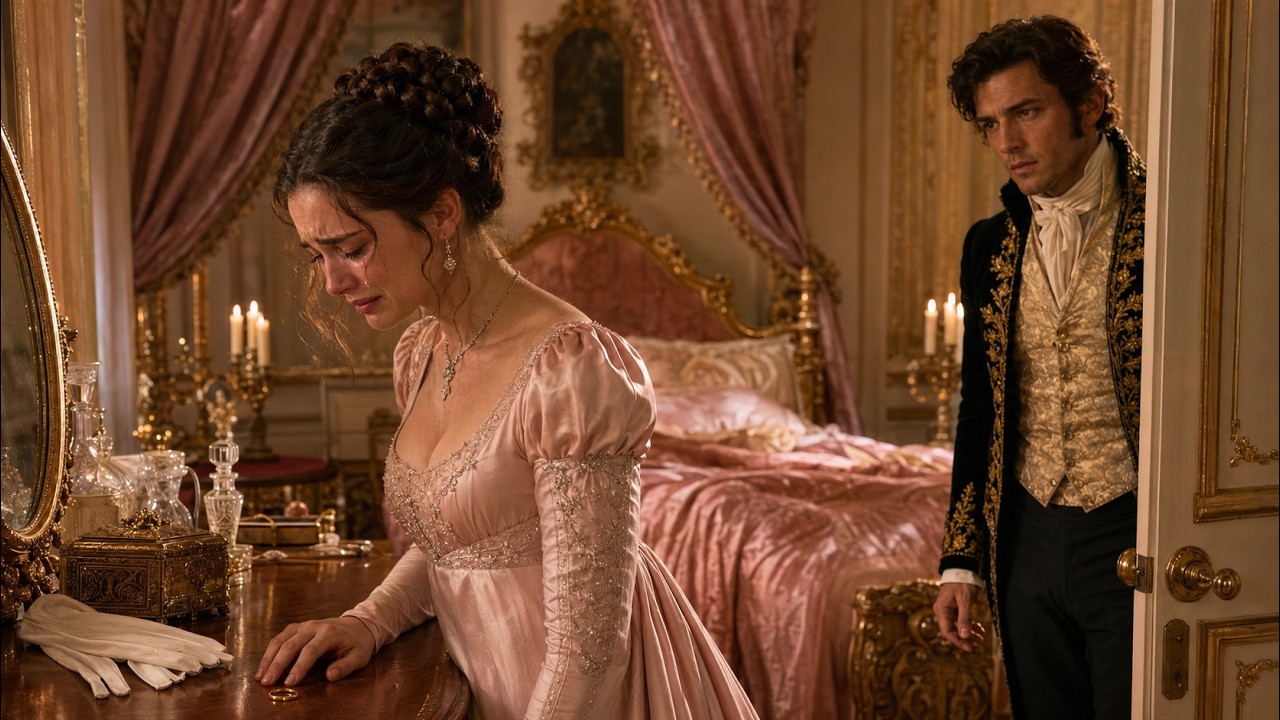
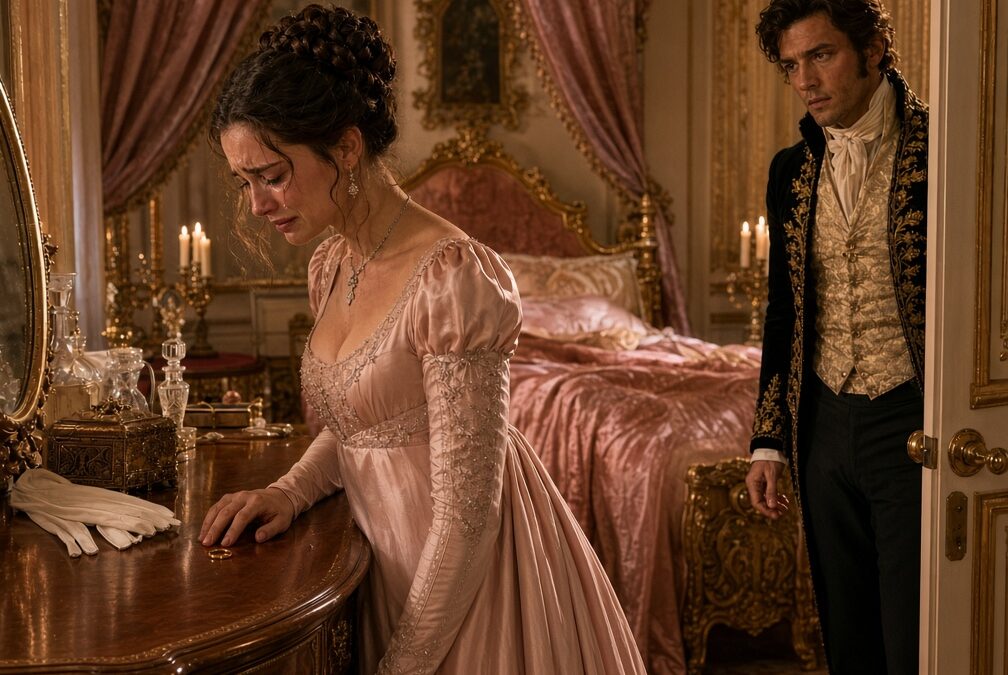
The door slammed before Charlotte Winslow could even remove her gloves. She stood alone in the middle of the bridal chamber, candlelight flickering across silk sheets that had been pressed and perfumed for a night that was supposed to change her life forever.
Instead, her husband of six hours had turned on his heel the moment the door closed behind them, muttered something about needing air, and walked out without a single glance back.
Charlotte did not move for a long moment. She listened to his footsteps fade down the corridor, listened to a door close somewhere far below, and then listened to nothing at all.
She had known, of course, that this marriage was not born of love. Lord Alister Grey, Earl of Rensworth, had needed a wife with a respectable name and a quiet fortune to settle his family’s debts, and her father had needed a title to secure his place among men who had once looked down on him.
It was a bargain struck over brandy and ledgers, sealed with vows neither of them had chosen to mean.
But she had not expected this. She had not expected to stand in her wedding dress, alone, while the man she had just promised her life to disappeared into the night as though the sight of her offended him.
Charlotte walked to the window and pressed her palm against the cold glass. Below, in the moonlit garden, she could just make out a shape moving toward the stables.
It was him. He did not look back at the house. He did not look back at her.
She should have felt sorrow. Instead, something colder and sharper took root in her chest.
She thought of her mother, who had spent 30 years married to a man who barely spoke to her, who had faded a little more each year until there was almost nothing left of the woman she once was.
Charlotte had promised herself, long before she ever met the Earl of Rensworth, that she would not become that.
She would not spend her life waiting in empty rooms for a man who could not be bothered to explain himself.
A soft knock came at the door. It was Nora, her lady’s maid, the only person in this house who had traveled with her from her father’s estate, the only face here that did not belong to strangers.
“My lady,” Nora said quietly, stepping inside and closing the door behind her. The staff are saying his lordship rode out.
Are you unwell? Charlotte turned from the window. In the candlelight, her face betrayed nothing, though inside a storm was gathering.
I am perfectly well, she said, but I find I am no longer tired. Sit with me a moment, Nora.
I wish to think. Nora sat, though her eyes were full of worry. She had known Charlotte since childhood, had watched her grow from a clever, curious girl into a woman who noticed everything and said little.
She knew that quiet, thoughtful look on her mistress’s face. It was the look Charlotte wore when she was solving a problem no one else had noticed yet.
You are not thinking of the wedding breakfast, Nora said carefully. You are thinking of something else.
I am thinking, Charlotte said slowly, that a man does not walk away from his own wedding night without a reason.
And I intend to learn what that reason is. She did not sleep that night.
Instead, she sat at the small writing desk in the corner of the chamber and began, quietly, to think through everything she had observed since the engagement was announced 2 months before.
She thought of the way the Earl’s mother, the Dowager Countess, had gone pale the day the betrothal was signed, then recovered herself so quickly that Charlotte had almost believed she imagined it.
She thought of the letters the Earl received and burned rather than read aloud at breakfast, though it was his habit to share small pieces of correspondence over tea.
She thought of the strange visitor who had come to Rensworth Hall a week before the wedding, a man in a plain black coat who had spoken with the Earl behind closed doors for nearly an hour, and who had left looking satisfied in a way that made the servants uneasy.
Something was wrong at Rensworth Hall. Something had been wrong for weeks, and on the one night when a husband was meant to turn toward his wife, Alister Grey had turned away instead, as though protecting her from something he could not bring himself to name.
Charlotte did not believe, not for a single moment, that he simply did not want her.
She had seen the way his eyes lingered on her during the ceremony, quick and searching, as though he were trying to memorize her face before something took it from him.
That was not the look of an indifferent man. That was the look of a man saying goodbye.
By the time the first gray light touched the windows, Charlotte Winslow, now Countess of Rainsworth in name if nothing else, had made her decision.
She would not wait in this house like her mother had waited in another. She would not sit quietly while a secret she did not understand shaped the rest of her life.
If her husband would not tell her the truth, she would go and find it herself, on her own terms, by her own hand.
“Nora,” she said softly, as the maid dozed in the chair beside her, “wake up.
We have very little time, and a great deal to do before the household stirs.”
Nora’s eyes opened at once, sharp and alert, as though she had never truly been asleep at all.
“My lady?” “I am leaving,” Charlotte said, “before sunrise, and I need your help to do it quietly.”
Nora did not argue. She had seen that look before, on the day Charlotte’s father tried to force her into a match with a man twice her age, and Charlotte had calmly, methodically, made herself so unpleasant to the suitor that he withdrew his offer within a fortnight.
She knew better than to stand between Charlotte Winslow and a decision already made. “Where will you go?”
Nora asked, already moving to the wardrobe, already thinking ahead to what could be carried and what must be left behind.
“To my aunt’s cottage in the north, first,” Charlotte said. “No one thinks of her.
No one will look for me there. And from there, I intend to learn exactly what Lord Rainsworth is hiding, and why he thought it wiser to abandon me than to trust me with the truth.”
She changed quickly out of her wedding dress and into a plain traveling gown that Nora had thought to pack, almost as though some part of her had known this night would end differently than expected.
She took only what she could carry easily, a small case of clothes, the modest jewelry that had belonged to her own mother rather than than given to her by the Gray family, and a leather pouch of coins she had quietly saved over the past 2 months, unwilling to depend entirely on a husband she barely knew.
Before she left, she stood once more at the small writing desk and took up her pen.
She did not write a letter of anger. She did not write a letter of heartbreak, though some small part of her did ache at the thought of the man who had looked at her so strangely during their vows.
Instead, she wrote a single line, precise and unreadable to anyone who did not know her well enough to understand it.
“I will not be left in the dark. When you are ready to see me as an equal, you may come and find me.”
She left the note on the pillow beside her wedding ring, the gold band catching the first thin light of morning, and then she and Nora slipped down the servants’ stair and out through the kitchen garden, where a hired carriage was already waiting on the lane beyond the hedge, arranged the night before through a note Nora had carried to the village without a single soul at Rensworth Hall suspecting a thing.
As the carriage pulled away into the pale morning, Charlotte allowed herself one glance back at the great stone house rising behind her, its windows still dark, its secrets still locked inside its walls.
She did not know yet what Alister Grey was hiding, or why he had chosen silence over honesty on the very night he owed her the truth, but she intended to find out.
And when she did, she would not come to him as a forgotten bride begging for explanations.
She would come to him as a woman who had built a life without him, strong enough to demand the truth on her own terms, and never again to be left standing alone in an empty room while someone else decided what she was allowed to know.
Nora sat across from her in the swaying carriage, watching the hedgerows blur past in the grey morning light, and finally allowed herself to ask the question she had been holding back since they slipped through the kitchen garden.
“Are you frightened, my lady?” Charlotte considered the question honestly before answering, turning it over the way she turned over every difficult thing, slowly and without flinching.
“I am not frightened of what lies ahead.” She said at last. “I am frightened of what it would have cost me to stay.
That fear is worse, Nora. A woman can survive uncertainty. I am not certain she can survive a lifetime of being made small in her own home.”
Nora nodded, though her eyes remained troubled. “And if he comes after you, if he demands you return, as is his right by law?”
“Then he will find a woman who left because she was given no reason to stay, and who will only return when she is given a reason worth returning for.”
Charlotte said. “Not before.” The carriage rattled on through the pale morning, past fields still silvered with frost, past a small chapel where a lone farmer’s boy was already at work sweeping the front steps, past all the ordinary business of a world that had no idea a scandal was about to break wide open behind them.
Charlotte watched it all pass with a strange, distant calm, as though she were already several steps ahead of herself, already living in the life she meant to build rather than the one she had left crumbling in her wake.
The carriage rounded the bend in the road, and Rensworth Hall disappeared behind the hills, taking its secrets with it, for now.
By the time the sun rose fully over the estate, casting warm gold light across the lawns and gardens, the new Countess of Rensworth was already gone, and nothing at Rensworth Hall would ever be quite the same again.
Inside the house, a housemaid climbing the stairs with the morning tea tray paused outside the bridal chamber, knocked softly, and receiving no answer, pushed the door open to begin her morning duties.
The room was empty. The bed had not been slept in, and on the pillow, catching the early light, lay a single gold ring beside a folded note, the only trace left of the woman who had walked out of Rensworth Hall before the household even woke to discover she was gone.
The maid’s tray slipped from her hands, and the sound of shattering porcelain echoed through the silent corridor, the first sign of the scandal that was about to break over the entire county.
Word would spread by midday. By evening, it would reach London. And somewhere on the road north, riding away from the only home she had ever been promised, Charlotte Winslow was already beginning to plan her next move, unaware of just how far this single choice would carry her, or how completely it would change the man she had left behind.
By the time the sun had fully risen over Rensworth Hall, the entire household was in an uproar.
Servants whispered in the corridors, the housekeeper wept into her apron, and the dowager countess sat rigid in the morning room, her tea untouched, her face pale as parchment.
Alister Gray returned just after dawn, his boots muddy from the fields, his mind still tangled in the decision he had made the night before.
He had told himself it was for her protection, that walking away was the only way to keep the danger circling him from ever touching her.
He had told himself many things during his long sleepless ride across the estate. None of them had prepared him for what awaited him at the top of the stairs.
He found the bridal chamber exactly as the housemaid had left it. The bed untouched, the ring resting on the pillow like a small accusing eye, and beside it the note, its ink still dark and fresh.
He read it twice before the words settled into meaning. I will not be left in the dark.
When you are ready to see me as an equal, you may come and find me.
For a long moment, Alister simply stood there, the paper trembling slightly in his hand, though he would never have admitted to trembling at anything.
“She is gone, my lord,” said Hensley, the estate steward, standing carefully in the doorway as though afraid to enter fully.
“No carriage was seen leaving from the front drive. The stable master says none of the horses are missing.
We believe she left on foot, or by a private arrangement made before the household woke.”
“Search the grounds,” Alister said, his voice low and controlled, though something in his chest had gone tight and cold.
“Quietly. I do not want this spoken of outside these walls until I understand what has happened.”
But it was already too late for quiet. By mid-morning, a stable boy delivering feed to a neighboring farm had mentioned, quite innocently, that a hired carriage had been seen on the north road before sunrise, and by midday, the story had traveled from farmhouse to farmhouse, gathering detail and speculation with every retelling, until it reached the ears of the one person in the county who most wished to make use of it.
Baron Edric Farrah read the news over his breakfast with a slow, satisfied smile. He had waited a long time for an opportunity such as this.
Ever since Alister Grey had refused to hand over the deed to the western fields 3 years before, refused to bow to pressure or threat, Farrah had been searching for a way to bring the proud Earl of Rensworth to his knees.
A scandal involving a vanished bride, arriving on the very night of the wedding, was more than he could have hoped to engineer himself.
He folded the newspaper carefully, called for his valet, and began composing, in his mind, the letters he intended to send to every drawing room in London before the week was through.
Farrah had known Alister’s father years ago, and had watched the old Earl grow desperate and careless in his final years, borrowing against land that was never truly his to risk.
When the debt passed to Alister unpaid, Farrah had believed the matter would resolve itself quickly, that a proud young Earl, newly burdened with his father’s mistakes, would rather surrender a distant field than see his family’s name dragged through court.
He had not accounted for Alister’s stubbornness, nor for the quiet, careful way the young Earl had begun rebuilding the estate’s finances through honest means rather than convenient surrender.
Three years of frustration had curdled, slowly, into something closer to personal hatred, and Farrah had grown patient in the way only a truly bitter man can grow patient, waiting for the single crack in his rival’s composure that would finally let him inside.
A vanished bride, on a wedding night no less, was more than a crack. It was a door standing wide open.
Meanwhile, on the road north, Charlotte Winslow watched the countryside roll past the carriage window, her hands folded calmly in her lap, though her thoughts moved faster than the wheels beneath her.
She had expected to feel frightened. Instead, she felt strangely alive, as though she had spent her whole life waiting for permission to act, and had finally simply taken it.
“You are certain your aunt will receive us without warning?” Nora asked, breaking the long silence between them.
“My aunt has never once turned away a guest in her life,” Charlotte said. “Least of all one who arrives with a story worth hearing.”
Her aunt, Mrs. Beatrice Holloway, lived a full day’s journey from Rensworth Hall, in a modest stone cottage on the edge of a quiet village that most of society had long since forgotten existed.
She had married beneath her own family’s expectations decades before, choosing a country doctor over a title, and had never once regretted the trade.
She was exactly the sort of woman who would understand why a bride might choose to vanish rather than remain silent.
When the carriage finally rolled to a stop outside the cottage late that evening, Beatrice Holloway opened her door before Charlotte had even reached the gate, took one look at her niece’s traveling clothes and determined expression, and said only, “Come inside before the whole village sees you standing there.
You can explain everything over supper.” Charlotte did explain every detail she could recall, from the strange visitor in the black coat to the burned letters to the look on her husband’s face as he said his vows, as though he already knew the marriage was doomed before it had truly begun.
Beatrice listened without interrupting, her sharp eyes narrowing slightly at certain details, until Charlotte finally finished and sat back, exhausted from the telling.
“You believe he is protecting you from something,” Beatrice said slowly, “not rejecting you.” “I believe,” Charlotte said, “that a man does not look at a woman the way he looked at me during our vows, and then walk away out of indifference.
Indifference does not carry that much sorrow in it. Beatrice was quiet for a long moment, turning her teacup slowly in her hands.
“There are old rumors,” she said finally, “about the Grey family, about a debt the old Earl left behind when he died, one that was never fully settled.
I heard whispers of it years ago, though I never gave them much attention at the time.
If those rumors carry any truth, your husband may be caught in something far larger than either of you understands.”
Charlotte felt a small, cold thrill of certainty settle over her. “And I intend to learn exactly what that something is,” she said.
“And I do not intend to wait quietly for him to decide when I am allowed to know.”
Over the following days, Charlotte did not sit idle in her aunt’s cottage, waiting for news or for rescue.
Instead, she began quietly building a life of her own, one that owed nothing to the name she had married into.
She used the small sum of coins she had saved to purchase fabric and thread, and within a week, she had set up a modest work of fine embroidery and dressmaking, offering her considerable skill to the wives of the local gentry, who had grown tired of sending to London for every new gown, and were delighted to find such talent close to home.
Word of the skilled seamstress with the elegant, unusual designs spread quickly through the county, though no one connected the quiet, composed woman working from Mrs.
Holloway’s cottage with the vanished Countess of Rensworth making headlines two counties away. Charlotte kept her true name close, introducing herself only as Charlotte Winslow, her maiden name, and allowing everyone who met her to assume whatever story suited them.
She was not lying, not truly. She had simply chosen, for now, not to be defined by a marriage that had begun with a locked door and an empty room.
Meanwhile, back at Rensworth Hall, Alister Grey found himself trapped between two forces he could not control.
On one side, Baron Farrow’s whispers were growing louder, painting Alister as a cruel and neglectful husband who had driven his young bride to flee in terror on their very wedding night.
On the other side, the true danger that had made Alister walk away in the first place had not disappeared simply because his wife had vanished.
If anything, her disappearance made the threat more dangerous, not less, because now no one knew where she was, and a man who wished to use her against Alister might search for her with far less mercy than her own husband had shown.
“You must find her,” his mother told him one evening, her voice sharp with worry she rarely allowed herself to show.
“Whatever foolishness led you to walk away that night, you must set it right before [clears throat] Pharaoh destroys what little reputation this family has left.”
“I am not concerned with reputation,” Alister said, though the words came out heavier than he intended.
“I am concerned that the man threatening this family may find her before I do.”
His mother’s face went very still. “Then you had better start looking,” she said quietly, “and pray you are not already too late.”
That night, Alister sat alone in his study long after the household had gone to sleep, staring at the note his wife had left behind, reading her words again and again until they were burned into his memory.
“I will not be left in the dark. When you are ready to see me as an equal, you may come and find me.”
He had married a woman he barely knew, expecting perhaps a quiet, obedient companion who would ask no difficult questions and accept whatever explanation, or lack of one, he chose to offer.
Instead, he had married a woman who had looked at silence and secrecy and simply refused to accept them, who had taken her fate into her own hands the very first night she was given reason to doubt him.
For the first time since the wedding, Alister allowed himself to wonder if perhaps Charlotte Winslow was far stronger and far more dangerous to underestimate than he had ever imagined.
He rose from his desk, crossed to the window, and looked out at the dark field stretching toward the northern road, the same road she had vanished down before sunrise.
Wherever she was, he intended to find her. Not to drag her back to a marriage built on silence, but to finally give her the truth he should have offered from the very beginning, before Pharaoh, or whatever force had frightened him into walking away, could reach her first.
He spent the following days making quiet, careful inquiries, reluctant to draw attention to the search and give Pharaoh further fuel for his whispers.
He wrote to distant relations who might have offered her shelter, sent a trusted groom to make discreet inquiries along the northern coaching routes, and combed through every conversation he could recall from their brief courtship, searching for any mention of family, any offhand remark about a beloved aunt or a childhood friend, anything that might point toward where a clever, resourceful woman would choose to disappear.
It was slow, frustrating work, made harder by his own insistence on discretion, and harder still by the growing pressure of Pharaoh’s public campaign against his name.
More than once, he considered abandoning caution altogether and simply riding out in every direction until he found her, but Louisa talked him out of it each time, reminding him that a reckless search would only draw Pharaoh’s attention faster, and that whatever protection Charlotte had managed to find for herself, a loud and desperate search from her husband might undo in an afternoon.
The question that kept him awake long into the night was not whether he could find her.
It was whether, once he did, she would ever be willing to listen. Three weeks after the wedding that never truly began, the story of the vanished Countess of Ransworth had become the most talked about scandal in London.
It traveled from drawing room to drawing room, growing more elaborate with each telling, until the simple truth of a bride who had walked away from a silent husband became a tale of cruelty, madness, and hidden violence, each version more dramatic than the last.
Baron Pharaoh made certain of that. He wrote letters under false names to the most influential gossips in the city.
He arranged, quite by accident of course, to be seated beside the right hostesses at the right dinners, where he would sigh heavily and say only that he feared for the poor young countess, that he had heard troubling things about Lord Rensworth’s temper, and that he hoped, sincerely, that she had found somewhere safe.
He never said anything that could be traced directly back to him. He did not need to.
The seeds he planted grew on their own, watered by the eager curiosity of a society that loved nothing more than a fallen aristocrat.
Alister felt the weight of it everywhere he went. Doors that had once opened easily now closed a fraction slower, a fraction more carefully.
Old friends greeted him with polite distance rather than warmth, and through it all, he could not defend himself without revealing the very secret he had walked away to protect.
The truth was this: His father, the late Earl, had borrowed heavily from Baron Ferro’s own father years before, using a portion of the estate’s most valuable land as collateral, land that had belonged to the Grey family for generations, and that Alister had sworn, on his father’s deathbed, never to surrender.
When Alister refused to honor a demand from Ferro to hand over the land in exchange for silence about the old debt, Ferro had turned to quieter, crueler methods of pressure.
A letter had arrived 3 weeks before the wedding, warning Alister that if he did not comply, someone close to him would suffer the consequences instead.
The wedding had already been arranged by then, the contract signed, the date fixed. Alister could not undo the marriage without scandal of its own, but he could, he believed, protect his new wife by keeping his distance from her, by ensuring that whatever danger followed him never had reason to follow her as well.
It had seemed, in the quiet desperation of that night, like the only path that might keep her safe.
It had not occurred to him, not truly, until he watched her disappear into the very danger he was trying to shield her from, that silence could be its own kind of harm.
His sister, Louisa, found him in the study one gray afternoon, staring at a letter from Ferro that had arrived that morning, its tone light and almost friendly, which somehow made the threat inside it feel worse.
“You cannot keep carrying this alone,” Louisa said, closing the door behind her. “Mother suspects something is wrong beyond a simple quarrel between husband and wife.
I suspect it, too. And if we suspect it, Pharaoh’s enemies in London will begin to suspect it as well.
And then it will no longer be your secret to control.” Alister set the letter down slowly.
“If I tell you the truth,” he said, “you must promise me it goes no further than this room.”
Louisa sat across from him, her expression steady. “I have kept your secrets before,” she said.
“I can keep this one.” So, Alister told her everything. The debt, the threat, the reason he had walked away from Charlotte on their wedding night rather than risk her safety by staying close to a danger he did not yet know how to defeat.
Louisa listened in silence, her hands folded tightly in her lap, until he finished. “You fool,” she said at last, though there was no cruelty in her voice, only sorrow.
You thought distance would protect her, but distance only left her exposed, without protection, without even the knowledge of what she needed to guard against.
If Pharaoh learns where she has gone before we do, she will have no idea what danger she is truly in.”
The words struck Alister harder than he expected. “Then we must find her first,” he said, rising from his chair with new purpose.
“Quietly, before Pharaoh’s people do.” Meanwhile, far from London and its whispers, Charlotte Winslow had begun to build something she had never expected to find so quickly, a life entirely her own.
Her small dressmaking work had grown beyond anything she or her aunt had anticipated. What began as a favor for a neighbor’s daughter’s ball gown had turned, within a month, into a steady stream of commissions from families across the county, drawn by the elegance of her designs and the quiet confidence with which she discussed fabric, cut, and color, as though she had studied fashion in Paris itself.
She had, in fact, learned much of her skill from her own mother, who had once dreamed of opening a shop before marriage and circumstance closed that door for her.
Charlotte had never forgotten those lessons, tucked away quietly through years of formal education meant to prepare her for a life as someone’s wife rather than someone’s equal.
Now, far from the expectations of that old life, she found herself finally using them.
“You have a gift for this,” said Mrs. Winthrop, the wife of a prosperous local merchant, during a fitting one afternoon.
“I dare say you could dress half of London if you set your mind to it.”
Charlotte only smiled and continued pinning the hem of the gown, though something in her chest warmed at the words.
For the first time since her wedding night, she felt useful, valued, and entirely certain of her own worth, independent of any name a marriage had given her.
But even as her new life flourished, Charlotte had not abandoned her quiet investigation into the truth behind her husband’s silence.
She wrote carefully worded letters to a distant cousin who worked as a clerk in London, asking, under the guise of idle curiosity, whether he had heard any recent talk of the Gray family’s finances or old debts.
She listened closely whenever a client mentioned news from the city, filing away every scrap of gossip that might one day prove useful.
It was through one such conversation, during a fitting with Mrs. Winthrop’s sharp-tongued sister, that Charlotte first heard Baron Farrow’s name spoken aloud.
“They say he has been quite vicious in his talk of the Rensworth scandal,” the woman said, admiring her reflection in the glass.
“Practically dining out on the story every night this month. Strange, is it not, how eager he seems to keep the tale alive when most men would have grown bored of gossip by now?”
Charlotte kept her expression carefully neutral, though her mind moved quickly. “Strange indeed,” she murmured, securing a final pin.
“One might almost think he had some personal interest in the story continuing.” “Oh, I shouldn’t wonder,” the woman said carelessly.
“There was some old business between the families years ago, though I could never get the full details.
Something about land, I believe, or debts left unpaid. My husband would know more if you are curious.
He does enjoy discussing such things over dinner far more than I care to hear them.
Charlotte filed the information away carefully, her earlier suspicions sharpening into something closer to certainty.
A debt, old business between the families, a man who seemed unusually invested in keeping a private scandal alive in public conversation.
It was not proof, but it was a thread, and Charlotte Winslow had never in her life been the sort of woman to leave a thread unpulled.
That evening, she sat with her aunt over a simple supper and laid out everything she had gathered.
“I believe,” Charlotte said slowly, “that my husband did not walk away from me out of coldness or regret.
I believe he walked away because someone was threatening him, and he thought silence would keep that danger from touching me as well.”
Beatrice studied her niece carefully. “And what will you do with this belief?” She asked.
Charlotte was quiet for a long moment, staring into the fire. “I do not yet know,” she admitted, “but I know I will not simply wait for him to come and explain himself, as though I were a piece of property left behind to be reclaimed when convenient.
If there is danger, I want to understand it. And if my husband will not offer the truth freely, I intend to find enough of it myself that he has no choice but to finish the story when we meet again.”
“And you believe you will meet again?” Beatrice said, not quite a question. Charlotte allowed herself, for the first time since that terrible wedding night, a small determined smile.
“I believe,” she said, “that a man who looked at me the way he did during our vows does not simply let a woman disappear from his life forever.
He will come looking, and when he does, I intend to be exactly where I choose to be, on exactly the terms I choose to set.”
Outside the cottage window, the last light of evening faded slowly over the quiet county, while 200 miles away, in a townhouse in London, Alister Gray stood before a map spread across his desk, marking every road, every village, every place his missing wife might possibly have gone, determined to find her before the man who had driven him to walk away in the first place could find her first.
Charlotte’s cousin in London, a mild and rather bored clerk named Edwin Halstead, proved more useful than she had expected.
His reply arrived within the week, carefully worded but rich with detail, describing a heated exchange he had overheard at his employer’s offices between two solicitors discussing a long-running boundary dispute between the Gray and Sparrow estates.
A dispute that, according to one of the men, had recently taken a distinctly personal turn.
Edwin could not say more without risking his own position, but he promised to keep his ears open and write again the moment he learned anything further.
Charlotte read the letter twice by candlelight, then folded it carefully into the small wooden box where she kept every scrap of information she had gathered so far.
It was not proof of danger, but it confirmed at least that the conflict between the two families was real, ongoing, and far more personal than simple old business between distant relations.
Whatever her husband was protecting her from, it had teeth, and it had been growing sharper for years before she ever arrived at Rensworth Hall.
She thought, not for the first time, of the strange visitor in the black coat who had come to the house a week before her wedding, and wondered, with a growing certainty she did not like, whether that visit and the boundary dispute Edwin described were one in the same thread, simply waiting for her to pull it fully into the light.
Neither of them yet knew how close their paths were about to come, nor how much would change the moment they finally crossed.
The invitation arrived at Mrs. Holloway’s cottage on a bright autumn morning, carried by a footman in fine livery, who looked distinctly out of place among the modest stone houses of the village.
Mrs. Winthrop was hosting a grand autumn assembly at her husband’s estate, the largest social gathering the county had seen in years, and she had specifically requested that Miss Charlotte Winslow attend, both as an honored guest and as the talented seamstress whose work would be on full display across half the gowns in the room.
“You cannot refuse,” Beatrice said, reading the invitation over Charlotte’s shoulder. “It would be an insult to a woman who has done more for your reputation in this county than anyone else.”
Charlotte hesitated only briefly. Attending a large gathering meant risking recognition, meant stepping, however briefly, back into a world where someone might connect the quiet seamstress Charlotte Winslow with the vanished Countess of Rensworth, but it also meant an opportunity.
Large gatherings drew visitors from London, drew gossip and news from the very circles she had been trying to learn about from a distance for weeks.
“I will attend,” Charlotte said finally, but carefully. She spent the following days preparing not only Mrs.
Winthrop’s gown, but her own, choosing a design elegant enough to befit the occasion, yet different from anything she had worn as Countess of Rensworth that even someone who had attended her wedding might not immediately recognize her.
She wore her hair in a new style, added a pair of simple spectacles she did not truly need, but which subtly changed the shape of her face, and reminded herself, quietly, that confidence was often the best disguise of all.
People rarely looked closely at a woman who appeared entirely at ease with her surroundings.
The night of the assembly arrived clear and cold, the Winthrop estate glowing with candlelight spilling from every window.
Charlotte arrived with her aunt, and within minutes of entering the great hall, found herself surrounded by admiring guests eager to compliment the gowns she had designed, each one more effusive than the last.
She was in the middle of a conversation about fabric imported from the continent when she felt it, a strange prickling awareness, as though someone across the crowded room had gone suddenly still.
She turned and found herself looking directly across the hall into the eyes of her husband.
Alister Gray stood near the far entrance, having arrived only that evening, drawn to the Winthrop Assembly by a lead from his cousin in London who had mentioned, offhandedly, that a woman of remarkable skill and unusual composure had recently established herself as a seamstress somewhere in this county.
A woman no one seemed to know much about, who had arrived, quite suddenly, some weeks before.
It was a thin lead, but it was the first thin lead he had found in three weeks of careful, quiet searching, and he had followed it without much hope, expecting another dead end.
He had not expected to see her immediately, standing across a crowded ballroom in an unfamiliar gown, her hair styled differently, a pair of spectacles perched on her nose that she had certainly never worn during their brief courtship, and yet unmistakably, impossibly, his wife.
For a long moment, neither of them moved. The music continued. The crowd continued its bright, oblivious chatter.
And across the space between them, husband and wife regarded each other for the first time since the night he had walked out of their bridal chamber and she had vanished before sunrise.
Charlotte recovered first. She turned smoothly back to her conversation, her expression giving nothing away, though her heart hammered violently beneath her carefully composed gown.
She did not know yet whether he had recognized her fully or whether the changes to her appearance had bought her even a moment of doubt.
She needed time to think, time to decide how to handle this sudden collision of the life she had built and the life she had left behind.
She did not get much time. Within a quarter hour, Alister had made his way across the room, navigating polite greetings and conversations with the practiced patience of a man determined to reach a single destination.
He arrived at her side just as the small crowd around her began to disperse toward the refreshment tables, leaving them, for a brief moment, almost alone.
“Miss Winslow, I believe,” he said quietly, using only her maiden name, though his eyes held a question far too sharp to be simple politeness.
I understand you are responsible for a great deal of the finery in this room tonight.
Charlotte met his gaze steadily, refusing to let even a flicker of recognition cross her features.
You understand correctly, my lord, she said, matching his careful formality. Though I confess I do not believe we have been introduced.
Something shifted behind his eyes, something that might have been relief, or perhaps disappointment, that she had not immediately abandoned the pretense.
Alister Gray, he said. Earl of Rainsford. A pleasure, Charlotte said smoothly. I have heard the name, of course.
It has been rather difficult to avoid these past weeks. A faint, humorless smile touched his mouth.
Yes, he said. I imagine it has. They spoke for several minutes more, carefully, cautiously, each testing the boundaries of what the other was willing to reveal.
Charlotte found herself, despite every reason for caution, genuinely engaged by the conversation. Whatever else was true of her husband, he was not a foolish man, nor a dull one.
He spoke with quiet intelligence about trade, about the difficulties facing the county’s farmers this season, about a book of poetry he had recently read, and found more moving than he expected.
He listened, truly listened, to her opinions in return, without the dismissive politeness so many men offered women whose thoughts they had no real interest in hearing.
It would have been easy, dangerously easy, to forget for a moment who he truly was.
You seem a woman of remarkable independence, Miss Winslow, Alister said eventually, his tone carefully light, though his eyes remained watchful.
Tell me, have you always lived so freely, answering to no one but yourself? Charlotte held his gaze, understanding perfectly the question beneath the question.
I have learned, she said carefully, that a woman who waits for permission to live her own life may find herself waiting a very long time.
I decided, some while ago that I would rather act than wait. Something flickered across his face, quick and difficult to read.
Regret, perhaps, or recognition. “That seems,” he said quietly, “a very wise philosophy.” Before either of them could say more, Mrs.
Winthrop swept in to claim Charlotte’s attention for an introduction to a visiting duchess, and the moment broke apart, leaving Alister standing alone with far more questions than he had arrived with, and Charlotte retreating across the hall with her heart pounding and her mind racing through every word they had exchanged.
She did not believe he had recognized her fully, not with certainty, but she had seen the way his eyes lingered, the way something in his expression seemed to be searching for confirmation of a suspicion he had not yet allowed himself to fully trust.
She would need to be more careful. And yet some quiet, unexpected part of her was almost sorry the conversation had ended so soon.
Later that evening, as the assembly began to wind down and guests gathered their cloaks against the cold night air, Alister found himself standing near the entrance hall when a familiar, unwelcome voice spoke close behind him.
“Rensworth, what an unexpected pleasure.” Alister turned to find Baron Ferro smiling at him with the particular warmth of a man who enjoys watching another suffer.
“Ferro,” Alister said coldly, “I did not expect you at a country assembly so far from London.”
“Business brings me to the area,” Ferro said lightly, “land business, in fact, of the very sort we discussed some months ago.
I confess I am pleased to see you looking so well, given the difficulties your household has faced lately.
I do hope your missing countess has been found safe and well.” Alister kept his expression carefully blank, though every instinct in him sharpened at once.
“She is being sought,” he said simply, “as you well know.” Ferro’s smile widened slightly.
“Of course,” he said. “Do give her my regards whenever you find her. I am, after all, quite invested in the continued good health and reputation of the Grey family.
It would be such a shame if anything further were to disrupt it. He walked away before Alister could respond, leaving behind only the cold echo of a threat delivered in the politest possible terms.
Alister stood very still for a long moment, his mind racing through the implications. Pharaoh had been present at this very assembly, the same assembly where he had just spent nearly an hour in close conversation with a woman he strongly suspected was his missing wife.
If Pharaoh had noticed that conversation, if he had drawn even a fraction of the same suspicion, then Charlotte’s careful disguise might already be compromised, and the danger he had walked away to protect her from might now be closer than either of them realized.
He turned quickly, scanning the thinning crowd for a glimpse of blue silk and carefully styled hair, but Charlotte and her aunt had already gone, slipping quietly out a side entrance while Pharaoh held his attention at the front of the hall.
Alister’s jaw tightened. He had found her after weeks of searching, and in finding her, he may have inadvertently led the very danger he feared straight to her door.
He found Louisa still awake when he returned to his lodgings that night, working through correspondence by lamplight, and told her, in low, urgent tones, everything that had happened at the assembly.
“You must go to her tomorrow,” Louisa said at once, setting down her pen. “Not in a week, not once you have composed the perfect speech.
Tomorrow, before Pharaoh has time to act on whatever suspicion he carried away from that ballroom.
“And if she refuses to see me?” Alister asked. “I gave her every reason to refuse.”
Louisa studied her brother for a long moment, her expression softening slightly. “Then you will have lost nothing you had not already lost the night you walked out of that bridal chamber,” she said.
“But I do not think she will refuse. A woman who left a note asking to be seen as an equal is not a woman who has closed her heart entirely.
She has simply closed the door on being taken for granted. Those are are the same thing, Alister, though I suspect you have spent 3 weeks confusing them.
There was no more time for careful distance, for silent protection from afar. Whatever pride or fear had kept him from telling her the truth on their wedding night, he could not afford to make that same mistake twice.
He needed to reach her again, quickly, and this time he needed to tell her everything.
Charlotte did not sleep well that night. She lay awake long after the carriage returned her and her aunt safely to the cottage, replaying every word of her conversation with Alister, every glance, every careful pause between them.
She had gone to the assembly determined to gather information from a safe distance. She had not expected to come away instead with her heart unsettled and her certainty shaken.
By morning, her doubts had hardened into resolve. Whatever she felt during that brief conversation changed nothing about the fact that her husband had still walked away from her on their wedding night without a word of explanation.
Attraction was not trust, and she had built too much in too short a time to abandon it now for the sake of a few charming sentences exchanged across a crowded ballroom.
She was in the small workroom at the back of the cottage sorting through fabric samples for an upcoming commission when Nora burst in, breathless and pale.
“My lady,” Nora said, forgetting in her hurry to use the false name they had agreed upon, “there is a carriage on the road, a fine one with the Rensworth crest.
I believe it is him.” Charlotte’s hands stilled over the fabric. “Did he see you?”
She asked. “No, my lady. I came the moment I saw the crest.” “Through the back garden?”
Charlotte rose slowly, smoothing her skirts, steadying her breath. She had known, somewhere in the back of her mind, that this moment would come eventually.
She had simply not expected it quite so soon. “Tell my aunt to receive him in the front room,” Charlotte said.
“I will join you both shortly. And Nora, whatever happens, do not let him see how frightened you are for me.
I do not intend to be frightened for myself.” By the time Charlotte entered the front room a quarter hour later, composed and dressed simply but with quiet dignity, Alister had already been shown inside, standing near the modest fireplace with an expression caught somewhere between hope and dread.
He turned as she entered, and for a long moment neither of them spoke. “You found me,” Charlotte said finally, her voice steady despite the pounding of her heart.
“I did,” Alister said. “Though I confess, Miss Winslow’s spectacles very nearly fooled me a second longer than they should have.”
A faint, unwilling smile touched Charlotte’s mouth before she could stop it. “Aunt Beatrice,” she said without looking away from her husband, “would you give us the room, please?”
Beatrice studied the pair of them for a moment, then rose without argument and left, closing the door quietly behind her, though Charlotte suspected she did not go far.
“You have 3 weeks of silence to answer for,” Charlotte said once they were alone, her tone measured but firm.
“I suggest you begin at the beginning, and I suggest you leave nothing out.” Alister nodded slowly, and for the first time since she had known him, he looked less like a distant, controlled earl and more like a man carrying a weight he had finally decided to set down.
He told her everything: the old debt his father had left behind, the land Ferro’s family believed was owed to them, the threat that had arrived 3 weeks before their wedding, warning him that anyone close to him would suffer if he did not comply with Ferro’s demands.
His decision, made in desperate haste the night of their wedding, to keep his distance from her in the hope that it would keep her safe from a danger he did not yet know how to defeat.
“I thought,” he said quietly, “that if I stayed away from you, if I gave Ferro no reason to believe you meant anything to me, he would have no reason to use you against me.
I thought I was protecting you. I understand now how foolish that was. I gave you no explanation, no warning, nothing to arm yourself with.
I left you exposed to a danger you did not even know existed, simply because I could not bring myself to trust you with the truth.
Charlotte listened in silence, her expression unreadable, though inside something long clenched tight in her chest began, slowly, to loosen.
“You should have told me,” she said finally. “Whatever your reasons, whatever fear drove your silence, you should have trusted me enough to make my own choices about my own safety.
I am not a piece of property to be hidden away for protection. I am your wife.
If there was danger, I had every right to know it and every right to decide for myself how to face it.”
“I know,” Alister said. “I have known it for 3 weeks, watching Pharaoh’s whispers destroy what little reputation my family had left, wondering every single day whether he had found you before I could.
I have thought of little else since the morning I found your note on that pillow.”
Charlotte crossed the room slowly and picked up the fire poker, more to give her hands something to do than any real need to tend the flames.
“And last night,” she said, “at the assembly, did you know then, truly know?” “I suspected,” Alister admitted.
“The moment I saw you across that room, something in me recognized you, even before my mind fully caught up.
And after we spoke, I was almost certain, but I said nothing, because I did not know yet whether you wish to be found or whether revealing myself too soon might frighten you further away.”
Charlotte set the poker down and turned to face him fully. “Pharaoh was there as well,” she said slowly, piecing together the danger with sharp clarity.
“You spoke with him.” “I did,” Alister said, his expression darkening. “And I fear he may have noticed our conversation or grown suspicious enough to investigate further.
That is why I came so quickly, Charlotte. Whatever you decide about our marriage, about me, I could not leave you unwarned a second time.
Pharaoh may already suspect where you are. You are not safe remaining here.” The weight of his words settled over the room.
Charlotte felt the careful, independent life she had built over the past weeks suddenly threatened by the very danger she had been trying to understand from a distance.
“What do you propose?” She asked, her voice carefully controlled. “I propose,” Alister said, “that you return with me.
Not as a woman being rescued, but as my equal partner in facing this threat directly, with full knowledge of everything I know, and full voice in every decision made from this point forward.
I have spent 3 weeks learning what it cost to keep secrets from you. I do not intend to make that mistake again.”
Charlotte studied him carefully, searching his face for any trace of the coldness that had sent her fleeing on their wedding night.
She found none. Instead, she found a man who looked, for the first time since she had met him, entirely and honestly exposed, offering her not protection from a safe distance, but partnership, freely and completely given.
It was not a small thing to trust him again after everything, but it was, she realized slowly, exactly the offer she had left Rensworth Hall 3 weeks before hoping, someday, to receive.
“I will return,” she said finally. “But not as the woman who vanished on your wedding night, expected to simply forgive and forget.
I return as Charlotte Winslow, a woman who has built her own skill, her own reputation, and her own strength these past weeks, and I intend to keep every part of that, marriage or no marriage.
If we are to face Pharaoh together, we face him as equals in every sense of the word.
Do you accept those terms, my lord?” Alister crossed the room and took her hand, not with the formal, careful distance of their wedding day, but with something warmer, more certain.
“I accept them gladly,” he said. “And I promise you, Charlotte, whatever comes next, you will never again be left standing alone in an empty room while I decide what you are allowed to know.”
Outside the cottage window, the autumn afternoon stretched calm and golden across the countryside, though both of them understood that calm would not last long.
Pharaoh’s suspicion had been stirred, and a man who had waited years to bring the Grey family to ruin would not simply give up his advantage now that his target had reappeared.
Before he left the cottage that afternoon, Alister paused at the door and turned back to her.
“There is one more thing you should know,” he said. “My mother suspects a great deal already, and Louisa knows everything.
If you are willing, I should like them to hear the truth from you directly, rather than through whatever version reaches them secondhand.
My mother in particular has carried a great deal of guilt these past weeks, believing her own silence about the old debt somehow contributed to what happened between us.”
Charlotte considered this for a moment, then nodded. “I should like to meet her properly,” she said.
“Not as a runaway bride returning in disgrace, but as the countess she will have to learn to trust, whether or not she yet believes I have earned it.”
“You have earned a great deal more than that already,” Alister said quietly. “Though I understand if it will take time for the rest of the world to see it as clearly as I have come to.”
Charlotte permitted herself then a small measure of warmth she had been guarding carefully since he arrived.
“Time,” she said. “I have. What I will not permit again is silence.” “Then you shall have honesty instead,” Alister said.
“For as long as you are willing to remain my wife.” The true confrontation, they both knew, was still ahead of them.
But for the first time since their wedding night, they intended to face it together.
Baron Ferro moved quickly once his suspicions were confirmed. Within days of the assembly, he had sent a quiet man of unpleasant reputation to make discreet inquiries in the village near Mrs.
Holloway’s cottage, and it did not take long for word to reach him that the celebrated new seamstress, Miss Charlotte Winslow, had suddenly and completely disappeared along with her aunt and her lady’s maid only hours after Lord Rensworth’s own carriage had been seen departing the same road.
Ferro smiled when he received the news. It confirmed everything he needed to know, and it told him precisely where to strike next.
He did not go to Rensworth Hall directly. That would have been clumsy, and Baron Ferro prided himself on never being clumsy.
Instead, he sent a carefully worded letter to the one place he knew would guarantee the fastest, most damaging response, the desk of the most influential gossip columnist in London, along with a second letter to the magistrate overseeing the old boundary dispute between the Grey and Ferro estates, hinting darkly that Lord Rensworth’s missing bride might not have vanished of her own free will at all, and that certain parties had reason to believe foul play had been involved.
It was a bold, ruthless move, and it worked exactly as Ferro intended. Within a week, whispers of a criminal investigation had spread through London society, and the magistrate, eager to avoid any appearance of favoring a titled family, announced that formal inquiries would be made into the circumstances surrounding the Countess of Rensworth’s disappearance.
Alister received the news at Rensworth Hall with a grim, steady calm that surprised even himself.
He had spent the past several days working closely with Charlotte, laying out every detail of Ferro’s history with the family, every scrap of correspondence, every witness who might be persuaded to speak the truth.
For the first time in years, he did not feel as though he were facing this threat alone.
“He believes cornering us will force your hand,” Charlotte said, reading Ferro’s public statements with narrowed eyes.
“He wants you desperate enough to hand over the land simply to make the scandal disappear.”
“Then we will not give him a desperate man to negotiate with,” Alister said. “We will give him the truth, delivered in a way he cannot control or twist into something uglier.”
Together, they devised a plan. Rather than hiding from the scandal or attempting to quietly settle matters behind closed doors, as Ferro expected, Charlotte and Alister chose to meet the accusation directly, in the most public setting available to them.
The county’s autumn charity ball, hosted that year by the local magistrate himself, was to be held within the fortnight, drawing guests from across the region, including, they had confirmed through careful inquiry, Baron Ferro, who fully intended to attend and continue his campaign of whispered suspicion in person.
It was, Charlotte pointed out, the perfect stage. On the night of the ball, Charlotte arrived on Alister’s arm, not disguised, not hidden, but fully and publicly present as the Countess of Rensworth, dressed in a gown of her own design that turned heads the moment she entered the hall.
Gasps rippled through the crowd. Whispers turned to open staring. The vanished bride, very much alive, very much unharmed, stood calmly beside her husband, as though the past 3 weeks of scandal had never happened at all.
Ferro’s confident smile faltered the moment he saw them. He recovered quickly, moving through the crowd toward them with practiced charm, clearly intending to steer the conversation toward his own advantage before anyone else could ask the questions clearly forming on every guest’s lips.
“Lady Rensworth,” he said smoothly, bowing with exaggerated courtesy, “what a relief to see you safe and well.
The whole county has been quite beside itself with worry.” “How kind of you to say so, Baron Ferro,” Charlotte replied, her voice carrying clearly across the hushed gathering nearby.
“Though I confess, I am curious how such worry translated so quickly into letters suggesting foul play to the London papers, when the truth is a good deal simpler.”
A ripple of interested murmurs spread through the crowd. Ferro’s smile tightened. “I merely repeated concerns others had raised,” he said carefully.
“Did you?” Alister said, stepping forward, his voice calm, but carrying an edge of steel beneath its politeness.
“How curious then, that the concerns you repeated so closely match the language of a letter you sent to my study some weeks before my wedding, threatening harm to those close to me should I refuse to surrender land your family has had no legal claim to for over a decade.”
Ferro’s face went pale, then hard. “That is a serious accusation, Rensworth,” he said. “One I would advise you to be very careful making without proof.
“I have proof,” Alister said. “The letter itself, kept safe these past weeks, along with the testimony of a witness who delivered a second threat to my household on your instruction.
A threat which drove me to make the very foolish, very costly decision to keep my own bride in the dark about the danger surrounding her, rather than trust her with the truth she deserved.”
He turned then, deliberately, to address the gathered crowd rather than Pharaoh alone. “I owe my wife a public apology for that decision,” Alister said, his voice steady despite the weight of the admission.
“I believed silence would protect her. I was wrong, and I believe many of you, hearing whispers these past weeks about cruelty or scandal within my household, deserve the truth as well, rather than the version crafted by a man with a long-standing grudge and a great deal to gain from my family’s ruin.”
Charlotte stepped forward beside him, her chin lifted, her voice clear and unwavering. “I left Rensworth Hall on my wedding night,” she said, “not out of fear of my husband, but out of refusal to remain silent and powerless while decisions were made about my own safety without my knowledge or consent.
I built a life for myself these past weeks, entirely my own, and I returned to my husband’s side not as a woman rescued, but as his equal partner, once he finally trusted me with the truth Baron Pharaoh has spent weeks trying to twist into something far uglier than it ever was.”
The magistrate, present among the guests and already growing uneasy at the public unraveling of the case he had so recently opened, stepped forward with evident interest.
“Lord Rensworth,” he said, “if you possess written evidence of threats made against your household, I would strongly advise you bring it to my office at the earliest opportunity.
Such evidence would significantly alter the nature of any inquiry currently underway.” “I intend to do exactly that, first thing tomorrow morning,” Alister said, his eyes never leaving Pharaoh’s increasingly pale face, “along with the testimony of my sister and my steward, both of whom witnessed the threats delivered against my household in the weeks before my wedding.
Faro, seeing the crowd’s sympathy shifting rapidly away from him, attempted one final, desperate gambit.
“This is a fabrication,” he said sharply, “an elaborate story crafted to distract from the very real question of why a bride would flee her own wedding night in the first place.”
“She fled,” Charlotte said, her voice ringing clear and unshaken across the hall, “because her husband, frightened for her safety, made the mistake of choosing silence over trust.
That is the whole of the scandal, Baron Faro. The rest, the whispers of cruelty, the suggestions of foul play, the pressure applied to the magistrate himself, that is entirely your own creation, built from a decade-old grudge over land your family has no legitimate claim to.
I wonder how the rest of this room will feel once the full truth of your letters becomes known tomorrow.”
A heavy silence fell over the assembly, broken only by the soft murmur of guests exchanging stunned glances.
Faro looked from face to face, watching sympathy and suspicion turn steadily against him, and finding, for the first time in years, no clever words left to salvage his position.
He left the ball shortly after, without another word, his carriage disappearing swiftly down the drive, while the county’s finest families watched him go with expressions that promised his reputation would not recover easily from what they had just witnessed.
The following morning, true to his word, Alister delivered every letter, every piece of evidence, every witness statement to the magistrate’s office, and within a fortnight, the true story had spread through the county with the same speed and thoroughness that Faro’s false version once had.
The formal inquiry into Charlotte’s disappearance was quietly closed, replaced instead by a far more serious investigation into Baron Faro’s history of threats and manipulation, one that would, in time, see his own reputation and fortune diminished far more severely than he had ever intended for the Grey family.
Charlotte stood beside her husband on the steps of Rensworth Hall one crisp morning some weeks later, watching the last of the season’s leaves drift down across the drive, and felt, for the first time since that terrible wedding night, entirely and completely at peace.
“You know,” she said, glancing sideways at Alister, “I never did give you back your ring.”
Alister smiled, reaching into his coat pocket and withdrawing the very ring she had left on the pillow the morning she vanished, which he had carried with him every day since.
“Then perhaps,” he said, taking her hand gently in his own, “we might begin again, properly this time, with nothing left unspoken between us.”
Louisa joined them on the steps a moment later, along with the Dowager Countess, who had, in the weeks since Charlotte’s return, gone from wary distance to something approaching genuine warmth, impressed despite herself by the steady, clear-eyed way her new daughter-in-law had handled both the scandal and its aftermath.
“I owe you an apology as well, my dear,” the Dowager said, coming to stand beside Charlotte.
“I knew of the old debt for years and said nothing, believing it was not a woman’s place to interfere in such matters.
I see now that my silence did as much harm as my son’s. I hope, in time, you will forgive an old woman for learning her lesson so late.”
“There is nothing to forgive,” Charlotte said gently, and found, to her own surprise, that she meant it fully.
“We have all learned, I think, that silence rarely protects the people we love. It only delays the reckoning.”
Charlotte looked down at the ring, then up at her husband, seeing in his eyes none of the cold distance of their wedding night, only honesty, respect, and a quiet devotion earned through weeks of hard truth, rather than empty promise.
“Properly this time,” she agreed, allowing him to slide the ring back onto her finger.
“And this time, my lord, if you ever think of walking away without a word again, you may be certain I will simply follow you out the door and demand an explanation before you reach the stables.
Alister laughed, a warm genuine sound she had not heard from him before that morning, and drew her hand to his lips.
I would expect nothing less, he said, from my equal in every sense of the word.
Behind them, Rensworth Hall stood bathed in the soft morning light, its secrets finally laid to rest, its future no longer shadowed by silence or fear, but built, at last, on the honest partnership between a man who had learned the cost of walking away, and a woman who had proven, beyond any doubt, that she would never again allow herself to be left behind.
A year passed, and Rensworth Hall looked nothing like the cold, silent house it had once been on the morning Charlotte’s disappearance shattered its quiet halls.
The great house was often full now, filled with laughter from the drawing room, with the steady hum of Charlotte’s growing dressmaking work, which she had continued even after returning to her husband’s side, refusing to let marriage erase the independence she had built during those weeks apart.
Her designs were now sought after by families well beyond the county, and she had taken on two young apprentices from the village, teaching them the same skill her own mother had once taught her, determined that her success should open doors for other women, rather than close behind her alone.
Baron Farro’s fortunes, meanwhile, had continued their steady decline. Stripped of much of his credibility after the scandal at the autumn ball, and facing mounting legal troubles from the formal investigation into his threats against the Grey family, he had quietly retreated from London society altogether, selling off much of his estate to cover mounting debts of his own, a quiet, fitting end to a man who had spent so many years attempting to ruin others, rather than build anything worthwhile of his own.
Alister had changed as well, in ways both subtle and profound. He no longer carried decisions alone, no longer mistook silence for strength or distance for protection.
He consulted his wife on matters of the estate, valued her sharp judgment on tenant disputes and financial planning as much as he valued her company at the dinner table, and had, more than once, found himself grateful that she had refused, on that very first morning, to simply wait quietly for an explanation that might never have come.
“You were right, you know,” he told her one evening, as they sat together by the fire in the study that had once held nothing but his loneliest, most desperate decisions.
“Walking away nearly cost me everything worth having. If you had waited quietly for me to find my courage, I fear it might have taken far longer than either of us could have afforded.”
Charlotte looked up from the ledger she had been reviewing, a small, knowing smile touching her lips.
“I did not wait quietly,” she said, “because I learned very early that waiting rarely brings anyone what they truly deserve.
It must be built, deliberately, by one’s own hand. I simply chose to build it myself, rather than leave my future in someone else’s silence.”
Alister reached across the small space between them and took her hand. The same hand he had once slipped a ring onto with careful, formal distance, now held with the easy familiarity of a partnership neither of them had expected, but both had come to treasure.
“Then I am grateful, more than I can properly say,” he said, “that the woman I married that night was never the sort to simply wait.”
Outside, the autumn wind stirred the last golden leaves across the grounds of Rensworth Hall.
The same grounds where, a year before, a bride had walked away before sunrise rather than accept silence in place of truth.
The house that had once nearly crumbled under scandal and secrecy now stood steady and warm, built on honesty hard-won, and on the quiet, unshakable strength of a woman who had refused, from the very first morning, to be anything less than her husband’s equal.
And somewhere in the county, in a modest cottage that had once sheltered a runaway countess, Beatrice Holloway smiled every time she heard news from Rensworth Hall, knowing she had played her own small part in a story that had, against every early fear, found its way to a truly happy ending.








