They Mocked Their Elder Sister For Being Unmarried… Until The Duke Chose Her Before Everyone.
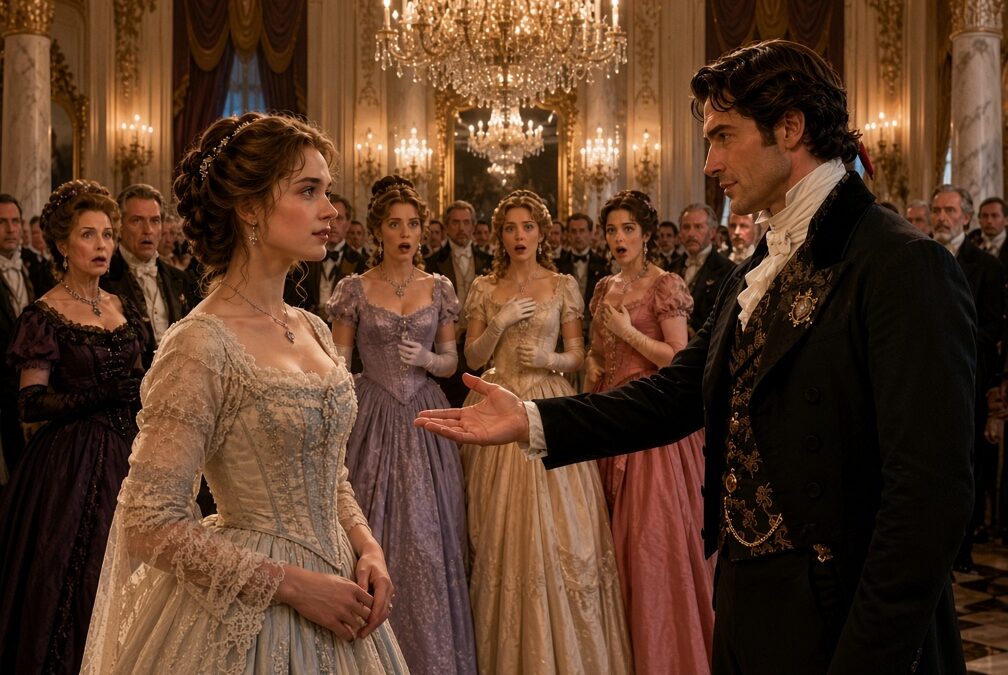
They Mocked Their Elder Sister For Being Unmarried… Until The Duke Chose Her Before Everyone.

The words dropped into the ballroom like a glass falling from a high shelf. Every head turned toward the woman standing near the wall in a gray gown that matched the color of her mood.
Emmeline Wintermere did not flinch. She had learned over many years how to hold her face still even when her chest ached.
Her younger sister Lucinda lifted her hand slowly letting the candlelight catch the new diamond on her finger.
She smiled the way a cat smiles at a bird it has already caught. Some of us are fortunate enough to be chosen, Lucinda said sweetly.
Others simply wait. A ripple of laughter moved through the crowd soft and cruel the kind of laughter that hides behind fans and gloved hands.
Emmeline looked toward her father hoping for even one word in her defense. Lord Wintermere only sighed as though his eldest daughter’s unmarried state was a debt he was tired of paying.
Then the great doors at the end of the hall opened with a sound like thunder rolling in from a distance.
A footman’s voice rang out over the music. His Grace the Duke of Ravenscroft. The room seemed to hold its breath all at once.
Every young woman straightened her spine every fan stopped moving. Mothers pushed their daughters half a step forward as though an extra inch might catch a Duke’s eye but the Duke’s gaze did not move toward the beautiful daughters lined up like prized flowers.
It moved past them. It settled instead on the one woman in the room no one had wanted to look at all evening.
Why would England’s wealthiest and most guarded Duke walk into a ball he was never expected to attend and why out of every glittering woman present would his eyes find her?
To understand that moment we must go back to where it all began. Before she was mocked in front of a crowded ballroom Emmeline Wintermere was mocked quietly, in small ways, every single day of her life.
She was 29 years old, born into a family with an old name and a large house, yet she moved through that house like a servant who had forgotten her wages.
While her younger sisters Lucinda and Henrietta were dressed in silk and paraded before every eligible bachelor in the county, Emmeline managed the household ledgers.
She counted candles. She mended torn hems. She wrote letters her father was too impatient to write himself.
No one asked her opinion on anything important. No one seemed to remember she had one.
At supper one evening, a family friend visited and Lord Wintermere introduced his daughters one by one.
“My youngest, Henrietta, plays the pianoforte beautifully,” he said, beaming. “And my Lucinda, soon to be wed to a most respectable gentleman.”
He gestured vaguely toward Emmeline without quite looking at her. “And this is my eldest.”
That was all. Not her name. Not one kind word. Simply the eldest, as though age alone had erased everything else about her.
Emmeline lowered her eyes and said nothing. She had grown skilled at swallowing silence. Later that night, as she folded linens in the small sewing room she had claimed as her own, the old housekeeper, Mrs.
Prudence, entered quietly and sat down a cup of warm tea beside her. “You work harder than any lady I have ever served,” Mrs.
Prudence said gently. “And you are treated worse than any lady I have ever served.”
Emmeline managed a small, tired smile. “Kindness from you means more than you know, Mrs.
Prudence. It should not have to,” the housekeeper replied. “You deserve kindness from those who share your blood.”
Emmeline said nothing to that. There was nothing to say that would not hurt. It had not always been this way.
Once, many years earlier, Emmeline had known what it felt like to be looked at with real affection.
Not politeness, not obligation, but genuine warmth. His name had been Nathaniel Everhart. He was the son of a physician, a young man with clever hands, a gentle voice, and a mind that never seemed to rest.
He did not care for titles or fortunes. He cared about the way Emmeline spoke of the books she read, the way she noticed things other people overlooked, the quiet strength beneath her shyness.
“You see people clearly,” he told her once, as they walked along the edge of her father’s estate.
“Most people only see what they want to see. You see what is actually there.”
Emmeline had believed, for one bright season of her life, that she might be loved simply for being herself.
Then her father learned of the courtship. Lord Wintermere summoned Nathaniel to his study and made his feelings plain.
A physician’s son, however clever, however kind, had no title and no fortune worth mentioning.
He was not a match worthy of the Wintermere name. “You will not see my daughter again,” her [clears throat] father said, in the same flat tone he used to dismiss a servant.
Nathaniel tried, gently and respectfully, to argue his case. He spoke of his prospects, his devotion, his willingness to work for a future worthy of her.
Lord Wintermere would not hear it. Emmeline begged her father to reconsider. She had never begged him for anything before.
“Love does not pay debts,” her father told her coldly, “and it does not restore a family’s reputation.
You will forget him.” She did not forget him, but she obeyed. Nathaniel left England soon after, hoping to build a name and a fortune of his own in the colonies, believing that if he returned successful enough, her father might change his mind.
Two years later, a letter arrived instead of a man. Nathaniel had fallen ill with fever not long after arriving, and he had never recovered.
Emmeline read that letter alone in her room, and she did not cry where anyone could see her.
She folded her grief the way she folded linens, carefully, quietly, and put away where it could not trouble anyone else.
She kept his final letter, the one written before his illness, tucked in the bottom of an old writing box, and on the darkest evenings, she would take it out and read his familiar hand once more, though she had long since memorized every word.
From that day forward, she decided something important, though she never said it aloud. Love was not meant for women like her.
Usefulness was safer. Duty did not break your heart. She threw herself into the running of the household, into caring for servants who cared for her in return, into becoming so quietly essential that no one noticed how invisible she had become.
Years passed this way. She watched Henrietta grow from a child into a young woman eager for her first season.
She watched Lucinda receive suitor after suitor, each one more eager than the last. She sat quietly in the corner of countless drawing rooms while her sisters were courted, complimented, and celebrated, offering her own quiet congratulations each time without ever once being asked whether she wished for the same.
Some evenings, after the house had gone still, Emmeline allowed herself to imagine a different life, one where her father had welcomed Nathaniel rather than dismissing him, where she might have become a physician’s wife, modest but genuinely happy, rather than a spinster daughter managing linens in a house that barely remembered her name.
She never allowed herself to dwell there long. Such imaginings, she had learned, only sharpened the ache of what was, rather than easing it.
She told herself she did not mind. Then, one ordinary afternoon, a letter arrived that would change everything, though Emmeline had no way of knowing it yet.
Lucinda was engaged. A grand ball would be held to celebrate the match, the largest the Windermere family had hosted in years.
Every notable family in the county would attend. Emmeline read the invitation in her own hand, since it was she who had written most of them, and felt nothing but a familiar tiredness.
She did not yet know that somewhere else in England a man just as guarded as she was, just as wounded by love, was about to receive an invitation of his own.
That night, unable to sleep, Emmeline sat by her window and watched the moon settle over the garden hedges below.
She thought of Nathaniel often at this hour, when the house had gone quiet and there was no one left to perform composure for.
She remembered the sound of his laugh, easy and unguarded. She remembered the way he used to walk slightly behind her on narrow paths, so that she might choose the direction, rather than simply following where he led.
Small things, things no one else would have noticed about him, things she had never told anyone, not even Mrs.
Prudence. “You would tell me I am being foolish,” she whispered to the empty room, half smiling despite the ache in her chest.
“You always did have a way of making foolishness sound sensible.” She pressed her palm against the cool glass of the window and let herself remember, for just a few minutes, before folding the memory carefully away again, as she always did.
The following morning brought the usual business of preparing for a ball that was not truly hers to enjoy.
Emmeline spent the early hours reviewing menus with the cook, confirming which linens needed pressing, and answering letters her mother had no patience to answer herself.
Henrietta found her in the study shortly before noon, breathless with excitement. “Do you know who has been invited?”
Henrietta asked, dropping into the chair across from her sister without waiting for an answer.
“Nearly every respectable family in the county. Mother says even Lord Kingsford might attend, and he is hardly seen anywhere these days.”
“That is wonderful for Lucinda,” Emmeline said, not looking up from the ledger in front of her.
“Are you not excited?” Henrietta pressed. “It will be the grandest thing this house has seen in years.”
Emmeline set down her pen and looked at her younger sister for a long moment.
Henrietta was not unkind by nature, only careless in the way the young and comfortable often are, unaware of how much their words could weigh on someone standing just outside the circle of their good fortune.
“I am happy for Lucinda,” Emmeline said carefully. “Truly. I only wonder sometimes what it might be like to be the one being celebrated rather than the one arranging the celebration.”
Henrietta’s excitement dimmed slightly, a flicker of understanding crossing her young face. “You could still find someone, Emmeline.
You are not so very old. 29 is old enough in the eyes of most,” Emmeline said without bitterness, simply stating a fact she had made peace with long ago.
“But I thank you for the kindness.” Henrietta left soon after, called away by their mother to be fitted for a new gown, and Emmeline returned to her ledgers.
The quiet weight of the coming ball settling over her like a familiar coat. She did not resent her sisters, not truly.
She resented, if anything, the shape of a world that had decided so early and so firmly what her place within it would be, and had never once asked whether she agreed.
Duke Theodore Ravenscroft was, by every measure society cared about, the most fortunate man in England.
He held one of the oldest titles in the kingdom. His estate stretched further than most counties.
Mothers dreamed of him for their daughters, and daughters dreamed of him for themselves. Wherever he went, rooms rearranged themselves around his presence.
Yet Theodore trusted almost no one. He had not always been this way. As a younger man, he had believed, quite genuinely, that his title mattered less than his character to the people who surrounded him.
His mother, before her passing, had often told him that a good man would always be recognized as such, regardless of his position.
And Theodore had carried that belief with him well into adulthood, certain it would prove true when the time came.
He had been wrong. Three years earlier, he had been engaged to Lady Cressida Blackwell, a woman celebrated across London for her beauty, her wit, and her charm.
Theodore had believed, foolishly he later thought, that she loved him for himself. He learned otherwise the day he discovered she had quietly accepted the attentions of a wealthier Earl the moment the opportunity presented itself.
She had not even waited for the engagement to end properly. She had simply moved on as easily as changing a gown.
“You were never truly unhappy with me,” Theodore had said to her, more confused than angry, when the truth came out.
Cressida had only shrugged, as though the matter were beneath serious discussion. The Earl offers more, Theodore.
Surely you understand. Everyone is looking for the best possible position. That single sentence had reshaped the way Theodore saw every woman who smiled at him afterward.
He no longer heard compliments as compliments. He heard calculations. He remembered the day he had discovered the truth clearly, though he had spent 3 years trying not to.
He had arrived unannounced at a garden party, where Cressida was in attendance, hoping to surprise her, only to find her deep in conversation with the Earl of Pembroke, her hand resting lightly on his arm in a manner far too familiar for mere acquaintance.
She had not even startled at Theodore’s arrival. She had simply smiled, as though nothing at all were amiss, and introduced the Earl as though Theodore were the one intruding on her afternoon, rather than the other way around.
He had said nothing that day. He had simply turned and left, driving himself home through a light rain that matched his mood far better than any sunshine could have.
It was only later, piecing together the small inconsistencies he had overlooked for months, that he understood how long the arrangement had likely been unfolding beneath his notice.
His closest friend, Archibald Sterling, often told him he had let one disappointment poison an entire view of the world.
Not every woman is Cressida, Archibald said one afternoon, as the two men rode along the border of Theodore’s estate.
Perhaps not, Theodore replied, but I have no wish to discover that the hard way twice.
Archibald shook his head, exasperated in the fond way old friends often are with each other.
You cannot spend your whole life guarding a door no one is trying to open.
Theodore said nothing to that. He had grown comfortable behind his walls. It was Archibald who, weeks later, brought the invitation to the Windermere ball.
Lord Windermere’s eldest daughter is finally marrying off her sister, Archibald said, half amused. The whole county has been invited.
You should attend. Theodore did not look up from the letter he was writing. Another evening of ambitious mothers and their daughters.
I have little appetite for it. You have little appetite for anything these days, Archibald said.
Come for my sake then. I hear the family has fallen on quieter times. It might do you good to see people who are not performing quite so hard for your attention.
Something in that comment lingered with Theodore longer than he expected. There is one daughter no one speaks of, Archibald added, almost as an afterthought, refilling his glass.
The eldest, unmarried. I am told she manages the entire household while her younger sisters are paraded about like prize mares.
Theodore looked up at that, though he could not have said exactly why. An overlooked daughter in an ambitious family, he said slowly.
That does not sound like the usual fare. No, Archibald agreed, it does not. Theodore turned the thought over for a moment, the way a man turns over a coin he is not certain he wants to spend.
He had grown so tired of women who smiled with their mouths but calculated with their eyes.
He had grown tired, too, of his own bitterness, though he would never have admitted that to Archibald.
Very well, he said finally. I will attend, but do not expect me to dance.
Archibald grinned. I would not dream of it. Neither man could have known in that quiet study with its fire crackling low that the woman no one spoke of was about to change the course of both their lives.
Theodore did not attend balls to find a wife. He attended them, when he attended them at all, out of obligation, standing near the edges of rooms, watching, saying little, leaving early.
But something about the description of the overlooked eldest daughter had planted itself in his mind like a seed in dry ground, waiting only for a little water to begin growing.
Later that evening, alone in his study, Theodore found himself staring at the invitation Archibald had left on his desk.
The Wintermere crest was pressed into the wax seal, unremarkable among the dozens of similar invitations that arrived every season.
He thought of Cressida again, as he often did when considering whether to attend any gathering at all.
He remembered the exact moment he had understood the truth of her affection. Not in a single dramatic confrontation, but in a quiet realization that had crept over him slowly, the way cold settles into a room through a window left open too long.
He had asked her once, near the end, whether she had ever truly loved him or only the position he could offer her.
“Does it matter?” She had replied, genuinely puzzled by the question. “You would have had my loyalty either way, Theodore, so long as you remained who you are.”
He understood now that her loyalty had never been to him at all, only to what he represented.
The distinction had cost him more than he cared to admit, even now, years later.
He did not wish to make that mistake again. And yet Archibald’s offhand comment about the overlooked eldest daughter continued to surface in his thoughts, unbidden, over the following days.
“You are still thinking about her.” Archibald observed a few evenings later, finding Theodore staring into the fire with the same invitation still resting nearby.
“I am thinking about very little,” Theodore said, though the denial lacked conviction even to his own ears.
“A woman no one else troubles themselves to notice,” Archibald said thoughtfully, settling into the chair across from him.
“That is rather the opposite of every woman who has ever sought your attention, is it not?”
“Perhaps that is exactly why it interests me,” Theodore admitted quietly. “I have grown so accustomed to being pursued that I have nearly forgotten what it might feel like to simply observe someone who is not pursuing anything at all.
Then go,” Archibald said simply. “Observe. You need not commit to anything more than that.”
Theodore considered this for a long moment, watching the flames shift and settle in the hearth.
“Very well,” he said again, more firmly this time. “I will go.” He told himself, as he had before, that it [clears throat] was nothing more than curiosity, a passing interest in a woman he had never met, based on nothing more than a friend’s brief description.
But some quiet part of him, the part that had spent 3 years guarding itself so carefully against disappointment, recognized something else stirring beneath that curiosity, something closer to hope, though he was not yet ready to name it as such.
The Wintermere ballroom had never looked so grand. Hundreds of candles lined the walls, their light catching on crystal chandeliers and polished floors.
Musicians filled the far corner with soft, elegant music. Guests arrived in waves of silk and jewels, their voices blending into a steady hum of excitement.
Emmeline moved through the preparations like a shadow, checking that the refreshments were arranged properly, that the servants had everything they needed, that nothing would embarrass her father in front of his guests.
No one thanked her for any of it. No one noticed. By the time the ball began in earnest, she had retreated to a quiet spot near the wall, dressed simply in gray, while her sisters shone in blue and gold.
She watched the dancing from her corner, as she had watched countless similar evenings before, finding a strange comfort in her own invisibility, even as it ached.
From here, she could observe without being observed, could admire the swirl of silk skirts and the easy laughter of young couples without anyone expecting her to join in.
A young gentleman, new to the county and unaware of the household’s particular arrangements, approached her at one point and asked, quite politely, whether she might care to dance.
“You are very kind,” Emmeline said, offering a genuine smile, “but I believe you may be mistaken.
I am not truly part of this evening’s celebration in that way.” The young man looked confused, glancing toward the dance floor where Lucinda spun happily in the arms of yet another admirer.
“Forgive me. I only assumed, given how lovely you look this evening.” “That is a kindness I do not often hear,” Emmeline said softly, touched despite herself.
“But I thank you for the thought.” He bowed and moved on, slightly bewildered. And Emmeline returned her attention to the room, that small, unexpected compliment settling warmly somewhere beneath the familiar ache of standing at the edges of her own family’s celebrations.
It was there, in the middle of the celebration, that Lucinda chose to make her cruel remark about Emmeline’s unmarried state, lifting her ring for all to see.
It was there that their father sighed instead of defending her, confirming to the entire room that he agreed with the unspoken verdict.
Emmeline stood very still, absorbing the humiliation the way she absorbed most things, quietly, without complaint, though something inside her chest twisted painfully tight.
Then, before anyone else noticed, something happened that would change the direction of her whole evening.
A young housemaid, no older than 16, hurried past with a tray of crystal glasses, nervous under the weight of so many important guests watching her.
Her foot caught the edge of a rug, and the tray tumbled from her hands.
Glass shattered across the floor. A sharp cry followed as a piece cut across her palm.
A nearby gentleman, more concerned with his polished shoes than the frightened girl, stepped back sharply, muttering something about ruined silk.
A cluster of young women drew their skirts away as though the accident might somehow spread to them, whispering behind their fans about the clumsiness of servants these days.
One older matron sniffed audibly and turned back to her conversation as though nothing at all had happened.
For a moment, the nearest guests recoiled, more concerned about their skirts and shoes than the frightened bleeding girl at their feet.
Someone muttered about the mess on the expensive carpet. Someone else simply stepped around her, annoyed at the interruption to the music.
Emmeline did not hesitate. She crossed the floor quickly, knelt beside the girl without a moment’s concern for her own gown, and took the girl’s trembling hand gently in hers.
“You are going to be all right,” Emmeline said softly, wrapping her own handkerchief tightly around the wound.
“Breathe slowly. It looks worse than it is.” The housemaid, near tears, nodded shakily. “I am so sorry, miss.
I did not mean Hush now,” Emmeline said, her voice warm and steady. “Accidents happen to everyone.
You have done nothing wrong.” She helped the girl to her feet and guided her gently toward the kitchen, away from the staring crowd, murmuring quiet reassurances the entire way.
What Emmeline did not know was that she was being watched. Standing near the entrance, just arrived and not yet announced, Duke Theodore Ravenscroft had seen the entire scene unfold.
He had watched the guests recoil from the frightened girl. He had watched the woman in the plain gray gown kneel without a second thought, more concerned for a servant’s pain than for her own appearance in front of a room full of important people.
Something in his chest shifted, quiet and unexpected. In the kitchen, the housemaid, whose name Emmeline had learned was Rosalind, sat on a low stool while an older cook cleaned and bandaged her hand properly.
“Thank you, miss,” Rosalind said, her voice still shaking slightly. “I thought I might lose my position over such a clumsy accident.”
“You will lose nothing of the sort,” Emmeline said firmly. “Accidents are simply accidents, Rosalind.
Anyone who tells you otherwise has never carried a heavy tray through a crowded room themselves.”
Rosalind managed a small, grateful smile, and Emmeline squeezed her uninjured hand gently before rising to return to the ballroom, smoothing her skirts and preparing once more to become invisible among the glittering crowd she had left only minutes before.
Moments later, the footman’s voice rang out, announcing his arrival properly. “His Grace, the Duke of Ravenscroft.”
The room transformed instantly. Fans stopped moving. Conversations paused mid-sentence. Every eligible young woman straightened, hoping to catch his eye, but Theodore’s gaze searched the room for one person only, the woman who had just returned from the kitchens, quietly rejoining the edge of the room as though nothing at all had happened.
He found her standing near the wall, her handkerchief gone, a faint red stain still visible on the edge of her sleeve.
Archibald, standing beside him, followed his gaze and raised an eyebrow. That is the eldest daughter I mentioned.
I know, Theodore said quietly. Archibald studied his friend’s face for a long moment, noting something there he had not seen in a very long time.
You mean to approach her? I do. Theodore, Archibald said, half amused and half genuinely startled.
You have not approached a woman directly in 3 years. You usually wait for them to be brought to you, and even then you barely spare them more than a few polite words.
This is different, Theodore said simply, his eyes still fixed on Emmeline across the room.
Clearly, Archibald murmured, unable to keep a small pleased smile from his face. Well, then, go on.
I shall enjoy watching this unfold. He watched her a moment longer, taking in the quiet dignity with which she held herself, despite the humiliation she had clearly suffered only minutes earlier.
He thought of Cressida, who would never have knelt beside a bleeding servant girl for fear of ruining her gown.
He thought of every calculated smile he had endured in the years since. Emmeline was not smiling at him.
She had not even noticed him yet. That, more than anything, drew him forward. He crossed the ballroom floor with slow, deliberate steps, and the entire room seemed to turn to watch him go, murmurs rising like a tide behind him.
He did not stop before Lucinda, radiant in her new engagement finery. He did not stop before any of the other hopeful young women watching him with barely concealed excitement.
He stopped before Emmeline. She looked up, startled, uncertain whether he had mistaken her for someone else.
Your Grace, she said carefully, offering a small, polite curtsy. I believe you may be looking for my sister.
Her engagement is being celebrated tonight. I am not looking for your sister, Theodore said quietly, his tone leaving no room for doubt.
I saw what you did for that girl. Not many people in this room would have done the same.
Emmeline’s cheeks warmed, unused to being noticed for anything at all, let alone something she considered simply the right thing to do.
She was frightened and hurt, Emmeline said simply. Anyone would have helped her. No, Theodore said, his voice low enough that only she could hear.
Not anyone. The music shifted into a new set, and Theodore extended his hand toward her, the gesture unmistakable even to those watching from across the room.
Would you do me the honor of a dance? A ripple of astonished silence spread outward from where they stood, guests turning to whisper behind gloved hands, Lucinda’s triumphant smile faltering into something closer to disbelief.
Emmeline hesitated only a moment before placing her hand in his. I would be glad to, your grace.
Her voice, though quiet, did not waver, and something in its steadiness seemed to settle the room around them, as though the entire hall had exhaled at once.
Nearby, Lord Wintermere had gone very still, his glass of wine forgotten in his hand.
He watched his eldest daughter, the one he had introduced only moments earlier without even naming her properly, step onto the dance floor beside the wealthiest duke in England.
Did you know of this? He muttered to his wife, who stood equally frozen beside him.
I knew nothing, Lady Wintermere replied, her voice tight with a mixture of confusion and rapidly dawning calculation.
Nothing at all. Lucinda, still standing near the refreshment table, where she had so recently displayed her ring with such triumph, watched the scene unfold with an expression she could not quite arrange into anything graceful.
The engagement that had felt, only minutes earlier, like the crowning achievement of the evening, now seemed suddenly uncomfortably small.
“He asked her,” Lucinda said under her breath, to no one in particular, “He asked her, and not me.”
Henrietta, standing beside her sister, said nothing, though her eyes remained fixed on Emmeline with something closer to genuine curiosity than jealousy.
Across the room, murmurs rippled outward in every direction, guests leaning toward one another to exchange hurried whispers.
“Surely, he does not mean to court her seriously. Perhaps it is simply a kindness, given the scene with the servant girl.”
“Kindness or not, I have never seen the Duke approach anyone so directly in all my years attending these gatherings.”
Emmeline heard none of it clearly, too absorbed in the strange, unfamiliar sensation of being led onto a dance floor by a man who had chosen her, deliberately and publicly, over every other woman in the room.
The moment Theodore’s hand closed gently around hers, the entire ballroom seemed to hold its breath.
No one had expected this, certainly not Lucinda, who stood frozen near the refreshment table, her diamond ring suddenly feeling small and unimportant in her hand.
Certainly not Lord Windermere, who watched with an expression caught somewhere between confusion and disbelief.
Emmeline felt every eye in the room upon her as Theodore led her onto the floor, and for a moment, old habits nearly overtook her.
The urge to shrink, to apologize for taking up space, to disappear back into the safety of the wall, but Theodore’s hand was steady and his eyes, when she finally met them, held none of the mockery she had expected to find.
“You seem surprised,” he said as the music began, guiding her easily through the first steps.
“Forgive me, Your Grace. I am not accustomed to being asked to dance.” Emmeline paused, then added honestly, “I am not often asked to do much of anything.”
“That surprises me more than it should,” Theodore said. “The way you handled that girl tonight, most women in this room would not have known what to do.
Many would not have wanted to know.” Emmeline considered her words carefully. She was unused to being asked for her opinion, let alone having it valued.
She was frightened and she was hurting. Emmeline said, “It did not require courage to help her, Your Grace, only attention.”
“Attention,” Theodore repeated thoughtfully. “That is a rarer gift than people realize.” “You speak as though you understand its absence well, Your Grace,” Emmeline said, surprising herself with her own boldness.
Theodore’s expression flickered, something guarded shifting briefly beneath the surface. “I understand it in a different way than you, perhaps.
I am given a great deal of attention. Very little of it, I have come to learn, has anything to do with who I actually am.”
“That sounds a lonelier condition than mine,” Emmeline said thoughtfully. “I am ignored because I am considered unremarkable.
You are noticed constantly, yet still feel unseen. I am not certain which is the crueler fate.”
Theodore studied her for a long moment, clearly not accustomed to a partner who examined his circumstances so plainly, rather than simply flattering him.
“You are more perceptive than most people I encounter in rooms such as this,” he said finally.
I have had a great deal of practice observing rooms such as this. Your grace, from the edges rather than the center.
Emmeline replied, one notices a great deal more I find when no one expects anything of you.
They moved through the steps of the dance in comfortable silence for a moment. The music swelling gently around them.
May I ask you something your grace? Emmeline said eventually. You may. Why did you truly come tonight?
I understand this is not the sort of gathering you typically attend. Theodore’s mouth curved slightly.
Not quite a smile but close to one. A friend convinced me it might do me good to see people who were not performing for my attention.
And did it? Emmeline asked genuinely curious rather than fishing for a compliment. Which Theodore noticed immediately and appreciated more than she could have guessed.
It did, he said simply. More than I expected. Emmeline felt warmth rise in her cheeks again but she did not look away this time.
Inwardly she reminded herself firmly that this was likely nothing more than a duke’s passing curiosity.
A moment’s kindness that would be forgotten by morning. She had learned painfully what became of hope placed carelessly in the wrong hands.
Nathaniel’s memory rose briefly in her mind gentle and sorrowful. A reminder of how quickly warmth could turn to loss.
She would not allow herself to hope too quickly. Yet something about the steadiness in Theodore’s gaze made that resolve harder to hold on to than she expected.
As the dance drew to its close Theodore did not release her hand immediately. I would like your permission, he said quietly, to call upon your family again.
Emmeline blinked certain she had misheard him. Upon my family, your grace? Upon you, Theodore corrected gently.
If your father permits it. Across the room, Lord Wintermere had already begun making his way toward them.
His earlier confusion transformed rapidly into eager, practiced charm. Your grace, he said, bowing low.
You honor our home. Please, allow me to introduce you properly to my daughters. I have already had the pleasure of meeting your eldest daughter.
Theodore said smoothly, cutting off what was clearly about to become an introduction to Lucinda instead.
I would like your permission to call upon her again, if she is willing. Lord Wintermere’s mouth opened, then closed, then opened again, clearly struggling to process a request he had never once considered possible.
Of course, he managed finally. Of course, your grace. Whatever pleases you. Emmeline watched her father’s sudden, startled deference with a strange, hollow feeling in her chest.
Not joy, exactly. Something closer to disbelief mixed with old, familiar hurt. The recognition that her father’s warmth, when it finally appeared, had nothing to do with her at all.
Theodore, watching her expression carefully, seemed to understand more than she expected. You need not decide anything tonight, he said quietly, just for her.
I only ask for the chance to know you better. Emmeline studied his face for a long moment, searching for the calculation she had learned to expect from people who suddenly wanted something from her.
She found none. I would like that, your grace, she said finally, quietly, and meant it.
As the music shifted once more, and other couples took the floor, Theodore bowed and stepped back, leaving Emmeline standing near the center of a ballroom that, for the first time in longer than she could remember, was watching her with something other than pity or scorn.
And she did not know yet what this evening would mean for her future. But for the first time since Nathaniel’s death, something inside her chest that had been closed for years loosened, just slightly, like a window cracked open after a long winter.
Later that night, once the guests had gone and the candles had been snuffed one by one, Emmeline sat at her small writing desk, unable to settle her thoughts enough for sleep.
She took out a sheet of paper and began, out of old habit, to write down what had happened, the way she often recorded small events in a private journal no one else had ever read.
She wrote of the housemaid’s fall, of the Duke’s unexpected kindness, of the dance that had upended an entire evening she had expected to simply endure.
She paused over the final line for a long while before finally setting down her pen.
“I do not yet know what to make of tonight. I only know that for the first time in many years, someone looked at me and did not look through me.”
She closed the journal and pressed it gently to her chest, allowing herself, just for a moment, to feel something dangerously close to hope.
Mrs. Prudence found her still awake an hour later, delivering a fresh candle to replace the one burning low.
“You are smiling,” the housekeeper observed, setting the candle down carefully. “I have not seen that in quite some time.”
“Was it so noticeable?” Emmeline asked, embarrassed. “Only to someone who has known you long enough to remember what it once looked like,” Mrs.
Prudence said gently. “Whatever happened tonight, my dear, I am glad of it.” Emmeline said nothing, but she reached out and squeezed the older woman’s hand gratefully before Mrs.
Prudence withdrew for the night, leaving her alone once more with her thoughts and with the quiet, fragile beginnings of something she had not allowed herself to feel in a very long time.
News of the Duke’s attention traveled through the Wintermere household faster than any letter could have carried it.
Within days, Emmeline noticed changes she barely recognized. Her mother, who had rarely spoken more than a few words to her at a time, suddenly appeared in her room with three new gowns draped over her arm.
“These will suit you beautifully,” her mother said, holding up a deep blue silk against Emmeline’s shoulders.
“We must have you looking your best when the Duke calls again.” Emmeline accepted the gowns quietly, though something in her chest recognized the change for what it truly was.
This was not a mother suddenly remembering affection for a daughter long overlooked. This was a mother recalculating her daughter’s worth now that a Duke’s attention had rewritten the numbers.
At dinner that evening, for the first time in years, Emmeline was seated near the head of the table instead of near the far end with the younger cousins.
“Emmeline, dear, what do you think of the new curtains for the drawing room?” Her father asked, an unfamiliar warmth in his voice.
Emmeline answered carefully, watching her father nod along eagerly to opinions he would have dismissed outright only weeks earlier.
She said nothing about how hollow the sudden attention felt. She simply accepted it the way she had accepted so much else in her life and reminded herself silently that this transformation was not truly about her at all.
Lucinda, for her part, did not adjust so easily. “You must not let this go to your head,” Lucinda said one afternoon, finding Emmeline in the garden with a book she was not truly reading.
“Dukes are often charming to many women. It rarely means anything lasting. I have not assumed it means anything, Lucinda, Emmeline replied evenly.
Good, Lucinda said, though her tone suggested she was not entirely convinced. It would be a shame to embarrass yourself further.
Her father’s transformation was, in some ways, the most difficult to bear. He began seeking her opinion on matters he had never once consulted her about.
The management of the tenant farms, the selection of a new steward, even small questions of household expenditure that he had previously handled entirely on his own.
You have a sharp mind for these things, he told her one evening, reviewing a stack of correspondence together in his study.
I confess, I had not noticed before. I have managed the household accounts for eight years, Father, Emmeline replied evenly.
There was a great deal to notice, had anyone troubled themselves to look. Lord Windermere had the grace, at least, to look faintly uncomfortable at that, though he did not apologize outright.
Apologies, Emmeline had learned long ago, were not a language her father spoke fluently. Well, he said instead, clearing his throat, I notice now.
Emmeline said nothing further, accepting the small, imperfect gesture for what it was, though she could not quite bring herself to feel the warmth such attention might once have given her, had it arrived years earlier, unprompted by a duke’s interest.
Henrietta, younger and less guarded than her sister, was somewhat kinder, though her curiosity carried its own sharp edges.
Is he truly as serious as everyone says? Henrietta asked one evening, settling onto the edge of Emmeline’s bed uninvited.
Mother says he might propose within the year. Mother says a great many things, Emmeline replied gently, though privately she wondered the same thing herself, and quickly pushed the thought away before it could take root too deeply.
Despite the whispers and the sudden uneasy attention from her family, Emmeline found genuine comfort in her growing acquaintance with Theodore.
He called upon the household several times over the following weeks, and their conversations gradually deepened beyond polite formality.
One afternoon, walking together through the gardens while a respectful distance behind them, Emmeline finally found the courage to ask him about his own past.
“You mentioned once that you understood disappointment,” she said carefully. “May I ask what you meant?”
Theodore was quiet for a moment, his gaze fixed on the path ahead. “I was engaged once,” he said finally, “to a woman named Cressida.
I believed she cared for me. I later learned she cared a great deal more for what I could offer her than for who I actually was.”
Emmeline absorbed this quietly, feeling an unexpected kinship take root in her chest. “I loved a man once, too,” she said softly.
“His name was Nathaniel. My father judged him unworthy because he had no title and no fortune.
He left England hoping to prove himself worthy in my father’s eyes. He died before he ever had the chance to return.”
Theodore stopped walking and turned to face her fully, his expression gentle rather than pitying.
“I am sorry,” he said simply. “That is a heavy grief to carry alone.” “I have carried heavier things quietly,” Emmeline admitted.
“It becomes easier with practice, though I am not certain that is something to be proud of.”
Theodore studied her for a long moment. “I think it is something to be admired, actually.
Not the pain itself, but the strength it took to endure it without becoming bitter.”
Emmeline felt something warm loosen further in her chest at his words, though she still guarded herself carefully against hoping too much.
Their shared wounds, rather than driving them apart, seemed instead to draw them closer together, each recognizing in the other a kindred understanding that required no explanation.
On another visit, the two of them sat together beneath an old oak tree at the edge of the estate, a respectful distance from the house, while a servant waited discreetly nearby.
“May I ask you something rather forward?” Theodore said, watching Emmeline turn a leaf slowly between her fingers.
“You may,” she said, echoing the words she had once said to him at the ball.
“Do you ever resent them?” He asked. “Your family, I mean, for the years they overlooked you.”
Emmeline considered the question carefully, as she considered most things. “I did, for a time,” she admitted.
“Now I feel something closer to tiredness than anger. Resentment takes a great deal of energy to maintain, your grace, and I found I had little to spare after Nathaniel.”
“You may call me Theodore,” he said quietly, “when we are alone, at least.” Emmeline glanced up at him, surprised by the offer, and felt something warm settle in her chest at the small, deliberate intimacy of it.
“Theodore, then,” she said softly, testing the sound of it. “And you may call me Emmeline.”
“Emmeline,” he repeated, as though committing the name to memory in a new way. “I confess, I find myself thinking of little else these past weeks.”
“What is it you think of, exactly?” She asked, curious despite herself. “The way you spoke to that housemaid,” Theodore said, “not with the practiced kindness of someone performing generosity for an audience, but with genuine gentleness, as though her comfort mattered more to you than anything else in that room.
I have met a great many people who are kind when it is convenient. I have met very few who are kind when no one is watching.
Someone was watching, as it turned out. Emmeline said, with the faintest hint of a smile.
I was not meant to be, Theodore said. Which is precisely why it mattered so much.
They sat in comfortable silence for a moment, the afternoon light filtering gently through the leaves above them.
She looked away, flustered by the plainness of his admission, unused to such directness from anyone, let alone a man of his standing.
You must understand, she said carefully, that I have learned to guard myself rather carefully against such thoughts.
It is not that I doubt your sincerity, Theodore. I simply no longer trust my own judgment where hope is concerned.
That is fair, he said, without offense. I do not ask you to trust blindly.
I only ask for the chance to prove myself worthy of trust, in time. Emmeline nodded slowly, something in her chest easing at the reasonableness of his request.
He was not demanding certainty from her. He was simply offering steadiness, patiently, without pressure.
The very thing she had least expected from a man of his position. I do not know what the future holds, Theodore, she added after a moment, her voice careful.
I have learned, painfully, not to assume too much about it. Then we shall discover it together, slowly, without assumption, Theodore replied.
I find I do not mind uncertainty nearly so much when I am uncertain alongside someone I trust.
It was a small exchange, quiet and unremarkable to anyone who might have overheard it.
And yet, Emmeline carried the weight of it with her long after they had risen and walked back toward the house, something in her chest settling more firmly into place than it had in years.
It was on one such afternoon, as their friendship deepened into something neither of them dared name aloud just yet, that unwelcome news arrived.
Lady Cressida Blackwell, whose engagement to the wealthier Earl had recently ended in scandal and disappointment, had returned to society and had already begun making inquiries about the Duke’s growing attachment to Emmeline Wintermere.
Cressida Blackwell had never been a woman accustomed to losing. Her engagement to the wealthier Earl had ended badly some months earlier, the details whispered about in every drawing room in London, though never confirmed.
Some said he had simply lost interest once a younger heiress caught his eye. Others said Cressida herself had grown restless with a match that, in the end, had offered less excitement than she expected.
Whatever the truth, she had returned to society with her pride bruised and her options considerably narrower than they had once been.
It was in this state of quiet, simmering dissatisfaction that word reached her of Theodore’s growing attachment to an overlooked spinster from a modest county family.
She sat with the news for a long while, turning it over the way one turns over an old wound to see if it still aches.
She had not thought of Theodore often since their parting, certain that a man of his fortune would recover quickly and marry well within a season or two.
The idea that he had instead fixed his attention on a woman society barely noticed struck her as both absurd and, unaccountably, unsettling.
“Surely you are mistaken,” she said to the friend who brought her the gossip. “Theodore Ravenscroft courting the Wintermere family’s eldest daughter, the one no one speaks of?”
“I have heard it from three separate households.” Her friend replied, clearly delighted by Cressida’s evident discomfort.
“They say he danced with her the entire evening at her sister’s betrothal ball and has called upon the family several times since.”
Cressida found the notion almost laughable. And yet the laughter would not quite come. When word reached her that Duke Theodore Ravenscroft, once so thoroughly devoted to her, had begun paying serious attention to an overlooked spinster from a modest county family, she found the notion almost laughable.
She arranged to attend the next significant gathering where she knew Theodore would be present.
Dressed in a gown chosen specifically to remind him of everything he had once found irresistible about her.
“Theodore,” she said smoothly, finding him near the edge of the room, “it has been far too long.”
“Cressida,” he replied, his tone polite but noticeably cool. “I hear congratulations may soon be in order,” she said, her smile not quite reaching her eyes.
“Though I confess I am surprised by your choice. Surely a man of your position could look higher than the Windermere family’s plain eldest daughter.”
Theodore’s expression did not change though something in his voice hardened slightly. “I have learned the difference between someone who values a title and someone who values a person,” he said.
“I did not understand that difference clearly enough three years ago. I understand it very clearly now.”
Cressida’s smile faltered just slightly before she recovered her composure. “I only meant to offer my congratulations,” she said stiffly.
“Then you have offered them,” Theodore replied, inclining his head politely before turning away, leaving no room for further conversation.
That same evening in a quieter corner of the estate’s gardens, Emmeline had stepped outside for a moment of peace away from the crowded rooms.
She paused near a tall hedge unnoticed when she heard familiar voices on the other side.
“She has managed to secure quite a remarkable prize.” Lucinda’s voice said, low and clearly meant to remain private.
“Though I cannot imagine it will last. Men like the Duke grow tired of novelty quickly enough.”
“Do you truly believe he means to marry her?” Henrietta’s voice replied, more curious than cruel, though still careless of who might overhear.
“She has never been the sort men choose for more than a passing amusement.” Emmeline stood frozen, old wounds opening beneath the weight of her sister’s words, though she made no move to reveal herself.
What she did not know was that Theodore, having stepped outside to find her, had approached from the opposite direction and had overheard every word as well.
Rather than remaining silent, he stepped around the hedge directly into view. Lucinda and Henrietta startled, clearly mortified to discover they had been overheard.
“Your Grace,” Lucinda stammered, “we did not mean “You meant precisely what you said.” Theodore replied evenly, his voice calm but unmistakably firm.
“And I would ask that you not speak of your sister that way again, in my presence or otherwise.”
Both sisters fell silent, clearly unaccustomed to being corrected so plainly. “Emmeline is not a passing amusement.”
Theodore continued. “She is the most honest, steady, and genuinely kind person I have encountered in years of moving through rooms full of people pretending to be exactly that.
If either of you had spent half as much effort understanding her worth as you have spent overlooking it, you might have recognized what I recognized the very first evening I met her.
He paused letting the words settle fully before adding more quietly, I would suggest you consider that rather than her marital prospects going forward.
Lucinda and Henrietta had no response to offer. They simply stood in uncomfortable silence as Theodore turned and walked away.
On the other side of the hedge, unseen by any of them, Emmeline pressed a hand to her chest.
Tears rising unexpectedly to her eyes. No one had ever defended her so plainly before.
Not her father. Not her mother. No one. Not since Nathaniel had stood firmly in her corner without being asked to.
She allowed herself cautiously to feel something she had guarded against for years. Hope. She waited a moment longer before stepping around the hedge herself, wiping her eyes quickly before Theodore could see them.
He turned as she approached, his expression softening immediately. You heard, he said. It was not a question.
I heard, Emmeline admitted. All of it. I meant every word, Theodore said stepping closer.
I do not say things simply to be gracious, Emmeline. I have very little patience left for empty courtesy.
I know, she said quietly. That is precisely why it means so much. He reached out and took her hand gently.
And for a long moment neither of them spoke. The garden quiet around them except for the distant sound of music drifting from the house.
I have spent a great many years believing that my worth was measured by how useful I could be to others, Emmeline said finally.
It is a strange thing to be told otherwise so plainly by someone with no obligation to say it at all.
You were never merely useful, Theodore said. You were simply unseen by people who did not deserve the privilege of seeing you clearly.
I intend to make certain that changes, if you will allow me the chance. Emmeline felt tears threaten again, though these carried none of the old grief.
She squeezed his hand gently in response, unable to find words equal to the moment.
They walked back toward the house together in comfortable silence. And for the first time in longer than she could remember, Emmeline did not feel the need to fold her feelings carefully away before anyone could see them.
Lucinda and Henrietta, for their part, treated Emmeline with noticeably more caution in the days that followed the garden incident.
Lucinda, in particular, seemed genuinely shaken by the Duke’s plain words, avoiding her sister’s company for nearly a week before finally approaching her one quiet afternoon in the small sitting room where Emmeline sat mending a torn hem.
I did not mean for him to hear, Lucinda said stiffly, standing awkwardly near the doorway.
I want that understood, at least. Whether he heard or not, Lucinda, the words were still spoken, Emmeline replied, not looking up from her sewing.
That much remains true, regardless of who overheard them. Lucinda was quiet for a long moment, twisting her hands together in a manner Emmeline had rarely seen from her usually composed sister.
I have been unkind to you, Lucinda admitted finally. The words clearly costing her some effort.
For a long while, if I am honest with myself. Yes, Emmeline said simply, still working her needle steadily through the fabric.
You have. I do not entirely know why, Lucinda continued, almost to herself. Perhaps it was easier to feel superior to someone than to examine why I needed to feel superior at all.
Emmeline finally looked up, studying her sister’s uncharacteristically vulnerable expression. “I do not require an apology to move forward, Lucinda, but I would welcome one if you find you mean it.”
“I am sorry,” Lucinda said, and for the first time in longer than Emmeline could remember, she believed her sister meant it.
It was not a complete reconciliation, not yet, but it was a beginning, and Emmeline found she had more patience for beginnings than she once thought herself capable of.
Days later, an invitation arrived at the Windermere household bearing the royal seal, an invitation to the King’s Midsummer Banquet, an event attended by the very highest circles of English society.
It was widely understood, whispered eagerly across every drawing room in the county, that Duke Theodore Ravenscroft was expected to announce his intentions there, before the entire court, once and for all.
On the morning of the banquet, Theodore stood in his private study, turning the small velvet box over in his hands.
Archibald watched from a nearby chair, uncharacteristically quiet for once. “You are certain of this?”
Archibald said finally. It was not truly a question. “I have not been certain of anything in 3 years,” Theodore replied, “until now.
And if her family objects? If the court whispers cruelly, as courts often do?” Theodore closed the box gently and slipped it into his coat.
“Let them whisper. I did not build a life around the good opinion of people who mistake cruelty for wit.
I do not intend to start now.” Archibald smiled, rising to clasp his friend’s shoulder.
“Then I wish you every happiness, Theodore. Truly, I have not seen you look this certain of anything since before Cressida.”
“This is nothing like before, Cressida.” Theodore said quietly. “That was hope, built on very little.
This is built on a great deal more.” He thought of every quiet afternoon spent walking the gardens with Emmeline, every honest conversation that had asked nothing of him beyond his attention, every moment she had offered kindness to someone with nothing to give her in return.
He thought of the steadiness in her voice, even when she spoke of grief, and the quiet strength that had carried her through years of being overlooked without ever once curdling into bitterness.
He was not nervous, precisely, as the carriage carried him toward the palace that evening.
He felt instead a calm certainty he had not experienced in longer than he could remember.
The particular calm that comes only once a man has stopped questioning what he wants, and has simply decided to pursue it.
The king’s midsummer banquet was unlike anything Emmeline had ever attended. The great hall shimmered with candlelight, reflected endlessly across gold-trimmed mirrors.
Musicians filled the air with music grander than anything the Wintermere ballroom could have produced.
Every notable family in England seemed to have gathered beneath that single glittering roof, dressed in their finest silks and jewels.
Lady Cressida Blackwell was there, elegant as ever, watching the room with sharp, calculating eyes.
Lucinda and Henrietta stood near their parents, dressed beautifully, whispering nervously behind their fans. Emmeline wore a simple gown of soft green, chosen not to compete with the grandeur around her, but to feel, quietly, like herself.
In the carriage on the way to the banquet, Emmeline sat beside her mother, who fussed endlessly with the folds of her gown, while her father reviewed, half aloud, the names of every important guest likely to be in attendance.
You must remember to curtsy properly before the king, her mother instructed, adjusting a stray curl near Emmeline’s temple.
And do try to smile, dear. It softens the face so. Emmeline nodded absently, her thoughts elsewhere entirely.
She thought of Theodore’s steady voice in the garden, of the ring box Mrs. Prudence had glimpsed briefly in his coat pocket during his last visit and mentioned to her in hushed, excited confidence.
She thought, too, of Nathaniel, allowing herself a brief, gentle acknowledgement of the love that had shaped her before this one without letting it overshadow the hope now blooming carefully in its place.
You are quiet, Henrietta observed from across the carriage. I am simply thinking, Emmeline said.
About the duke? Henrietta pressed, unable to help herself. About a great many things, Emmeline replied with the faintest smile and said nothing further, watching the countryside blur past the window as the carriage carried them steadily toward the palace.
Whispers moved steadily through the crowd. They say the duke intends to make an announcement tonight.
Surely he will choose someone suitable, someone of higher standing. I hear Lady Cressida still hopes to win back his favor.
Emmeline heard every whisper and old fears rose easily to the surface. Perhaps tonight would prove her sister’s right after all.
Perhaps she had allowed herself to hope too freely, too foolishly, only to be humiliated once more before an even grander audience than before.
She reminded herself gently, silently, that whatever happened tonight, she had already gained something real from these past weeks.
The knowledge that she was capable of being seen, of being valued, even if only briefly.
Lady Cressida found her way to Emmeline’s side at one point during the early hours of the banquet.
Her smile polished and cool. “You must be very proud of yourself.” Cressida said, her tone light but her eyes sharp.
“Not every woman manages to catch a duke’s attention so unexpectedly.” “I did not set out to catch anyone’s attention, Lady Cressida.”
Emmeline replied evenly. “I am afraid I would make a poor subject for that particular ambition.”
“How refreshingly modest.” Cressida said, though the words carried little warmth. “I do wonder though, whether you understand what you are stepping into.
Theodore is not an easy man to hold on to once the novelty fades.” “I do not intend to hold on to anyone, Lady Cressida.”
Emmeline said quietly. “I only intend to be honest and to let whatever happens happen honestly as well.
That has served me better, I find, than calculation ever could.” Something flickered across Cressida’s composed expression, though she recovered quickly, offering a tight smile before excusing herself to rejoin a nearby cluster of guests.
Emmeline watched her go, feeling neither triumphant nor unkind, only a quiet, settled certainty that she had spoken honestly and that honesty, whatever else it lacked in polish, had never once failed her.
Across the hall, Theodore stood near a group of noblemen, his expression composed, though his gaze searched the crowd until it found her.
When the moment finally came, the musicians fell silent at a signal from the king’s herald and the room quieted in anticipation.
Theodore stepped forward. He did not move toward Lady Cressida, whose posture straightened hopefully at his approach.
He did not move toward any of the other celebrated young women watching him eagerly from every corner of the hall.
He walked directly toward Emmeline. A wave of astonished murmurs followed his path across the floor, growing louder with every step until the entire hall had turned to watch in stunned silence.
He stopped before her and knelt, drawing a small velvet box from his coat. Emmeline’s breath caught entirely.
“Emmeline Wintermere,” Theodore said, his voice steady enough to carry across the silent hall. “I have spent years believing that people valued only my title, my fortune, or my name.
You are the first person I have met who valued none of those things and who valued me regardless.”
He opened the box, revealing a simple, elegant ring. “I do not choose you because of your name or your age or anything society believes should matter.
I choose you because of your kindness toward a frightened servant girl when no one else troubled themselves to help her.
I choose you because of your honesty, your steadiness, and the quiet dignity you carried through years of being overlooked by people who should have cherished you.”
He paused, his eyes never leaving hers. “Will you marry me?” The hall fell utterly silent, hundreds of eyes fixed upon the moment unfolding before them.
Lucinda’s face had gone pale with disbelief. Lady Cressida’s composed expression had cracked entirely. Lord Wintermere stood frozen, unable to speak.
Somewhere near the back of the hall, a dowager duchess leaned toward her companion, her whisper carrying further than she intended in the stunned quiet.
“I have attended 40 years of these banquets,” she murmured, “and I have never once seen anything like this.”
“Nor I,” her companion whispered back, eyes wide. “The Wintermere girl, the eldest, who would have imagined it?
Near the front, a young lord who had once overlooked Emmeline entirely at three separate gatherings, turned to his neighbor with an expression of genuine astonishment.
I did not even know her name until tonight. Everyone will know it by morning, came the reply.
Henrietta, standing beside her stricken parents, pressed her hand to her mouth, tears rising unexpectedly to her own eyes, not from envy, but from something closer to joy on her sister’s behalf, surprising herself with the depth of the feeling.
Emmeline felt tears rise freely to her eyes, though this time they carried no old grief with them, only a full, quiet joy she had not known herself capable of feeling again.
Yes, she said, her voice trembling but clear enough for the entire hall to hear.
Yes, I will marry you. A wave of astonished applause broke across the room as Theodore rose, slipping the ring gently onto her finger before drawing her into an embrace that neither of them cared in that moment was being witnessed by the entire English court.
The woman once mocked for being unmarried now stood at the very center of the grandest room in England, chosen publicly by the most sought after man in the kingdom, not for her name, not for her youth, but for exactly who she had always been.
The wedding itself, held some months later at the Ravenscroft estate, was a quieter affair than the grand banquet where the proposal had taken place, though no less joyful for it.
Emmeline had asked, gently but firmly, that the ceremony reflect who she truly was, rather than the spectacle society might have expected of a duke’s wedding.
Mrs. Prudence stood among the guests that day, weeping openly with pride, having been given a place of honor near the front, rather than relegated to the servants’ quarters as tradition might have demanded.
Theodore had insisted on it himself. Once Emmeline told him how much the old housekeeper’s kindness had meant to her through the loneliest years of her life.
She was more of a mother to me in many ways than my own, Emmeline had explained, and Theodore had simply nodded, understanding immediately, and had seen to the arrangements without further discussion.
Archibald stood beside Theodore as his closest attendant, grinning through the entire ceremony with the satisfied look of a man who had long suspected this outcome and felt no need to hide his pleasure in being right.
Even Lord and Lady Wintermere attended, seated in the front row, watching their eldest daughter exchange vows with a mixture of pride and something that, for once, resembled genuine affection rather than calculation.
Whether that affection was fully earned or simply borrowed from the occasion, Emmeline chose, that day at least, not to examine too closely.
There would be time enough for old wounds later. For now, she allowed herself simply to be happy.
Years passed and Emmeline Wintermere became Emmeline Ravenscroft, Duchess of Ravenscroft, beloved not merely for her title, but for the way she carried it.
She visited the sick in the villages surrounding their estate, sitting at bedsides where other ladies of her rank would never have thought to linger.
She remembered every servant’s name, every small kindness owed and returned, greeting the youngest kitchen maid with the same warmth she offered visiting nobility.
She never once forgot the housemaid whose bleeding hand had first caught a duke’s attention that fateful evening, and she made certain the girl, whose name was Rosalind, received an education and later a a respectable position within the estate’s growing household, one she filled with the same quiet grace Emmeline herself had once shown her.
Theodore, for his part, found in their marriage the very thing Cressida’s betrayal had once convinced him no longer existed, a partnership built on genuine understanding rather than calculation.
He often told Archibald in quiet moments over evening brandy but he considered himself the most fortunate man in England, not for his title or his fortune, but for having found someone who had never once wanted either.
Meanwhile, the marriages her sisters had once considered so much more promising than any future Emmeline could hope for, began over time to reveal their own quiet unhappiness.
Lucinda’s husband proved distant and cold once the excitement of courtship faded, more interested in his standing among his peers than in the wife waiting at home.
Henrietta’s match brought comfort but little genuine warmth, a comfortable arrangement rather than a marriage built on affection.
When, years later, both sisters found themselves in need of comfort, they had never learned to offer others, it was Emmeline they came to, arriving at her door with far less pride than they had once carried into that first grand ballroom.
“I do not know why you would receive us after everything.” Lucinda admitted quietly, sitting stiffly in the drawing room where Emmeline had once managed household accounts unnoticed.
“We were cruel to you for years.” “You were.” Emmeline agreed simply, without cruelty of her own.
“But I have found that carrying old grievances forward serves no one, least of all myself.
You are still my sisters. That has not changed, whatever else has.” She did not turn them away.
She did not remind them, beyond that single honest acknowledgement, of old cruelties, though she remembered every one of them clearly, and always would.
She simply offered them the same steady kindness she had once offered a frightened housemaid in a crowded ballroom, because that, in the end, had never been about earning someone’s favor.
It had simply been who she was all along. In the quiet years that followed, Emmeline often thought back to the girl who had stood against that ballroom wall in a plain gray gown, certain that love and recognition were things reserved for other women, women luckier, or younger, or more favored by circumstance than herself.
She thought of Nathaniel sometimes still, with gentleness rather than grief, grateful for the season of tenderness he had given her, even though it had ended too soon, and grateful, too, that his memory had never once been a burden Theodore asked her to set aside.
She thought, too, of that first evening, the housemaid’s fall, the shattered glass, the moment she had knelt without a second thought, while an entire room looked the other way.
She had not known then that a single small act of kindness, offered without expectation of anything in return, would become the quiet hinge upon which her whole life turned.
It was a lesson she carried with her always, and one she made certain to pass on gently to her own children in the years that followed.
That worth is never measured by who chooses to notice you, but by who you choose to be when no one is watching at all.
True worth, Emmeline had learned, was never something that needed to be granted by someone else’s attention.
It had been hers the entire time, waiting quietly to be recognized. First by a duke who saw her clearly across a crowded room, and finally, most importantly, by herself.








