“Tonight, We Become One” Whispered the Giant Comanche — “I Can’t Wait,” Replied the Mail-Order Bride
“Tonight, We Become One” Whispered the Giant Comanche — “I Can’t Wait,” Replied the Mail-Order Bride
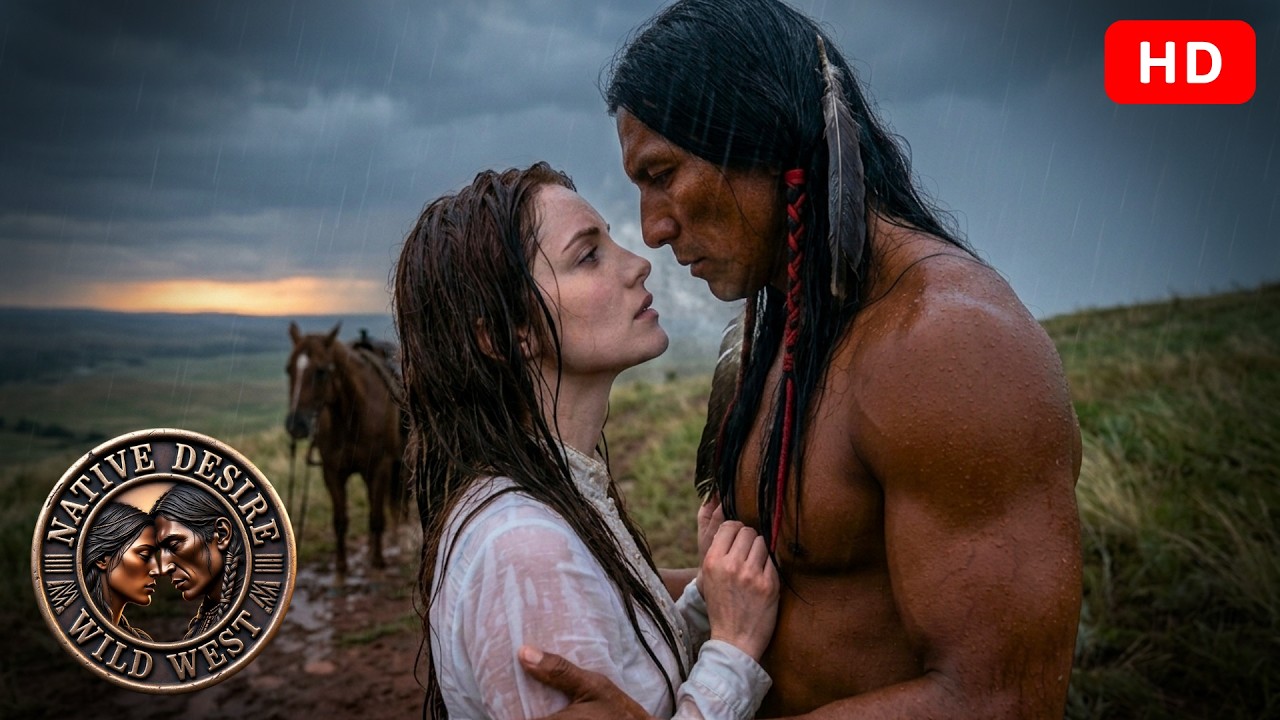
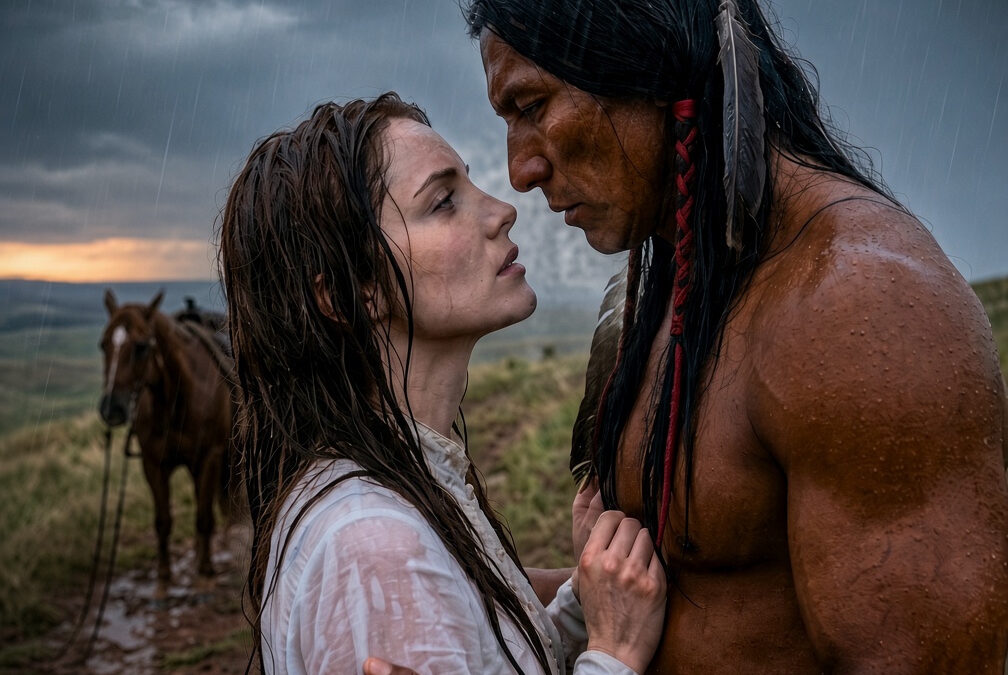
She came west to honor a promise. He stood at the edge of everything she had decided and refused to ask for what she could already see in his eyes.
One of them was going to break first. And when they did, it would cost someone else everything.
This is a story about what honesty does to people who aren’t ready for it.
And if you want more stories that don’t let you look away, follow this channel.
The stagecoach had not slowed before it lurched to a halt, throwing Eleanor forward hard enough that her hat struck the seat in front of her.
She caught herself with both hands and held still, listening. Dust came through the cracked window.
Outside, a man was arguing with the driver in a voice like gravel pulled over iron.
She had been traveling for 19 days, from Chicago to Kansas City, from there to a smaller depot, then from that depot to nothing.
A settlement that wasn’t named on the map she’d bought. The map had promised a town.
What she found, when she finally descended, was a scattering of buildings arranged without logic around a well, and sky so large it felt aggressive.
Eleanor was 26 years old, and she was not afraid of things that other women of her station feared.
She was afraid of very specific things. Humiliation, poverty, and dying without having been loved with honesty.
She had left Chicago because a man of wealth had offered all three of those fears in one neatly monogrammed envelope.
She had left him with the envelope still sealed and everything inside it unanswered. The arrangement that brought her west had been made through a man named Horace Callam, who described himself in correspondence as a prosperous ranch owner of good character.
His letters were spelled poorly, but felt sincere. She had agreed to come. She had not agreed to love him, only to evaluate the possibility.
Horace Callam was waiting near the well. He was shorter than his letters had suggested, his beard unevenly trimmed, his boots cracked at the toe.
He had the look of a man who worked hard and ate poorly and apologized for both.
He smiled at her with a kind of desperation that she recognized immediately as loneliness, and tried not to let it move her too quickly.
“Miss Voss,” he said. “Mr. Callam.” She shook his hand. It was rough and warm.
“You’re taller than I imagined,” he said, then reddened. “That’s not I meant it favorably.”
“I know,” she said, and allowed him a small smile. It was then that she saw the other man.
He stood at the far edge of the settlement’s western shadow, near a post where two horses were tethered.
He was not standing so much as occupying space. The distinction mattered because he seemed rooted rather than placed, as though the earth beneath him had decided he belonged there.
He was enormous in the way that real things were enormous, without effort [clears throat] or display.
His shoulders were broad under a loose shirt. His arms stitched with muscle that showed even in stillness.
His hair was black and worn long, braided once down the back with a wrapped piece of leather.
A single hawk feather, dark, edged in white, hung at an angle near his ear.
His face was angular, serious, the cheekbones high, and the jaw set with an expression that did not welcome approach.
He was looking at her. She looked back, which she knew was the wrong thing to do and did it anyway.
“That’s Achak,” Horace said quietly, coming to stand beside her. “Comanche man. He works the land north of mine.
We have an arrangement. He helps with the cattle when I need, and I stay out of the old trail that cuts through his side.
It works because we both keep to it.” “Does he often look at people that way?”
She asked. Horace followed her gaze. “I’ve never seen him look at anyone that way,” he said, and something complicated moved through his expression.
She made herself look elsewhere. The house was modest and clean enough. Horace had made an effort.
There were curtains at the windows, recently hung, and a dry bunch of wildflowers in a ceramic jar on the table.
She recognized the attempt for what it was and felt something between tenderness and guilt for not yet feeling more.
That evening she cooked from what he had, which was not much, but was honest.
Dried beans, salt pork, cornbread made without enough butter. They ate across from each other and spoke about practical things, the well, the schedule of the cattle, what she might do with the second bedroom that currently held his broken tools.
“I want to be fair with you,” she said eventually. “I came because your letters were decent and because I needed to come somewhere, but I need time before anything is decided between us.”
He put down his fork. “I expected that.” “And it doesn’t it doesn’t,” he said.
“I’m not a man who rushes.” He paused. “I’m also not a man who expects more than what’s offered freely.”
She felt for the first time in many weeks something loosen in her chest. She slept lightly.
In the early dark before the birds, she heard the sound of a horse passing slowly on the trail just north of the house, and without knowing why, she was certain it was him.
Three weeks passed before she spoke to Achak, and the three weeks passed slowly, the way that things do when a particular presence exists at the edge of your awareness without resolution.
She had seen him four times. Once crossing the northern field carrying a fence post over one shoulder as though it weighed nothing.
Once standing in the shadows of the creek that cut across the far property line, washing his arms methodically with a focus that made her look away from the window.
Once arriving at Horace’s door at dusk to discuss something about water rights, his voice measured and low, his eyes catching hers through the doorframe before moving back to Horace’s face with a discipline she found almost painful.
And once simply standing in the open, watching the horizon to the west with a stillness that suggested he was reading something in it she could not.
The fourth of those times she had gone out. She told herself she was checking the fence line, which needed checking.
The real reason was that it had been 22 days without conversation that mattered, and she was beginning to feel herself becoming quieter in ways she did not trust.
He heard her coming long before she reached him. He turned slowly when she was still 15 feet away, and his eyes moved over her with a directness that was not rudeness.
It was assessment, the same way a man looks at weather. “You’re Miss Voss,” he said.
His voice was deep and unhurried. “You know my name.” “Callam mentions you,” he said, not unkindly, but without embellishment.
She stopped a few feet from him. Up close, he was even larger than the distance had suggested.
The hawk feather moved in the dry wind. There were two thin braids at either temple, wrapped in red cord, and the rest of his hair lay loose and heavy between his shoulders.
His hands, she noticed, were extraordinary, the size and the definition of someone who had spent years working against real resistance.
“He says you’ve been here a long time,” she said. “My family was here before the town was drawn,” he said.
“I remain.” She didn’t know how to respond to that, so she said nothing, which he seemed to appreciate.
“You came from the city,” he said. “Chicago.” “Is it what they say?” “What do they say?”
He thought for a moment. “That it is very loud and no one looks at anyone.”
“That’s accurate,” she said. Something shifted in his expression, not quite a smile, but a movement that acknowledged hers.
She asked him about the land, and he answered without performance, pointing out the dry creek bed where water came in certain seasons, the way the cattle moved when a storm was 2 days out, the plants at the eastern edge that his grandmother had used for salting meat.
He spoke about these things as naturally as most men spoke about nothing. And she found herself listening with the kind of attention she hadn’t given to a conversation in longer than she could recall.
If this story is already pulling you in, you are not alone. Leave a comment below if you felt the tension in that first moment when Eleanor refused to look away.
This channel is built for stories that do not take the easy road. 150 comments and we start chapter three early.
And if you are new here, welcome. Stay. It was later, walking back, that she acknowledged the difficulty of what had occurred.
Not anything that had been said, what had been felt, which was worse, because feelings had no obligation to cooperate with arrangements already made.
Horace had been kind to her, more than kind. He had been patient and decent, and had never once made her feel she owed him what she had not offered.
He was a man she could respect, and respecting a person was the foundation on which she believed love could be built carefully, over time.
She had come here for that possibility. She had not come here for this. She stopped at the well and put her hands on the stone rim and stood there until her breathing was steady.
Atrac came to the house that night as he sometimes did to discuss the shared boundary and the water rights that were renegotiated every few months.
She served them both coffee. She sat at the table’s corner equidistant and kept her voice even and her eyes neutral and did not look at him any longer than she looked at Horace.
When he stood to leave, he paused at the door. The dry stretch is ending, he said.
Rain in 4 days. You should move the young cattle off the north slope before it turns.
He looked at Horace when he said it but his eyes, just for the fraction of a second, moved to her.
She felt it like a hand pressed flat against her sternum. After he left, Horace refilled his cup and was quiet for a long while.
Then he said, without accusation but with a heaviness that was its own kind of grief, He is not a simple man, Eleanor.
She said nothing. Neither are you, Horace said. That is the difficulty. She looked at him then, really looked and saw in his face that he was not angry.
He was preparing himself for something that he had perhaps been preparing for since the stagecoach arrived.
A man who loved enough to see clearly was a particular kind of sad. Horace.
Not tonight, he said gently. Let things be what they are tonight. She sat with him in silence for an hour and there was a kind of dignity in that, though it hurt.
It rained on the fourth day exactly as he said it would. It came hard in the early afternoon, the sky closing without ceremony and Eleanor was on the north slope when it began, attempting to move the youngest cattle toward the lower field.
She had the horse but not enough skill with the animal in wet ground and when the slope turned slick beneath them, the mare shied sideways and Eleanor’s boot came from the stirrup and she went down hard in the mud and grass.
She was not injured. She was humiliated and soaked and her left wrist ached from catching herself.
She sat there for a moment in the rain, the cattle dispersing in mild indifference around her and let herself be thoroughly, completely drenched before she decided to stand.
Atrac appeared at the ridge above her before she had found her feet. He came down the slope with the easy certainty of a man who understood wet terrain.
He brought his horse alongside, dismounted while still moving and reached her in time to take her arm as she stood.
The mare spooked, she said. I know. I saw from the north side. He looked at her wrist.
Give it to me. She let him take it. His hands wrapped around her wrist gently, thumbs pressing along the bone with a precision that was clinical and unhurried.
Not broken, he said. Swollen tomorrow. I know how a wrist works, she said though she made no move to pull it back.
He held it a moment longer than was necessary. They stood in the rain on the slope, her wrist in his hands and neither of them moved.
The cattle had drifted south on their own and the rain came in full sheets across the open land and there was no one watching and no arrangement that covered this moment.
Eleanor. He said. Not Miss Voss. Her name with the weight of a decision behind it.
Don’t, she said. Not yet. He waited. Horace knows, she said. He has known for some time and he is a good man and I arrived at his door with honest intentions and what I feel standing next to you is not nothing and I cannot pretend otherwise but neither can I simply She stopped.
The rain was very loud. I need you to understand that I am not a woman who abandons what she has promised.
I know what you are, he said. I have not asked you to abandon anything.
Then what are you asking? He was quiet for a moment, then that you not leave this place without saying so first.
That whatever happens, you do not disappear. She looked up at him. His face was wet, the hawk feather dark with rain, his eyes steady and very dark and completely open in the way that people only let themselves be in unguarded moments.
All right, she said. He let go of her wrist. That evening she sat across from Horace and did not pretend.
She told him that she had not lied to him and would not begin now.
That she had come with honest intentions and was not built for performances of feeling she did not yet have.
That she cared for him. That was real. But that she needed to be truthful about what was also real.
Horace listened without interrupting. When she finished, he said, I’d rather you be honest with me than comfortable.
He folded his hands on the table and I’d rather lose something real than keep something false.
She reached across and pressed her hand over his. He turned his palm up and held it for a moment and then let go with a grace that cost him something and that she would not forget.
Three days later, Atrac came to her in the evening arriving at the door without announcement because everyone in that landscape moved on their own terms and knocked only as courtesy.
She had been expecting him without knowing when. They walked out beyond the well to where the land opened and the last of the sunset sat orange and indigo at the horizon.
He told her about the land in winter, how the creek behaved, what the cold did to the northern field, how long the supply route took when the mud froze.
He told her practically as an invitation, as a description of a life that was actual rather than imagined.
She told him about Chicago in winter, the way the wind came off the lake like a judgement, the sound of the city at night, what she had wanted and not found there.
They stood close enough that the heat of him was distinct against the evening cold.
Tonight, he said quietly, we become one. His voice was very low as though he was saying something that had been true for longer than the words allowed.
I have known it since you stepped off that coach and looked back at me instead of looking away.
I can’t wait, she said and she did not look away now either. He reached up and his hand came to the side of her face and she turned her cheek into his palm and they stood like that for a long time while the last of the light left the sky.
What followed was not the story of a conquest or a surrender. It was the story of two people who had come by very different routes to the same open ground and found each other standing in it.
She stayed. Not because circumstance required it and not because she had run out of places to go.
She stayed because the land was honest and the man was honest and she had decided at 26 that honesty was the one thing she would not trade again.
Atrac never asked her to forget where she came from. She never asked him to be other than what he was.
They built something at the edge of two different worlds without pretending either world had disappeared.
Horace moved his operation 12 miles north the following spring. He sent a letter 2 months after that addressed to both of them which they read together at the table.
It was short and without bitterness. He had found, he said, a woman in the next county who made extraordinary biscuits and had no patience for self-pity.
He thought Eleanor would approve. She wrote back immediately. She said she did. The hawk feather hung above the doorframe for years.
Visitors asked about it. She always let him answer and he always answered the same way, briefly, with a satisfaction that needed no elaboration.
It had been there since before she arrived. It would be there after. The decision Eleanor made was not easy and it was not clean.
She honored one man by being honest about another and she chose a life that no map she had ever bought would have shown her.
That is the kind of love worth talking about. Leave a comment. Do you believe she made the right choice?
Was Horace’s grace the most quietly heroic moment in the story? And what do you think it cost Atrac to wait?
To ask for nothing more than that she not disappear. This channel exists for stories where the feelings are real and the cost is real.
If this one stayed with you, share it with someone who understands that the best love stories are never simple.
Your thoughts down below are what keep these stories coming.








