She Had 32 Cents, One Battered Suitcase, and a Whole Town Laughing at Her
She Had 32 Cents, One Battered Suitcase, and a Whole Town Laughing at Her. Then a Stranger Asked, “Can You Cook?” By Winter, 25 Rough Men Called Her “Ma” and Her Husband Came Back for Her
Part 1
The morning Una Farel was thrown out of the Dunore Flats lodging house, her breath hung in long white ribbons in the Alberta cold.
She stood in the alley with a traveling case at her feet and everything she owned split between that case and the coat on her back. She did not cry. After nineteen months alone in the Northwest Territories, she had learned that tears in public gave people something to use against you. ❄️
So she counted instead. Thirty-two cents. A spare dress. A kitchen knife wrapped in cloth. Half a heel of bread she had been rationing for two days.
The landlord, a man named Greel, had delivered the news loudly, at the top of the stairs, with four boarders watching from below. She was three weeks behind. Then he added one more line that the crowd found hilarious.
“Place wasn’t built to hold her anyway.”
Una heard the laughter. She picked up her case with both hands and walked down the back stairs without looking at a single face. The people who laughed at her in crowds were not worth the energy of her eyes.
In the alley, she saw the boy.
He was eight at most, curled against the stable wall, his coat useless against the cold. His face held the blank look of a child who had been hungry so long that hunger no longer felt like anything. Una looked at him. She looked at the bread in her pocket.
Then she crossed the alley and crouched in front of him. Crouching was never easy for her, but she did it. She held out the bread.
“Go on.”
He took it with both hands and ate without looking away from her face, as if she might snatch it back. Her own stomach said something sharp. She ignored it. 🍞
Behind her, a man at the alley’s mouth said something to his friend, and they both laughed. Una understood it was about her. She kept walking.
“Ma’am.”
She turned. The man was enormous, not soft, but weathered by twenty years of weather that did not allow softness. Dark beard. Heavy coat. A gray horse tied behind him. And his eyes were on her face, not on the rest of her, which was already unusual.
“Can you cook?”
She studied him the way she had learned to study strange men in alleys. Nothing alarming. Nothing friendly, either.
“Better than most men can keep accounts.”
Something shifted in his face. Not a smile, only the possibility of one.
“Stroud Mace. I run Stoneback Ranch, four hours north in the foothills. I’ve got twenty-five men and the worst cook in the Territories, who left last week owing me sixty dollars and taking my good cast iron. Twenty dollars a month. A room off the kitchen. The road closes with the first heavy snow.”
“Why me?”
His gaze flicked to the laughter behind her, then back. “Because I watched you give your last food to a starving boy when you had thirty-two cents and nowhere to sleep. A man who does that has his priorities straight.” He paused. “My men have eaten burned salt pork for six days.”
Una lifted her case. “I’ll need help up to the wagon seat. My knee’s been bad since September.”
He helped her up with both hands, no hesitation, no comment. 🐎
On the long road north, she learned the names of all twenty-five of his men. He asked about her marriage. She told him plainly: her husband, Morton Hawk, had put his debts in her name without telling her. When the creditors came, she was the one standing in the house.
“Nobody at Stoneback will ask you about it,” Stroud said at last.
“I appreciate that.”
“Not courtesy. Most of them have things they’d rather not be asked about either.”
That was when Una began to think she hadn’t made a mistake.
Twenty-five men waited outside the bunkhouse at dusk with the studied casualness of people who had formed opinions. They had expected a man. She felt every one of them recalculate. Someone barked a laugh from the back. “Won’t last a fortnight.”
Una set her case in the snow. “Breakfast is at five. Biscuits, bacon, fried potatoes, coffee. You’ll wash your hands before you sit at my table. Those are my terms. Good night.”
She walked away. After a long moment, someone said quietly, “Well, all right, then.”
The kitchen was a disaster of grease and ruined flour. She scrubbed all night. By dawn, the biscuits were rising, and the smell had done its work.
The first man through the door was Abel Pharaoh, so broad he had to angle his shoulders. He reached for a biscuit.
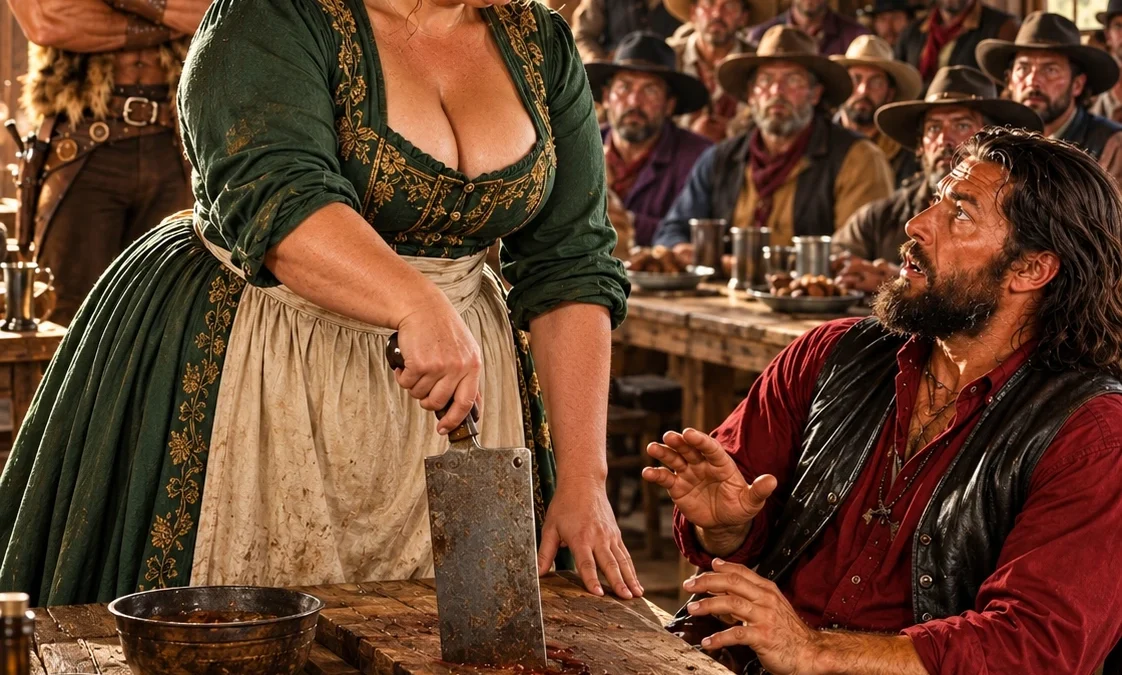
The flat of her cleaver slammed onto the counter between his hand and the basket. The crack echoed like a gunshot. 💥
“Basins at the end of the counter. Water’s hot. Go and wash.”
Pharaoh stared at the cleaver, then at her, then began to laugh, a real laugh that transformed his face. He washed his hands thoroughly, bit into a biscuit, and murmured, “Lord in heaven.”
After that, the ranch slowly rearranged itself around her. Old Lyndon Sparks said thank you at every meal, and she worried about his cough through the wall at night. Nineteen-year-old Seb Coulter had received no letter in four months, so she handed him her pen. Six weeks later, an answer arrived, and she didn’t need to ask what it said.
Stroud began lingering in her kitchen after the men were gone. He poured his own coffee. He told her about the daughter he had buried and the wife who had drifted away in grief. 🕯️
When Lyndon collapsed with fever, Una gave up her warm room and sat two nights beside him. One evening, Pharaoh stood in the doorway, hat in his hands.
“Ma, you got any coffee left?”
Silence. His ears went red. Una turned from the stove.
“Sit down, Pharaoh. Coffee’s hot.”
He sat. Within a week, she had stopped counting how many of them called her that. Someone built a new kitchen step, lower, at exactly the right height for her bad knee. She cried about it alone on a Tuesday evening.
Then, on a Wednesday in early December, two riders came through the gate at dusk, and Stroud’s face did something she had never seen before.
“Una,” he said quietly. “Your husband is in town.”
Part 2
“Una,” he said quietly. “Your husband is in town.”
The word landed in her stomach like a stone down a well.
“He says you took property belonging to him when you left,” Stroud continued. “He’s brought an NWMP corporal willing to serve a writ.”
“I left with one case.”
“I know. He heard you’re earning wages.” Stroud’s jaw tightened. “He’s using the paperwork as leverage.”
Una looked at her flour-covered hands, at the bread she had been shaping. Morton Hawk never traveled this far for principle. He traveled for money.
“Pack a case,” she said, her voice steady. “I’ll go down with them. I’m not bringing this to Stoneback.”
“Una.”
It was the first time he had used her given name. It landed like what it was, a line crossed on purpose. “This is your home.”
She went to her room. She was folding her second dress into the case when she heard the bunkhouse door, then boots, then a great many boots on the kitchen step all at once. 🥾
At the window, her breath caught.
Twenty-five men stood in the snow. Not one was armed. They simply stood in the cold, going nowhere. Pharaoh was at the front, holding her traveling case, the one she had left by the door.
She opened the door. The cold rushed in.
“Seb told us about the writ,” Pharaoh said, his voice flat and utterly serious. He held out the case. “Put this back. You’re not going.”
“Pharaoh…”
“You sat up two nights with Lyndon when he couldn’t breathe. You wrote that letter for Seb when he was too scared to write it himself. You came here with one case and turned it into the first proper table most of us have sat at in years.” His jaw was set, his eyes unguarded. “You taught twenty-five stubborn, beat-up men what it means to come home to something. You don’t get to teach us that and then walk away from your own.”
Something calcified inside Una, built from nineteen months alone and years of being made to feel that she took up more room than she deserved, cracked like spring ice. Her eyes filled. She did not blink them clear. 💔
Stroud stepped out of the dark where he had been standing for some time.
“You’re not going anywhere. We’re going to Dunore Flats. We’re going to find out what Morton Hawk built this out of, and we’re going to take it apart.” He met her eyes. “Then you’re coming home.”
They left before dawn: Stroud, Una, Pharaoh, and a quiet man named Vesey, who had spent eleven years as a county land recorder in Ontario and knew exactly what paperwork looked like when it lied.
On the wagon seat, Una told Stroud everything, not the managed version, but all of it. The forged signatures. The loan she had never seen. The magistrate who had looked at a forged document for thirty seconds and told her that marriage was complicated and perhaps she had misremembered signing.
“Financial documents filed in Lethbridge are duplicated in Regina,” Vesey said quietly. “If a forged signature was used, there will be a discrepancy. Give me a day in the right office.”
Morton was waiting outside the constable’s office, exactly where she had known he’d be. He looked unchanged after nineteen months, and that was the most unsettling part.
“Margaret,” he said.
No one at Stoneback called her that. “Morton.”
He offered Stroud a warm, practiced hand. Stroud did not take it. 🧊
Two hours in the constable’s office left Corporal Corin beginning to understand that he’d been given a simpler story than the true one. Morton had a list. He had a confident delivery. He had no documents and no witnesses.
Vesey rode for Regina that afternoon. He returned in three days with a leather satchel and the expression of a man who had found exactly what he was looking for.
Two loan documents. A signature recorded as Margaret Una Hawk. Bank correspondence sent to a post office box registered in Morton’s name alone. And a statement from the clerk who had processed the transaction.
The woman who signed, he remembered, was slight and young. Morton’s wife, he later heard, was neither.
Una went very still. She had always known it. She had been told to her face she’d simply forgotten. Now the knowing had somewhere to go.
The hearing before the land magistrate in Lethbridge took place in a cold, quiet room. Una sat in the witness chair and answered every question without once looking at Morton. His face was no longer the point. The magistrate was.
Then Morton stood, wearing the patient expression of a man explaining something obvious.
“Your Honor, my wife has had a very difficult year. Circumstances can alter a person’s perceptions.”
The magistrate raised one hand, never lifting his eyes from the document in front of him.
Una turned her head and looked straight at her husband for the first time in nineteen months. ⚖️
Part 3
“My perceptions are not altered,” Una said.
The room went silent.
She held Morton’s gaze, steady as a drawn line. “You spent six years convincing me that taking up space was the same as being in the way. That my size was the reason my word did not count. That my signature wasn’t worth verifying, and a magistrate would look at a forged document and assume I had simply forgotten.”
Morton’s mouth tightened.
“You needed me to believe that,” she said. “The moment I stopped believing it, you had nothing.” She let it settle. “I stopped believing it.”
Morton looked at her. For the first time in six years, he had nothing to say. 🔥
The magistrate dismissed his claim in full. He referred the forged loan documents to the territorial registrar for investigation. He noted that the evidence supported a formal petition for dissolution of the marriage and that he would expedite any such filing.
He said it procedurally, without drama. Una heard it as a door closing behind her and never reopening.
Morton left without a glance, walking past her as though she were a stranger. She understood, quietly, that she had become something he no longer knew how to use. For a man like Morton, that was the only category that had ever mattered.
In the hallway, Pharaoh was waiting. “That was the bravest thing I ever watched,” he said. “And I once saw a man argue with a grizzly.”
Una laughed. It came out unsteady and far too loud in the cold corridor, and she did not care. Stroud’s hand found the small of her back, brief and warm. She did not move away from it. 💛
The road back to Stoneback took longer than it should have. A heavy snow fell on the last stretch, the kind that did not negotiate. Stroud handled the reins with the steadiness of a man who knew the difference between storms worth fearing and storms worth enduring. They barely spoke, but the silence had changed. It was the silence of two people who had said enough that the rest could wait.
They reached the ranch as the snow thickened past seeing. Seb Coulter was at the gate. He had not gone to bed.
“You’re back,” he said, his face doing what young faces do when they feel something they have no words for.
“I’m back.”
He grabbed her case before she could climb down.
Inside the kitchen, someone had kept the fire burning. The stove was hot, the wood box full, the floor swept. Someone had looked at this room and thought about her coming home to it. 🏠
Una stood in the doorway a moment. Then she took off her coat, tied on her apron, and went back to work. It was the best way she knew to be home.
Three weeks after Christmas, a letter arrived from the Lethbridge magistrate’s office. The dissolution of her marriage had been confirmed, dated the fourteenth of December. She had been sitting beside Stroud in this very kitchen that night, the fire low, the ranch asleep around them. She had been right here the moment she became entirely, legally herself.
She read the letter at the table. Stroud sat across from her.
“It’s done,” she said.
He reached across and put his hand over hers. He had been coming to her kitchen for weeks. He had told her about his daughter, about his wife, about twelve years of building walls between himself and anything he might lose. He was not a man who moved quickly toward the things that mattered. He had learned, as she had, that wanting something openly gave others something to take.
“I’ve been thinking about something,” he said.
“I know,” she said softly. “I’ve known for about three weeks.”
“I’m not asking because of the letter. I was going to ask before the letter. I want you to know that.”
“I do.”
“I’m asking because this place is different since you came into it. Not just the kitchen. All of it.” He turned her hand over in his. “I spent twelve years in a house that was somewhere to sleep. I want to know what it feels like to actually live in one.”
Una looked at their joined hands. She thought of the alley behind the lodging house, the cold, the laughing crowd, the bread she had given away without calculating whether she could afford to. That morning she had been stripped of everything but who she really was.
That woman, the one who gave away her last food, stood straight while people laughed, and walked north with one case and thirty-two cents, had never needed saving.
She had needed room. 💍
“Yes,” she said.
One word. It meant nothing beneath it except what was already visible.
Stroud’s grip tightened. Outside, the Alberta winter did what Alberta winters do, arriving with total authority and indifference to anything smaller than the Rockies. Inside, the kitchen was warm and the fire was bright.
In the morning, twenty-five men would wash their hands, sit at her table, and say thank you, and mean it. 🕯️
Una understood, with the quiet clarity of things that arrive without announcing themselves, that she had not come to Stoneback Ranch to be rescued. She had come to build something. And she had built it biscuit by biscuit, cup of coffee by cup of coffee, one washed hand and one thank you at a time.
It was solid enough now to hold twenty-five men, a mountain winter, and one lonely man who had spent twelve years forgetting how to want anything.
She had arrived with one battered case, a proud private heart, and nowhere left to go.
By winter, twenty-five lost men called her Ma. And the solitary man who had built his walls high enough to disappear behind them had finally, quietly, with his whole self, come home. 💛
This story is entirely fictional and created for entertainment purposes only. It does not represent any organization or individual, nor does it encourage inappropriate behavior. The content was generated with AI assistance.








