19. My Mother Demanded I Remove My Navy Uniform at Dad’s Memorial—While His Old Commander Stood Behind Her Holding a Sealed Letter
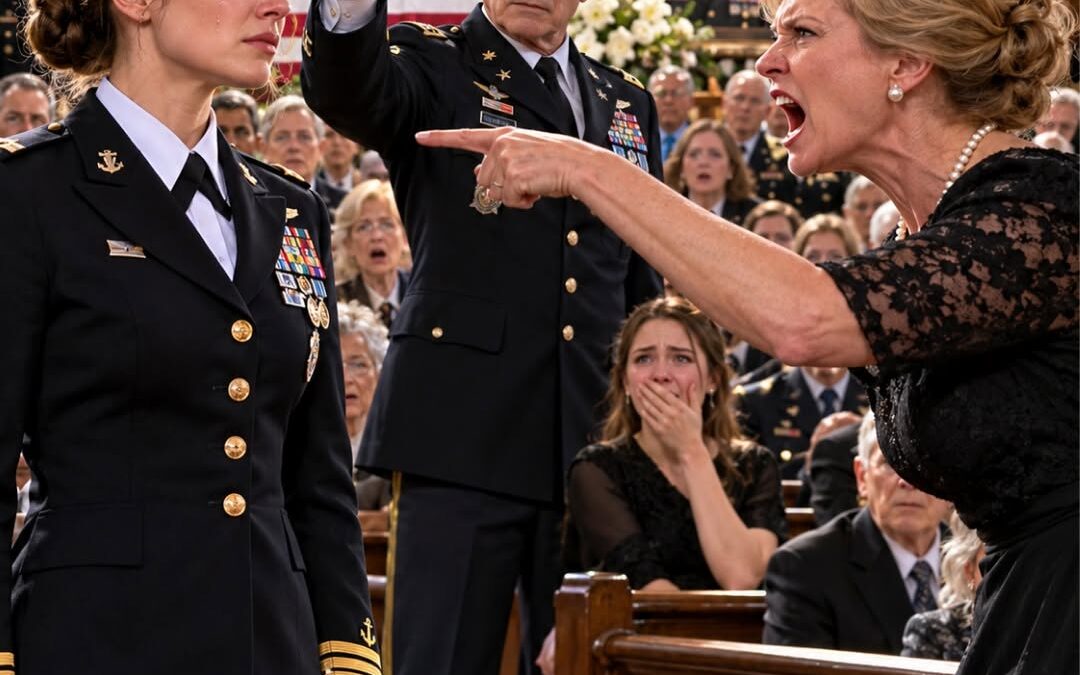
19. My Mother Demanded I Remove My Navy Uniform at Dad’s Memorial—While His Old Commander Stood Behind Her Holding a Sealed Letter
PART 2
My sister said she thought I knew because Mom had told her I agreed to keep my distance.
That was how the lie worked.
Each person received an explanation that made asking the other seem cruel.
Dad believed I’d refused his calls.
I believed he wanted rest and couldn’t bear emotional visits.
My sister believed we’d reached an arrangement she didn’t understand and wasn’t supposed to question.
Mom stood between all of us and called it protecting the family.
I looked again at the bill.
The number wasn’t mine.
It was a phone account Mom maintained in my name as a contact label.
She directed Dad’s calls there when he needed help using the device.
She handled the messages.
She explained the silence.
Over time, his health and reliance on her assistance made those explanations harder to challenge.
That didn’t mean nobody else had a responsibility to ask.
My sister knew she’d seen more than she admitted.
The photograph showed Dad asking her for help after he began doubting the story.
She helped preserve the call log.
Then she kept quiet because Mom said the truth would damage his final weeks.
I wanted to be kind to her.
I also wanted to scream.
Both feelings stayed in the little room beside the chapel.
Admiral Bennett told me Dad had asked him to deliver the letter personally if I couldn’t come before he died.
He tried to contact me through an independent route, but deployment and the timing meant the meeting happened at the memorial.
He didn’t pretend the delay was something words could repair.
He said he was sorry I hadn’t received the truth sooner.
Dad’s letter wasn’t an accusation.
That made it harder to read.
He wrote that he didn’t know which parts of the family account were real anymore.
He loved me.
He wanted me to know he hadn’t asked me to stop visiting.
And he hoped I’d built a life that included people who didn’t make affection feel like a test.
I cried without trying to look composed in my uniform.
The admiral waited.
My sister waited too.
For once, nobody explained what the tears supposedly meant.
We returned to the church when I was ready.
Mom asked whether we’d finished making her look bad.
I said I was there to mourn Dad.
That wasn’t permission for another public argument.
I kept the letter and sat where I could hear the service.
The uniform stayed on.
It was part of my life.
It didn’t need to become a weapon in a contest about who loved him most.
Afterward, I asked for records through appropriate channels and addressed the impersonation and financial questions with independent advice.
My transfers hadn’t all gone where Mom described.
Some supported genuine needs.
Others paid expenses she never disclosed.
I didn’t collapse every complicated year into one claim I couldn’t prove.
I separated what I knew from what I suspected.
The process was slower than a dramatic confrontation.
It was more useful.
My mother sent explanations about sacrifice.
She said she hadn’t wanted the Navy to take another member of the family away from her.
I remembered sending letters while she told people I’d disappeared.
Her fear had become something other people were required to live inside.
I wasn’t doing that anymore.
We took distance.
My sister and I spoke carefully.
She admitted where she’d stayed silent.
I told her what that silence cost me.
We weren’t going to repair twelve years in one afternoon because we were sad about the same man.
But we could stop asking Mom to translate our relationship.
We exchanged our own numbers.
We called directly.
Sometimes we discussed Dad.
Sometimes we discussed nothing important.
Those calls helped.
Before returning to duty, I visited the garden he loved.
I brought coffee and sat on the bench where he used to complain about the neighbor’s hedge.
His letter was in my bag.
For a while, I wanted another letter with instructions for how to forgive everyone.
He hadn’t left one.
I was grateful eventually.
It meant I could decide without turning his memory into another authority I had to obey.
Months later, my sister mailed a photograph she’d found.
Dad laughing, years before the hospital.
No phone in his hand.
No anxious look toward the doorway.
I framed that one.
The final letter went somewhere safe, where I could read it when I chose.
At the next family conversation, I didn’t remove the life I’d built to make someone else comfortable.
I introduced it honestly.
Then I waited to see who wanted to know me.
A few people did.
That was enough to begin.
For the first time, I wasn’t listening for my mother’s version before deciding what my own voice was allowed to say.
I kept speaking plainly.
Disclaimer: This story is entirely fictional and created for entertainment purposes only. It does not represent any organization or individual, nor does it encourage inappropriate behavior. The content was generated with AI assistance.








