21. I Walked Into My Father’s Party in a Bloodstained Uniform—And He Asked Who Had Let “Someone Like Me” Through the Front Door
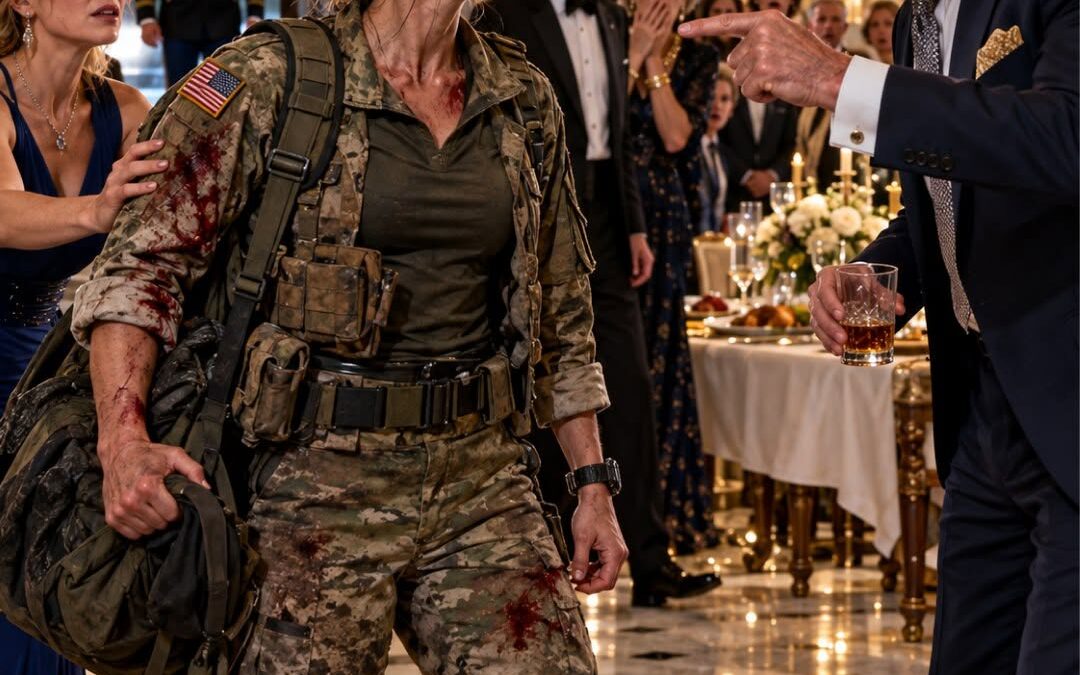
21. I Walked Into My Father’s Party in a Bloodstained Uniform—And He Asked Who Had Let “Someone Like Me” Through the Front Door
PART 2
I moved the phone out of my father’s reach.
Then I asked my sister to come outside with me.
She nodded immediately.
The woman holding the photograph followed after checking that I wanted her there.
My father said we were being dramatic.
For once, nobody stayed to make his room feel comfortable.
Outside, I told my commanding officer I could speak privately.
I didn’t discuss sensitive operational details in front of relatives or party guests.
The conversation concerned information that needed to be handled through the appropriate channels, including a contractor connected to the civilian transfer we’d responded to.
My father’s company appeared in those records.
The note on the photograph wasn’t proof of trafficking or some enormous conspiracy revealed by a birthday party.
It was a planning instruction attached to an approved movement of people.
That movement went badly wrong.
The child I remembered was among those affected.
Her mother was at Dad’s party because he’d invited people connected to the contract and described the evening as an opportunity to thank supporters.
She hadn’t known how much her daughter’s experience differed from his account.
The photograph had been used during the search and coordination.
His handwriting identified a decision he later preferred to describe as someone else’s.
I could provide what I was authorized to provide through the process underway.
I couldn’t decide every allegation from the shape of his face.
That restraint cost me more than I expected.
I’d spent the afternoon furious that he saw blood before he saw his daughter.
Now I needed to prevent that anger from choosing what I claimed to know.
The woman asked whether her child was safe.
I helped connect her with the appropriate contact instead of making promises beyond my role.
When she heard the confirmation and arrangements directly, she started crying again.
My sister stood beside her.
Dad came to the doorway.
He asked me to stop discussing company business with guests.
I told him I was making a call and helping someone obtain accurate information.
If he had questions about the formal review, he needed to use the proper channels too.
He looked at my uniform.
I wish he understood my life.
Mostly, he understood I wasn’t going to become his private source of reassurance.
The review examined instructions, communications, and decisions connected to the failed movement.
I gave my account as required.
Other people supplied theirs.
The findings didn’t depend on my father being cruel at a dinner party.
They depended on records and responsibility.
That distinction mattered to people who’d been endangered.
Their experience deserved better than becoming the satisfying ending of my family argument.
Personally, I went to be checked again and slept.
She didn’t tell me I looked brave.
She said I looked hungry.
I ate so quickly she made another sandwich.
The next afternoon, my brother called.
He apologized for staring at his drink while Dad spoke.
I appreciated that he named what he’d done.
He didn’t promise he’d become a different man by next Sunday.
He asked whether I wanted company when I collected belongings I’d left at the house.
I said yes.
Dad sent messages about loyalty.
I didn’t argue every definition.
I told him I would participate honestly in any required review and wasn’t discussing it as a family negotiation.
Our personal relationship was a separate question.
There had been years of him treating my work as an embarrassing phase and my visits as evidence I still needed approval.
I couldn’t fix that by returning from one mission impressive enough.
Someone who wanted to misunderstand could always find another stain on a sleeve.
I found support outside the family too.
Exhaustion wasn’t something training made me immune to.
Neither was the memory of a child asking whether her mother could come.
I talked to people who understood what could be shared and what needed care.
Months later, my sister sent a photograph from a quiet lunch.
The rescued child sat beside her mother holding a sandwich far too big for her hands.
It came with permission to share it with me.
No speech.
No award ceremony.
Just a thank-you and a question about whether I was getting enough rest.
I laughed.
Apparently, everyone sensible had chosen the same concern.
My father and I didn’t reconcile around the company review.
There were consequences to address and boundaries I no longer disguised as scheduling problems.
We spoke occasionally, directly.
He learned that calling me wasn’t the same as summoning me.
At my next visit with my sister, I changed before dinner because I wanted a clean shirt.
Not because blood made me shameful.
She opened the door, took my bag, and asked whether I wanted coffee.
I said yes.
Then I stepped inside without waiting for anybody to decide whether I belonged.
Disclaimer: This story is entirely fictional and created for entertainment purposes only. It does not represent any organization or individual, nor does it encourage inappropriate behavior. The content was generated with AI assistance.








