24. My Sister Said My Burn Scars Were Ruining Her Wedding—Then the Groom’s Mother Stepped Between Her and My Wheelchair
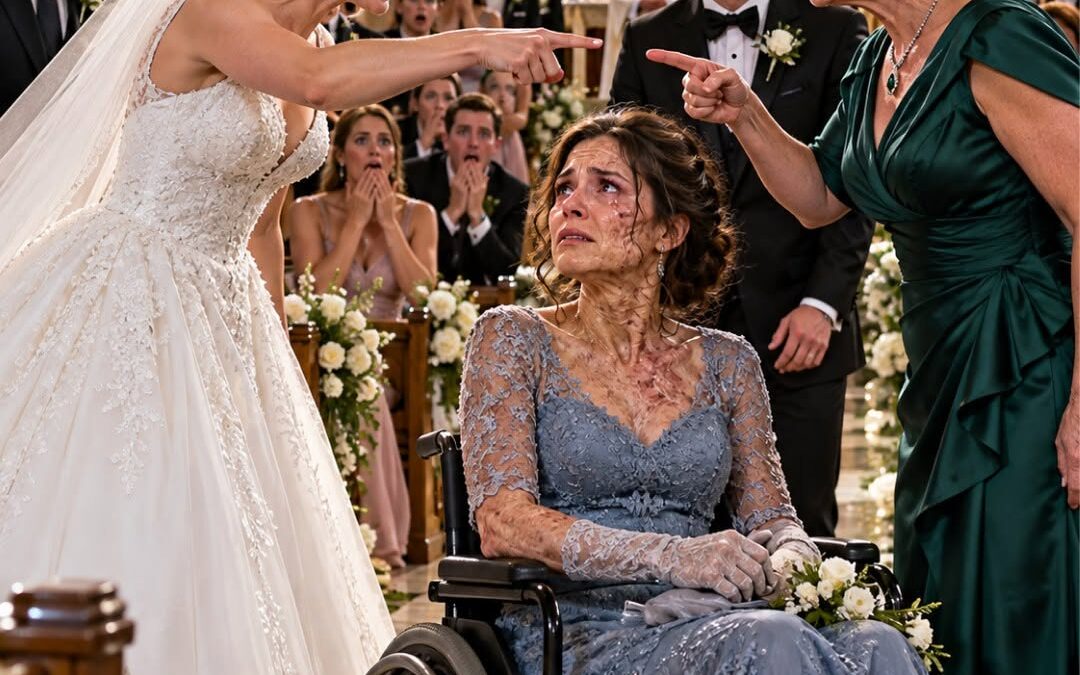
24. My Sister Said My Burn Scars Were Ruining Her Wedding—Then the Groom’s Mother Stepped Between Her and My Wheelchair
PART 2
I asked Vivian to bring the photograph closer.
Not to Natalie.
To me.
For years, people discussed the fire while looking around my chair as though the person who went inside wasn’t still there.
Vivian knelt where I could see the image.
A shape stood behind the upstairs window.
Another child.
I remembered a cough from somewhere beyond the curtain.
I remembered assuming it belonged to Natalie.
The room around me seemed too loud and too far away.
Then I asked whether we could continue somewhere private.
Vivian said yes.
Adam asked the guests to give us space.
My sister objected.
For the first time that morning, nobody treated her wish as the end of the discussion.
The photograph didn’t tell the whole story.
It revealed a question that deserved more care than a wedding argument.
Vivian’s brother had helped document the fire response.
His notes named our father as an initial witness because Dad described who should have been inside and where.
He said Natalie was alone.
The photograph contradicted that account.
Adam had heard the same story from her.
She said she’d been alone upstairs and I’d caused the fire through carelessness.
I had never understood how that version became easier to repeat than what I remembered.
Now Natalie began talking.
The other child was a friend she’d brought home without permission.
They’d been playing in a room our father used for storage.
Something ignited.
She panicked, went toward the bedroom, and left her friend behind.
I wasn’t in the kitchen.
I was returning from outside when I heard her screaming.
The origin and full sequence needed proper records, not a confession coerced beside flowers.
But one thing became clear.
Our family had protected a frightened child’s mistake by assigning responsibility to the child whose injuries made her least able to challenge the account afterward.
The other child survived.
That was the first question I asked, and the answer let me breathe.
Firefighters reached her through another part of the house.
Her family moved away during the long period when I was in treatment.
Our parents handled the communications.
They told me there had only been Natalie to rescue.
They told others I left something burning.
Different versions kept each person from asking the questions that might connect them.
Vivian had brought the photograph for a display honoring relatives connected with the venue and family history.
She recognized our house only when I described the fire.
Her brother’s notes had remained with the picture.
They weren’t a verdict.
They were a reason to retrieve the records and stop treating a convenient account as settled truth.
I asked Dad whether he knew.
He said he’d been protecting both daughters.
I looked at my sister.
She couldn’t look back.
“Which part protected me?”
Nobody answered.
The wedding didn’t become my courtroom.
I left with someone I trusted after making sure the photograph and notes would be preserved.
Adam and Natalie had decisions to make about their ceremony.
They weren’t mine.
For once, I didn’t stay to make everybody else’s day manageable.
Later, I sought independent help obtaining what records remained and understanding what could be established.
Memories were imperfect.
Some details could be checked.
Some couldn’t.
I didn’t need certainty about every second to know the family account had been unfairly placed on me.
My parents apologized in language that emphasized how young Natalie had been.
I agreed she was young.
So was I.
Seventeen didn’t make me an adult responsible for absorbing the consequences forever.
Natalie wrote a letter.
It admitted she knew I hadn’t caused the fire.
It admitted she’d let people believe otherwise because correcting it seemed harder each year.
I read it with support.
Then I put it away.
Her honesty mattered.
It didn’t require immediate closeness.
Vivian checked whether I wanted contact.
I did.
Not because she rescued me with five perfect words.
Because she asked me what I wanted before deciding where my chair should go.
We met for lunch.
She brought no photographs that time.
We discussed her garden and my work.
For an hour, I wasn’t the woman who survived a fire.
I was someone whose opinions about bad restaurant coffee were appreciated.
Months later, I wore the blue dress again.
A friend’s celebration.
Accessible entrance.
A table where I could sit comfortably.
Nobody suggested a pillar.
When the photographer arrived, I asked which angle worked best.
Not to hide my scars.
To make sure everyone fit.
The picture is on my shelf now.
My sleeves catch the light.
My face looks like mine.
I don’t love every photograph of myself.
I don’t have to.
But I no longer move out of the frame because somebody else prefers a family story without the person who carried its cost.
I keep my place.
Disclaimer: This story is entirely fictional and created for entertainment purposes only. It does not represent any organization or individual, nor does it encourage inappropriate behavior. The content was generated with AI assistance.








