5. The Church Called My Mother’s Dinner Guests “The Wrong People”—Then Its Chairman Came Across the Street Demanding Her Red Tickets
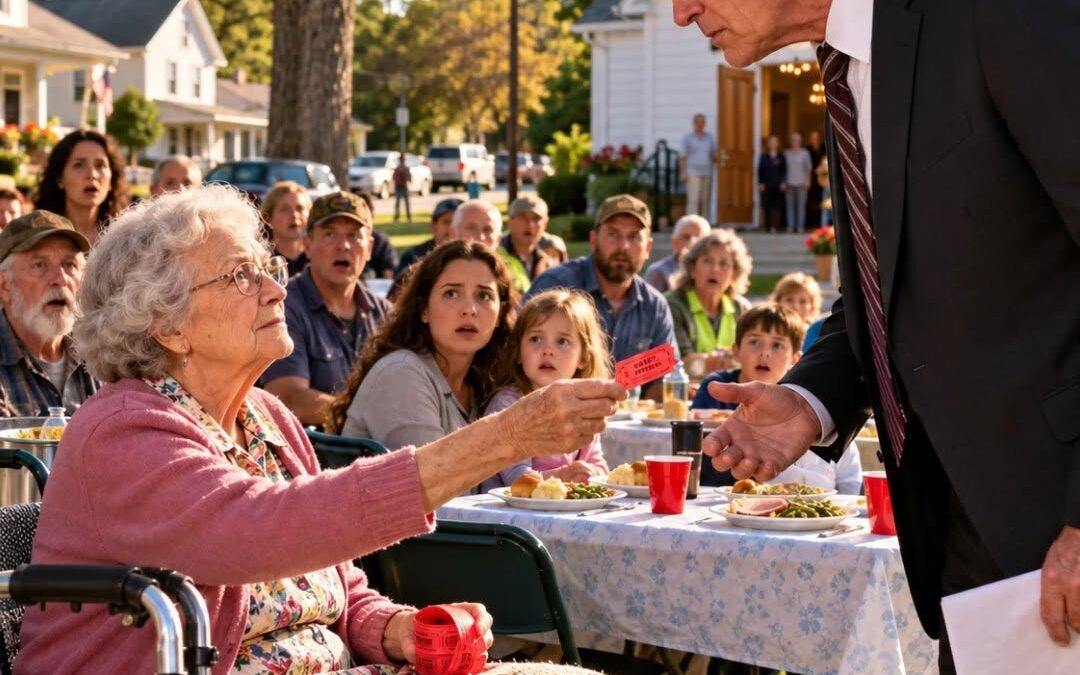
5. The Church Called My Mother’s Dinner Guests “The Wrong People”—Then Its Chairman Came Across the Street Demanding Her Red Tickets
PART 2
“That’s not a salary,” Howard said.
I pointed at the column heading.
For once, my mother’s notebook was getting more respect than her decades of work.
The pastor crossed the street then.
Not quickly enough to seem eager.
He asked whether we could discuss the report away from the tables.
Mom said people were eating.
We could discuss it after dessert.
So we did.
My husband kept serving while I photographed the page Howard had handed me. Mom gave the pastor a ticket and told him to sit.
He didn’t know what to do with it.
That little uncertainty told me how rarely anyone expected him to join the people he described as a program.
The report claimed two hundred weekly meals and a monthly payment to my mother.
Her notebook showed the actual attendance.
It also showed groceries she’d purchased herself, reimbursed irregularly or not at all.
Howard called it a bookkeeping classification.
I asked who received the money.
He said the church managed expenses collectively.
Mom asked again.
Who received it?
The pastor looked toward the building.
Then he said the county had requested supporting records.
The red tickets were supposed to help reconstruct attendance.
That was why Howard wanted the roll.
He wasn’t defending ownership of little scraps of paper.
He needed numbers that could support a report already submitted.
Shutting the dinner down had been presented as concern about the wrong people.
It also stopped guests and volunteers from asking why a program supposedly serving hundreds had so little food.
My mother wasn’t the person who made the reports.
She’d simply kept cooking.
When the county representative approached her in December, Howard intercepted the follow-up.
The ticket with the phone number had stayed in her notebook because she saved everything that seemed important.
I called the number the next morning.
I didn’t accuse every church member of a conspiracy.
I said there were discrepancies and records the person named in the reports wanted reviewed.
Mom spoke for herself.
Her voice shook at first.
Then the person on the line asked whether she preferred to go through the notebook one month at a time.
She said yes.
That was all she needed.
Someone willing to let the details take as long as they took.
The review didn’t produce instant answers.
There were documents to request, accounts to examine, and distinctions between inaccurate reporting, unauthorized payments, and the people responsible.
We provided what we had.
Howard stopped coming across the street.
The pastor did come back.
He asked Mom to return to the church kitchen.
She asked whether everyone who wanted supper would be welcome.
He said the board was discussing it.
“Then keep discussing,” she told him.
For the first time since the announcement, I laughed without trying to hide it.
Our yard dinners continued while volunteers organized a more durable arrangement.
I learned quickly that being angry at a board didn’t teach me how to plan meals for forty people.
Dale learned which extension cords survived rain.
Otis started arriving early to fold napkins.
The young father who’d eaten as though the plate might vanish began bringing his children to help set tables.
Nobody had to perform gratitude.
They could simply be hungry.
Mom kept handing out tickets.
This time, we counted the meals honestly and documented the costs.
She insisted that anyone handling money understand what each number meant.
Eventually, a community group arranged access to a proper kitchen with transparent oversight and enough chairs.
Mom didn’t become the employee who finally received thirty-four years of pay in one dramatic check.
The disputed payments were addressed through the review.
Her dignity wasn’t waiting in an account somewhere.
It was already there in the way she asked whether someone wanted more potatoes.
The hardest conversation happened at home.
She wondered whether I’d spent too much protecting her.
I told her I wasn’t protecting a helpless old woman.
I was helping someone who’d taught me what a full table could mean.
She corrected my potato slices again.
Apparently, understanding her lesson didn’t exempt me from practical instruction.
Months later, Howard passed us near the grocery store.
Mom nodded politely.
He looked away.
She didn’t follow him demanding an apology.
She asked whether I’d remembered the butter.
I had.
Mostly because she’d written it twice on the list.
That Wednesday, the first guest through the door was the pastor.
He wore an apron.
Mom handed him a ticket, then a dish towel.
He asked where to start.
She pointed toward the potatoes.
“Thinner than my daughter cuts them.”
Everyone nearby laughed.
This time, the laughter made room for somebody instead of pushing them out.
I set another place and carried the gravy to the table.
Mom still keeps the notebook. Nobody gets to call its numbers estimates anymore.
Disclaimer: This story is entirely fictional and created for entertainment purposes only. It does not represent any organization or individual, nor does it encourage inappropriate behavior. The content was generated with AI assistance.








