6. The Duke’s Grooms Gave Up on His Dying Stallion—Then a Plain Stepdaughter Took a Lantern and Recognized the Man at His Door
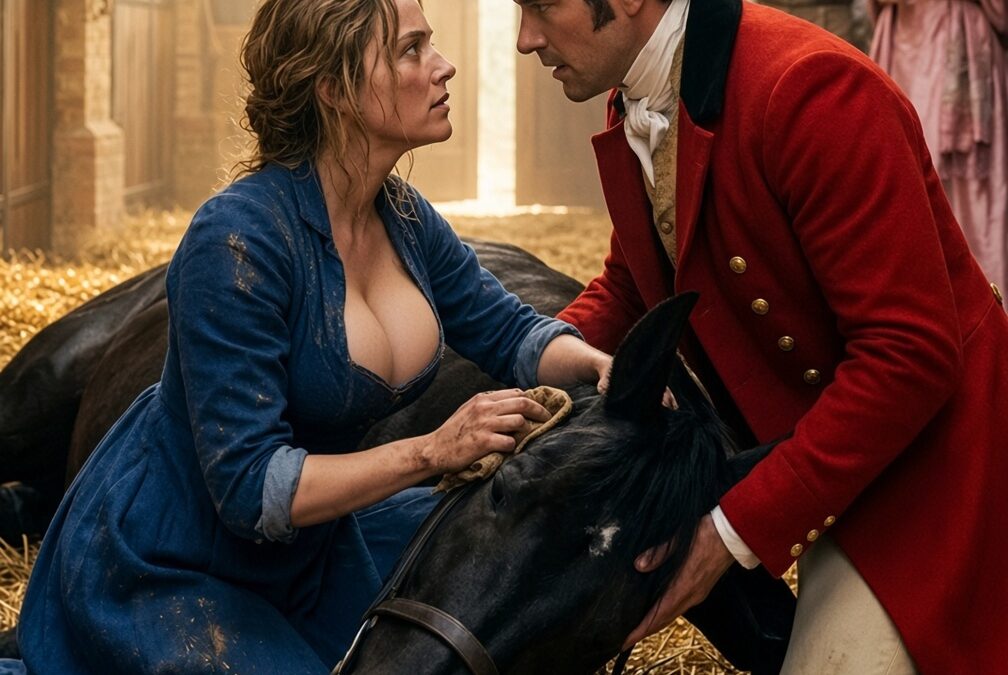
6. The Duke’s Grooms Gave Up on His Dying Stallion—Then a Plain Stepdaughter Took a Lantern and Recognized the Man at His Door
Part 2
Martha kept the lantern raised.
The man climbed down from the carriage and stopped.
He recognized her too.
“You’ve grown.”
“My father hasn’t.”
The duke stepped beside her.
“Who is this?”
“Silas Crowe. He worked with my father before the accusation.”
Crowe glanced at Lady Ellis.
That glance answered a question Martha had carried for years.
The duke ordered the groom to fetch the constable.
Crowe reached for his carriage.
Two stable hands moved into his path.
Nobody touched him.
Nobody needed to.
Inside, the veterinarian asked for quiet.
The stallion was still alive.
Martha forced herself to breathe.
Lady Ellis began speaking rapidly.
Crowe was an old acquaintance. The packet must have been mislaid. Martha confused events whenever her father was mentioned.
The duke looked at Martha.
“What do you remember?”
She told him.
Not perfectly.
She admitted where memory became uncertain.
The missing finger.
The whispered conversation at the funeral.
Her father’s notes disappearing.
The red symbol on the packet.
The constable took the paper away with the bucket and the groom’s letter.
Crowe’s belongings contained several copies of the same recommendation, each bearing a different estate’s name.
He sold supposed remedies, then charged desperate owners for further treatment when their animals worsened.
Years earlier, Martha’s father had discovered the practice.
Crowe had blamed him first.
Lady Ellis had supported the accusation because investigating Crowe meant investigating the money she had secretly invested in his business.
Her silence had protected herself.
Martha’s father had paid for it.
The proof emerged slowly through account books, witnesses, and surviving correspondence.
There was no dramatic confession to repair everything.
Her father remained dead.
But his name was cleared.
At the village church, Martha stood beside the duke while the vicar read a statement acknowledging what had happened.
She cried afterward.
The duke waited without trying to stop her.
His stallion recovered over several difficult days under the veterinarian’s care.
Martha visited whenever she was invited.
The first time the horse nudged her shoulder, she laughed so suddenly that the duke turned.
“I’d wondered what that sounded like,” he said.
“What?”
“You, when you aren’t expecting someone to interrupt.”
She looked away, smiling.
With help from her father’s former colleague, Martha began organizing his notes.
The duke offered to pay for their publication.
She asked him to fund a lending collection instead, so farmers could consult the material without buying expensive books.
He agreed.
They worked together through spring.
Sometimes he carried boxes.
Sometimes she corrected his assumptions about the people working his land.
He listened more than she expected.
One afternoon, he asked whether she ever wanted to ride.
She shook her head.
“I’ve always been told I’m too plain for fine company and too awkward for fine horses.”
“Who told you?”
She gave him a look.
He grimaced.
“Forgive me. Foolish question.”
He did not put her on his largest horse to prove a point.
He arranged a gentle lesson with a patient riding mistress.
Martha liked that he understood the difference.
Once, a village boy asked whether the story about her father was true. Martha told him which story mattered: that her father had helped animals and taught her to pay attention. The boy returned the week carrying an injured bird. Martha found herself teaching him the same lessons, discovering that clearing a name could also mean continuing its work.
By summer, they were riding together.
Her stepmother wrote twice.
Martha answered neither letter.
Forgiveness was not a duty someone else could assign her.
When the duke began courting her, he asked what she wanted from a future.
“A home where I don’t have to defend everything I know.”
He nodded.
“And work.”
“Of course.”
“And someone who asks before deciding what’s best for me.”
“I’ll try.”
She smiled.
“That answer is better than promising you’ll never make a mistake.”
He did make mistakes.
So did she.
They learned to speak before resentment grew roots.
In autumn, he proposed beside the stable where they had first met.
Martha looked toward the stallion watching over his door.
“Would you have noticed me at the house party?”
The duke considered.
“I hope so.”
“That isn’t very romantic.”
“I won’t pretend I know. But I know I would regret never having met you.”
She took his hand.
“Yes.”
At their wedding, she wore her father’s watch beneath the sleeve of her gown.
Afterward, they walked through the stables before joining their guests.
The stallion searched her pocket.
She produced an apple.
“You came for him,” the duke said.
“I did.”
“And stayed?”
“For myself first.”
He smiled.
“Good.”
Martha rested her hand against the horse’s warm neck.
Then she took her husband’s arm.
Outside, the lamps were being lit.
This time, she had no reason to fear what their light might reveal.
Disclaimer: This story is entirely fictional and created for entertainment purposes only. It does not represent any organization or individual, nor does it encourage inappropriate behavior. The content was generated with AI assistance.








