8. Hours After Our Wedding, My Husband Ordered Me Onto My Knees to Clean His Mother’s Mess While the Guests Were Still Eating
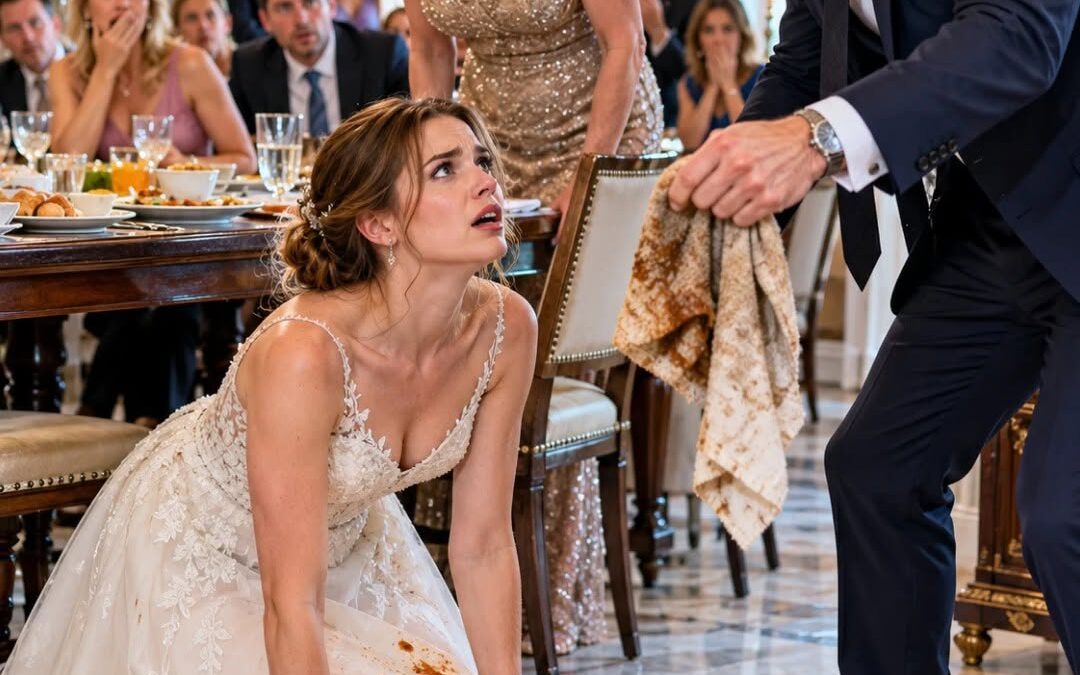
8. Hours After Our Wedding, My Husband Ordered Me Onto My Knees to Clean His Mother’s Mess While the Guests Were Still Eating
PART 2
“Whose necklace was it first?” I asked.
Daniel didn’t answer.
Fiona did.
“It was my grandmother’s. Then his first wife’s.”
The woman in the photograph wasn’t a stranger who happened to resemble someone I knew.
She was the person whose name had been removed from the family stories.
I asked the photographer to remain while I collected my bag.
Then I left the dining room.
The floor could be cleaned without me kneeling in a wedding dress to prove I understood my place.
Fiona followed.
She brought the photograph and letter after making sure they were preserved rather than quietly returned to a drawer.
We sat in a room away from the guests.
For several minutes, she simply let me cry.
The letter was dated eight months earlier, addressed in Daniel’s handwriting to a woman he called his wife.
It discussed moving money and giving his mother authority over a property.
That didn’t by itself prove he was married to two people.
It gave me something specific to verify.
The verification was worse than the mystery.
Daniel had told me he’d never been married.
He had.
He’d told Fiona the marriage was legally over.
It wasn’t fully resolved when he proposed to me, and he concealed the status and practical consequences instead of letting me decide what they meant.
The ceremony I’d just participated in couldn’t make that omission disappear.
I obtained independent advice before signing or accepting anything else.
The photograph explained my necklace.
He’d presented it as a family welcome.
His mother had taken it back from the previous woman during their separation and handed it to me as though objects carried no memories if you polished them.
The cut table runner explained Fiona’s reaction.
Their grandmother made it for the first wedding.
Afterward, their mother cut it into cleaning cloths, announcing that reminders of failure should be useful.
Fiona believed she’d donated the runner.
Seeing the initials at my feet exposed a familiar ritual dressed as a new bride’s introduction.
The first wife had been told to clean too.
Fiona didn’t claim she’d understood everything at the time.
She admitted she’d laughed at something she should have questioned.
That mattered.
She didn’t ask me to comfort her about it.
Daniel said his mother was traditional.
I asked whether tradition required lying about a wife.
He began describing how complicated the separation had become.
I agreed it sounded complicated.
That was why he should have told me.
His mother said the other woman had signed.
The signed paper she’d referred to was a private financial settlement, not proof that every legal step had been completed.
She treated consent to one document as permission to erase a person from the family account.
I wasn’t prepared to become the next edited chapter.
The wedding guests received a brief explanation that the remaining events were canceled.
I didn’t stand in the ballroom declaring a legal conclusion I hadn’t obtained.
I did tell the people helping me that I wouldn’t be leaving for a honeymoon with Daniel.
My sister collected me.
I hadn’t called her immediately because I was embarrassed.
She arrived wearing trainers and carrying a cardigan.
She didn’t ask how I could have missed it.
She asked whether I’d eaten anything that wasn’t covered in gravy.
That almost made me laugh.
The practical process took time.
There were deposits, belongings, and questions about documents I’d signed before the ceremony.
I worked through them with people whose only loyalty wasn’t to preserving a family image.
The necklace went back through an agreed arrangement.
I didn’t throw it at anyone.
I didn’t keep it as compensation for being deceived.
It belonged in a story I hadn’t consented to join.
Fiona and I spoke occasionally afterward.
We weren’t instantly sisters because she’d finally opened a drawer.
But she told the truth when asked, even when it made her uncomfortable.
That was a beginning.
Months later, I bought myself a small chain with no family history attached.
I wore it to lunch with my sister.
She asked whether it meant something.
“Yes.”
She waited.
“It means I liked it.”
She smiled and changed the subject.
I was grateful she understood.
Not every object needed to become proof of survival.
Not every dinner needed a confrontation.
Some days, I simply wanted food that stayed on the plate and people who asked before deciding what I should do.
At home that evening, I put flowers in a vase.
Not my wedding bouquet.
Flowers from a market stall, bought because they were cheap and bright.
I set them on the table.
Then I sat down in my own chair.
Nobody asked me to move.
Nobody handed me a rag.
I ate slowly, and the quiet in the room belonged to me.
I stayed until the candles burned.
Disclaimer: This story is entirely fictional and created for entertainment purposes only. It does not represent any organization or individual, nor does it encourage inappropriate behavior. The content was generated with AI assistance.








