Arrogant CEO Refused to Shake a Black Investor’s Hand in Front of Everyone—Then a $200 Million Decision Exposed the Secret That Destroyed His Company
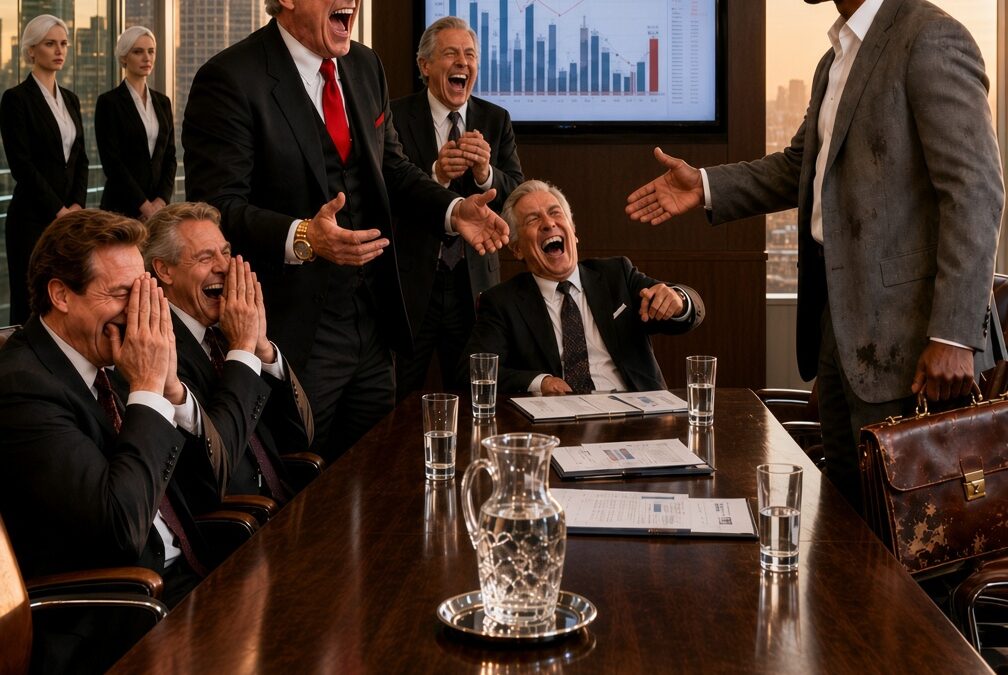
PART 2: The Money That Was Never His
Richard’s hand remained suspended between us.
Nobody shook it.
“Missing forty million?” he repeated.
Laura placed a folder on the table.
“I’ve been trying to explain this for six weeks.”
Richard’s jaw tightened.
“Laura, this is confidential.”
“So is misleading the board,” she replied.
I sat down.
“Then let’s hear her.”
Laura opened the folder and showed us a series of invoices from a consulting company called Northstar Advisory.
Harlan Technologies had paid Northstar nearly forty million dollars over eighteen months.
The invoices described equipment planning, international market research, and factory modernization.
But Laura’s team couldn’t find evidence that much of the work had happened.
Then she discovered Northstar was controlled by Richard’s brother-in-law.
Richard leaned forward.
“Those services were legitimate.”
“Then why did you tell accounting to stop asking questions?” Laura demanded.
Nobody moved.
I remembered the silent factory I’d toured the previous week.
Workers had told me replacement parts were delayed. Supervisors said maintenance budgets had disappeared. Yet Richard’s presentation showed every production line operating at full capacity.
I’d already instructed Rebecca to prepare a withdrawal notice.
Our fund’s proposed two hundred million dollar investment was still conditional. The money had not been released to Harlan Technologies.
We could walk away before closing.
But I wanted the board to understand why.
“Richard,” I said, “your company isn’t failing because I refused to invest.”
He glared at me.
“Then why is it failing?”
“Because someone has been hiding its problems.”
Laura slid another document across the table.
It showed overdue supplier payments, canceled equipment orders, and a cash forecast dramatically worse than the one Richard had presented.
His company had borrowed heavily to finance expansion.
The proposed investment was supposed to satisfy a condition imposed by its lenders.
Without it, the lenders could demand new collateral or negotiate emergency terms.
Richard looked at Rebecca.
“You can’t pull out now.”
She answered calmly.
“The investment agreement permits withdrawal before closing if material financial disclosures are inaccurate. We are exercising that right.”
I checked my watch.
Forty-seven minutes had passed since Richard refused my handshake.
Rebecca sent the signed notice.
The two hundred million dollars would remain in our fund.
Richard stared at his phone as messages began arriving.
One director asked for an immediate recess.
Another called the company’s outside auditors.
Laura sat down, looking exhausted.
For a moment, I thought the meeting was over.
Then Richard said something I hadn’t expected.
“You planned this humiliation.”
I looked at him.
“You humiliated yourself.”
He pointed toward Laura.
“She brought you here to destroy me.”
“No,” she said quietly. “I brought him here because I couldn’t get anyone to listen.”
Richard turned toward the board chair.
“You’re not going to believe her over me?”
The chair studied the invoices.
“We’re going to investigate.”
That afternoon, the board suspended Richard’s authority pending an independent review.
Within days, Harlan’s lenders demanded updated financial information. Suppliers tightened payment terms, and several customers delayed orders.
The company entered restructuring negotiations.
Three months later, Harlan Technologies filed for bankruptcy protection.
The investigation found that Northstar had received substantial payments without adequate documentation. Richard disputed wrongdoing, but the board referred its findings to the appropriate authorities.
The company he’d once called his empire was broken into pieces.
I didn’t celebrate.
Thousands of employees had built their lives around those factories.
They hadn’t chosen Richard’s decisions.
Rebecca and I spent the following weeks meeting with lenders and potential buyers.
We eventually supported a restructuring proposal that preserved the most viable operations and protected as many jobs as possible.
It wasn’t a perfect ending.
Some workers still lost positions.
Some families still struggled.
Money couldn’t undo every consequence.
One afternoon, Laura visited my office.
She carried a small cardboard box filled with photographs from the company’s earliest days.
“I thought you’d want to see these,” she said.
The pictures showed engineers assembling equipment in a rented warehouse.
Richard stood among them, younger and smiling.
“He wasn’t always like this,” Laura said.
“Maybe not.”
She looked at me.
“Do you ever wonder whether shaking his hand would have changed anything?”
I thought about the boardroom.
The laughter.
The silence.
The way Richard had reached for my hand only after discovering my name.
“No,” I answered. “The financial problems were already there.”
Laura nodded.
Then she placed one photograph on my desk.
It showed a young factory worker standing beside the first machine Harlan Technologies ever produced.
“That man’s name is Thomas,” she said. “He still works there.”
I studied his face.
He looked proud.
“He helped save the original production line during the restructuring,” Laura continued. “The new owners offered him a supervisory position.”
I smiled.
“That matters.”
A year later, I visited the factory again.
The building was smaller. Several departments had closed.
But the machines were running.
Thomas met me at the entrance and extended his hand.
“Mr. Brooks. Thank you for coming.”
I shook it.
His palm was rough from years of work.
We walked past the assembly lines while workers checked equipment and called instructions across the floor.
At the far end of the building, someone had hung an old photograph of the founding team.
Richard wasn’t in the picture.
The workers were.
Thomas noticed me looking.
“We wanted to remember who actually built this place,” he said.
I stood there for a moment.
Then I turned back toward the machines.
The sound was steady.
And for the first time in a long while, it sounded like a future.
Disclaimer: This story is entirely fictional and created for entertainment purposes only. It does not represent any organization or individual, nor does it encourage inappropriate behavior. The content was generated with AI assistance.








