Behind the Curtain, the Duke Asked, “Would You Like Me to Go Further?”
Part 2
Anna stopped gripping the coat.
For the first time that evening, her embarrassment gave way to anger.
Alaric looked at her, waiting.
“Yes,” she said. “I would like you to go further. I would like her to stop telling my story for me.”
He drew back the curtain.
Florence stood outside with her fan raised. When she saw Anna beside him, she glanced at the coat and smiled.
“I only meant to spare you an awkward situation.”
“Then tell me how the sleeve tore,” Alaric said.
“She caught it on the chair.”
“There was no chair beside her.”
“The table, then.”
Anna stepped forward.
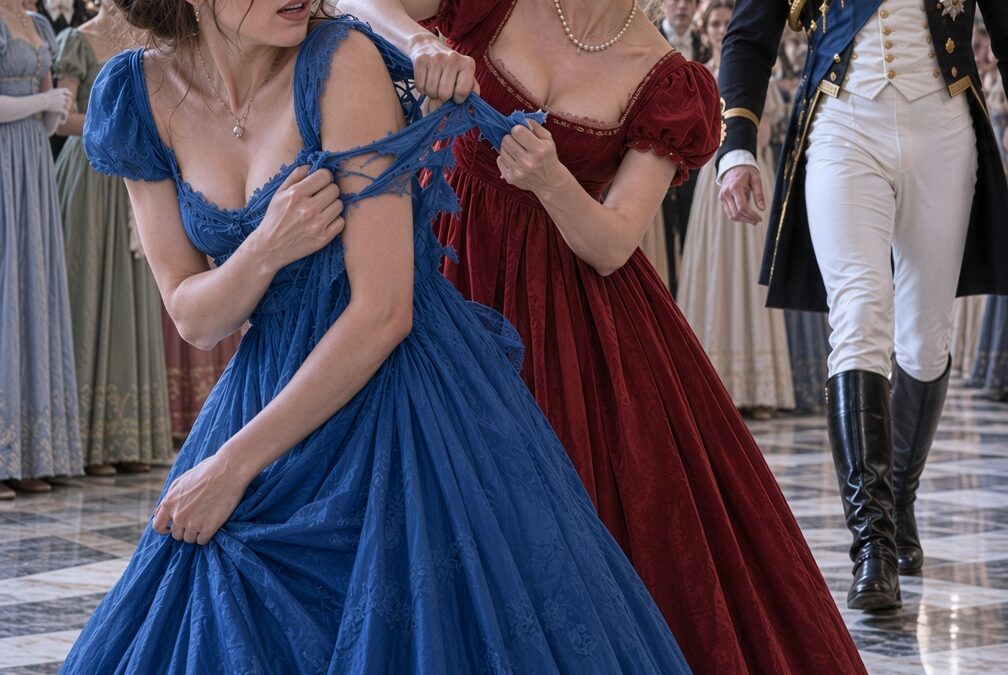
“You held my wrist and pulled the fabric against your bracelet.”
Florence’s eyes widened with practiced disbelief.
“That is a dreadful accusation.”
“So was yours.”
The nearest guests fell silent. Alaric did not raise his voice, but it carried.
“I saw Lady Florence take your arm. I saw her turn the bracelet inward. I saw her pull.”
Florence looked toward the mirrored doors.
“Your back was turned.”
“Yes.”
He waited until she understood.
The long mirror beside the entrance reflected the entire center of the gallery. From where he stood, he had seen every movement clearly.
Anna remembered him turning toward that reflection before crossing the room.
He had not been responding to the laughter.
He had already been coming.
Florence lowered her fan.
“It was an accident.”
“Then why tell everyone she did it herself?” he asked.
No one laughed now.
Alaric’s aunt approached. She looked at the torn fabric beneath his coat, then at Florence’s bracelet.
A pale thread clung to one of its tiny settings.
Florence tried to brush it away.
“Leave it,” Anna said.
Her voice surprised her by remaining steady.
“That thread is from my mother’s wedding dress. You do not get to call it cheap while hiding what you did to it.”
Florence’s face flushed.
“I wanted her to understand the expectations here.”
“She understands them perfectly,” Alaric replied. “You are the one who has mistaken cruelty for good breeding.”
His aunt asked Florence to accompany her out. Florence objected once, then saw the faces around her and went.
Anna exhaled slowly.
The room still watched.
Alaric turned toward the guests.
“This evening was meant to introduce people. It will not be a competition in who can make someone else feel small.”
He looked back at Anna.
“Would you like to leave?”
She thought of her mother waiting at their lodgings, hoping the dress would make her feel beautiful.
“Not yet.”
His eyes warmed.
“Then may I ask for a dance after we find someone to repair your sleeve?”
“My mother taught me how.”
“Of course she did.”
They found a sewing basket in the housekeeper’s room. Anna refused to let the ruined seam end the evening. She folded the damaged silk inward, made several careful stitches, and secured the sleeve differently.
Alaric watched from the doorway while the housekeeper held a lamp.
“Does it look strange?” Anna asked.
“It looks like someone refused to give up on it.”
“That was not my question.”
“No,” he admitted. “It looks lovely.”
She looked down before he could see how much the answer mattered.
Before returning, Anna asked whether he felt obliged to make the evening pleasant because it had gone wrong in his house. Alaric admitted that he did. Then he added that obligation had nothing to do with wanting another conversation in the library. She studied him for a moment, separating his concern from the warmth beneath it. When she offered her hand, it was because she wanted to, without owing anyone.
When they returned, he offered his arm again. Anna wore his coat until the music began. Then she handed it back, thanked him, and walked onto the floor without hiding the repaired sleeve.
He danced carefully. She discovered that a feared duke could lose count when she smiled at him.
“Was I chosen?” she asked softly.
His expression became serious.
“This is not a prize I intend to award.”
“What do you intend?”
“To call on you tomorrow, if you permit it. To meet the woman who taught you to rescue books and dresses.”
“My mother will ask difficult questions.”
“I suspect I should prepare.”
“She will also give you cake.”
“That improves my courage.”
Anna laughed.
The next afternoon, he arrived without an audience. Her mother’s mended wedding dress hung near the window, its altered sleeve catching the daylight.
Alaric bowed over the older woman’s hand, accepted tea, and stayed until the cake was gone.
As evening softened the little room, Anna reached to remove a loose thread from his cuff. He held still beneath her fingers, smiling at her as though nothing in the castle had been worth more than this small, ordinary moment beside her.
Disclaimer: This story is entirely fictional and created for entertainment purposes only. It does not represent any organization or individual, nor does it encourage inappropriate behavior. The content was generated with AI assistance.
Đang tóm tắt phần mở đầu câu chuyện】【。
Catching Her Duke With His Former Love, She Asked, “What Else Did You Think You Bought?”
Part 1
Beatrice had been a duchess for nine days when she heard another woman ask her husband what he had paid to get her.
She stopped outside the library.
Through the narrow opening, she saw Lady Marianne’s hand resting on Rowan’s sleeve. A document lay between them, marked with the name of the man Beatrice should have married.
Edward.
Her former fiancé had abandoned her two weeks before their wedding.
Apparently, humiliation had followed her to Coldmere Abbey.
Twelve days before she married Rowan, she had sat in her parents’ drawing room wearing half a bridal glove. Edward’s letter lay open on her lap.
He had found a more suitable match.
A richer one, her mother explained through tears.
At twenty-eight, Beatrice had expected betrayal to feel hot. Instead, she felt cold enough to hear the clock ticking in the hall.
The following afternoon, Rowan, Duke of Coldmere, asked for her hand.
London feared his silence, his temper, and his ability to make powerful people feel suddenly unimportant. He was thirty-three and had recently ended a celebrated courtship with Marianne.
“Why me?” Beatrice asked.
“Because I wish to marry you.”
“Do you always answer questions by repeating them?”
His mouth moved slightly.
“Only when I am afraid of giving the wrong answer.”
That admission unsettled her more than arrogance would have.
He offered her financial independence and a household where she would never need to earn her welcome.
“And what do you expect?”
“Honesty.”
“An heir?”
“Nothing you have not freely agreed to.”
Beatrice studied him. She remembered his father, a gentle man whose shaking hands had made holding playing cards difficult. At a ball the previous winter, she had sat beside him and pretended not to notice.
Rowan had stood across the room all evening.
She wondered whether he remembered her at all.
They married quietly. Her mother cried again, but differently.
At Coldmere, Beatrice found books she loved waiting in her room. At breakfast, Rowan remembered that she preferred marmalade to jam. He knocked before entering and always paused long enough for an answer.
Once, rain kept them in the library until afternoon. They argued over a novel, forgot luncheon, and laughed when the housekeeper finally interrupted.
That night, he found her struggling with the clasp of her silver bracelet. He asked before helping. His fingertips brushed her wrist, and for several seconds after the clasp closed, neither stepped away. Beatrice looked up to find him watching her instead of the bracelet. Then a servant knocked, and Rowan withdrew with such careful courtesy that she lay awake wondering what might have happened without the interruption.
Beatrice began looking forward to waking up.
Then Marianne arrived for the autumn reception.
She knew where the glasses were kept. She called Rowan by his childhood nickname. When Beatrice entered the drawing room, Marianne smiled without moving from the chair beside him.
“He has always been generous with unfortunate people,” she said later.
Beatrice set down her cup.
“How exhausting for his guests.”
Marianne’s smile sharpened.
That evening, Rowan disappeared before the dancing began.
Now Beatrice stood outside his library, staring at Edward’s name.
“Does she know why you wanted this marriage?” Marianne asked.
“No,” Rowan said.
His answer was quiet. Certain.
Beatrice pushed the door open.
Marianne’s hand slid from his sleeve.
Rowan rose immediately.
“Beatrice.”
She looked at the paper, then at the woman beside his desk.
“What did you pay Edward?”
“Nothing.”
“I heard her.”
“You heard a question.”
“And I am asking another.”
Her voice trembled, but she did not lower it.
“What else did you think you bought?”
Part 2
Rowan’s face changed as though she had struck him.
Marianne reached for the paper.
“Perhaps this conversation would be better continued tomorrow.”
Beatrice held out her hand.
“No. I would like to read it tonight.”
Rowan took the document before Marianne could fold it and passed it to his wife.
The first entry was for flowers.
The second was for the bridal gloves still wrapped in tissue at her parents’ house.
Below them came the dressmaker, the confectioner, and the musicians Edward had engaged for a wedding he never intended to attend.
Beatrice looked up slowly.
“The suppliers?”
“Yes,” Rowan said.
“Edward left the bills in my name.”
“He did.”
“And you settled them.”
“The work had been done. Your parents should not have been made to pay for his choices.”
Beatrice read the instruction at the bottom. No payment or acknowledgment was to be requested from her family.
Her anger faltered, then found a different place to stand.
“You could have told me.”
“I thought it would make you feel obligated to accept my proposal.”
“So you let me marry you without knowing what had happened.”
He lowered his eyes.
“Yes.”
Marianne gave a small laugh.
“You see? Merely a charitable arrangement.”
Rowan turned toward her.
“Enough.”
The word silenced her.
“You asked what I paid because you wanted it to sound like a purchase. You asked about my reasons because you hoped Beatrice would misunderstand them.”
“I was concerned about your haste.”
“You have expressed that concern. You will leave my wife out of it now.”
Marianne looked toward Beatrice, expecting embarrassment to rescue her.
Beatrice returned the look.
“I believe the footman can find your coat.”
For a moment, Marianne seemed unable to understand that neither of them would apologize.
Then she left.
Rowan remained standing until her footsteps faded.
Beatrice set the document on his desk.
“Why did you want this marriage?”
He drew a slow breath.
“Because I wanted a life with you. And I did a poor job of distinguishing that from an offer of assistance.”
Beatrice wanted to believe him. That frightened her more than Marianne had. Edward’s rejection had taught her how quickly a future could become an embarrassing mistake discussed over tea. She had accepted a practical marriage partly because its limits seemed clear. Now she wanted something that could not be secured by a settlement, and she needed him to understand how much courage asking for it would take.
“You barely knew me.”
“I knew you stayed beside my father when everyone else found reasons to leave.”
“He was good company.”
“He repeated himself.”
“So do most men. He was more entertaining.”
Rowan laughed once. The sound broke in the middle.
He opened a drawer and removed a playing card.
The queen of hearts.
Beatrice remembered its bent corner. His father had insisted it brought him luck.
“After he died, I found this beside a note reminding him to invite you again,” Rowan said. “He said you never made him feel ashamed of needing time.”
She touched the card.
“I liked him.”
“I know. That was why it mattered.”
He placed it between them.
“Afterward, I began noticing you. How you remembered servants’ names. How you argued when someone was treated unfairly. How you laughed when you forgot to be careful.”
“Why did you never speak?”
“You were promised to Edward. You seemed happy.”
“And then I was available.”
“And hurt. I was afraid anything I said would sound like an attempt to benefit from it. So I made the proposal practical.”
Beatrice looked toward the rain running down the windows.
“I was beginning to love being here,” she admitted.
“Were you?”
“The books. Our arguments. Finding you at breakfast.”
His fingers moved against the desk, then stilled.
“I did not purchase any of that,” he said. “But I have been hoping you might give it to me.”
She turned back.
“Then ask.”
Rowan stepped closer.
“Will you let me try being the husband I should have introduced you to before the wedding?”
“One who tells me things?”
“Yes.”
“Even when telling me is uncomfortable?”
“Especially then.”
Beatrice took his hand.
Downstairs, the orchestra began a waltz. He glanced toward the door, then back at her.
“Have we missed our dance?”
“Not if you hurry.”
He offered his arm. She slipped her hand through it and let him lead her toward the music.
At the ballroom entrance, he paused. Before the watching guests, Rowan bent and kissed her gloved fingers.
Beatrice smiled, feeling the warmth of his hand beneath hers.
They crossed the floor together. Beyond the windows, rain blurred the lake into silver. Inside, his solemn face softened when she drew closer, and this time, when he whispered her name, she knew what he was asking her to hear.
Disclaimer: This story is entirely fictional and created for entertainment purposes only. It does not represent any organization or individual, nor does it encourage inappropriate behavior. The content was generated with AI assistance.








