“Come Into My Barn Tonight, Cowboy… They Dumped Their Trash on My Land, but What’s Hidden Under It Could Make Us Rich!”
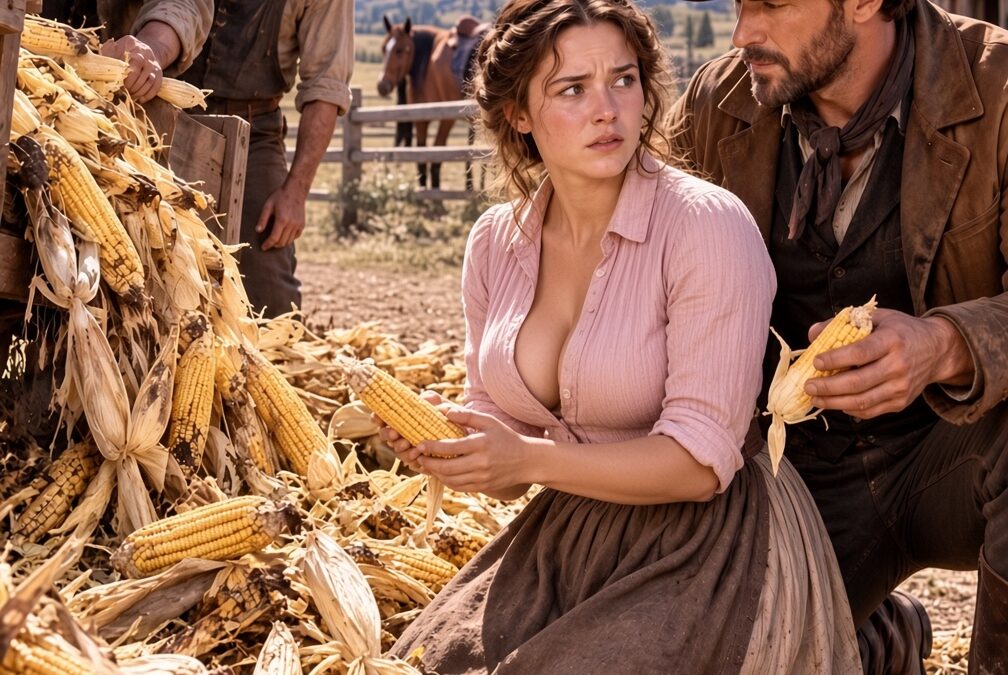
PART 2 — THE HARVEST THEY TRIED TO BURY
Clara stood beside Nathan, watching the armed men approach.
Whitcomb dismounted.
“Open the door!”
Nathan reached for his rifle.
Clara caught his arm.
“Please don’t start a fight.”
He looked toward her.
“I won’t unless he forces one.”
Whitcomb shouted again.
“That corn belongs to me!”
Clara stepped onto the porch.
“You called it trash.”
The merchant smiled.
“I’ve changed my mind.”
Nathan appeared beside her.
“Then perhaps you’d like to explain why.”
Whitcomb’s expression hardened.
“This doesn’t concern you.”
Nathan held up an ear of purple corn.
“I think it does.”
The merchant went pale.
For a moment, nobody spoke.
Then Whitcomb turned toward his men.
“Take the sacks.”
Nathan raised his rifle.
“Not without a court order.”
Whitcomb hesitated.
Clara folded her arms.
“You dumped them on my property.”
The merchant glared.
“You’ll regret this.”
He mounted his horse.
Then rode away.
Nathan waited until the riders disappeared.
Clara turned toward him.
“What’s so special about that corn?”
He opened his grandfather’s notebook.
“Forty years ago, several farmers developed a strain that could survive long periods without rain.”
Clara frowned.
“Then why haven’t I heard of it?”
“Because the original seed stock disappeared.”
Nathan pointed toward the drawing.
“My grandfather believed someone deliberately destroyed the experiment.”
Clara looked toward the barn.
“And now it’s here.”
He nodded.
“Or at least part of it.”
They spent the afternoon sorting the corn.
Some kernels were damaged.
Others remained dry and firm.
Nathan selected several ears.
“These might still be viable.”
Clara stared.
“Could we plant them?”
“We can try.”
The next morning, they prepared a small test field.
Nathan explained that the seeds would need careful observation.
Clara helped mark each row.
For weeks, they watered the soil and watched for growth.
Then tiny green shoots appeared.
Clara ran toward Nathan.
“Look!”
He knelt beside the seedlings.
His face brightened.
“They’re growing.”
She laughed.
“We did it!”
Nathan smiled.
“It’s only the beginning.”
But Whitcomb hadn’t given up.
He attempted to claim ownership of the seeds.
Then he spread rumors that Clara’s farm was contaminated.
Several merchants refused to trade with her.
Nathan contacted an agricultural researcher in Denver.
The researcher examined the surviving plants.
His preliminary findings suggested that the corn belonged to a rare locally adapted variety.
It wasn’t guaranteed to revolutionize farming.
But it had valuable traits worth preserving and studying.
The researcher also recognized the old experiment’s records.
Nathan’s grandfather had worked with James Hayes’s father.
Together, they had developed the strain.
Whitcomb’s company later acquired the storage facility where the seeds were kept.
When James discovered surviving stock, he began investigating.
Clara opened her husband’s letters again.
This time, she understood their meaning.
James had been trying to protect the seeds from destruction.
Before he died, he’d hidden copies of the records in their farmhouse.
Whitcomb eventually discovered the remaining corn in an old warehouse.
He intended to dump it on Clara’s property as part of a campaign to pressure her into selling.
But the sacks contained more surviving seeds than he’d realized.
The court examined the ownership records.
Whitcomb’s fraudulent claims collapsed.
Investigators also discovered that he’d falsified grain transactions and threatened neighboring farmers.
He faced prosecution for those crimes.
Clara retained possession of the corn legally abandoned on her land.
With Nathan’s help, she established a seed preservation project.
The Denver researcher assisted with testing and cultivation.
The following spring, several local farmers planted small experimental plots.
The results were promising.
Some plants survived dry conditions better than the region’s usual varieties.
Others produced modest harvests.
Nathan insisted they keep careful records rather than make extravagant promises.
Clara admired that about him.
He never pretended success was guaranteed.
He simply worked beside her.
One evening, they stood overlooking the growing fields.
Clara smiled.
“Do you remember when I thought this was all trash?”
Nathan nodded.
“You were ready to burn it.”
She laughed.
“And you stopped me.”
“Lucky timing.”
Clara looked toward him.
“Was it luck?”
He smiled.
“Perhaps.”
She took his hand.
“You’ve done more than save my farm.”
Nathan’s expression softened.
“What have I done?”
“You reminded me that I could build something new.”
He looked toward the sunset.
“James would have been proud of you.”
Clara’s eyes filled with tears.
“Thank you.”
Months passed.
Their friendship slowly became love.
Nathan never rushed her.
Clara never felt pressured to forget her husband.
When Nathan finally asked her to marry him, she smiled through her tears.
“Yes.”
Their wedding took place beside the first successful harvest.
The barn that once held wagonloads of discarded corn was filled with flowers.
And the farm Whitcomb had tried to destroy became a place where forgotten seeds, and forgotten hopes, were given another chance.
THE END.
Disclaimer: This story is entirely fictional and created for entertainment purposes only. It does not represent any organization or individual, nor does it encourage inappropriate behavior. The content was generated with AI assistance.








