He Wed Her to Humiliate Her Father—But the Bride Held His Inheritance in Her Hands
He Wed Her to Humiliate Her Father—But the Bride Held His Inheritance in Her Hands
Part 1
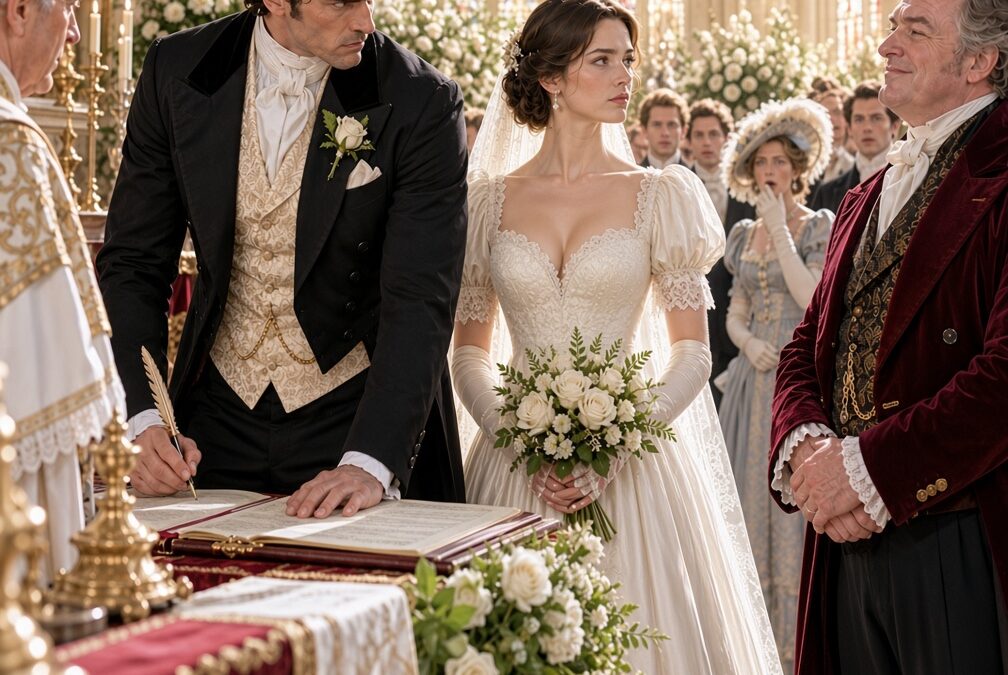
The bride signed the register while the Duke of Rookhaven watched her father smile.
Margaret Vale kept her gaze on the page. Her new husband, Gabriel Ashcombe, leaned close enough for the guests to mistake his silence for tenderness.
“Your father looks pleased,” he murmured.
“He is watching me marry a man who despises him.”
“Then he has received the lesson I intended.”
The clergyman asked them to exchange rings. Margaret held out her hand. Gabriel slid the band into place, his expression fixed and cold. Across the aisle, her father, once the duke’s steward, wore a wine-red coat and a quiet, almost satisfied smile.
The guests saw a beautiful wedding in the cathedral. Margaret saw an old accusation standing between the vows.
Gabriel believed her father had stolen from the Ashcombe family and set fire to the west wing to hide the missing money. He had returned from the Continent certain that Mr. Vale had ruined his father’s final years. Now he had married the man’s only daughter in front of the entire county, binding her to the family she had supposedly betrayed.
Margaret knew the accusation was false. Her father had kept the accounts and searched for proof until his death. Before he died, her father had told her that the duchess summoned him to the library after midnight. The woman feared the estate books were being altered, but she could not accuse anyone without proof. Margaret remembered helping her copy figures by candlelight, while the duchess asked questions about tenants and rent payments. That was the moment Margaret understood that an inheritance could be a duty to people who might never meet its owner. She had kept the memory, unsure whether anyone would believe her. She had accepted Gabriel’s proposal because she wanted access to the archive at Rookhaven, where the missing ledgers might still be kept. She had not expected him to use their wedding as a public punishment.
When the ceremony ended, the guests crowded around them. Gabriel offered his arm. Margaret placed her gloved hand on it, aware of his tension beneath the dark sleeve.
“Your father seemed to enjoy the vows,” he said as they crossed the aisle.
“He was proud I did not run.”
“Or proud his daughter is now a duchess.”
“Those are not the same thing.”
His eyes narrowed, then shifted toward the older man. Mr. Vale was greeting the solicitor, still smiling. Gabriel’s jaw tightened.
“You think he planned this.”
“I think you have decided what he thinks before asking him.”
The carriage carried them to Rookhaven House. Margaret looked through the window at the cathedral shrinking behind them. She had spent the last weeks sorting her father’s papers and found one document sealed with the late duchess’s crest. Her father had written only: “Give this to Gabriel when the time is right.”
She had brought it in her traveling case.
That night, Gabriel found her in the library, studying a ledger. He set a stack of letters on the desk.
“Your father’s account books,” he said. “You may look through them. Perhaps you’ll find the proof he never did.”
Margaret touched the sealed document in her pocket.
“Will you read one letter first?”
“I have read enough of his lies.”
“It is not from my father.”
She placed the paper beside his hand. The old duchess’s seal was still intact.
Gabriel stared at it. Before he could break the wax, the solicitor entered carrying a second leather case.
“Your Grace,” he said, “before you read that letter, you should know what your mother placed in Mrs. Ashcombe’s hands.”
Part 2
Gabriel looked from the solicitor to Margaret. “What did my mother place in her hands?”
The solicitor opened the case and removed a deed, several account books, and a letter bearing the same crest Margaret had been carrying.
“Your mother appointed Mrs. Ashcombe an independent trustee,” he said. “The bulk of your inheritance was placed in trust until the estate accounts were reconciled and the tenant holdings secured.”
Gabriel’s face went still. “My wife controls the inheritance?”
“Not the title, Your Grace. The estate’s property and revenues. She has authority to approve expenses, challenge debts, and prevent the land from being sold until the trust conditions are met.”
Margaret unfolded the old duchess’s letter. Her hands trembled once, then steadied.
The duchess had written that Mr. Vale was not a thief. He had discovered that the former steward was diverting funds through a company owned by his brother. The fire had destroyed some original ledgers, but Mr. Vale had preserved copies. The duchess had asked him to help her protect the estate from the fraud and to keep the evidence safe.
The letter continued: Margaret had helped the duchess during her last winter, reading aloud when her eyesight failed and organizing the household accounts. Her father believed the truth would clear his name, but never expected his daughter to carry that burden. The duchess had come to trust her judgment. She appointed Margaret trustee because she understood the books and could act independently of the Ashcombe family.
Gabriel sat down.
“All these years, I believed your father betrayed mine.”
“He was trying to protect him.”
The solicitor spread the account copies across the desk. Payments had been routed through the former steward’s brother. Several suppliers had been paid twice, including the coal merchant Gabriel had dismissed only months earlier. The fraud had been hidden in the same books he assumed Mr. Vale destroyed.
Margaret pointed to the repeated entries. “I found these in the archive. I wanted you to see them before you blamed my father again.”
Gabriel looked at her wedding ring. “You knew you controlled the trust when you married me.”
“I knew the duchess had named me trustee. I did not know you meant our wedding to humiliate my father. I accepted because I wanted the archive opened, and because my father’s name deserved the truth.”
He flinched at that. “I used you to punish him.”
“Yes.”
“He is dead.”
“Which is why your punishment only reached me.”
Gabriel turned away. For a moment, the library held only the rustle of papers and the steady clock. Then he faced her again.
“You can leave. I will not contest an annulment or interfere with your authority over the trust.”
Margaret studied the man who had stood beside her at the altar, watching her father instead of her. She had imagined this moment in a dozen ways. In none of them had she felt relief at being offered a choice.
“I will stay long enough to finish the audit,” she said. “After that, I will decide what I want.”
The solicitor confirmed the trust was independent of their marriage. Margaret could remain trustee, appoint a replacement, or resign after the accounts were settled. Her marriage gave Gabriel no control over her decision.
For the next several months, they worked through the estate’s records. Margaret visited tenant cottages, arranged overdue repairs, and stopped an agent from raising rents after a poor harvest. Gabriel apologized without asking her to forgive him. He publicly cleared her father’s name and acknowledged that he had accused him without proof.
Their conversations changed. He began asking before making decisions that affected the tenants. She learned that his anger had grown from grief over his father, but grief did not excuse his cruelty. They spoke honestly, sometimes painfully, until respect began to replace suspicion.
One evening, Gabriel brought tea to the library while Margaret reviewed the final ledger.
“What do you need from me?” he asked.
“The truth, even when it makes you look foolish.”
He nodded. “I can do that.”
When the audit ended, Margaret placed the last book on his desk. The missing money had been traced. The tenants’ accounts were corrected. The inheritance was finally his to manage, though she remained free to leave.
“You have your estate,” she said.
“And you have your choice.”
She looked at him, then at the ring he had placed on her hand beneath the cathedral windows. “I will stay. But we begin again, without using my father as a reason.”
Gabriel offered his hand. This time, he looked at her rather than across the room. Margaret took it. Through the library windows, the west wing glowed in the last light, its repaired windows catching the same gold that had filled the cathedral on their wedding day.
Disclaimer: This story is entirely fictional and created for entertainment purposes only. It does not represent any organization or individual, nor does it encourage inappropriate behavior. The content was generated with AI assistance.








