I Bought an Abandoned Ranch for Almost Nothing—Then a Woman Beneath the Floorboards Said My Father’s Name
PART 2
I asked Rebecca to repeat what she’d said.
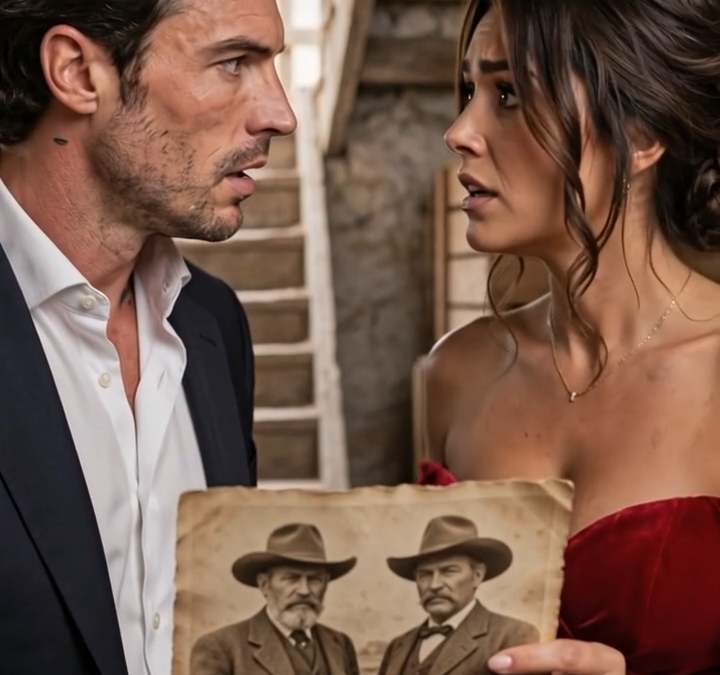
She pointed to the photograph.
“Your father helped mine survey this land.”
My father had worked seasonal construction jobs all over Montana, but he’d never told me he was involved in a ranch ownership dispute.
Rebecca sat on the cellar steps.
“Please don’t call anyone until you’ve seen the papers.”
I wanted to tell her that hiding in a stranger’s basement wasn’t a reasonable way to make a property claim.
Then I remembered the price I’d paid.
I followed her upstairs.
She spread survey maps across the kitchen table. Some were decades old. Others had been copied recently.
The original ranch boundaries included a stretch of rocky hillside that didn’t appear in my purchase documents.
“Why would anyone remove that?” I asked.
“Because the mineral rights underneath it were never properly transferred.”
She explained that her grandfather had allowed a mining company to perform preliminary geological testing years earlier. The results suggested a valuable mineral deposit, but development never proceeded.
After her father died, a series of confusing transactions separated the surface rights from the mineral rights.
Rebecca believed someone had used forged signatures to claim both.
I asked about the man marked with an X.
“He was my father’s business partner. He died before the dispute was settled.”
I looked again at my father’s face.
“What was his role?”
“Survey assistant. Later, a witness.”
She showed me a notebook with my father’s initials on the cover. Inside were measurements, dates, and detailed sketches of boundary markers.
The final page contained a note about a storage compartment beneath the barn.
I stared at it.
“I didn’t know he kept records like this.”
Rebecca said she’d found the notebook in her family’s belongings. She’d been searching the property because her grandfather’s letters referred to an original deed stored somewhere on the ranch.
She hadn’t approached the authorities directly because an earlier ownership challenge had failed, and she was afraid important documents would disappear again.
I told her she needed a lawyer.
“I know,” she said. “I just needed evidence first.”
I thought about calling the real estate agent, but decided to wait until an independent attorney reviewed the sale.
We searched the barn the following morning.
The storage compartment was exactly where my father’s sketch showed it.
Inside was a weatherproof metal tube containing copies of survey records and a handwritten statement signed by my father.
He described witnessing a disagreement over the transfer of mineral rights. He believed the recorded deed did not match the document he’d seen signed.
Then came the sentence that changed how I understood him.
I stayed quiet because I needed the money, and I’ve regretted it ever since.
I sat on an overturned bucket for a long time.
I’d always imagined my father as a man who stood up for what was right.
The statement didn’t erase the good he’d done. It showed me something harder: he’d made a selfish choice and later tried to correct it.
Rebecca stood beside the barn door, letting me read without interruption.
“He helped my father gather evidence before he died,” she said. “They were planning to challenge the transfer.”
I asked why she hadn’t mentioned that earlier.
“Because I didn’t know if you’d want to believe me.”
That was fair.
I had spent our first conversation treating her like an intruder.
Still, I told her she couldn’t remain hidden in the cellar. It wasn’t safe or appropriate, and the property was now legally in my name.
She agreed to stay elsewhere while we sorted things out.
We hired separate attorneys. I disclosed the documents I’d found and requested a full review of the purchase.
Over the following months, investigators identified inconsistencies in the historical records. Some signatures required expert examination, and the mineral-rights dispute moved into formal legal proceedings.
The preliminary valuation suggested the deposit could be worth hundreds of millions of dollars if development proved feasible.
Neither Rebecca nor I celebrated.
Money that large could attract people willing to say almost anything.
I wanted the paperwork settled before anyone talked about selling.
During the process, Rebecca and I spent afternoons reviewing old maps at the kitchen table. We disagreed frequently. She trusted the land more than lawyers. I trusted neither until I’d read everything twice.
She laughed at my terrible coffee.
I learned she liked the sound of rain on the barn roof.
Eventually, the attorneys negotiated an agreement recognizing her family’s claim to the disputed mineral rights while preserving my surface ownership and establishing access protections.
It wasn’t the enormous victory either of us had imagined.
It was something we could live with.
One evening, Rebecca found me repairing the porch steps.
“You could sell this place now,” she said.
“I know.”
“Are you going to?”
I looked across the pasture.
“My dad wanted a ranch. I think I’ll keep it.”
She sat beside me.
After a while, she asked whether I still blamed him.
“Some days,” I said. “But I think he was trying to leave me a chance to do better.”
Rebecca rested her hand beside mine on the porch.
I didn’t reach for it immediately.
When I finally did, she didn’t pull away.
And for the first time since I’d arrived, the house above the cellar felt like somewhere a future could begin.
Disclaimer: This story is entirely fictional and created for entertainment purposes only. It does not represent any organization or individual, nor does it encourage inappropriate behavior. The content was generated with AI assistance.








