I Humiliated a Waitress in Front of Everyone—Then Found Her Photograph on My Son’s Hospital Wall
PART 2
The warning carried a date I recognized.
It had been written three weeks before my son’s surgery, during the period when my company was preparing a new cardiac medication for wider distribution.
Grace’s note was short and clinical. She questioned whether a manufacturing change had affected the medication’s stability. She requested independent testing before the product reached more hospitals.
I remembered the meeting when that concern was supposedly resolved.
My executives had presented a reassuring summary. I’d signed the approval without reading the underlying report.
Now I was staring at the original warning.
I returned to the restaurant the next morning. Grace was wiping down the same table where I’d insulted her.
She looked at me, then continued working.
“I owe you an apology,” I said.
“Yes,” she answered.
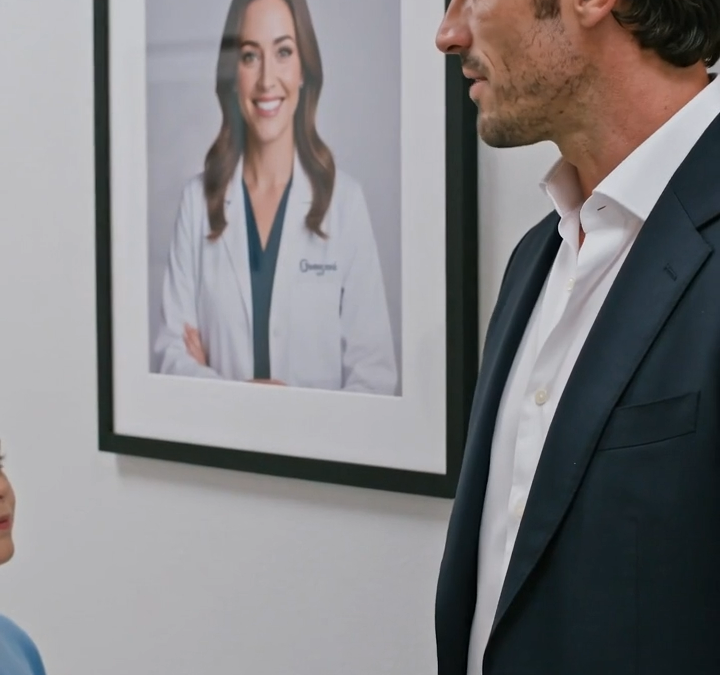
I explained that I’d seen her photograph at the hospital.
She stopped wiping.
“Then you know why I recognized you.”
I admitted I hadn’t known she operated on my son. She told me she’d recognized us immediately when I entered the restaurant. She had memorized his name because his recovery had been especially difficult.
“He made me promise I’d visit when he could ride a bike again,” she said.
I remembered my son talking about a doctor who kept a tiny bicycle drawing in her coat pocket. Until that moment, I’d forgotten the story.
I asked about the disciplinary case.
Grace folded the towel carefully.
“I was accused of altering clinical records. The hospital suspended me. My license was later restricted while the board investigated.”
“Did you alter them?”
“No. I reported inconsistencies. Someone changed the records afterward.”
She didn’t ask me to believe her. She showed me a copy of the original report she’d kept, with timestamps and an independent laboratory request.
I recognized one of the internal authorization codes.
It belonged to my company.
The worst part wasn’t that I understood the documents. It was that I remembered being told Grace was an unreliable physician who wanted publicity.
I’d repeated that explanation without asking why a respected surgeon would risk her career over a laboratory discrepancy.
“Why didn’t you contact me?” I asked.
“I did.”
She showed me an email addressed to my office. My assistant had forwarded it to the company’s legal department. The response instructed her to communicate only through counsel.
I had never seen it.
Grace explained that after losing her hospital position, she’d taken restaurant work to pay her rent and the legal bills. She still volunteered at a community health program when her professional restrictions permitted.
She was careful not to claim every medication issue was proven. Some evidence remained disputed. But she believed the company had hidden information regulators needed.
I asked what she wanted from me.
“Stop letting people decide what you’re allowed to know.”
It was the same disappointment I’d seen in her eyes the previous afternoon.
I left with copies of the documents and went directly to independent counsel. Within a week, I’d authorized an external investigation, preserved company records, and contacted the appropriate regulators.
The findings were worse than I’d expected.
Several executives had concealed failed quality tests and altered the summary presented to the board. The investigation found no evidence that Grace had falsified the original clinical observations. Her disciplinary case had relied heavily on records that were now under review.
I couldn’t restore her career myself. That decision belonged to the licensing authorities. I could, however, provide the records she’d been denied and acknowledge publicly what my company had concealed.
I did both.
Months later, Grace’s restrictions were lifted after the relevant review. She was offered an opportunity to return to supervised hospital practice while rebuilding her career.
By then, my son was finally strong enough to ride his bicycle around our neighborhood.
I invited Grace to watch.
She almost declined.
“Richard, being grateful doesn’t mean you owe me a friendship,” she said.
“I know. I’m asking because he remembers you.”
She arrived carrying a small paper bag.
Inside was a bicycle bell.
My son recognized her before she reached the front steps. He ran toward her, shouting her name.
Grace crouched to greet him, and I noticed the way he relaxed around her. She was still the doctor who’d stayed beside him when he was frightened.
Afterward, while he rode in circles, I told her something I hadn’t managed to say properly.
“I was cruel to you before I knew who you were. Knowing shouldn’t have been necessary.”
She watched the bicycle pass us.
“No,” she said. “It shouldn’t.”
We stood together without forcing another conversation.
Then my son stopped beside her and rang his new bell.
“Dr. Grace,” he asked, “do you want to see how fast I can go?”
She smiled.
“Only if you promise to wear your helmet.”
And for the first time since the restaurant, she laughed without looking over her shoulder.
Disclaimer: This story is entirely fictional and created for entertainment purposes only. It does not represent any organization or individual, nor does it encourage inappropriate behavior. The content was generated with AI assistance.








