I Married Her With Three Days Left to Live, and Her Sister Handed Me a Locked Wooden Box After the Funeral
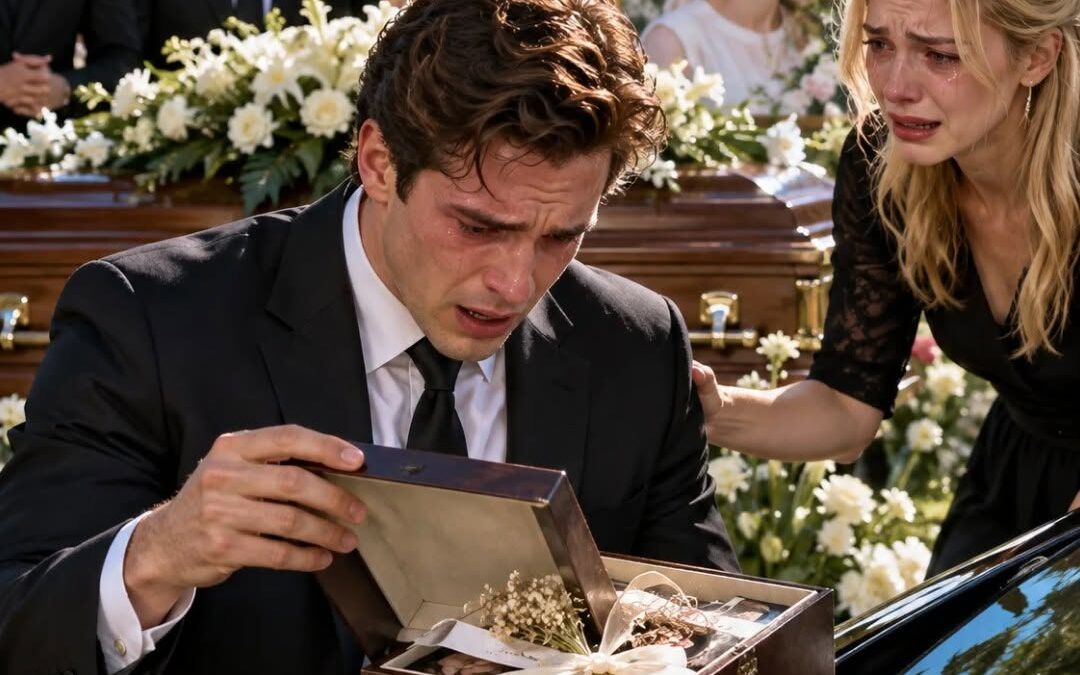
I didn’t open my mother’s letter until Claire sat beside me.
My hands were shaking too much to manage the flap.
Inside was a photograph of the same crooked rabbit and two pages written fourteen years earlier, shortly before Mom died.
Ben, if June ever finds you, please let her tell you who she is before you tell her who she ought to be.
I looked at Claire.
“Why would she write that?”
“Because June hated being called the sick little girl.”
My mother had volunteered at the children’s ward for years. June’s family traveled for treatment, sometimes staying in temporary housing nearby.
When I was four, Mom brought me along to a picnic.
June was two.
Apparently, I offered her half a cracker, then announced we were married because she agreed to share the rabbit.
There were paper flowers.
A nurse took the photograph.
Nobody thought it was a prophecy.
It was two children making an afternoon larger than it was.
We saw each other several times before June’s family moved away. I forgot the visits.
June kept the photograph because her mother told the story whenever hospital life felt overwhelming.
My mother stayed in touch with her family.
That was the part I’d never known.
She sent cards, sewed replacement rabbits, and sometimes helped with practical expenses without mentioning it at home.
When she became ill herself, she wrote the letter and sent it to June’s mother, asking her to keep it until the children were old enough to understand.
June’s family didn’t know where to find me after Mom died and we moved.
Years passed.
Then June saw my name in the fundraiser program.
“She recognized your mother’s name in the biography,” Claire said. “You’d dedicated the volunteer award to her.”
June hadn’t attended hoping to find a doctor.
She’d come hoping to return something to my mother’s son.
At the fundraiser, she’d asked whether my mother used to sew toys.
I’d answered yes, then changed the subject because discussing Mom with strangers still hurt.
I remembered that conversation.
I remembered thinking June looked disappointed.
“She could have told me anyway.”
Claire nodded.
“She should have. She knew that.”
Beneath Mom’s letter was June’s own.
Her handwriting wandered across the page, uneven from fatigue.
I didn’t marry you because of a promise you made when you were four.
I sat down against the car.
She wrote that she’d initially planned to give me the box, tell the embarrassing childhood story, and leave.
Then we started talking.
Our friendship grew around sandwiches, terrible parking, and her stubborn refusal to let every conversation become a discussion of illness.
By the time we fell in love, she was afraid the photograph would make everything seem arranged.
When her prognosis worsened, she feared I’d believe her proposal was a debt being collected.
So she postponed the truth.
Again.
I wish I’d trusted you with an awkward conversation instead of leaving you with a beautiful box, she’d written.
That sentence sounded more like June than anything anyone said at the funeral.
Not perfect.
Not saintly.
Funny, frightened, occasionally wrong June.
Her joke about disliking rabbits wasn’t a contradiction after all. She’d been teasing me about the toy I’d apparently refused to surrender during our first ceremony.
She’d almost told me then.
I read Mom’s letter again.
It didn’t ask me to marry anybody.
It asked me to remember that helping someone didn’t make their life a repayment.
Your kindness should leave people freer, she wrote.
I cried for both women then.
Claire stayed without trying to tidy the moment.
The box wasn’t full of money or an explanation that made dying fair.
It held proof that people could matter to each other across years without anyone knowing the whole map.
For a while, I was angry June kept it secret.
Grief had enough unfinished conversations without being handed another.
A counselor helped me admit that anger without treating it as disloyalty.
Love didn’t require agreeing with the way she’d said goodbye.
Months later, Claire and I sorted June’s belongings.
We found restaurant receipts with ratings written on the back.
My sandwich choices scored poorly.
That made me laugh for the first time in days.
I framed the childhood photograph, but not as evidence that fate demanded our marriage.
I framed it because my mother looked happy.
So did June.
So did I.
The crooked rabbit sits beside it.
Sometimes I tell the story to people who ask, and sometimes I say only that it belonged to my wife.
Both answers are true.
Last Thursday, I ordered lunch without studying the menu.
The sandwich was terrible.
I could almost hear June laughing, and for once the memory let me smile.
I wrote the rating on the receipt and kept it in her box.
Disclaimer: This story is entirely fictional and created for entertainment purposes only. It does not represent any organization or individual, nor does it encourage inappropriate behavior. The content was generated with AI assistance.








