In June 2002, a 15-year-old
In June 2002, a teenage girl escaped from a man who had held her captive for approximately eighteen hours. She had no way of knowing that the details she remembered would help investigators unravel a series of murders dating back several years.
Her name was Kara Robinson, and she was just fifteen years old.
The man who had abducted her was Richard “Marc” Evonitz, someone whose past would soon become the focus of an investigation involving three murdered girls in Virginia.
But Kara’s escape was only part of a much larger story.
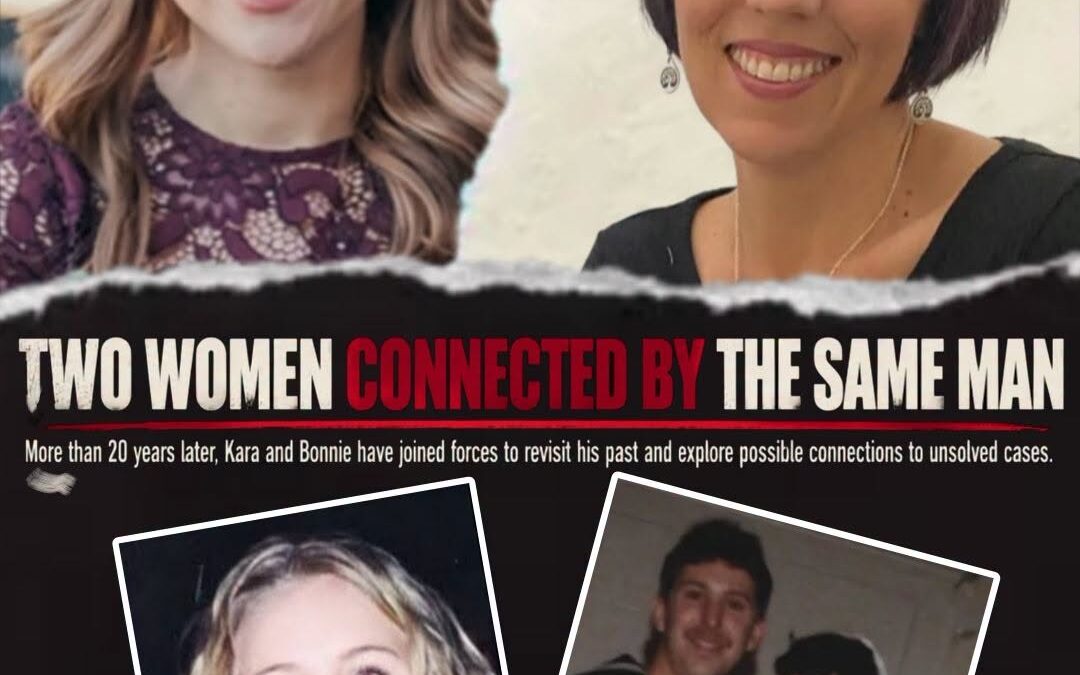
More than twenty years later, she would form an unexpected partnership with a woman who had once shared Evonitz’s home, his daily routines, and nearly a decade of his life.
That woman was his former wife, Bonnie Lou Gower.
Their separate experiences would eventually bring them together in an effort to understand what Evonitz had been doing during the years before investigators identified him.
The story begins long before Kara’s escape.
In 1988, Bonnie married Evonitz when she was seventeen years old. Their marriage lasted nearly ten years, a period during which she came to know his habits, movements, and personal history from the perspective of someone living alongside him.
At the time, Bonnie had no knowledge of the criminal history authorities would eventually uncover.
That distinction is important.
Knowing someone personally does not necessarily mean knowing everything about that person’s activities. In Bonnie’s case, the investigation that followed Evonitz’s death would reveal a side of her former husband that she had never understood during their marriage.
One event from those years would later become especially significant.
In September 1996, sixteen-year-old Sofia Silva disappeared in Virginia.
Her disappearance was devastating for those who knew her, and investigators faced the difficult task of determining what had happened.
At that point, Evonitz had not been publicly identified as the person responsible.
Bonnie and Evonitz were still married when Sofia vanished.
That meant Bonnie possessed firsthand memories of a period investigators would later examine closely.
Then, in May 1997, another tragedy occurred.
Two sisters, fifteen-year-old Kristin Lisk and twelve-year-old Kati Lisk, disappeared.
The cases became part of a frightening series of crimes involving young girls in Virginia.
For years, investigators worked to establish who was responsible.
The connection between these disappearances and Evonitz would not become clear until events unfolded hundreds of miles away.
In June 2002, Kara Robinson was abducted.
During approximately eighteen hours of captivity, she found herself in circumstances where remembering seemingly ordinary details could become crucial.
Rather than focusing only on her immediate surroundings, Kara paid close attention to the place where she was being held.
She observed the apartment’s layout and noticed details about her captor’s possessions.
These observations would later prove extraordinarily useful.
When Kara managed to escape, she was able to provide investigators with information that helped them identify Evonitz.
The breakthrough redirected attention toward a man whose history had not previously been understood in the context of the Virginia murders.
Investigators began examining his background and possible involvement in earlier crimes.
Their work eventually connected Evonitz to Sofia Silva and the Lisk sisters.
Evidence recovered during the investigation established his connection to those cases.
However, Evonitz died before he could be brought to trial.
His death meant investigators could no longer question him directly or pursue a criminal prosecution that might have clarified additional details.
For the families of the victims, the identification of a suspect did not eliminate every unanswered question.
And for those examining Evonitz’s past, another difficulty remained.
There were years of movements, relationships, and activities that had not been fully reconstructed.
Bonnie’s memories belonged to that period.
Although she had lived with Evonitz for years, her perspective was fundamentally different from Kara’s.
Bonnie remembered the ordinary routines of their marriage.
Kara remembered the man whose actions had placed her in danger and whose identification had helped uncover evidence concerning three murdered girls.
For a long time, those two histories remained separate.
Then, more than two decades after Evonitz’s death, Bonnie began sharing her experiences online.
She discussed her former marriage and the unsettling experience of learning what investigators had discovered about someone she once knew intimately.
Her story eventually reached Kara.
The two women connected and began recognizing how their different experiences might complement each other.
Bonnie could potentially help establish where Evonitz had traveled, what he had been doing, and which details of his behavior she remembered from their marriage.
Kara had spent years becoming familiar with the investigation that followed her escape.
Together, they began revisiting old photographs, documents, and timelines.
The purpose was not to assume that every unsolved crime could be attributed to Evonitz.
Instead, their work involved examining whether documented movements and remembered details might correspond with information from unresolved investigations.
This distinction matters because similarities between cases do not automatically establish a connection.
A person’s presence in a particular region, for example, does not prove involvement in a crime committed there.
But reliable timelines and previously overlooked information can sometimes provide investigators with useful leads.
That possibility became central to Bonnie and Kara’s collaboration.
Their work eventually became the focus of a three-part documentary from Investigation Discovery, which premiered October 7 and was also made available through HBO Max.
The series follows the women as they revisit Evonitz’s history, speak with people connected to the original investigation, and consider whether additional cases deserve closer examination.
The documentary also brings attention to the unusual circumstances that united them.
One woman had survived Evonitz.
The other had once been married to him.
Neither possessed a complete account of his past, but each held information the other had not experienced firsthand.
Their partnership does not establish that Evonitz committed additional crimes.
Nor does it mean that every question surrounding his activities can now be answered.
What it offers is an opportunity to examine old information from two perspectives that were previously disconnected.
More than two decades after Kara’s escape, the murders linked to Evonitz remain an important part of the historical record.
Yet questions about his movements before 2002 continue to attract attention.
Somewhere among Bonnie’s memories, surviving photographs, and investigative records may be information that helps clarify those years.
For now, the women continue examining a past that neither fully understood when their separate stories first began.








