Judge Sent a Black Teen to Jail Without Hearing His Defense—Then One Phone Call Exposed a Secret That Could End His Career
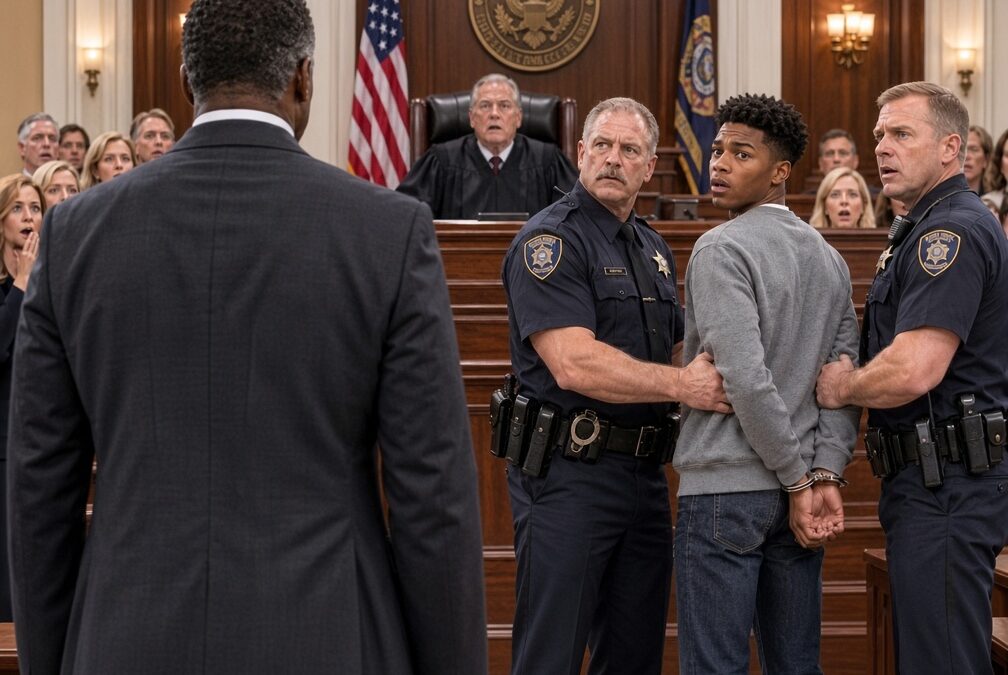
Judge Sent a Black Teen to Jail Without Hearing His Defense—Then One Phone Call Exposed a Secret That Could End His Career
PART 1: The Phone Call That Silenced the Courtroom
The judge looked at my skin, glanced at my worn sneakers, and said, “Thirty days in detention. Next case.”
It took him eleven seconds.
No witness testimony. No opportunity for me to explain. Not even a question about the evidence.
I was sixteen years old.
My name is Caleb Monroe, and until that morning, I’d never been inside a courtroom.
“Your Honor,” I whispered, “I didn’t do anything.”
Judge Harrison Blake adjusted his glasses.
“Another word, young man, and I’ll make it sixty.”
A few people in the gallery shifted uncomfortably.
My public defender, Ms. Torres, stood immediately.
“Your Honor, the prosecution hasn’t established probable cause. My client is entitled to a hearing.”
Blake barely looked at her.
“Counsel, sit down.”
“But the surveillance footage—”
“I said sit down.”
The bailiff approached me.
I looked toward the back of the courtroom, where my mother should have been sitting.
Her chair was empty.
She’d promised to come, but her overnight nursing shift had run late.
I felt suddenly smaller than I’d ever felt in my life.
Two nights earlier, someone had stolen expensive electronics from a downtown store. A security guard claimed he’d seen a teenager wearing a gray hoodie running nearby.
I owned a gray hoodie.
That was apparently enough.
The arrest report listed no recovered merchandise, no fingerprints, and no witness who could identify my face.
Still, the judge had already made his decision.
“Please,” I said. “Can I call my father?”
Blake laughed.
“Your father should have taught you to stay out of trouble.”
Something inside me went cold.
“You don’t know my father.”
The judge leaned forward.
“I know enough.”
Ms. Torres stepped between us.
“Your Honor, this child is requesting contact with his parent.”
Blake sighed dramatically.
“Fine. One call. Then take him downstairs.”
The bailiff handed me my phone.
My hands shook as I searched for the number.
Dad had warned me never to use it unless something serious happened.
He worked in government. His schedule was unpredictable, and he hated being interrupted during meetings.
But he’d also told me something I’d never forgotten.
“If someone in authority refuses to listen, don’t argue until you’re exhausted. Get help. Make sure somebody records what happened.”
I pressed CALL.
He answered on the second ring.
“Caleb? Aren’t you supposed to be in court?”
“Dad,” I whispered, “the judge just sentenced me.”
Silence.
“Sentenced you?”
“Thirty days. He wouldn’t let my lawyer explain.”
“Are you hurt?”
“No.”
“Is your attorney beside you?”
I looked at Ms. Torres.
“Yes.”
“Put me on speaker.”
I hesitated.
“Dad, he’s really angry.”
“Caleb. Speaker.”
I obeyed.
My father’s voice filled the courtroom.
“Good morning. This is Jonathan Monroe. May I speak with the presiding judge?”
Blake rolled his eyes.
“Sir, this court does not negotiate with parents.”
“I understand,” Dad replied. “I’m not asking you to negotiate.”
“Then what do you want?”
“Your full name and the case number, please.”
Blake smirked.
“Judge Harrison Blake. And who exactly are you?”
My father paused.
“Jonathan Monroe. State Attorney General.”
The courtroom fell silent.
Blake’s expression changed.
Then Dad said something that frightened me more than the sentence.
“Judge Blake, my office received a complaint about this courtroom yesterday. Caleb, do not leave until your attorney tells you to.”
Ms. Torres looked sharply toward the prosecutor.
The prosecutor lowered his eyes.
And from the gallery, a woman stood holding a sealed envelope.
“Your Honor,” she said, “I think everyone needs to see what happened to the last three boys.”
PART 2: The Evidence the Judge Didn’t Want Anyone to See
The woman holding the envelope wasn’t a reporter.
She was the courthouse’s former records supervisor.
Her name was Denise Walker, and she’d spent twenty-three years watching cases move through that building.
“Your Honor,” she said, “I tried to report this last month.”
Judge Blake struck his gavel.
“Sit down. You’re disrupting proceedings.”
Denise didn’t move.
“Three teenagers were detained after hearings lasting less than two minutes. Two were Black. One was Latino. None had been given a meaningful chance to challenge the allegations.”
Ms. Torres turned toward her.
“Do you have documentation?”
Denise raised the envelope.
“Certified docket records and hearing timestamps.”
The judge’s face tightened.
“Those are confidential court materials.”
“They were obtained through authorized records requests,” Denise answered. “And copies have already been delivered to judicial oversight.”
My father was still on speakerphone.
He spoke carefully.
“Ms. Torres, please request a recess and preserve the record. My title does not give me authority to reverse a judge’s decision.”
I stared at the phone.
For a moment, I’d imagined Dad could simply order everyone to release me.
But he couldn’t.
And he wouldn’t pretend otherwise.
Ms. Torres requested an immediate review of my detention order.
The prosecutor, a young man named Andrew Price, stood slowly.
“Your Honor, the state does not oppose that request.”
Blake glared at him.
“Mr. Price, we discussed this case.”
Andrew swallowed.
“Yes, Your Honor. But I need to correct something.”
He opened his folder.
“The store’s surveillance footage was delivered to our office this morning. It shows the person leaving the building.”
My heart began pounding.
“Was it me?”
Andrew looked directly at me.
“No.”
The courtroom seemed to tilt.
“The individual appears substantially taller than Caleb,” he continued. “The footage also shows distinctive markings on the person’s jacket that aren’t consistent with the clothing described in the arrest report.”
Ms. Torres held out her hand.
“Then why wasn’t this disclosed before the hearing?”
Andrew’s voice dropped.
“I received it twenty minutes ago. I was attempting to raise it when the court issued the detention order.”
Judge Blake stared at the papers.
“Why didn’t you speak sooner?”
Andrew looked stunned.
“I tried.”
Nobody said anything.
Then Ms. Torres spoke.
“Your Honor, the defense requests immediate release and dismissal of the complaint based on the state’s representation.”
Andrew nodded.
“The state moves to dismiss.”
For the first time that morning, Judge Blake looked uncertain.
He signed the dismissal order.
The bailiff stepped away from me.
But the story didn’t end there.
Denise’s records revealed a troubling pattern.
Over several months, Blake had repeatedly rushed initial hearings, discouraged defense attorneys from presenting arguments, and imposed detention without adequately explaining his decisions.
Some children had remained in custody while their families struggled to arrange legal assistance.
My father didn’t personally investigate the judge.
Because I was his son, he referred the complaint to an independent judicial oversight body and arranged for another official to handle any related matters within his office.
The distinction mattered.
He wanted accountability, not special treatment.
Three weeks later, investigators interviewed me, Ms. Torres, Denise, and several other families.
I told them everything.
The judge’s laughter.
The empty chair where my mother should have been.
The feeling of standing alone while someone decided my future without listening.
I also told them about Andrew.
He had eventually spoken up.
But I couldn’t forget how long he’d waited.
The investigation took months.
The judicial oversight commission eventually found serious procedural misconduct and recommended disciplinary action.
Blake was removed from hearing juvenile cases while further proceedings continued.
Several affected cases were reviewed.
Some detention decisions were overturned.
Other families received opportunities to challenge rulings that should have been examined more carefully from the beginning.
One afternoon, Dad sat beside me at our kitchen table.
He wasn’t wearing a suit.
Just an old college sweatshirt, reading glasses, and the exhausted expression he wore after long days.
“Caleb,” he said, “there’s something I need you to understand.”
I looked up.
“You were right to call me. But your rights didn’t come from my job.”
I nodded slowly.
“They were already mine.”
“Exactly.”
I thought about the other boys.
The ones whose fathers weren’t attorneys general.
The ones who couldn’t reach anyone important.
“What happens to them?” I asked.
Dad was quiet for a moment.
“That’s the question we have to keep asking.”
A year later, I attended a public forum about juvenile justice.
Ms. Torres sat in the front row.
Denise was beside her.
Several families from the courthouse had come too.
When it was my turn to speak, I walked toward the microphone with a folded piece of paper in my hand.
I’d written a long speech.
But looking at the audience, I knew exactly what I wanted to say.
“People keep telling me I’m lucky my father answered the phone.”
I paused.
“And I am.”
The room was silent.
“But no kid should need an important father to get a fair hearing.”
I looked toward my parents.
Mom was crying.
Dad sat perfectly still.
“I was innocent before I made that call,” I continued. “The evidence didn’t change because someone recognized my last name.”
I folded the paper.
“Somebody finally listened. That’s what changed.”
Afterward, Ms. Torres approached me.
“You know,” she said, “your father didn’t win that case.”
I smiled.
“I know.”
She glanced toward the families gathering around the stage.
“The record did. The evidence did. And people who refused to stay silent did.”
Outside, evening sunlight spilled across the courthouse steps.
I stood there for a moment, watching families walk through the doors.
Some looked hopeful.
Others looked terrified.
I remembered being sixteen, standing before a judge who wouldn’t hear my voice.
Then I saw a younger boy approaching the entrance with his mother.
He looked nervous.
I held the door open.
“You okay?” I asked.
He nodded uncertainly.
I smiled.
“Make sure they hear you.”
And this time, when the courtroom doors opened, I walked away knowing my voice had mattered.
Disclaimer: This story is entirely fictional and created for entertainment purposes only. It does not represent any organization or individual, nor does it encourage inappropriate behavior. The content was generated with AI assistance.








