My Parents Arrived With Three Suitcases Fourteen Years After Disowning Me for Marrying an Injured Veteran
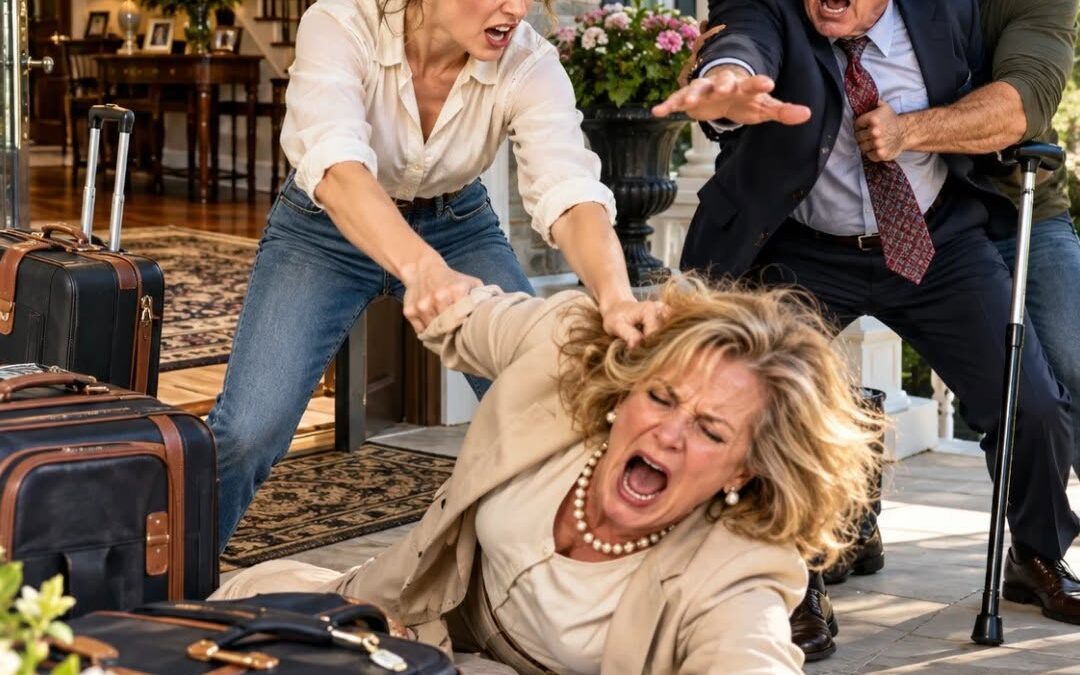
“Show me her replies,” I told Dad.
Mom reached for the envelope.
He pulled it away.
For the first time that morning, they weren’t moving toward the same thing.
Dad unfolded the pages on the porch. Mark stepped back and asked whether everyone could keep their hands to themselves.
I said yes.
So did Dad.
Mom said we were embarrassing her.
The emails began six weeks earlier, just after the magazine article appeared.
The first message invited my parents to reconnect. That much resembled the phone conversation we’d actually had.
Then the story changed.
The sender claimed Mark and I had two children who wanted to meet their grandparents.
We supposedly needed help at home.
Bedrooms were ready.
A family account would cover expenses.
Dad had asked whether I’d really forgiven the old argument.
The reply said I wanted to begin again without discussing it.
I looked at the address.
It resembled our office email, but the domain was wrong.
Not our company.
An imitation.
I asked Mom where she’d found it.
She said online.
Dad looked up.
“You told me Rebecca sent it to your phone.”
She began straightening her pearls.
That little movement was familiar. She used to do it before telling somebody else’s version of an argument.
Mark asked whether we should call for medical help after her fall.
She stood without assistance and said no.
We moved the conversation to the porch chairs, keeping the doorway clear.
Then Dad asked her again.
Had I written those emails?
“No,” she said.
The word arrived so quietly I nearly missed it.
She’d created the address herself.
She wrote the invitation.
She invented the grandchildren.
Dad wouldn’t agree to leave their apartment unless he believed I’d asked them to come. He knew how he’d behaved at our engagement dinner.
He expected an apology to be necessary.
Mom preferred a story in which one had already happened without anyone having to say it.
“So you wrote my forgiveness for me,” I said.
She told me she was trying to reunite the family.
I asked why the reunion included access to our money.
She looked at Mark.
“Your success isn’t entirely yours. Parents make sacrifices.”
Mark stayed beside me.
He didn’t defend our business, explain his injury, or list what he’d earned.
He’d spent fourteen years living a life that didn’t require her approval.
I finally understood I could do the same.
Dad sat holding the fake letters.
For a moment, I felt sorry for him.
Then I remembered he had arrived willing to occupy our home without confirming any of it directly.
Being deceived didn’t erase the questions he’d chosen not to ask.
“I wanted it to be easy,” he said.
“So did I,” I told him. “Fourteen years ago.”
He cried then.
Mom said the conversation had become ridiculous.
Dad asked her to stop.
I didn’t invite them inside.
We arranged a taxi and gave them time to collect the spilled belongings. They were responsible for deciding where to stay.
Dad asked whether we could meet for coffee after all.
I said I would think about it, and that any meeting would include respect for Mark.
Mom told me I’d changed.
I looked at the luggage and realized she was right.
I no longer believed proving I was a good daughter required making my husband unwelcome in his own home.
After they left, I apologized to Mark for letting the confrontation become physical.
He reminded me he’d also needed to step away sooner.
We discussed what we’d do if they returned.
No improvising in the doorway.
No grabbing sleeves.
We could protect our boundaries without performing another generation’s arguments.
I also notified our office about the imitation address so nobody there would mistake it for company correspondence.
A month later, Dad met us at a cafe.
He arrived alone.
His first question was about Mark’s software work.
His second was whether I’d kept the lemon cake recipe from our wedding.
He’d found an old invitation in a drawer and realized how many things he’d refused to know.
We stayed forty minutes.
There were no promises about spare bedrooms.
Mom didn’t come.
She still sends messages suggesting I’m punishing her.
I don’t answer every one.
Sometimes I miss the parents I hoped would arrive at my door.
Then Mark calls from the kitchen, asking where we put the good coffee.
I go help him look.
The cane rests by the wall where it belongs.
Nobody apologizes for it.
Our house has plenty of room for guests who ask, people who listen, and a life that never needed to prove itself worthy of being loved.
That evening, we ate leftovers on the porch. Mark read beside me, and I didn’t once check my phone to see whether my parents had called.
Disclaimer: This story is entirely fictional and created for entertainment purposes only. It does not represent any organization or individual, nor does it encourage inappropriate behavior. The content was generated with AI assistance.








