On September 25, 1981
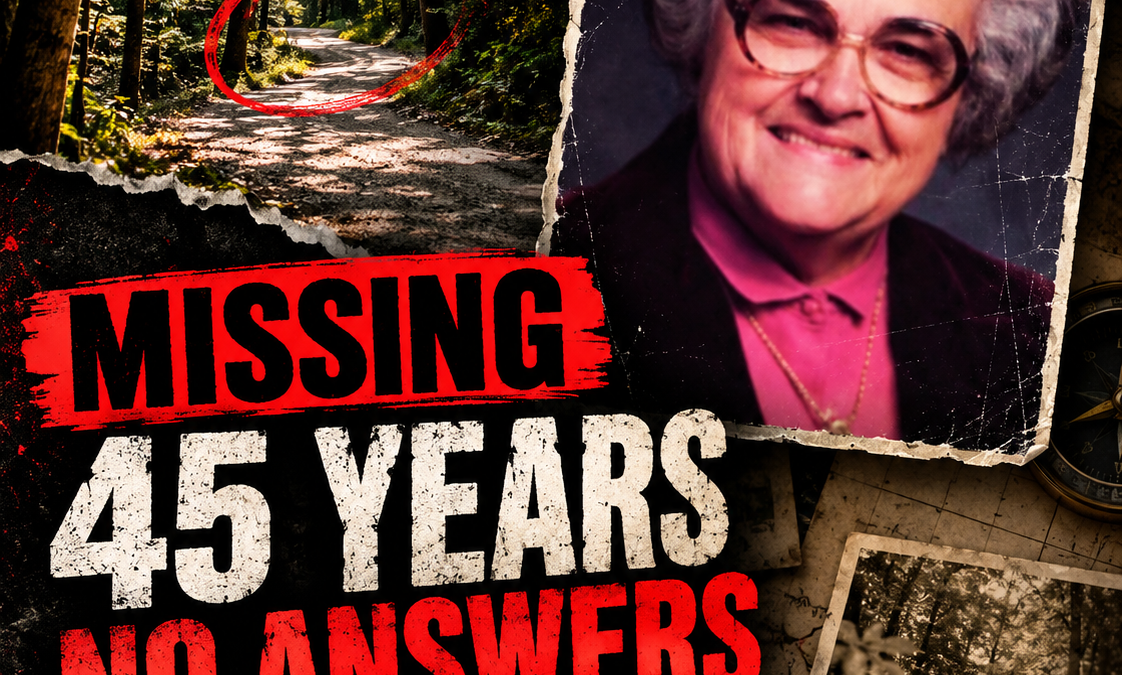
On the afternoon of September 25, 1981, three women set out for what should have been an ordinary walk through Great Smoky Mountains National Park. The weather, the familiar surroundings, and the routine nature of the outing offered no obvious warning that anything was wrong.
Before the afternoon was over, one of those women would disappear without leaving a confirmed trace.
Her name was Thelma Pauline Melton, known to friends and family as Polly. She was 58 years old, married, and familiar with the wooded trails surrounding Deep Creek, near Bryson City, North Carolina.
For years, Polly and her husband, Bob, had spent their summers in an Airstream trailer in the area. Their seasonal visits had given Polly plenty of opportunities to explore the surrounding countryside. Deep Creek was not an unfamiliar wilderness to her. It was somewhere she had walked repeatedly.
That familiarity would eventually become one of the most troubling aspects of her disappearance.
The day began with the kind of small domestic details that rarely seem important until something terrible happens. Polly had started preparing spaghetti sauce for dinner. Her husband, who was dealing with serious health problems, remained at their trailer.
Polly then joined two friends, Trula Gudger and Pauline Cannon, for a walk along the Deep Creek Trail.
There was nothing particularly unusual about the outing itself. The women were following a familiar route, and Polly had no apparent reason to expect that she would not return.
But during the walk, her behavior suddenly changed.
According to accounts of the disappearance, Polly began moving ahead of her companions at a noticeably faster pace.
This surprised the other women.
Polly was described as a larger woman who ordinarily walked more slowly. Her sudden acceleration was unusual enough that both companions noticed it.
She continued forward until she rounded a bend in the trail.
Then she disappeared from their view.
At that moment, her friends apparently had no reason to assume anything catastrophic had happened. They believed Polly might simply have decided to return to the campground ahead of them.
They continued their outing, expecting to find her there afterward.
Approximately half an hour later, they returned.
Polly was missing.
She had not returned to the trailer, and there was no clear explanation for where she had gone.
What initially seemed like a minor misunderstanding was becoming a serious emergency.
A search was organized in the surrounding area. As the effort expanded, more than 150 people became involved, along with nine search dogs.
Searchers examined the landscape around Deep Creek, looking for anything that might reveal where Polly had gone after disappearing around the bend.
The terrain presented obvious difficulties. Wooded mountain environments can conceal a person from view, and searching them requires careful attention to trails, vegetation, and surrounding ground.
But this was not simply a case of someone unfamiliar with the outdoors wandering into unknown territory.
Polly knew the area.
She had also disappeared while walking with two companions who had been close enough to notice her sudden change in pace.
One search dog reportedly showed interest near a fallen tree. It was a potentially intriguing development, but investigators were unable to establish a meaningful connection between that location and Polly’s disappearance.
The search continued without producing a confirmed explanation.
Investigators also had to consider what Polly had left behind.
Her purse, identification, money, and medication remained at the trailer.
These belongings were significant because they offered little support for the idea that she had prepared for an extended absence.
She had gone walking in ordinary shoes, apparently expecting to return to the same place where she had begun preparing dinner.
Still, investigators could not rule out every possibility.
An accident, an unexpected encounter, or a voluntary departure could each be considered in theory. None, however, had been established by the available evidence.
Then another detail emerged, one that had occurred before Polly ever stepped onto the trail.
On September 24, the day before she vanished, Polly reportedly used a telephone at the senior nutrition center where she volunteered.
According to her supervisor, this was unusual behavior.
Investigators attempted to determine whom she had contacted, but the identity of the person on the other end of the call was never established.
There was no confirmed evidence that the telephone call had anything to do with the disappearance.
Nevertheless, its timing made it difficult to ignore.
If the call was completely ordinary, it may have had no relevance whatsoever. But without knowing whom Polly contacted or why, investigators were left with another unanswered question.
For months, the disappearance remained unresolved.
Then, in April 1982, approximately seven months after Polly vanished, a financial transaction drew attention to a city far from the Smoky Mountains.
A check made payable to Polly was cashed in Birmingham, Alabama.
The transaction was investigated, but it did not establish whether Polly had personally been in Birmingham.
Nor did it conclusively identify who had cashed the check.
The discovery was unusual because it introduced a possible connection to a location outside the original search area. Yet it remained just that: an unresolved lead, not proof that Polly had survived or traveled to Alabama.
Meanwhile, the consequences of her disappearance were unfolding within her family.
Bob’s already fragile health reportedly deteriorated severely on the same night Polly vanished. He subsequently spent the remainder of his life in a nursing home.
For relatives, the absence of answers meant that the disappearance never became a closed chapter.
Polly’s father reportedly continued hoping for her return throughout the remainder of his life.
Years passed, then decades.
No confirmed discovery established that Polly had died in the mountains. No verified sighting established that she had left the area alive. The mysterious telephone call remained unexplained, and the Birmingham check did not resolve the uncertainty.
By the forty-fifth anniversary of her disappearance in September 2026, renewed coverage and podcast discussions had brought her story back to public attention.
The National Park Service continued to classify the investigation as unresolved.
What remains most haunting about the case is not a dramatic discovery, but the absence of one.
Three women walked together along a familiar trail. One unexpectedly increased her pace. She rounded a bend and passed beyond the others’ sight.
Everything that followed began with that brief separation.
And despite decades of searching, investigation, and speculation, no confirmed evidence has explained where Polly Melton went after those final visible moments on the Deep Creek Trail.








