PART 1 — The Night I Entered the Colonel’s Bedroom
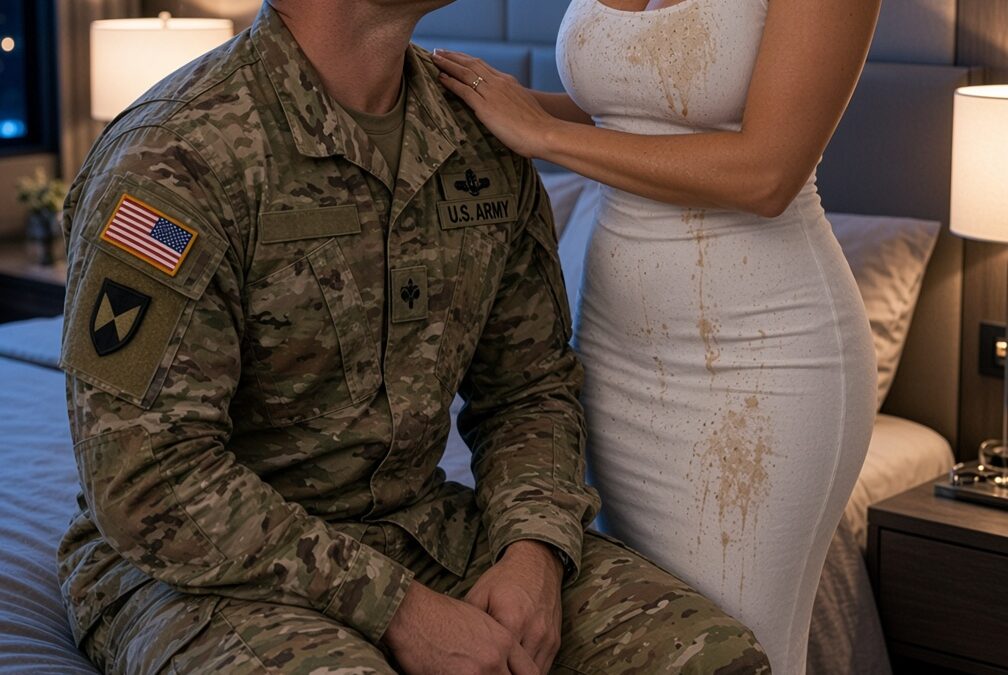
PART 2 — The Secret That Changed Everything
The woman in the photograph wasn’t me.
It was my mother, twenty eight years younger, standing beside Colonel Mercer outside a hospital that no longer existed.
And the little girl holding her hand was his daughter.
Me.
He stared at the picture. Then he shook his head.
“No,” he whispered. “I was told the baby didn’t survive.”
The knock came again.
“Sir? Everything all right?”
Mercer didn’t answer. His thumb moved across the photograph, stopping over the child’s face.
“Eleanor told you that?” I asked.
“No. The hospital administrator.”
My stomach sank. That was the missing piece.
My mother had spent my childhood telling me my father had chosen his career over us. She never called him cruel. She simply said some people were better at leaving than staying.
When she passed away last spring, I found a box beneath her bed. Inside were birthday cards she’d never mailed, photographs, and a letter addressed to Daniel Mercer.
I opened the blue envelope and handed it to him.
He recognized her handwriting immediately.
His hands began to shake.
“Read it,” I said.
He unfolded the letter.
Daniel,
If this reaches you, I hope you finally know that Claire lived. They told me you had agreed to give her up. I believed them because I was nineteen, alone, and frightened. By the time I learned the papers were false, you had been transferred. I tried to find you. I never stopped wondering whether you tried to find us.
Love,
Eleanor.
He read it twice.
Then he covered his mouth.
“I went back,” he said. “I went to that hospital three times.”
I could barely speak. “What happened?”
“They told me you were gone. They said Eleanor wanted nothing to do with me.”
I thought about every birthday I’d spent imagining a man who couldn’t be bothered to call.
He thought about a daughter he’d mourned without ever meeting.
Outside, the visitor knocked harder.
I flinched. Mercer noticed.
“Who followed you?”
“The records officer. I requested copies of the original hospital files this morning. Someone flagged the request and told me I couldn’t take them.”
“Why would they care now?”
“Because the administrator’s son oversees the archive. I think he knows the signatures were forged.”
Mercer looked at the door. “Come in.”
A young captain entered with a folder. He stopped when he saw me sitting beside the bed.
For one awful second, I understood exactly what he must have assumed.
“Sir,” he said stiffly, “Lieutenant Bennett accessed restricted historical records.”
“She was looking for her family,” Mercer replied.
The captain blinked.
“My family,” Mercer added.
The room went silent.
I expected questions. Instead, the captain placed the folder on the dresser.
“My grandmother worked at that hospital,” he said. “She asked me to deliver this when she heard someone was searching.”
Inside was a signed statement. The former administrator had changed records after pressure from both families. My mother’s parents had considered Mercer unsuitable. His father had wanted no interruption to a promising career.
Two families, certain they knew best, had separated three people for nearly three decades.
The captain quietly left.
I sat with my hands folded so tightly my fingers hurt.
Mercer stared at the statement.
“I wasn’t there,” he said.
“You didn’t know.”
“I should have looked longer.”
I wanted to tell him he should have. I wanted to ask why three visits had been enough.
Instead, I asked the question that had lived inside me since childhood.
“If you’d known I was alive, would you have come?”
He looked straight at me.
“Every single day.”
I believed him. Not because his answer was perfect, but because he looked devastated that he couldn’t prove it.
He opened his arms, then stopped himself.
“May I?”
I nodded.
When he hugged me, he held on gently, like someone afraid of waking from a dream.
For the first time, I noticed how much older he seemed without his uniform jacket, how tired his eyes were, how ordinary his breathing sounded.
Not a decorated officer.
Just a father who had missed almost everything.
We passed the old oak tree near the entrance. I remembered wondering whether I could tell him. Now he slowed down to walk beside me, with no one else between us anymore.
At sunrise, we walked out together. The hallway lights were still on, and two nurses paused when they saw us.
I knew what the whispers would sound like.
I no longer cared.
He carried my mother’s letter in his pocket. I carried the photograph.
At the exit, he stopped.
“Claire, would you have breakfast with me?”
I smiled through tears.
“Only if you tell me about the day I was born.”
He offered his arm.
“That,” he said, “might take all morning.”
And for once, we had time.
Disclaimer: This story is entirely fictional and created for entertainment purposes only. It does not represent any organization or individual, nor does it encourage inappropriate behavior. The content was generated with AI assistance.








