PART 2 — THE SONG INSIDE THE STONES
PART 2 — THE SONG INSIDE THE STONES
Amira stood inside the narrow canyon passage, listening as her grandmother’s familiar voice repeated words she’d believed nobody else could possibly know.
Owen Fletcher remained beside her, holding the lantern carefully while a strange, delicate melody emerged from the hollow brass cylinder.
“Don’t follow the sound,” he whispered. “Remember what you told me about voices in this canyon.”
Amira nodded.
But she couldn’t stop wondering how the object seemed to carry a message from her childhood.
They returned to the shelter and examined the cylinder in better light.
Its surface contained rows of carefully arranged openings, while a thin strip of metal was fitted inside the hollow center.
When wind passed through the openings, the strip vibrated.
The resulting notes resembled speech.
Amira recognized the design from her grandfather’s notebooks.
He had experimented with musical instruments that imitated the sounds of birds, bells, and human voices.
Years earlier, he’d worked with a traveling craftsman to create a collection of wind-powered devices.
Most had been forgotten.
But several remained hidden along the canyon walls.
“The voice isn’t coming from a person,” Amira said slowly. “It’s coming from an instrument.”
Owen examined the markings.
“Then how does it know your grandmother’s words?”
Amira studied the arrangement of the openings.
She remembered a childhood lesson in which her grandfather taught her to repeat a phrase while adjusting a small wooden whistle.
The phrase had become part of a demonstration he performed for his grandchildren.
She had forgotten the instrument.
But she remembered the words.
The apparent secret wasn’t supernatural.
It was a family memory preserved in a carefully designed mechanical object.
At sunrise, Amira and Owen returned to the deeper passage.
There, they discovered several more cylinders mounted inside a wooden frame.
Each produced different sounds when air passed through the canyon.
One created a melody resembling a familiar lullaby.
Another produced the rhythmic pattern of spoken syllables.
Together, the instruments formed an elaborate sound installation.
Owen recognized the song his mother had sung in Missouri because the melody had been widely shared among travelers, settlers, and families across several territories.
Amira’s grandmother had learned it from a visiting teacher many years earlier.
The two families had unknowingly preserved the same tune.
Yet another mystery remained.
Why had the instruments been hidden so carefully?
Amira found an answer in her grandfather’s journal.
He had designed the installation to demonstrate how easily familiar sounds could be misinterpreted when their source was concealed.
During one severe winter, travelers had repeatedly wandered away from the main trail after hearing what they believed were voices calling for help.
The sounds were actually produced by wind passing through natural openings in the rock.
Her grandfather hoped to teach people how to recognize the difference.
The instruments had been constructed as part of that lesson.
Amira smiled sadly.
“He wasn’t trying to frighten anyone.”
“He was trying to keep them safe,” Owen replied.
They returned to the settlement, where Amira showed the journal to her grandmother.
The elderly woman immediately recognized the drawings.
For years, she had believed the instruments were lost.
She embraced Amira and thanked Owen for helping her recover them.
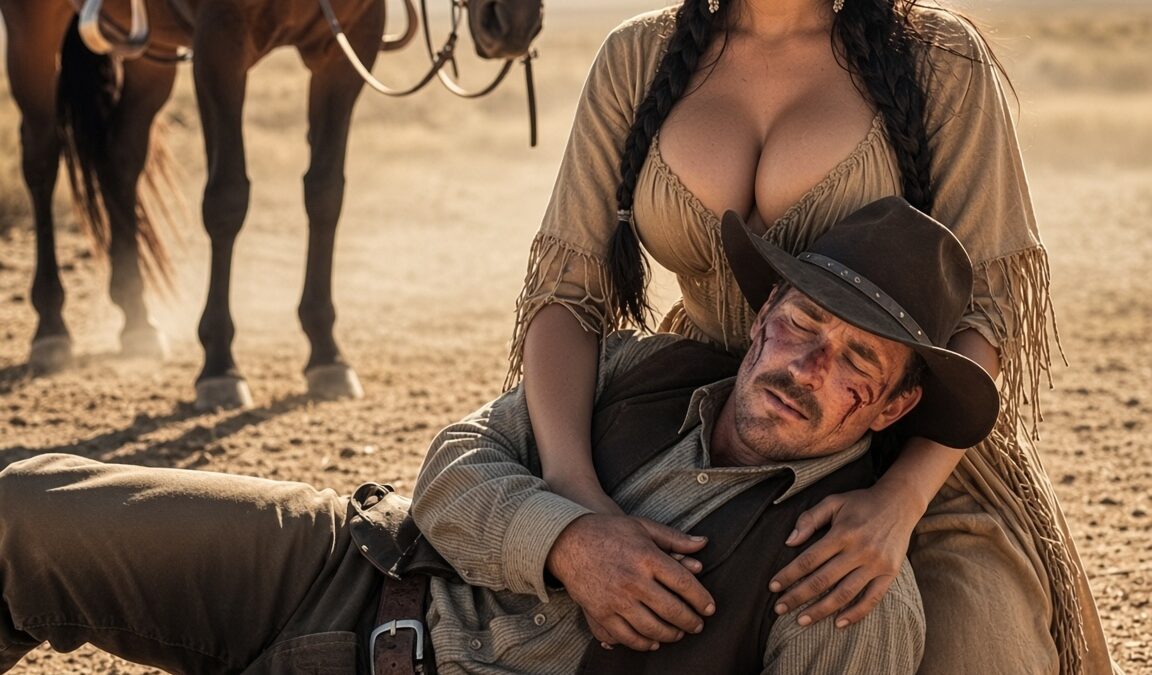
The discovery also eased the disagreement over Amira’s decision to assist the injured rancher.
Her family had never forbidden helping strangers. The old caution concerned entering the canyon after sunset because of its dangerous terrain and misleading echoes.
Amira had challenged the warning because someone needed help, but she now understood the practical reason behind it.
Her grandmother smiled.
“Your grandfather would have been proud that you asked questions instead of simply accepting a frightening story.”
Owen recovered gradually and returned to his ranch, although he continued visiting Amira’s settlement.
He brought books about acoustics and mechanical design, while she shared her grandfather’s journals and stories about the region.
Their friendship developed naturally.
Owen admired Amira’s intelligence and compassion, while she appreciated his patience and quiet humor.
One evening, he found her beside the canyon entrance, listening to the wind.
“Do you hear the voices?” he asked.
She smiled.
“Only the music.”
Owen reached for her hand.
“And what does it say?”
Amira looked into his eyes.
“That some journeys bring us exactly where we need to be.”
He leaned closer.
Their first kiss came beneath the fading desert sunlight.
Months later, Owen invited Amira to help establish a small educational exhibit explaining the canyon’s natural acoustics and the instruments her grandfather had built.
Families traveled from nearby settlements to visit.
Children delighted in learning how the rocks seemed to sing.
The following spring, Owen asked Amira to marry him beside the restored sound chamber.
She accepted.
Their wedding brought both families together beneath the Arizona sky.
As the celebration continued, a gentle evening wind passed through the canyon.
The old instruments began playing their familiar melody.
Owen smiled.
“Your grandfather certainly knew how to make an entrance.”
Amira laughed.
“He knew how to leave something beautiful behind.”
And as the music drifted across the desert, the voices that once frightened travelers became a reminder of the knowledge, kindness, and love that could survive long after their creators were gone.
Disclaimer: This story is entirely fictional and created for entertainment purposes only. It does not represent any organization or individual, nor does it encourage inappropriate behavior. The content was generated with AI assistance.








