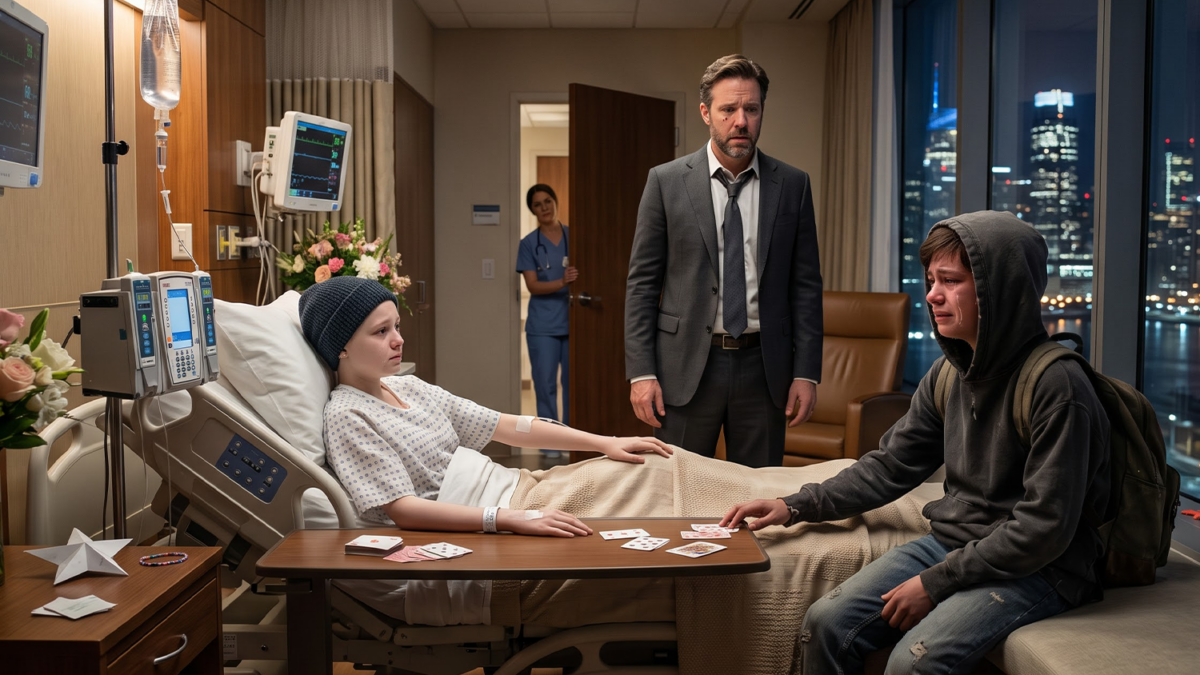
Part 3 Lucas kept holding Emma’s hand.
Part 3
Lucas kept holding Emma’s hand.
“I told Maya I’d never let another kid in this room think nobody was coming.”
I looked at him.
“You were eleven.”
“Yeah.”
“That was not your responsibility.”
“I know that now.”
His answer sounded older than thirteen.
Emma squeezed his fingers.
“Did she know you loved her?”
Lucas blinked hard.
“I think so.”
“She knew.”
“How can you know?”
“Because I know when my dad loves me, even when he’s being annoying.”
I almost laughed.
Lucas did.
Then Emma smiled.
For the next few weeks, he kept visiting, but no longer by sneaking through stairwells.
I spoke with Emma’s medical team, the hospital social worker, and the shelter responsible for Lucas. Because Emma’s immune system was fragile, visits had to follow the same rules as everyone else: permission, handwashing, masks when required, and no visits when Lucas was sick.
He complained about the paperwork.
Emma told him to stop being dramatic.
Their friendship became strangely ordinary.
They argued over card games.
He brought library books.
She corrected his homework.
There was no sudden miracle.
I learned not to measure hope by a single afternoon.
One night, Emma developed a fever.
Within minutes, nurses were moving faster, doctors were ordering tests, and I was standing uselessly beside the wall while antibiotics ran through her IV.
Lucas arrived during visiting hours and was stopped outside.
I found him sitting in the hallway.
“Is she dying?” he asked.
The question hit me like a blow.
“I don’t know.”
He looked toward her closed door.
“I hate this hallway.”
I sat beside him.
For once, I did not tell him everything would be fine.
I had learned that children recognized false promises faster than adults did.
“I’m scared too,” I said.
He nodded.
We sat there together.
Emma stabilized before morning.
The infection was serious, but treatment worked.
When Lucas finally saw her again, she was exhausted.
“You look terrible,” he said.
“So do you.”
“I always look like this.”
She smiled.
Months passed.
Her doctors eventually told us the treatment was working well enough to move into the next phase.
I cried in the parking garage where nobody could see me.
Then I called Lucas.
He shouted so loudly I held the phone away from my ear.
Emma was not finished with treatment, and nobody used the word cured carelessly.
But she was going home.
On her final night in that room, Lucas sat in his usual chair by the window.
Emma looked around.
“Do you still come here after I leave?”
Lucas shook his head.
“I don’t think they’d let me.”
“That has never stopped you.”
He smiled.
Then his face became serious.
“I don’t know.”
I understood.
For two years, Room 714 had been where his sister died.
Then it became where Emma lived.
Maybe leaving it behind frightened him too.
I sat across from them.
“What if you didn’t have to keep coming back here to keep your promise?”
Lucas frowned.
I had spoken with the hospital social worker about a volunteer program for teenagers once he was old enough. Until then, there were supervised youth activities and grief-support programs he could join without wandering hospital floors alone.
“You could help people in ways that don’t involve trespassing,” I said.
Emma grinned.
“That sounds less fun.”
Lucas rolled his eyes.
But he accepted the information.
The next morning, Emma left Room 714 in a wheelchair because the walk to the lobby was too far.
Lucas walked beside her.
At the elevator, she looked back at the window.
“Your sister had you,” she said.
Lucas swallowed.
“I wasn’t there.”
“You loved her anyway.”
The doors opened.
He nodded.
A year later, Emma still had checkups, medication, and days when fear returned without warning.
Lucas still missed Maya.
Grief did not disappear because he found someone else to sit beside.
But he stopped carrying his sister’s death as a debt he had to repay every night.
And I changed too.
Before Lucas, I thought being a good father meant buying the best care and keeping danger outside the door.
A homeless boy taught me that sometimes what a frightened child needs most cannot be purchased.
It is simply someone willing to stay.
Lucas came to our room because once, when his sister needed him, he could not get there in time.
He kept coming because he refused to let another sick girl feel forgotten.
And on the night Emma asked why, I finally understood something money had never taught me:
Being unable to save someone does not mean you failed to love them.
Disclaimer: This story is entirely fictional and created for entertainment purposes only. It does not represent any organization or individual, nor does it encourage inappropriate behavior. The content was generated with AI assistance.








