“Please, Farmer… Let Me Work for You Tonight, and I’ll Do Anything You Ask,” She Begged
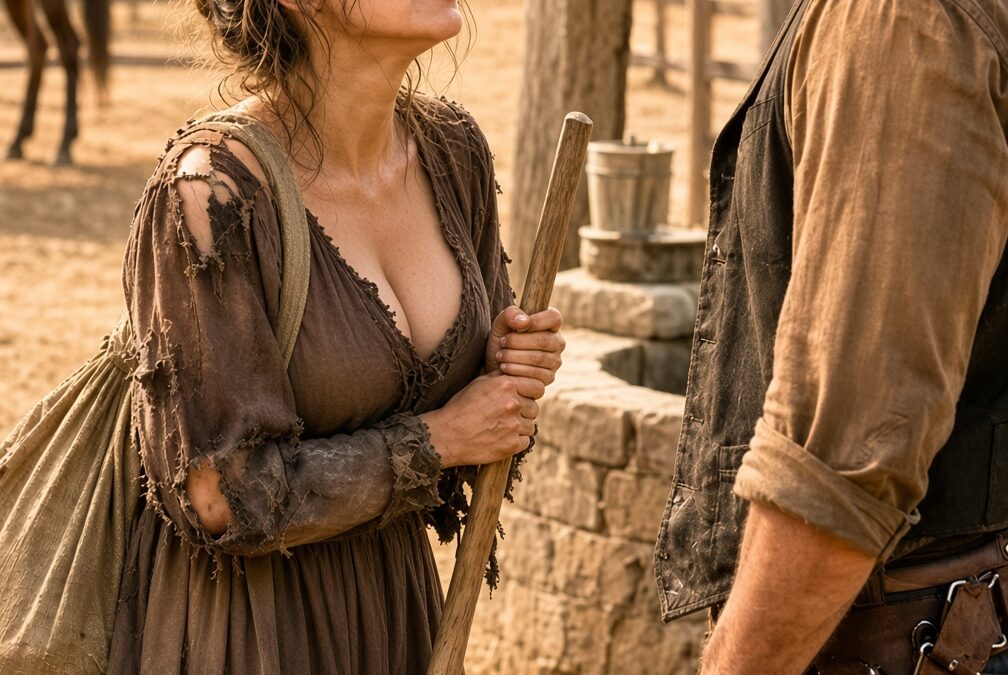
Part 2
Jacob stood between Sarah and the farmhouse door.
“What are you carrying?” he asked quietly.
Sarah pressed a trembling hand against the pocket of her dress.
“Something that proves I never stole from him.”
Outside, Harlan struck the door again.
“Open up, Miller!”
Jacob raised his voice.
“This is private property. Come back with the sheriff.”
Harlan laughed.
“My brother is the sheriff.”
“Then bring him in daylight.”
For several moments, nobody spoke.
Finally, hoofbeats faded down the road.
Sarah sank into a chair.
“He won’t stop.”
Jacob sat across from her.
“Tell me what happened.”
She withdrew a small leather notebook from her pocket.
“I kept the grain accounts. Every shipment, every payment, every name.”
Jacob opened the book.
Pages of careful handwriting filled it.
“What’s wrong with these numbers?”
“Look at the wheat purchases from the northern farms.”
Jacob studied the entries.
His expression changed.
“These farmers were paid half the amount recorded.”
Sarah nodded.
“Harlan kept the difference.”
“That’s dishonest, but why come after you?”
“Because I discovered he was also collecting money from families who never received their grain.”
Jacob turned another page.
He recognized several names.
Mrs. Bennett, whose husband had died last winter.
The Dawson family, who had lost their barn.
And his own late wife’s brother, Samuel.
“Samuel paid Harlan two hundred dollars?”
Sarah nodded.
“He was promised enough seed to plant his entire field. Harlan delivered almost nothing.”
Jacob remembered Samuel borrowing money and eventually losing his land.
For years, everyone believed the man had simply made poor decisions.
Now the truth lay before him.
“Why didn’t you take this to the county judge?” Jacob asked.
“I tried.”
“What happened?”
“Harlan found out. He dismissed me and accused me of stealing his money.”
She lowered her head.
“I left before his brother could arrest me.”
Jacob closed the notebook.
“Then we’ll take it somewhere his brother can’t interfere.”
“Where?”
“The district courthouse in Brighton.”
Sarah looked frightened.
“That’s two days away.”
“I have a wagon.”
“And your farm?”
“It’ll survive two days.”
She stared at him.
“You’d risk your livelihood for a stranger?”
Jacob smiled gently.
“My wife used to say that doing the right thing rarely arrives at a convenient hour.”
Sarah’s eyes filled with tears.
“What was her name?”
“Elizabeth.”
“She sounds wonderful.”
“She was.”
The following morning, Jacob prepared the wagon while Sarah baked bread for the journey.
Before leaving, he stopped beside his wife’s grave beneath the orchard tree.
Sarah waited respectfully.
Jacob placed a small wildflower beside the stone.
“I think you’d like her, Lizzie,” he whispered.
They traveled through rolling wheat fields and dusty settlements, stopping only when the horses needed rest.
At the district courthouse, a clerk examined Sarah’s notebook.
“These entries need verification,” he explained. “But they’re detailed enough to justify an investigation.”
He requested the merchant’s original accounts and arranged interviews with the affected farmers.
Sarah gave a sworn statement.
Jacob remained beside her, offering reassurance whenever her voice trembled.
Within weeks, investigators uncovered altered receipts, missing grain shipments, and payments diverted into Harlan’s private accounts.
The accusations against Sarah were withdrawn.
Harlan faced formal charges, while his brother’s handling of the complaint came under review.
Several families recovered part of their losses.
Samuel received compensation that allowed him to begin farming again.
When Sarah and Jacob returned home, the orchard was beginning to bloom.
She stood beside the kitchen table, holding her small suitcase.
“I suppose I should look for another position.”
Jacob frowned.
“Why?”
“Because you don’t really need a bookkeeper.”
“Actually, I do.”
Sarah blinked.
“You do?”
“I’ve been terrible at keeping accounts since Elizabeth passed.”
He placed a clean ledger on the table.
“Fair wages. Your own room. Sundays free.”
Sarah smiled through tears.
“And supper?”
“Every evening.”
She laughed.
“Then I accept.”
Months passed.
Sarah organized the farm’s finances, helped negotiate better grain prices, and discovered that Jacob’s neglected orchard could supply fruit to the nearby school.
Together, they turned a struggling farm into a comfortable home.
One autumn evening, Jacob found Sarah watching the sunset from the porch.
“Are you happy here?” he asked.
She looked toward the golden fields.
“More than I ever thought possible.”
He sat beside her.
“Then I hope you’ll stay.”
“For how long?”
“As long as you choose.”
Sarah reached for his hand.
“Jacob, when I came here, I thought I had nothing left to offer.”
“You brought honesty, courage, and more determination than this farm has seen in years.”
“And you gave me a chance.”
He smiled.
“You earned the work. The chance was yours to take.”
Sarah leaned against his shoulder.
Beyond the orchard, the wheat moved gently beneath the evening wind.
She had arrived hungry, frightened, and convinced that nobody would believe her.
Now she had steady work, a home, and someone who valued her for more than what she could provide.
And Jacob, who had spent three lonely winters believing his happiest days were behind him, discovered that kindness could open a door he had thought was closed forever.
Neither rushed to name what was growing between them.
They simply watched the sunset together, grateful that one unexpected knock had changed both their lives.
Disclaimer: This story is entirely fictional and created for entertainment purposes only. It does not represent any organization or individual, nor does it encourage inappropriate behavior. The content was generated with AI assistance.








