Restaurant Manager Humiliated a Black Waitress for Feeding a Homeless Trucker—Weeks Later, Her Name Tag Left Him Speechless
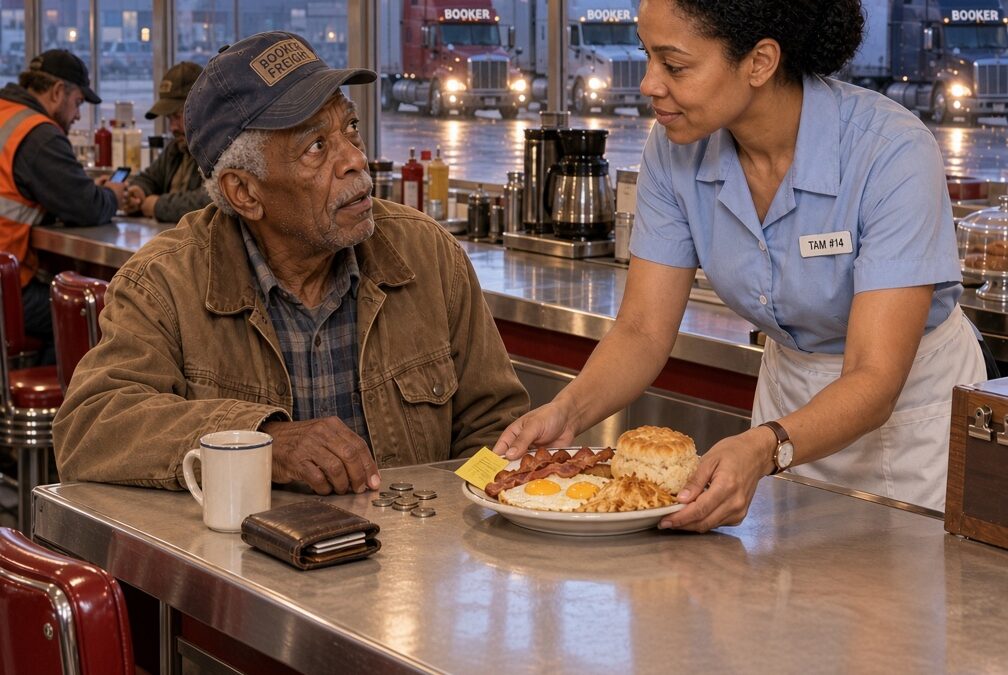
PART 2: The Secret Behind Booth Seven
Walter said my father’s name, and suddenly the basement door mattered more than the envelope.
“Daniel Brooks,” he repeated. “He was my business partner.”
I gripped the counter. My father had driven delivery trucks until a highway accident ended his career. He died two years later, leaving Caleb and me with a box of photographs and unpaid bills.
“You knew him?”
Walter nodded. “He saved this diner once. I never thanked him properly.”
Voss interrupted. “This is a private business matter.”
“Not anymore,” Walter said.
The woman in the tailored coat introduced herself as Elena Park, an attorney. Her colleague carried a folder of financial records. Neither looked at Voss.
Walter pulled out a chair.
“Eleven years ago, Daniel helped me buy Miller’s. I handled the paperwork. He contributed his savings and repaired the building himself. We agreed that his family would inherit his share.”
My mouth went dry.
“Then why are we broke?”
Walter looked toward Voss.
“Because I trusted the wrong manager.”
Voss began protesting, but Elena raised a document.
“Payroll deductions, diverted rental income, and forged signatures. We’ve been reviewing the records for six weeks.”
I remembered Walter asking who signed our checks. His questions hadn’t been idle conversation. He had been investigating.
“And the basement?” I asked.
Walter nodded toward the kitchen.
“Go look.”
Elena unlocked the door. I followed her down narrow steps, expecting something terrible. Instead, fluorescent lights revealed shelves stacked with old invoices, broken chairs, and cardboard boxes.
Against the far wall stood a wooden cabinet labeled BROOKS.
Inside were my father’s work gloves, a photograph of him smiling beside Walter, and a metal lunchbox I recognized immediately.
I opened it.
There was a letter addressed to me.
My father’s handwriting leaned sharply to the right, just as I remembered.
He wrote about repairing the diner after a flood. About bringing me there as a toddler. About hoping one day I’d run a place where nobody had to choose between paying for food and feeling welcome.
I sat on the bottom stair and covered my mouth.
For years, I’d believed Dad left us nothing because he had nothing left.
He had left us a future. Someone had hidden it.
Upstairs, Voss was speaking rapidly into his phone. Elena told him the ownership records were being challenged and that an independent accountant would determine what the estate was owed.
Walter approached me slowly.
“Why dress like a trucker?” I asked.
“Because I was one. I still keep my old rig. When I learned what was happening here, I wanted to see the place without anyone performing for the owner.”
“And you let me pay for your breakfast?”
His face fell.
“I shouldn’t have. I tried to repay you, but you kept refusing.”
“You could’ve told me.”
“I should have told you sooner.”
For the first time, he looked like the tired old man from booth seven again.
“I was afraid you’d think I came to buy your gratitude.”
I looked at his hands. They were rough, with small scars from decades of work. His old jacket hadn’t been a costume. His loneliness hadn’t been fake either.
“But why the envelope?”
Elena handed it to me.
Inside was a proposed settlement acknowledging my father’s share, an offer of temporary financial support for Caleb and me, and a letter from Walter apologizing for failing to protect Daniel’s interests.
Nothing required my signature that morning.
“You deserve time and your own lawyer,” Elena said.
Three months later, an independent review confirmed our inheritance. Voss was dismissed, and the missing funds became the subject of a separate legal case.
I didn’t suddenly become rich. There were taxes, repairs, and questions about missing money. Some employees distrusted Walter and the new arrangement. I wondered too. He never asked me to stop questioning him. He showed up for meetings, answered what he could, and admitted when he didn’t know. That mattered more than the suit or the envelope. On quiet afternoons, I still served tables. Sometimes people assumed the owner must be someone in the back office. I let them finish ordering before I corrected them with a smile.
Walter offered to train me in the business. I accepted, on one condition: nobody would ever be turned away for being short a few dollars.
He agreed.
On my first morning as co owner, I wore my waitress uniform. Caleb stood near the register, grinning at the new name tag pinned above my heart.
JASMINE BROOKS — OWNER.
Walter arrived at six fifteen, wearing his faded jacket.
“Usual?” I asked.
He reached for his wallet.
I slid a plate of eggs onto the counter.
“This one’s on me.”
He smiled, then looked at the photograph of my father hanging beside the coffee machine.
For once, neither of us needed another word.
Disclaimer: This story is entirely fictional and created for entertainment purposes only. It does not represent any organization or individual, nor does it encourage inappropriate behavior. The content was generated with AI assistance.








