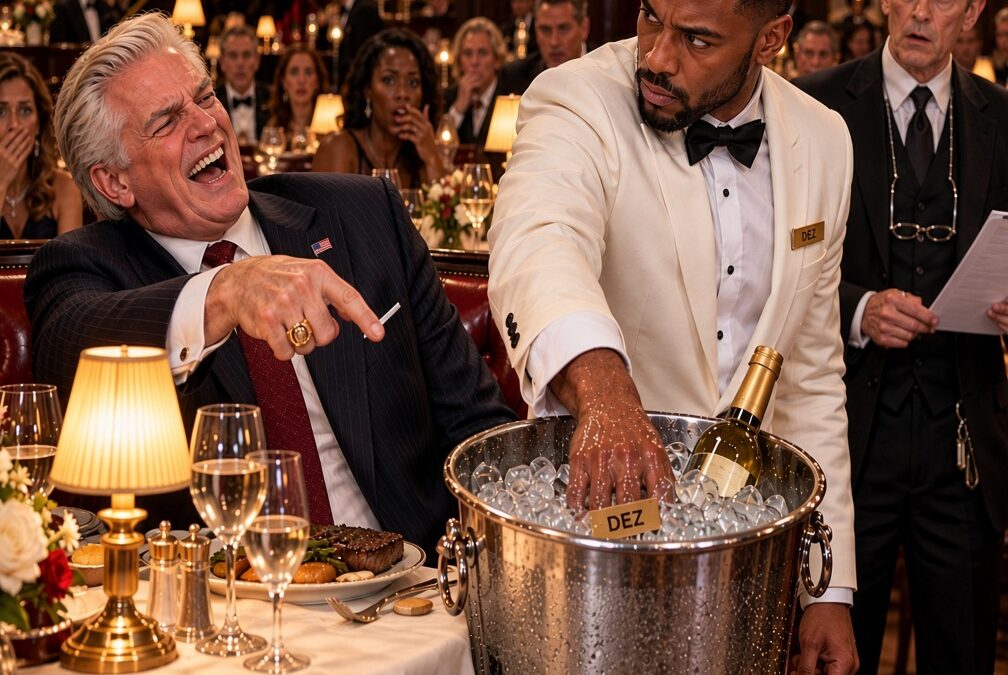
Rich Millionaire Forced a Black Waiter to Dig His Name Tag Out of Ice—Then Discovered the Waiter Owned His Exclusive Club
PART 2: The Secret Behind the Name Tag
The woman didn’t look at me when she said it. She looked at Preston, whose hand was still pointing toward my chest.
“Whose club?” he repeated.
“Marcus Reed’s,” she answered.
Someone laughed, assuming it was a joke. Preston didn’t. He stared at the leather portfolio as if he recognized the seal stamped across its cover.
Her name was Evelyn Shaw. At least, that’s what the woman had introduced herself as when we first met six months earlier. She was the attorney handling my grandfather’s estate.
Preston turned toward me. “You’re the owner?”
“Part owner,” I said. “And tonight, apparently, your waiter.”
The truth was more complicated than the room could imagine.
My grandfather, Samuel Reed, founded the Monarch Club forty years ago with Preston’s father. Samuel managed the music, staff, and kitchen. Arthur Vale supplied the initial investment. Their agreement split ownership equally.
When Samuel became ill, Arthur persuaded him to hand over daily management. After both men died, Preston claimed the club belonged entirely to his family.
For years, my mother believed him.
Then she found Samuel’s original partnership agreement inside an old record sleeve. She died before the dispute was settled, leaving me the papers and a warning: Don’t confuse a fancy title with an honest man.
I showed the agreement to Evelyn. She spent months tracing company filings, bank records, and missing distributions. The evidence supported our claim, but we still needed a formal settlement.
“So you came here pretending to serve drinks?” Preston asked.
“I’ve worked here since I was nineteen,” I replied. “You just never bothered learning my name.”
Helen cleared her throat.
“He worked double shifts while we kept this place open through the renovation. When the estate review began, he asked us not to announce anything until the paperwork was complete.”
Preston looked at Evelyn. “You said there was a meeting tonight.”
“There is. You declined three invitations. Then you booked the club for a private event and announced plans to sell it.”
Celeste slowly set down her glass.
“You told me your father built this place alone.”
Preston didn’t answer.
Mrs. Bell rose from her chair.
“Samuel built the first stage himself,” she said. “I watched him carry the boards through those doors.”
She was the club’s first singer, not an uninvited stranger. Every Thursday, she came to hear the songs she once performed beside my grandfather.
The photograph showed Samuel on opening night. Preston had mistaken it for a meaningless keepsake. Celeste recognized it because Arthur’s old files contained the same picture, cropped to remove Samuel.
Evelyn laid several documents on the table.
“Last week, the parties executed a settlement recognizing Marcus’s controlling interest after the Reed estate purchased additional shares. The transfer became effective at nine tonight.”
Helen glanced at the antique clock. Nine exactly.
Preston’s mouth opened, then closed.
“And my event?” he asked.
“You can finish it,” I said. “As long as everyone here treats our staff and guests respectfully.”
He looked down at the ice bucket.
For the first time, he seemed to understand what he’d done.
Celeste removed her engagement ring and placed it beside her glass.
“I’m going home,” she said quietly. “We need a serious conversation.”
She walked away before he could respond.
Preston followed her toward the elevator, leaving his friends staring at their phones. The recordings had already traveled farther than any apology could.
Evelyn asked whether I wanted to issue a public statement. I shook my head. The club needed stability, not another spectacle.
I didn’t forgive Preston that night. Papers couldn’t erase his words to Mrs. Bell or the silence of those watching. I met staff and asked what really needed changing. Their answers were practical: better schedules, clearer reporting, and a rule that no private event could exclude a guest with a valid reservation. We wrote those changes down together.
Later, after the last guest left, Helen brought me a dry name tag from the office. It had been made months earlier, when the settlement first seemed possible.
MARCUS REED OWNER
I held it without pinning it on.
Mrs. Bell approached the empty stage. “Your grandfather used to say this room belonged to whoever made people feel welcome.”
I looked at the bucket, now filled with ordinary water.
“Then we’ve got work to do,” I said.
The next morning, I put the old waiter’s tag in my desk drawer. I kept it there beside Samuel’s photograph, not as proof that I’d been insulted, but as a reminder of how easily a person can overlook someone standing right in front of them.
At six, I opened the club doors myself. Mrs. Bell arrived carrying sheet music. Helen switched on the lights. And when the first customer asked who owned the place, I smiled.
“Come inside,” I said. “I’ll show you.”
Disclaimer: This story is entirely fictional and created for entertainment purposes only. It does not represent any organization or individual, nor does it encourage inappropriate behavior. The content was generated with AI assistance.








