Rich Millionaire Mocked a Black Orphan and Challenged Her to Play a $2 Million Violin—Then Her First Song Exposed a Family Secret
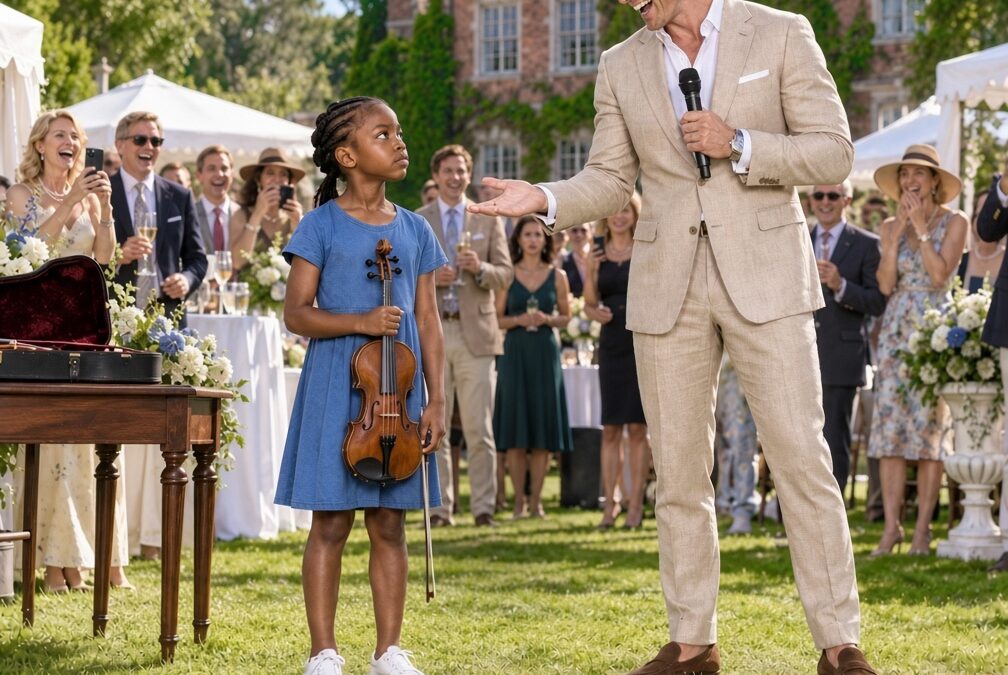
PART 2: The Secret Behind the Million-Dollar Violin
Evelyn’s words didn’t make me stop playing. They made me hold the last note until my bow began to shake.
Then the ballroom fell silent.
“What did you say?” I asked.
Charles set down his glass. “Evelyn, not here.”
She ignored him.
“Amara, your mother was my sister.”
I stared at her. We didn’t look alike. Her pale hands were trembling against her dark dress, while mine clutched the violin so tightly my fingers hurt.
“My mother was named Lena Brooks,” I said.
“I know.”
Evelyn opened a small pendant hanging beneath her collar. Inside was a photograph of two young women standing beside a piano. One was my mother. The other was Evelyn, younger and smiling.
My knees weakened.
“Then where is she?”
Evelyn glanced toward the man with the black folder.
“Mr. Ellis is the attorney who handled her estate.”
Estate.
The word seemed to swallow every sound in the room.
My mother hadn’t left me because she didn’t want me. She had died after a sudden illness, and the letter she’d written for me had never reached the foster home.
I looked at Mrs. Lane. She was crying.
“I never received a letter,” she said.
“I believe you,” Evelyn replied.
Charles stepped forward. “This is supposed to be a fundraiser.”
“No,” Evelyn said. “This was supposed to be a reunion.”
She turned to me and explained that Lena had become estranged from their family years before I was born. Their father had disapproved of her marriage, and Evelyn had been too frightened to challenge him.
When Lena became ill, she tried to reconnect. But Evelyn was traveling abroad, and their messages crossed through an old address.
After Lena died, a relative arranged my placement in foster care without informing Evelyn that I existed.
“I found your name three months ago,” she said. “I didn’t know whether you would want to meet me.”
“Then why bring me here?”
Evelyn looked ashamed.
“Charles said he could arrange a private introduction after the gala. He wanted the charity board to see the children perform first.”
Charles folded his arms. “I was trying to help.”
“You turned adoption into a joke,” she answered.
He looked around at his guests, searching for someone to defend him. Nobody spoke.
I stared at the violin.
“Did you know it was hers?” I asked Charles.
He hesitated.
“Yes.”
“Then why pretend you bought it at an estate sale?”
“Because I didn’t want the evening becoming emotional.”
A bitter laugh escaped me. “You invited an orphan to play her dead mother’s violin and expected no emotions?”
Evelyn lowered her head.
Mr. Ellis finally approached. He explained that Lena had entrusted the violin to a family friend, who later transferred it to Evelyn. Charles had arranged its display without explaining its history to me.
The attorney opened his folder. Inside was my mother’s letter, along with photographs, medical records, and a handwritten melody.
I recognized the music immediately.
It was the song I’d just played.
At the bottom, Mom had written: For Amara, whenever she needs to find her way home.
I sat on the edge of the stage and read her letter twice.
She wrote about teaching me to hold the bow. About my habit of sleeping with one sock missing. About how fiercely she’d wanted to stay.
There was no grand secret inheritance. No fortune waiting in a bank. Just proof that I had been loved, even when I couldn’t remember the sound of her voice.
Evelyn sat beside me, leaving space between us.
“I don’t expect you to call me family tonight,” she said.
“Good,” I whispered. “Because I don’t know you.”
She nodded. “Then we can start there.”
Across the ballroom, Charles left. Evelyn ended their engagement a week later. She told me his behavior hadn’t been the first time he’d confused generosity with control.
We didn’t rush into adoption. Mrs. Lane helped arrange supervised visits, and a social worker made sure I had choices. Evelyn came every Saturday. Sometimes we talked. Sometimes we played music. Sometimes I asked questions she couldn’t answer.
Months later, I moved into her home after the reviews were completed.
At school, people later asked whether the performance had made me famous. I told them the applause was the part I remembered least. I remembered the weight of the violin, the three scratched stars, and the woman who finally told me the truth without asking for anything in return.
On my first evening there, she placed my mother’s violin on the kitchen table.
“No glass case?” I asked.
Evelyn smiled. “It was never meant to be locked away.”
I lifted it beneath my chin and played the lullaby again.
This time, nobody laughed.
And when the last note faded, Evelyn didn’t ask me to prove anything.
She stayed.
Disclaimer: This story is entirely fictional and created for entertainment purposes only. It does not represent any organization or individual, nor does it encourage inappropriate behavior. The content was generated with AI assistance.








