She Met Her Father’s Guest with Untidy Hair—Never Guessing He Was the Duke
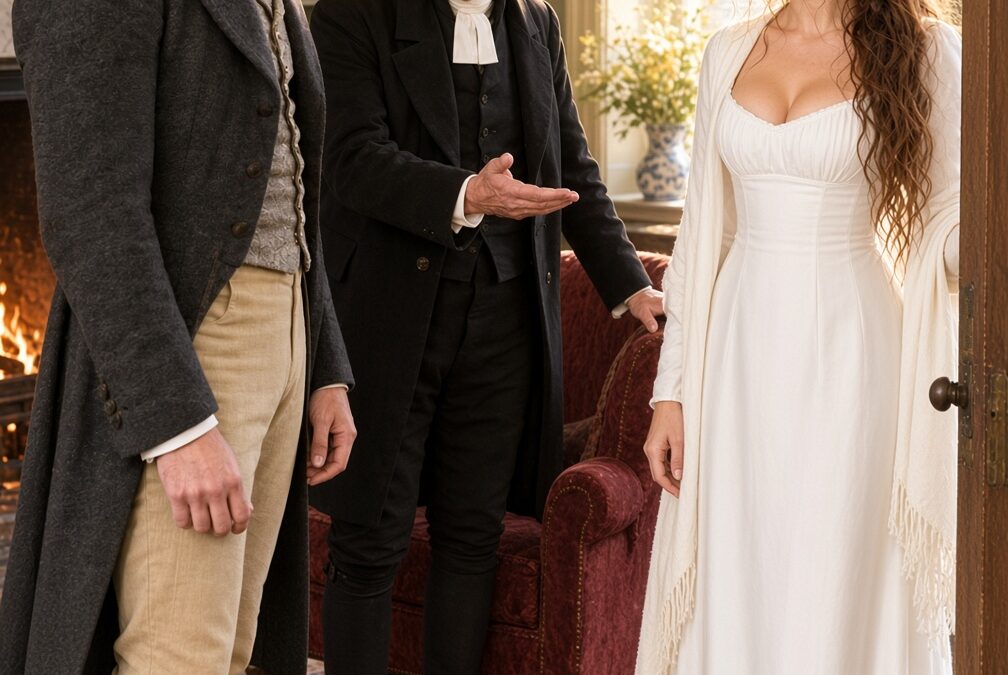
Part 2
The footman opened the carriage door, and a crest gleamed on its panel.
“James is short for James,” Martha said. “That much is not a surprise.”
He almost smiled, but did not.
“James Ashford. Duke of Bellmere.”
Martha felt the warmth leave her face. She remembered the unpaid loan, the estate survey, and the way he had asked whether she would leave if the debt were paid.
“You came to inspect what you might take.”
“I came to discuss the loan. I should have told you.”
Her father stepped forward. “His Grace has offered to extend the repayment date.”
“Because he wants the mill?” Martha asked.
“Because the mill is worth more working than sold,” James said. “The debt is secured against it, but I have no wish to close it.”
“Why not say that this morning?”
“I wanted you to speak freely, without thinking every answer might change the negotiation.”
“And did my disheveled hair help you judge whether I was free?”
His regret was immediate. “No. I was wrong to hide who I was.”
Her father invited them back inside. Martha remained by the river.
James let the carriage wait. “You have every right to be angry.”
“I am not angry that you are a duke. I am angry that you decided I could only be honest if you deceived me first.”
“I thought my title would make you careful.”
“It should have made you careful.”
He accepted that in silence.
Martha looked at the wheel. “If the loan is extended, the mill needs repairs before winter. The tenants can help with the work if they are paid. The accounts can show you what it will cost.”
“Will you show me?”
“I will show you the figures. I have not decided whether I want to know you.”
“That is fair.”
They returned to the house separately. James spoke with her father, then asked permission to call again. Martha did not answer for him. Her father left the choice to her.
For several weeks, James came as himself. He brought the loan papers, answered questions, and let Martha challenge every clause. They agreed that the mill would stay open, the workers would be paid for repairs, and the debt would be reduced from its profits rather than from the sale of their home.
The agreement took three visits and several crossed-out drafts. James did not rush her when she questioned the interest or asked what would happen if the river flooded again. He let her consult the miller and two tenant families before signing. That patience mattered more than his fine words. One rainy afternoon, he arrived soaked again, and Martha handed him a towel without comment. He told her that he had been hoping she would do exactly that.
He never called her “my duchess” or praised her for being plain. He asked about the school she wanted to build above the mill office. She asked why he had left London. He told her he disliked being treated as a title with a face attached.
“You could have said that,” she reminded him.
“I know.”
“You could have trusted me with the truth.”
“I’m trying to learn.”
She found that he listened when corrected. The attraction she had first felt beside the river slowly became something more deliberate. She began to look forward to his visits, though she never stopped asking what he wanted from the estate. He never hurried her answer or praised her for yielding.
James told her that he had come in person because his steward’s report described a mill at the edge of failure, but made no mention of the families who relied on it. He wanted to see for himself before deciding what to do. Martha told him that seeing was not the same as understanding. He returned the next morning and spent the day speaking with the miller, the baker, and the tenant whose cottage roof had begun to leak. She liked him better for listening than for any promise he could make.
The mill reopened before spring. At its first full day of work, Martha showed James the new wheel turning cleanly in the current. Flour dust rose from the open doors, and the miller’s children ran laughing along the bank.
James held out his hand. “Will you walk with me, Miss Vale?”
“Only if you tell me where you’re going.”
“To ask whether you might let me court you.”
“That is a better beginning.”
She placed her flour-marked hand in his. The water flashed beneath the wheel, carrying the old debt downstream one turning at a time.
Disclaimer: This story is entirely fictional and created for entertainment purposes only. It does not represent any organization or individual, nor does it encourage inappropriate behavior. The content was generated with AI assistance.








