“Sit Beside Me ” the Lakota Chief Told the Woman Forced to Stand — What He Slipped Under Her Plate Left Her Trembling
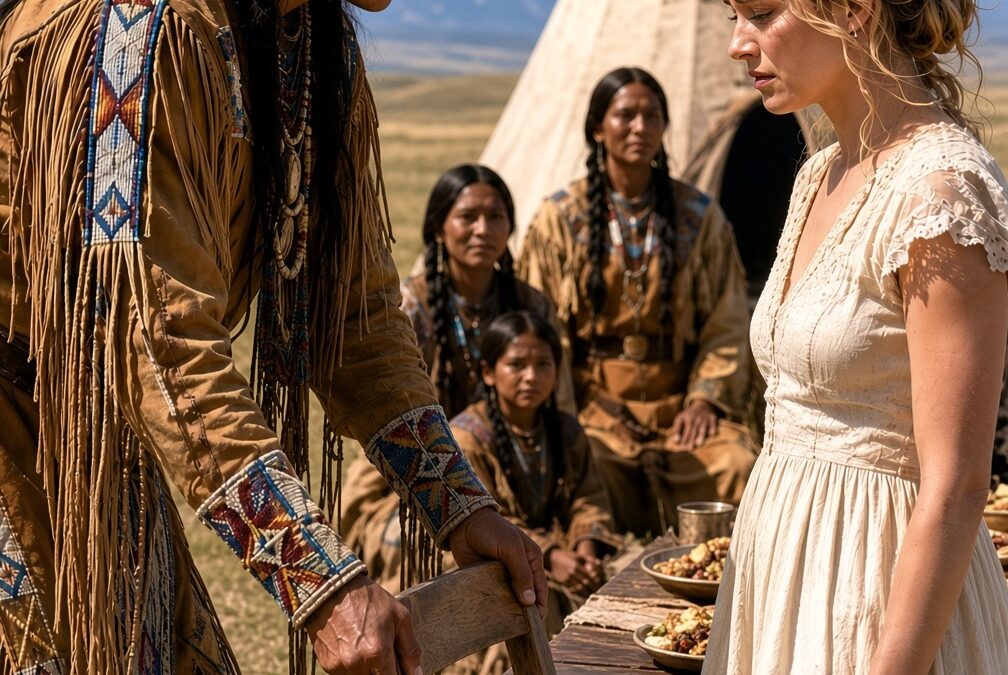
Part 2
Clara read the sentence again, afraid she had misunderstood.
Edwin reached for the letter, but she drew it against her chest.
“Mother left the ranch to me?”
“Not exactly,” Mato answered. “Read the next page.”
Her mother’s handwriting filled the paper in careful lines. Years earlier, the ranch had nearly failed during a terrible drought. Mato’s father had helped Clara’s mother protect the cattle and keep the creek open for both families.
Together, they had signed an agreement preserving shared access to the water and recording Clara’s future interest in the property.
“Why didn’t you tell me?” Clara asked Edwin.
He stared at the table.
“I managed everything after your mother died.”
“That wasn’t my question.”
Lydia leaned forward.
“Father, you told us Clara wanted nothing to do with the ranch.”
“She was young,” Edwin replied. “Someone had to make decisions.”
Mato spoke evenly.
“Decisions are not the same as ownership. The county records should show what was agreed.”
Clara unfolded the map. A blue line marked the creek, and beside it her mother had drawn a small circle around the old orchard.
Below the drawing were four words: For Clara, when ready.
She remembered walking there as a child, gathering apples while her mother talked about responsibility and belonging.
“Did you know her well?” Clara asked Mato.
“I met her twice. My father knew her better. He said she kept her promises, even when keeping them cost her something.”
Edwin rose abruptly.
“You’re taking a stranger’s word over mine?”
“I’m reading Mother’s words,” Clara answered.
For the first time, her voice did not tremble.
Mato gathered his coat.
“I came to discuss the creek agreement. Tomorrow, if Clara wishes, we can visit the county clerk together.”
He turned toward her.
“You don’t need to decide anything tonight.”
After the guests departed, Clara remained at the table. Lydia returned from the kitchen carrying two cups of tea.
“I should have said something,” Lydia admitted.
“You knew?”
“I knew Father treated you unfairly. I didn’t know about the letter. I told myself staying quiet kept peace.”
Clara looked at the empty chairs.
“It kept things comfortable for everyone except me.”
Lydia nodded, ashamed.
The next morning, Clara rode to town with Mato and Lydia. The county clerk located the original agreement and an earlier deed. Together, the documents confirmed that Clara held a recorded interest in the ranch and that Edwin could not simply claim it as his own.
The clerk recommended legal assistance to settle the remaining questions.
Clara left the office holding certified copies. Nothing was finished, but the truth was no longer hidden in a drawer.
Outside, Mato waited beside the horses.
“What will you do now?” he asked.
“Learn everything I should have learned years ago.”
He smiled.
“That sounds like a beginning.”
Over the following weeks, Clara met with an attorney, reviewed the ranch accounts, and began taking part in decisions about the land. Edwin resisted, but the records left him little room to deny her rights.
She also visited Mato’s community with an invitation from his family. There, she listened as his father spoke about the drought and the trust he had shared with her mother.
“She treated our agreement as a responsibility,” the older man said. “Not a favor she could take back.”
Clara thanked him, realizing how much of her mother’s life she had never known.
By autumn, a settlement allowed Clara to take responsibility for the orchard and a portion of the ranch operations. She hired workers, repaired fences, and negotiated grazing arrangements herself.
One evening, Mato visited after a long ride. Clara had prepared supper beneath the orchard trees. Lydia arrived carrying bread, and several neighbors gathered around a plain wooden table.
Mato paused beside an empty chair.
“Is this seat taken?”
Clara laughed softly.
“Only if you promise not to pull it out for me again.”
“Why not?”
“Because this time, I want to pull out yours.”
She did, and he sat with a grateful smile.
As dusk settled over the orchard, Clara looked around at the people sharing her meal. Nobody stood apart. Nobody waited for permission to eat.
She remembered the corner of Edwin’s dining room, the cold plates, and the years spent believing she deserved no place at the table.
Then she looked at the empty chair beside her and thought of her mother.
The prairie wind moved through the branches, carrying the scent of apples and fresh bread.
Clara lifted her glass.
“To everyone who makes room for someone else.”
Mato raised his own.
“And to those who finally claim the room that was always theirs.”
Her past remained, but it no longer decided her future.
Under the fading gold of the western sky, Clara sat among family and friends, exactly where she chose to be.
Disclaimer: This story is entirely fictional and created for entertainment purposes only. It does not represent any organization or individual, nor does it encourage inappropriate behavior. The content was generated with AI assistance.








