Six lanterns. Six men. One wagon loaded with kerosene.
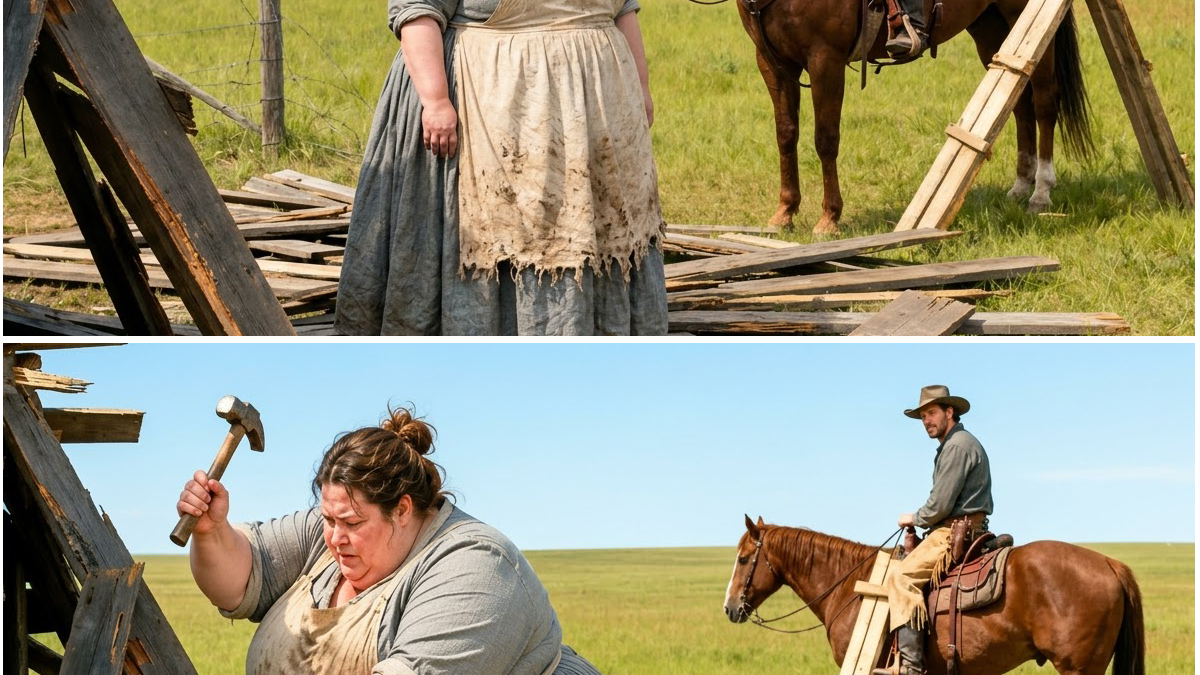
Six lanterns. Six men. One wagon loaded with kerosene.
Wade reached for his rifle. Margaret stopped him.
“No. If there’s shooting, they’ll say a squatter’s friend started it. Let me talk.”
“Ma’am, those boys aren’t the talking kind.”
“Then they’ll learn.”
She stepped in front of her crooked shelter with the handsaw still in her hand.
The lanterns stopped at the fence. A familiar figure climbed down from the wagon seat.
Harold Fenwick.
He looked exactly like his photograph: clean collar, careful mustache, eyes that never quite settled on anything.
“Margaret.” He sounded almost gentle. “You shouldn’t be here.”
“I keep hearing that tonight.”
“This land belongs to the Ainsworth mill. These men have work to do. I’ll pay your fare back to Illinois myself.”
“With what? The money you promised to repay me for my mother’s table?”
His face flickered. Behind him, one of the mill men chuckled.
Margaret reached inside her coat and pulled out a bundle of letters tied with twine. Fifteen of them. She had crushed only the last.
“You wrote me sixteen letters, Harold. You described this creek, this ridge, this pasture. You told me it would be our home. And in the eleventh letter, you asked me to sign my name for the preacher.”
Harold’s mouth tightened. “That proves nothing.”
“Mr. Callahan saw the claim at the land office. My name. Your handwriting on the filing.” She turned toward the mill crew. “So tell me, gentlemen. Who are you about to burn out? A squatter? Or the legal claimant?”
The men looked at one another. Burning an empty cabin was a job. Burning a woman off her own land was a hanging.
“Harold,” one of them said slowly, “you told Mr. Ainsworth this place was free and clear.”
“It will be,” Harold snapped. “She can’t prove up. She has no money, no stock, no house. Five years, Margaret. You won’t last one winter.”
The words hit harder than she wanted them to. He wasn’t wrong about the money. Thirty-two dollars had become six.
Then Wade stepped forward.
“I’ll lend her a cow and two calves. Claim law says improvements. She’s got a roof started. That’s an improvement.”
“Half a roof,” Harold sneered.
Margaret raised the saw. “By spring it’ll be a whole one.”
The lantern light trembled in the wind. Finally, the oldest mill hand spat into the snow.
“I’m not burning a woman’s home over your lie, Fenwick. Mr. Ainsworth can hear it from you.”
One by one, the men climbed back onto the wagon. Harold stood alone in the dark, then turned without a word and rode after them.
Margaret’s legs shook so badly she had to sit down on a broken board.
Wade crouched beside her. “You all right?”
“No,” she said honestly. “He didn’t just abandon me. He used me. I sold everything my mother left me to be a name on his paper.”
“Then make it your name on your land.”
It was not easy.
The Ainsworth family filed a challenge at the land office. Clara Whitmore spread stories through town that Margaret had known about the claim all along. Twice, Margaret’s woodpile burned in the night. Twice, she rebuilt it.
Wade came by on Sundays with nails and stubborn advice. She paid him back in biscuits and refused anything she couldn’t repay.
In February, the land agent from Helena compared Harold’s handwriting on the claim with the fifteen letters. The signature on the filing was Margaret’s. The rest was Harold’s.
The challenge was dismissed.
Word spread fast. Patricia Ainsworth’s father, embarrassed before the whole county, took his timber business elsewhere. Harold’s fine marriage became a quiet, cold one.
Margaret felt no joy hearing it. Only a door finally closing.
In late April, she nailed the last board onto the roof.
That evening Wade rode up and found her sitting on the porch she had built from broken gray boards and stubborn hope. Beside her sat the bundle of Harold’s letters.
“Keeping those?” he asked.
“Not anymore.”
She opened the stove and fed them in, one by one. The paper caught and curled, sixteen lies turning to warmth in a home they had never promised honestly.
When the last one burned, she set two cups on the rough table.
“Coffee, Mr. Callahan?”
He took off his hat. “Only if I’m invited.”
“You are.”
Outside, the sun dropped behind the pine ridge, gilding the creek and the south pasture exactly the way Harold had once described it.
Only now, it was true.
Disclaimer: This story is entirely fictional and created for entertainment purposes only. It does not represent any organization or individual, nor does it encourage inappropriate behavior. The content was generated with AI assistance.








