“Stay Just Like That,” the Officer Whispered Against My Ear—He Had No Idea Who My Wife Was Calling
PART 2 — THE CALL THAT CHANGED EVERYTHING
The sound above the pine trees wasn’t the rescue Officer Cheney expected.
It was the beginning of a record he could never erase.
A helicopter passed high over the highway, heading toward a regional medical center. Cheney watched it for a moment, then laughed at himself. He thought my silence meant surrender. He thought Hendry’s pale face meant fear had finally settled us both.
He was wrong about almost everything.
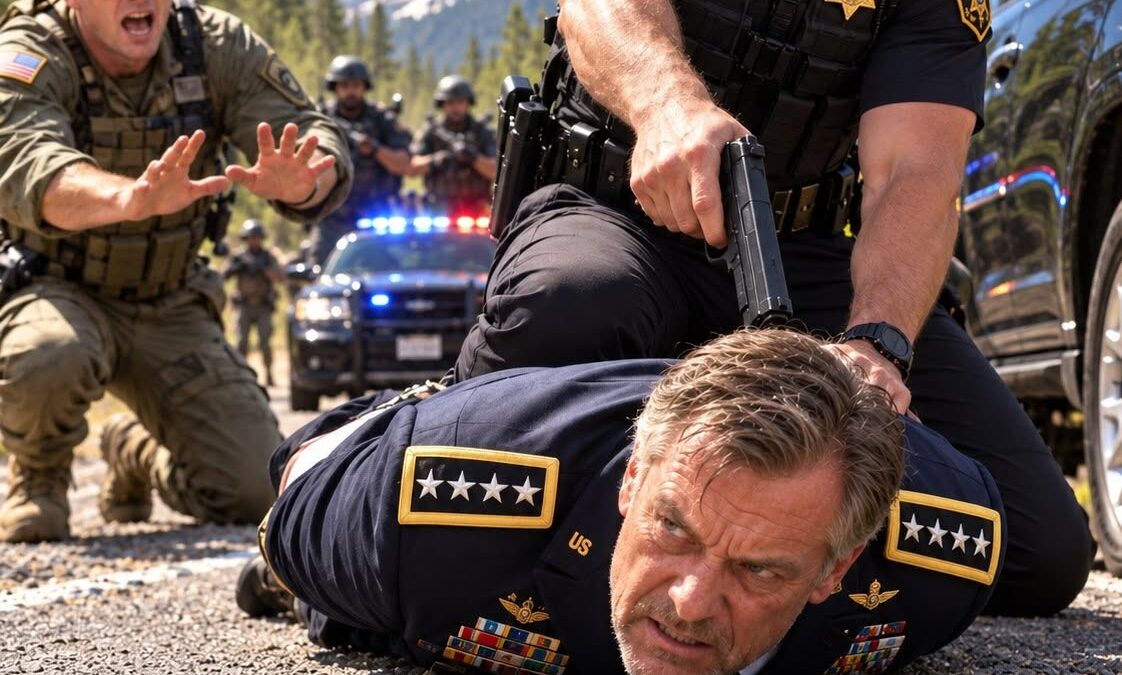
The blinking blue light in our dashboard wasn’t a decorative accessory. It marked a protected recording system installed for official travel. When Cheney forced us from the SUV, Hendry had quietly pressed the emergency control on his watch.
The alert went to our security office and to my wife, Rebecca.
Rebecca wasn’t simply waiting at home. She had served as an Army attorney before retiring. She knew that a husband’s rank couldn’t cancel a police officer’s authority. She also knew exactly how to preserve evidence when authority was abused.
She didn’t call the Pentagon demanding revenge. She contacted our duty officer, requested that the recording be secured, and asked for local supervisors and medical assistance to be notified.
On the shoulder, none of that was visible.
Cheney kept one hand on my back while he spoke into his radio.
“Two uncooperative males. Possible contraband.”
Hendry stared at him. “We followed every instruction.”
“Quiet.”
“Your camera will show that,” Hendry said.
For a second, Cheney’s expression shifted.
Then he noticed the small camera mounted beneath our rearview mirror.
“What’s that recording?”
“Our trip,” I said.
He stepped toward the SUV.
“Don’t touch it,” Hendry warned.
Cheney turned sharply, but before he could answer, another patrol vehicle pulled onto the shoulder.
A woman in a county supervisor’s uniform climbed out. Her nameplate read CAPTAIN MARA ELLIS.
“Officer Cheney,” she called. “Step away from that vehicle.”
He looked astonished. “Captain, I’ve got this handled.”
“Step away.”
Her voice left no room for negotiation.
She helped me sit upright while another deputy checked Hendry. My cheek was scraped, and my shoulder throbbed, but I could move without assistance.
Ellis examined my identification, then studied the camera.
“General Langford, I’m sorry. We’re arranging medical care.”
“Thank you,” I said. “Please preserve every recording, including his radio traffic.”
Cheney interrupted. “He was resisting.”
“No,” Ellis replied. “I’ve already heard the first transmission from their security office.”
The color drained from his face.
What happened next wasn’t a dramatic parade of generals or a squad of helicopters landing on the highway. It was quieter, and for Cheney, far more damaging.
Ellis separated everyone, collected statements, and secured the vehicle footage. She requested an independent review rather than allowing Cheney’s own colleagues to decide what the recording meant.
At the medical center, Rebecca called me.
“Are you alone?” she asked.
“Hendry’s here.”
“Good. Put me on speaker.”
Her voice trembled when she heard how my breathing caught as I shifted my shoulder.
“I saw the alert,” she said. “For twelve minutes, nobody could tell me whether you were safe.”
I closed my eyes.
In thirty years of service, I’d learned to report injuries without emotion. Hearing my wife’s fear made that discipline feel suddenly useless.
“I’m here,” I told her. “I’m coming home.”
“No,” she said, almost laughing through tears. “First you’re going to see your mother. She has been waiting all week for that photograph.”
By evening, a deputy drove us to her house. My mother opened the door before we reached the porch.
She looked at the scrape on my cheek, then at my uniform.
“Nathaniel,” she whispered. “What happened to your face?”
“Long story, Mom.”
She reached up and straightened my collar, the same way she had when I was a boy.
“Then come inside. You can tell it sitting down.”
Months later, the independent investigation found that Cheney had made unsupported claims and used force without justification. He lost his position and faced disciplinary and legal proceedings. The recording, radio logs, and witness statements formed the foundation of the case.
There was no applause, no speech and no exemption. There was evidence, accountability, and a family grateful for another ordinary evening together.
Rebecca never asked anyone to give me special treatment. She asked them to apply the same rules to everyone.
And the words Cheney whispered against my ear that afternoon finally took on their real meaning. He wasn’t offering a secret arrangement. He was counting on isolation, embarrassment, and silence to keep his conduct hidden.
He had mistaken restraint for weakness.
My mother kept the photograph we took that evening on her mantel. In it, my cheek is bandaged, Hendry stands beside me, and my mother holds my arm with both hands.
Whenever I visit, she points to it and smiles.
“My boys came home,” she says.
That’s the part I remember most.
Disclaimer: This story is entirely fictional and created for entertainment purposes only. It does not represent any organization or individual, nor does it encourage inappropriate behavior. The content was generated with AI assistance.








