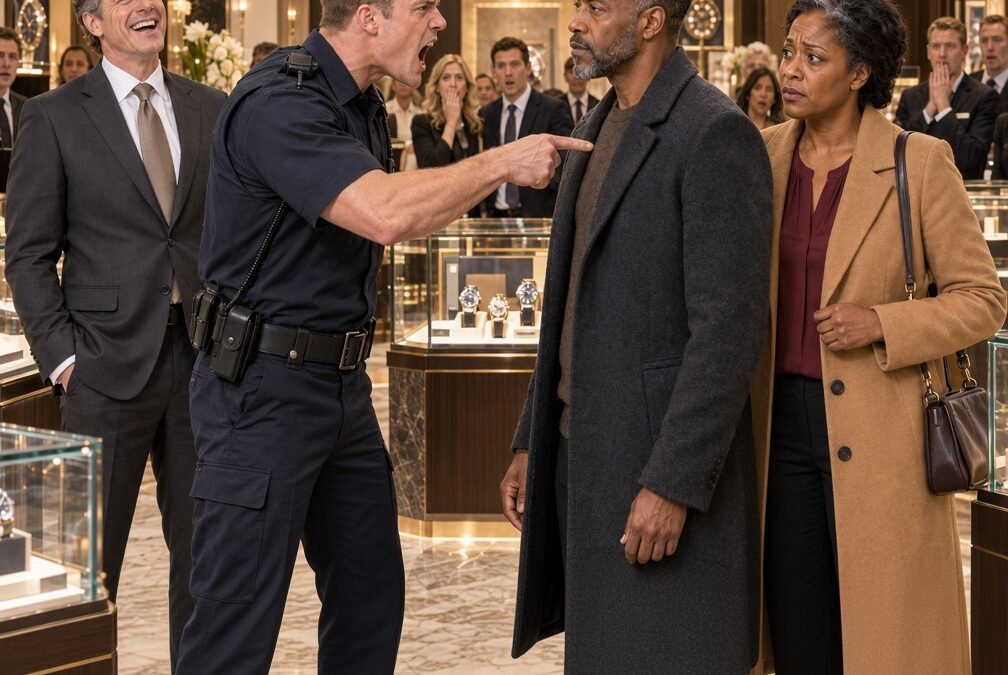
Store Manager Had Security Throw Out a Black Couple for Looking “Suspicious”—Then Discovered They Owned the Entire Retail Chain
PART 2: The Secret Behind the Store Visit
The woman with the briefcase wasn’t there to rescue us.
She was there to deliver the report that could destroy everything my husband had spent thirty years building.
Her name was Margaret Hayes, our company’s chief legal officer.
Bradley stared at her.
“Your company’s what?”
James turned toward him.
“Bellamy’s belongs to Carter Holdings. My wife and I founded the company that purchased this chain fourteen years ago.”
Bradley’s mouth opened.
Then closed.
“You’re the owners?”
I watched his eyes travel from our sneakers to Margaret’s briefcase.
He looked like a man searching desperately for a different answer.
James nodded.
“And you’ve been receiving paychecks from our company for six years.”
Rachel covered her mouth.
Bradley stepped backward.
“Sir, I had no idea.”
“That,” James replied, “is exactly the problem.”
But the biggest surprise wasn’t Bradley’s reaction.
It was what Margaret told us next.
“James, the investigation is further along than we expected.”
I turned toward my husband.
“Investigation?”
He looked away.
For months, our company had received complaints about customers being followed, questioned, and denied service at several locations.
Most complaints came from Black families and other minority shoppers.
James had quietly hired an independent auditing firm.
He hadn’t told me because he wanted to present the findings at our anniversary dinner.
He thought the investigation would prove our stores were improving.
Instead, the reports revealed something disturbing.
Several managers had been using an unofficial customer screening system.
Employees were encouraged to identify people who supposedly looked unlikely to purchase expensive merchandise.
There were no written rules about race.
But the complaints and surveillance recordings showed a troubling pattern.
Bradley had helped create the system.
Margaret opened her briefcase.
Inside were printed emails bearing his signature.
Bradley stared at them.
“I was protecting inventory.”
“By humiliating customers?” I asked.
He swallowed.
“We’ve had problems with theft.”
James stepped closer.
“Then you investigate actual incidents. You don’t decide someone’s character by looking at their clothes or skin.”
Rachel began crying quietly.
I turned toward her.
“What’s wrong?”
She wiped her cheeks.
“I reported this three months ago.”
Margaret looked up.
“To whom?”
“Human Resources. I told them Bradley was treating customers unfairly.”
Bradley interrupted.
“She misunderstood our procedures.”
Rachel shook her head.
“You told me people like them were bad for our image.”
Silence filled the entrance.
James looked at Margaret.
“Was her complaint included in the audit?”
Margaret hesitated.
“No. It was marked resolved.”
“By whom?”
She checked the document.
“Bradley’s district supervisor.”
My husband closed his eyes.
For the first time that afternoon, I saw something worse than anger on his face.
Disappointment.
He had built this company around a promise that customers would be treated with dignity.
Somewhere along the way, that promise had become nothing more than words printed on employee handbooks.
“Margaret,” he said, “preserve every complaint and every relevant recording.”
She nodded.
“We’ll begin an independent review immediately.”
Bradley reached toward James.
“Please, sir. I have a family.”
James looked at his hand but didn’t take it.
“So do the people you’ve embarrassed.”
Bradley was placed on administrative leave pending the investigation.
Rachel was assured that her complaint would be reviewed without retaliation.
But I wasn’t satisfied.
Outside, customers were still gathering around the windows.
Some had recorded everything.
Others were already posting videos online.
I turned toward James.
“You knew there was a problem.”
He nodded.
“And you kept it from me.”
“I thought I could fix it before you found out.”
I looked at the necklace still sparkling behind the glass.
“That’s not how marriage works.”
He lowered his eyes.
“I know.”
We drove home without speaking.
Three weeks later, the independent investigation confirmed widespread failures in training, complaint handling, and management oversight.
Several managers lost their positions.
New reporting procedures were introduced.
We also created an outside review committee with authority to investigate discrimination complaints.
But the changes didn’t erase what happened.
One evening, James found me sitting beside our anniversary photographs.
“I ruined your surprise,” he said.
I shook my head.
“The surprise wasn’t the necklace.”
He sat beside me.
“Then what was it?”
I showed him a photograph from our first store.
Two young people stood outside a tiny rented shop, smiling beneath a crooked sign.
“We promised to build somewhere people felt welcome,” I whispered.
James studied the photograph.
Then he reached for my hand.
The following Saturday, we returned to Bellamy’s.
Rachel greeted us at the entrance.
This time, nobody followed us.
Nobody questioned our clothes.
And when James asked whether I still wanted the sapphire necklace, I smiled.
“Maybe later.”
He laughed softly.
We walked outside together, holding hands.
For once, being recognized didn’t matter.
Being treated with respect did.
Disclaimer: This story is entirely fictional and created for entertainment purposes only. It does not represent any organization or individual, nor does it encourage inappropriate behavior. The content was generated with AI assistance.








