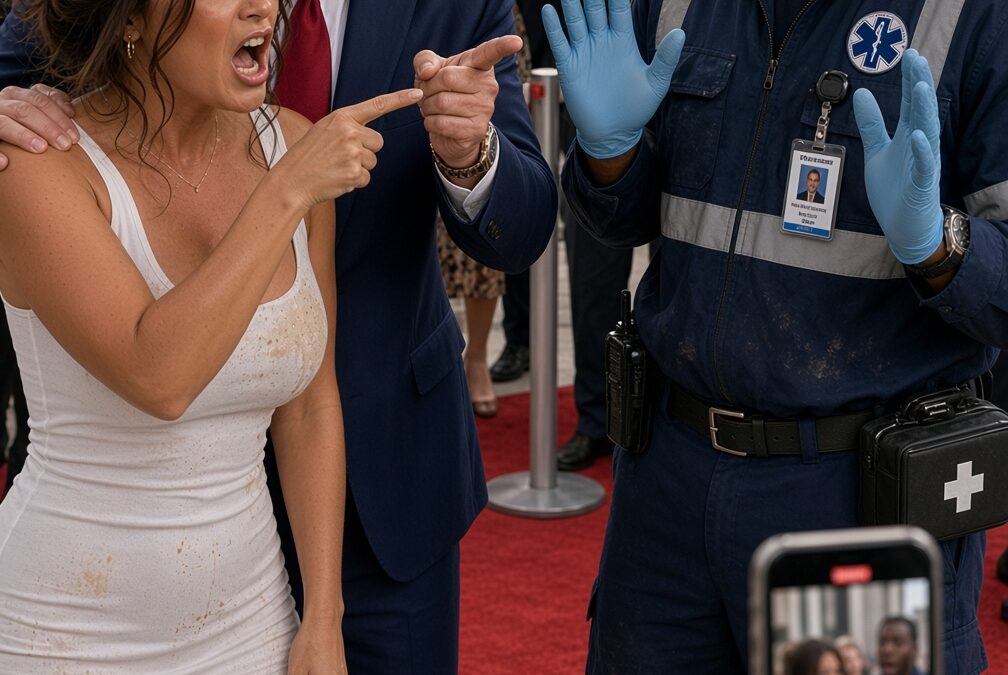
The fourteen second video that destroyed my reputation began in the middle of Katherine’s sentence.
PART 2
The fourteen second video that destroyed my reputation began in the middle of Katherine’s sentence.
What came before it changed everything.
But the person who cut the footage wasn’t simply trying to embarrass me.
He was trying to hide why the senator’s daughter had collapsed in the first place.
I learned that two days after the gala.
My supervisor had placed me on administrative leave while the department reviewed the incident.
The official complaint didn’t accuse me of a specific criminal act.
But that distinction hardly mattered online.
People had already decided what they’d seen.
A wealthy young woman.
A Black emergency worker.
A statement about physical contact.
The rumors practically wrote themselves.
Then I received a message from an unfamiliar number.
It contained a photograph of a handwritten safety checklist.
Three items were circled in red.
Blocked medical access.
Improper generator placement.
Unresolved ventilation concerns.
Beneath the photograph was a single sentence.
She was trying to tell them before she collapsed.
I forwarded the message to my supervisor and the department investigator.
Within hours, we learned that Katherine had been asking questions about the event’s safety arrangements for several days.
Her father had asked her to oversee part of the charity gala.
She discovered that a safety contractor had raised concerns about the positioning of temporary generators and ventilation equipment near a partially enclosed service area.
The contractor recommended changes before guests arrived.
But relocating the equipment would have required delaying preparations.
Bradley Collins, the event operations manager, had rejected the recommendation.
He documented the issue as resolved.
It wasn’t.
During the gala, exhaust from one generator accumulated near the covered passage where Katherine later collapsed.
Several staff members had reported headaches and dizziness.
Katherine began investigating after hearing their complaints.
She confronted Bradley shortly before her medical emergency.
That’s why she approached me.
She wanted independent confirmation that the symptoms might indicate a safety problem.
When Bradley interrupted our conversation, she became suspicious.
Later, she went toward the service passage to photograph the generator arrangement.
That’s where she lost consciousness.
Our medical team responded immediately.
We assessed her breathing, provided appropriate emergency care, and arranged further evaluation.
Her eventual recovery wasn’t proof that the event had been safe.
It was proof that somebody had recognized the emergency in time.
After leaving the hospital, Katherine decided to address what happened publicly.
She wanted to explain why she’d needed emergency treatment and thank the responders.
Her father encouraged her to speak.
Bradley volunteered to coordinate the video distribution.
That was his opportunity.
The complete recording showed Katherine saying:
“Some people asked why I let that Black paramedic put his hands on me. I let him because I was unconscious, I needed medical attention, and he was doing his job. He may have saved my life.”
But the version released online removed her explanation.
It began with the phrase about allowing me to touch her.
Then it cut to my face.
The edited clip made her gratitude sound like an accusation.
Bradley understood how quickly people would focus on the apparent scandal.
And they did.
For forty eight hours, almost nobody asked why Katherine had collapsed.
Almost nobody discussed the generator.
Nobody questioned why the event had continued despite earlier warnings.
Instead, reporters contacted my employer.
My photograph circulated online.
Someone even posted the name of my daughter’s school.
Katherine discovered the edited video while recovering at home.
She immediately requested the original recording.
Bradley told her the full file had been corrupted.
But the event’s audiovisual contractor had retained an independent backup.
When Katherine obtained it, she contacted investigators.
The unedited footage was released through her attorney.
Then came the inspection records.
Emails confirmed Bradley had received the contractor’s warnings.
Event planning documents showed the requested changes hadn’t been made.
Investigators also reviewed communications relating to the decision to distribute the shortened video.
The evidence connected Bradley’s office to the misleading edit.
An independent inquiry followed.
Bradley was removed from his position with the charity’s event organization.
The event contractor’s procedures and the management decisions were reviewed by the relevant authorities.
Senator Reynolds publicly acknowledged that his staff had failed to act appropriately on the safety concerns.
He also apologized for allowing the misleading narrative to spread without first verifying the facts.
My department completed its review.
I was cleared to return to duty.
The official findings confirmed that I’d followed appropriate emergency response procedures.
But returning to work wasn’t the same as returning to normal.
For weeks, strangers had looked at my face and decided I was guilty of something they couldn’t even explain.
Katherine understood that.
One afternoon, she came to our station.
She wore jeans, a white sweater, and no makeup.
There were no reporters.
No cameras.
Just a young woman standing awkwardly in a building she’d once visited only for publicity photographs.
She asked to speak with me.
We sat in a small conference room.
For several minutes, she struggled to find the right words.
Finally, she placed her phone on the table.
The complete video was paused on a frame showing me kneeling beside her during the emergency.
“I watched this over and over,” she said.
I waited.
“You were helping me, and someone turned that into something ugly.”
Her eyes filled with tears.
“I should’ve checked what they posted under my name.”
I looked at the screen.
The person in that image was doing exactly what I’d trained to do.
Nothing more.
Nothing less.
Katherine asked whether I hated her.
I shook my head.
“I wish you’d spoken sooner.”
She nodded.
“I know.”
Outside the conference room, my partner was preparing equipment for another shift.
An ambulance engine started.
A dispatcher called over the radio.
Life was continuing.
Before leaving, Katherine thanked Luis and the rest of the medical team personally.
Then she walked out into the afternoon sunlight.
A reporter waiting across the street lifted a camera.
Katherine stopped.
For a moment, I thought she might turn away.
Instead, she faced him.
And this time, she told the entire story.
Disclaimer: This story is entirely fictional and created for entertainment purposes only. It does not represent any organization or individual, nor does it encourage inappropriate behavior. The content was generated with AI assistance.








