THEY MARRIED HER TO A “BROKEN” RANCHER FOR A $40 DEBT—THEN SHE FOUND WHAT WAS BURIED INSIDE HIS EAR
Part 2
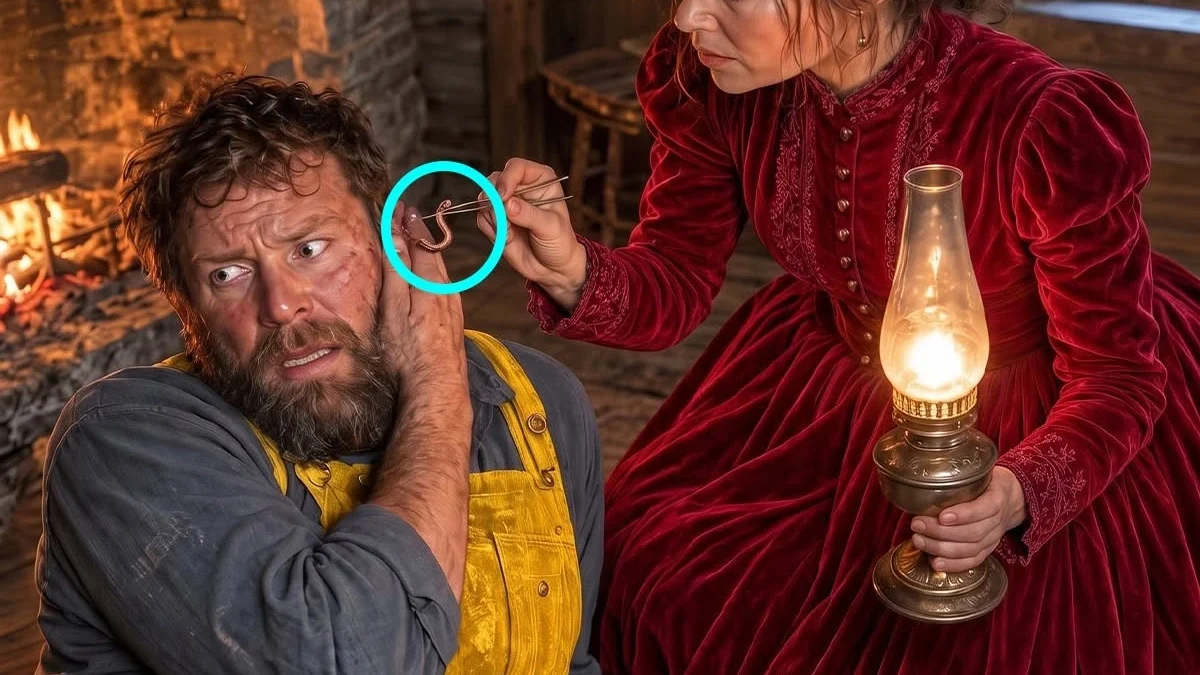
June held the creature in the tweezers while it twisted, pale and slick, and then she dropped it into the boiling pot. The kitchen went still. Silas sagged against the table, blood dripping from his ear onto the floorboards.
She set the brass capsule on the slate. The symbol on its lid was a circle split by a crooked arrow, the same one carved into his gate.
Silas stared at it. For the first time, June saw fear in him that had nothing to do with pain.
He took the chalk with a shaking hand.
I KNOW THAT MARK.
June wrote back slowly. WHOSE IS IT?
He wrote one word, pressing so hard the chalk snapped.
FATHER.
She bandaged his ear in silence. Then he rose, took a lantern, and motioned for her to follow. They crossed the yard to the old barn, where he pulled aside a stack of rotted feed sacks and lifted a trapdoor.
Below sat a crate full of brass capsules, each stamped with the same mark. Beside it lay a ledger bound in cracked leather.
June opened it by lantern light. Names, dates, and dollar amounts filled every page. Beside each name was a small notation: Deaf. Placed.
Her stomach turned. “These are people,” she whispered, though he couldn’t hear her.
Silas turned to the last page and set his finger beside a name.
SILAS REED. AGE 7.
June read the entry twice. Paid in full by Hollis Reed, father of the child. Debt settled.
Silas tapped his chest, then his ear, and wrote with a trembling hand.
HE SOLD MY HEARING.
“Sold it to whom?” June said aloud, then caught herself and picked up the chalk.
Silas shook his head. He didn’t know. He only knew that at seven years old, his father had taken him to a doctor in a canvas tent, and he had woken up in silence. His father had told the whole county it was a fall from a horse.
June closed the ledger. “That’s why you never let anyone near this place.”
He nodded.
“And why the town calls you a devil. They never knew.”
Another nod. His jaw worked. Then he wrote the line that stopped her heart.
THE MARK ON MY GATE WAS NEVER MINE. IT WAS A WARNING TO KEEP OTHERS OUT.
Before June could answer, Silas stiffened. His head turned toward the yard, though he could not have heard a thing. Then she felt it too, the faint tremble of hooves through the barn floor.
Riders.
She snuffed the lantern. Through a gap in the boards, she counted six men in long coats, a lantern swinging at the lead rider’s saddle. They stopped at the gate, and the biggest one pointed at the carving.
“Reed’s boy has been poking around the old stock,” he called loudly. “Heard he got himself a bride from town. Foolish thing, that.”
June’s breath caught. She knew that voice. Judge Ambrose Whitfield, the same man who had sat on the church bench grinning while her father’s debt became a wager.
The wager, she realized. The marriage. None of it had been a cruel joke.
It had been a leash.
Silas gripped her hand and guided her toward the back of the barn. He wrote fast on his palm with a finger. STAY HERE. She seized his sleeve and shook her head. Then she took the ledger, opened the trapdoor, and shoved a handful of the brass capsules into her apron.
“We end this tonight,” she said, and mouthed it slowly so he could read her lips.
He stared at her. Then, for the first time since she’d met him, Silas Reed smiled.
They stepped into the yard together.
Whitfield’s grin faltered when he saw the ledger in June’s arms. “Mrs. Reed. You’ve found something that doesn’t belong to you.”
“It belongs to every name written in it.” June lifted her voice so the riders could hear. “Forty dollars, Judge. That’s all you paid for me. How many children did it cost, back then?”
The men shifted in their saddles.
“Hand it over,” Whitfield said quietly, “and you both live.”
Silas walked forward and set his open hand on the ledger. Then he turned the book around and held it high toward the riders.
Six lanterns lit the page. Four of the men leaned in and read their own fathers’ names.
One by one, they lowered their guns.
“Ambrose,” the youngest rider said, his voice cracking, “you told us it was medicine.”
Whitfield drew his revolver, but the young rider’s gun was faster. The judge dropped his weapon and raised his hands, his face gray.
By morning, the territorial marshal’s wagon rolled up to the ranch. The ledger went with it, along with Whitfield in chains.
That night, Silas stood at the gate with a hammer and chisel. June watched him strike the cruel mark from the wood, one careful stroke at a time, until only smooth pine remained.
When he finished, he turned and wrote on the slate in the lantern light.
STAY?
June took the chalk and wrote beneath it.
I’M HOME.
Beyond the hills, the sun climbed over Red Mesa, and for the first time in thirty-three years, the ranch gate stood open.
Disclaimer: This story is entirely fictional and created for entertainment purposes only. It does not represent any organization or individual, nor does it encourage inappropriate behavior. The content was generated with AI assistance.








