THEY THREW ME OUT OF THE GENERAL’S FUNERAL UNTIL HIS FINAL LETTER REVEALED WHO I REALLY WAS
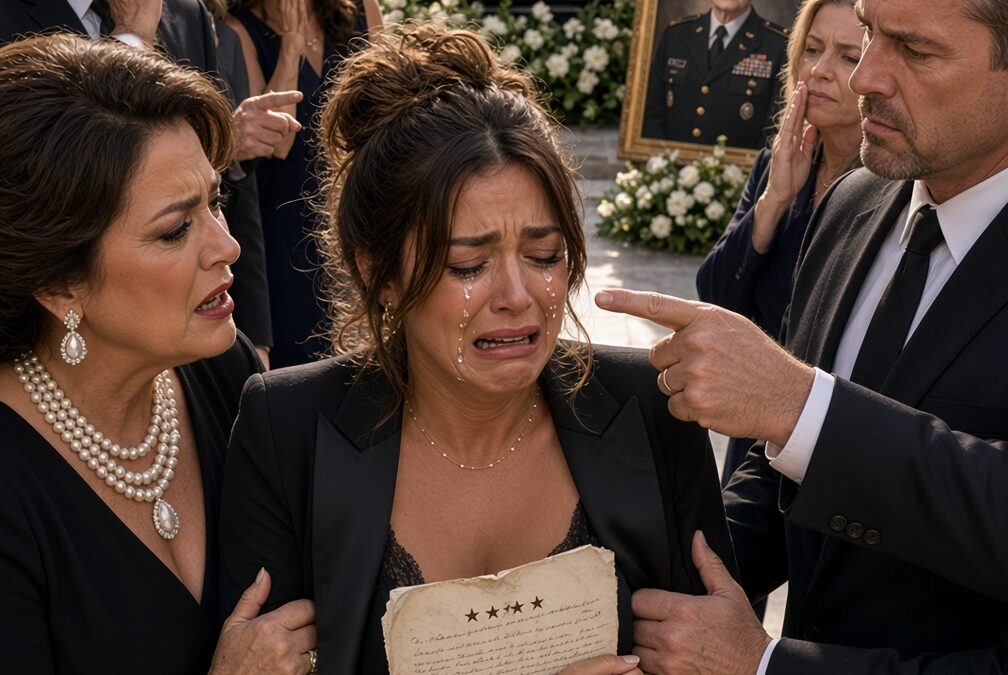
PART 2
The old man knew my mother’s name before I said another word.
And when he told me why, I realized the general’s family had been hiding an entirely different story.
“My name is Colonel Robert Ellis,” he said.
His voice trembled.
“I served with William Harrison for thirty years.”
The general’s son stepped forward.
“Colonel, please. This is a private family matter.”
Robert shook his head.
“Not anymore.”
He looked at me.
“Emily, your mother was Sarah Parker?”
I nodded.
“Did she ever tell you about a little girl named Grace?”
My breath caught.
Grace.
I’d seen that name written on the back of an old photograph.
A little girl with dark curls.
Standing beside my mother.
I had always assumed she was a cousin.
“No,” I whispered.
Robert closed his eyes.
“Then there’s something you need to hear.”
The general’s widow sat down slowly.
Her hands were shaking.
Twenty-five years earlier, my mother had worked as a civilian medical assistant at a military hospital overseas.
She was twenty-two.
General Harrison, then a colonel, had been assigned to coordinate a humanitarian support mission.
During that assignment, my mother became responsible for helping a young child whose family had been separated during an emergency evacuation.
The girl’s name was Grace.
She was barely eighteen months old.
My mother cared for her while officials searched for surviving relatives.
General Harrison visited the hospital frequently.
He helped coordinate paperwork, medical transportation, and temporary housing.
Over time, he became close to both my mother and the child.
When the search for Grace’s relatives produced no immediate results, my mother applied to become her legal guardian.
The process was complicated.
Documents were missing.
Several offices disagreed about jurisdiction.
And a planned transfer threatened to separate them.
General Harrison helped my mother find legal assistance.
But he couldn’t simply change the rules.
Months passed.
Eventually, my mother received permission to bring Grace to the United States under a lawful guardianship arrangement.
That child was me.
I stared at Robert.
“No.”
He looked at me gently.
“Emily was the name Sarah gave you after the adoption was finalized.”
My legs felt weak.
I sat on the nearest bench.
For twenty-six years, I’d believed my mother had hidden the identity of my biological father.
Now I was learning she’d hidden an entire chapter of my childhood.
“Why didn’t she tell me?” I whispered.
Robert looked toward the widow.
“Because someone told her that keeping quiet would protect you.”
The widow covered her face.
I turned toward her.
“Was it you?”
She slowly lowered her hands.
“Yes.”
The chapel fell silent.
She looked at me through tears.
“When William returned home, I found the letters he’d written to Sarah.”
Her voice shook.
“I thought he had another family.”
I couldn’t speak.
“He tried to explain. He told me about the hospital and the child. But I was angry. I didn’t believe him.”
She looked down.
“I contacted Sarah and asked her to stop writing.”
Robert stepped forward.
“William never stopped trying to reach them.”
The widow nodded.
“I know.”
She wiped her cheeks.
“Years later, I learned the truth. But by then, Sarah had moved. William searched through official channels, but the records were incomplete.”
I looked at the necklace.
“Then why did my mother have this?”
Robert smiled sadly.
“Because William gave it to her before she left the hospital. It belonged to his mother.”
I opened my hand.
The pendant rested against my palm.
“He told Sarah to give it to Grace when she was older,” Robert said.
The general’s son stared at his mother.
“You knew?”
She nodded.
“I knew there was a child. I didn’t know Emily had found the letters.”
He looked at me.
His expression changed.
The suspicion was gone.
In its place was something that looked painfully close to shame.
“I’m sorry,” he whispered.
I couldn’t answer.
Robert reached into his jacket and removed a folded document.
“William asked me to keep this.”
It was a letter.
Written just six months earlier.
Addressed to Emily Parker.
My hands trembled as I opened it.
William had written about the hospital.
About my mother’s kindness.
About the little girl who refused to sleep unless someone held her hand.
He described how I’d once grabbed his finger and refused to let go.
Then came the words that finally made me cry.
I may not be the father who gave you life, Emily, but I have spent twenty-five years hoping life would give me the chance to know you.
I pressed the letter against my chest.
For so long, I’d imagined meeting him.
I’d rehearsed angry questions.
Why did you leave?
Why didn’t you come?
Why wasn’t I enough?
Now those questions had changed.
He hadn’t abandoned me.
He had helped my mother bring me home.
And somewhere along the way, he’d begun thinking of me as family.
The general’s widow approached slowly.
“Emily, I can’t undo what I did.”
I looked at her.
“No.”
She nodded.
“But I’d like to tell you everything I remember about him. If you’ll let me.”
I looked toward the portrait.
The general was still smiling.
I wondered whether he’d imagined this moment.
Whether he’d hoped his family would finally understand.
Then his son stepped beside me.
“Would you like to sit with us?”
I looked at the empty front row.
For a moment, I remembered standing outside the chapel while strangers questioned why I’d come.
Then I nodded.
“Yes.”
During the ceremony, Robert told the story of a young colonel who had once spent an entire night searching for a missing child’s medical records.
Nobody laughed.
Nobody interrupted.
When the service ended, I approached the portrait.
I placed my mother’s photograph beneath it.
Then I touched the silver necklace.
“I made it home,” I whispered.
Outside, the afternoon sun shone through the chapel windows.
For the first time in my life, I wasn’t wondering why my father had left.
I was wondering how many people had quietly helped me find my way home.
And as I walked outside, the general’s family walked beside me.
Disclaimer: This story is entirely fictional and created for entertainment purposes only. It does not represent any organization or individual, nor does it encourage inappropriate behavior. The content was generated with AI assistance.








