Twenty minutes later, my grandmother stood in the foyer and forgot how to breathe.
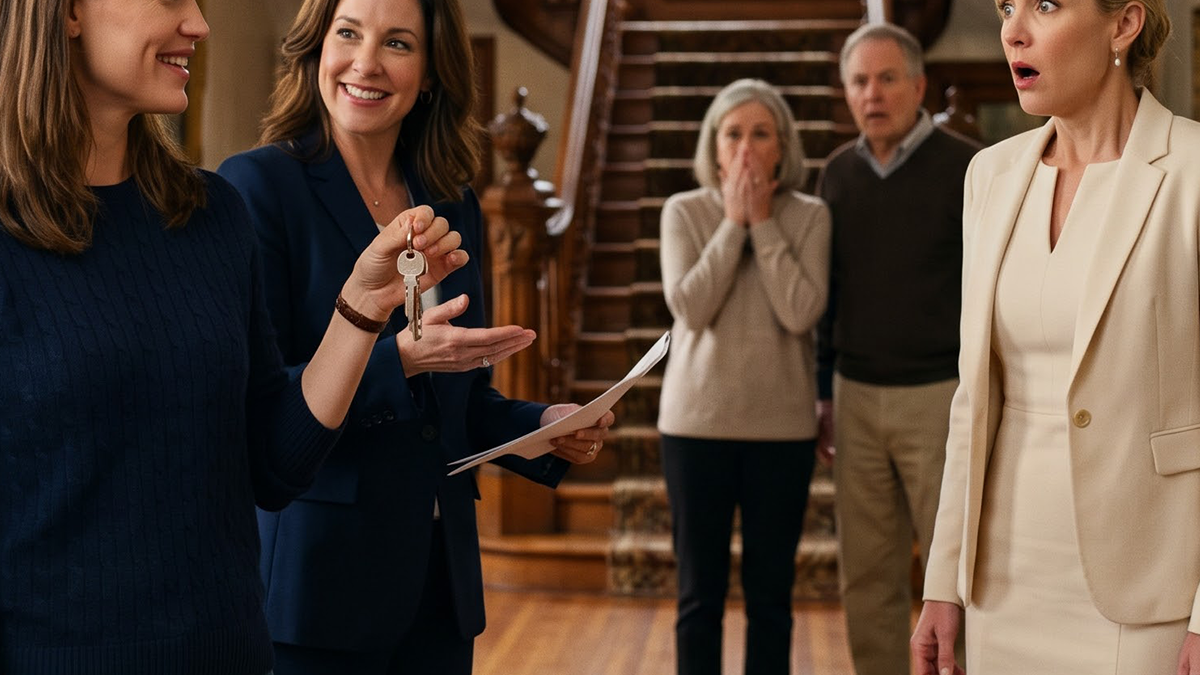
Twenty minutes later, my grandmother stood in the foyer and forgot how to breathe.
Her hand tightened around mine.
“Rachel.”
“I know.”
She looked up at the staircase, then toward the dining room.
Mom moved closer.
“Mom, Rachel told us you worked here.”
Grandma nodded.
Claire looked uncomfortable.
“She said something happened.”
Grandma’s eyes stayed on the floor.
“I was fired.”
Nobody spoke.
In 1984, she worked for the family who owned the mansion. One afternoon, a silver bracelet disappeared from the upstairs bedroom.
Grandma was the newest employee.
She was also the poorest.
That was enough.
“They searched my bag,” she said.
Mom covered her mouth.
“They didn’t find anything.”
“No.”
“But they still fired you?”
Grandma gave a small shrug.
“The owner’s daughter said she had seen me near the dresser. They believed her.”
“What happened to the bracelet?” Claire asked.
“It turned up two days later in the daughter’s car.”
Dad stared at her.
“Did they apologize?”
“One phone call.”
Grandma smiled without humor.
“They offered my job back.”
“You didn’t return?”
“No.”
I knew why.
She had walked home that day carrying her uniform in a paper bag, humiliated and terrified about rent.
A week later, she found another cleaning job.
Then another.
She spent the next four decades working in hospitals, offices, and private homes.
She never became wealthy.
She never had the kind of house Claire liked showing off.
But she helped raise me while Mom worked double shifts, taught me how to balance a checkbook, and slipped twenty-dollar bills into my hand when college got tight.
When my company sold, I asked her what she wanted.
She said nothing.
Then I found the mansion listing.
Grandma looked at me now.
“You bought this because of that?”
“Partly.”
“Rachel, that was forty years ago.”
“I know.”
“You spent all that money because somebody was cruel to me?”
“No.”
I turned toward the windows.
“I bought it because every time you told that story, you acted like being accused was something shameful you carried.”
Her eyes filled.
“It wasn’t yours to carry.”
Mom stood beside Grandma without saying anything. Dad looked embarrassed by how little he had known. For once, nobody tried to fill the silence. We let her decide how long she needed to stand there.
I continued.
“I’m not trying to punish dead people or prove we’re better than anyone. I just wanted you to walk through that front door once because you chose to.”
Grandma looked around slowly.
“And what are you going to do with this enormous place?”
I laughed.
“I haven’t decided.”
Claire did not at first.
Then she walked over to me.
“I owe you an apology.”
“For what?”
“For today. And probably for a lot before today.”
I waited.
She glanced at the keys.
“I kept treating your life like a scoreboard. I thought because you didn’t talk about what you were doing, there wasn’t much happening.”
“That was your mistake.”
“I know.”
Grandma asked if we could see the upstairs.
We climbed slowly.
She remembered which room had belonged to whom.
She remembered where the linens were stored.
She even remembered a loose floorboard near the back hallway.
At the top of the stairs, she stopped beside a tall window.
“I used to clean this glass every Thursday,” she said.
“Did you hate it?”
“No.”
She smiled.
“I hated the people sometimes. Not the window.”
Before we left, Grandma asked for the keys.
I handed them over.
She stood outside on the front steps and locked the door herself.
Then she unlocked it.
Once.
Twice.
Like she was testing the feeling.
Finally, she handed the keys back.
“There,” she said.
“There what?”
“Now I’ve left this house because I wanted to.”
I eventually decided not to live in the mansion.
It was too large and too full of someone else’s history.
I kept it long enough for Grandma to visit several times, then began planning to convert part of the property into office and community space for small-business workshops.
Claire helped with the legal paperwork.
She never joked about my career again.
And my family stopped calling me the one who was still figuring things out.
But none of that mattered as much as what happened that first afternoon.
I had spent years believing success would feel like proving people wrong.
It didn’t.
The best part was watching my grandmother stand inside a place where she had once been treated as disposable and realize it no longer had power over her.
She did not need the mansion.
Neither did I.
We only needed one set of keys and one afternoon to change the ending of an old memory.
When we drove away, Grandma looked back once.
Then she faced forward.
So did I.








