“You Can’t Even Hold a Hammer,” He Sneered. She Raised Her Arm and Said, “I Can Hold Your Land.”
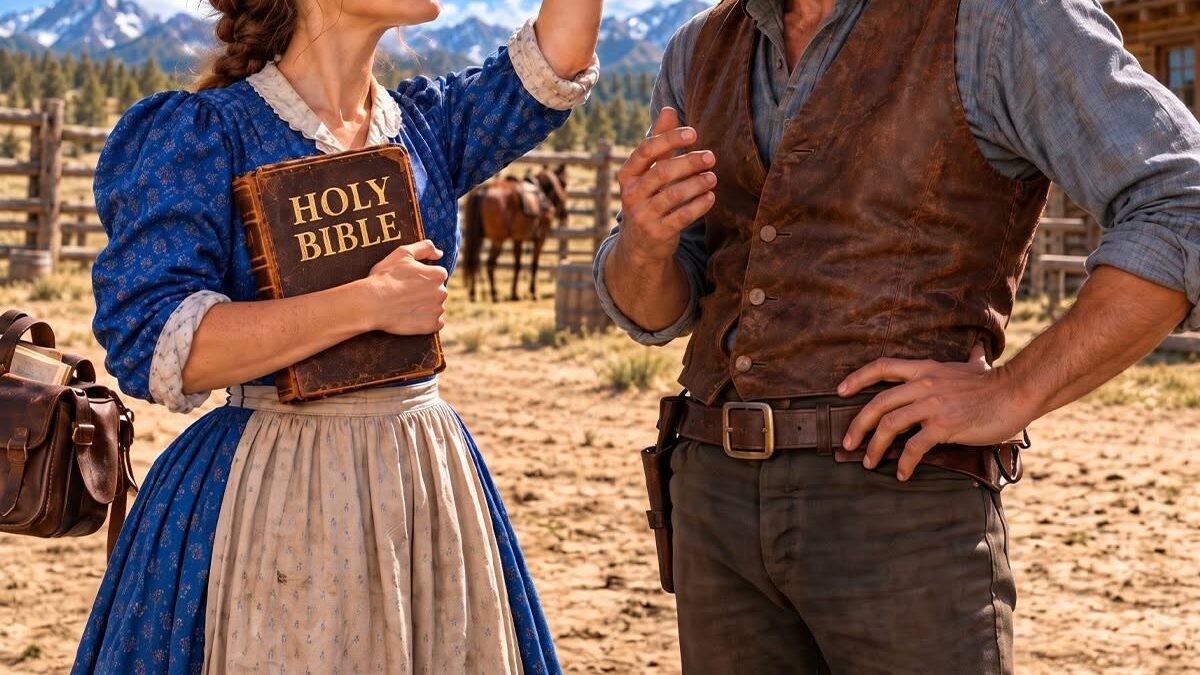
Cutler stared at the deed as if it might bite him. He did not touch it.
“Where did you get that?” His voice had gone rough.
“My father kept it in this Bible until he died. My mother carried it after.” Sarah kept her hand flat beside the paper. “I came to find out how a man ends up living on land he never bought.”
“I bought this place fair.” He said it too fast. “Paid the county, paid the bank. I’ve got papers of my own.”
“Then show me.”
He didn’t. He crossed to the window instead, shoulders rigid, and stood looking toward the barn.
“Supper’s at six,” he said finally. “Stay out of that barn.”
That night, Sarah lay awake in the little room off the kitchen. Past midnight, she heard boots on the porch. She went to the window and saw Cutler crossing the yard with a lantern. He stopped at the barn door, laid his palm against the old brass bell, and stood there a long time. His shoulders shook once. Then he walked back, and the light went out.
By the third day, the house was clean and supper was hot. He ate in silence. On the fourth, she found the child’s wooden horse on the porch rail, set there carefully, as if someone had finally decided it deserved better than the dirt.
On the fifth, she found the barn door unlatched.
She told herself she would only look.
Inside, dust floated in the slanting light. In the far stall, where hay should have been, stood a small bed with a patchwork quilt and a row of tin soldiers on the sill. On the wall hung a child’s coat, no bigger than a flour sack.
“I told you not to come in here.”
Cutler stood in the doorway, and the anger she expected was not on his face. Only a tiredness so deep it looked like age.
“Whose boy was he?” Sarah asked softly.
“Mine.” The word came out cracked. “Eli. He was six.” He stared at the bell. “Fire took the old house the winter after I came here. Eli ran for the barn to ring that bell, to wake the hands. He rang it until the roof came down.” He pressed his fist against his mouth. “I cut the rope so nobody would ever ring it again.”
Sarah’s own throat ached. She knew the shape of that grief. She had buried it, too.
“I’m sorry,” she said, and meant every word.
He sat down heavily on an overturned crate. “You want to know about your father’s land. Sit down, Miss Whitmore. I’ve kept this long enough.”
She sat.
“Your father, Samuel, fell sick the year before I came. He owed the bank more than he could pay. A man from the land office named Harlan Voss told me the ranch was in foreclosure and I could buy it clean. I had money from selling my own place back East. I paid every cent.” He looked at her. “Voss showed me a bill of sale with your father’s signature.”
“My father could barely hold a pen by then,” Sarah said. “My mother signed everything for him.”
“I know that now.” Cutler pulled a folded paper from inside his vest, soft from handling. “I found this in the ashes after the fire, in a tin box under the floor. I never understood it until you set that deed on my table.”
She unfolded it. It was a letter, written in her father’s shaky hand. To whoever holds this land: I never sold it. I am being pressed to sign. If you read this, the sale is a lie.
Sarah’s breath left her. “You knew. All this time, you knew it might not be legal.”
“I suspected.” His eyes were wet. “And I was a coward. I’d lost my boy. This land was all I had left of him. Every time I thought about writing to the county, I thought about losing Eli twice.” He shook his head slowly. “Then you stepped off that stage, and I wanted to hate you. But you stood there with one arm and told me you’d manage my house. And you have.”
Sarah looked at the empty sleeve, then at the small bed in the stall.
“I came here to take back what was stolen,” she said quietly. “I didn’t come to take it from a man who was robbed, too.”
“Voss cheated us both.”
“Then we find him.” She folded the letter and held it out. “Together. We write the county. We tell them everything, the deed, the letter, the forged sale. Whatever the judge decides, we stand there side by side.”
Cutler stared at the paper, then at her. “You’d share it? After what I kept from you?”
“I’d rather share a truth than win a lie.”
He took the letter with a trembling hand. Then he stood, crossed the barn, and lifted the old brass bell down from its nail. He ran his thumb over the green metal.
“Eli would’ve liked you,” he said.
Weeks later, the judge ruled the sale void and Voss was hauled off in irons. Redstone Valley agreed the ranch would be held jointly, Whitmore and Cutler, a name painted on one new sign.
On the first evening of spring, Sarah stood on the porch while Cutler climbed the barn ladder with a fresh length of rope. He knotted it to the bell and let it swing.
It rang once, clear and low, rolling across the valley as the sun slid red behind the hills. Sarah pressed her good hand to her heart, and for the first time in years, she felt her family was standing beside her.
Disclaimer: This story is entirely fictional and created for entertainment purposes only. It does not represent any organization or individual, nor does it encourage inappropriate behavior. The content was generated with AI assistance.








