🔥 THE TOWN MOCKED THE WOMAN WHO COULDN’T SELL A SINGLE LOAF — THEN A LONELY GUNSLINGER BOUGHT EVERY PIECE OF BREAD
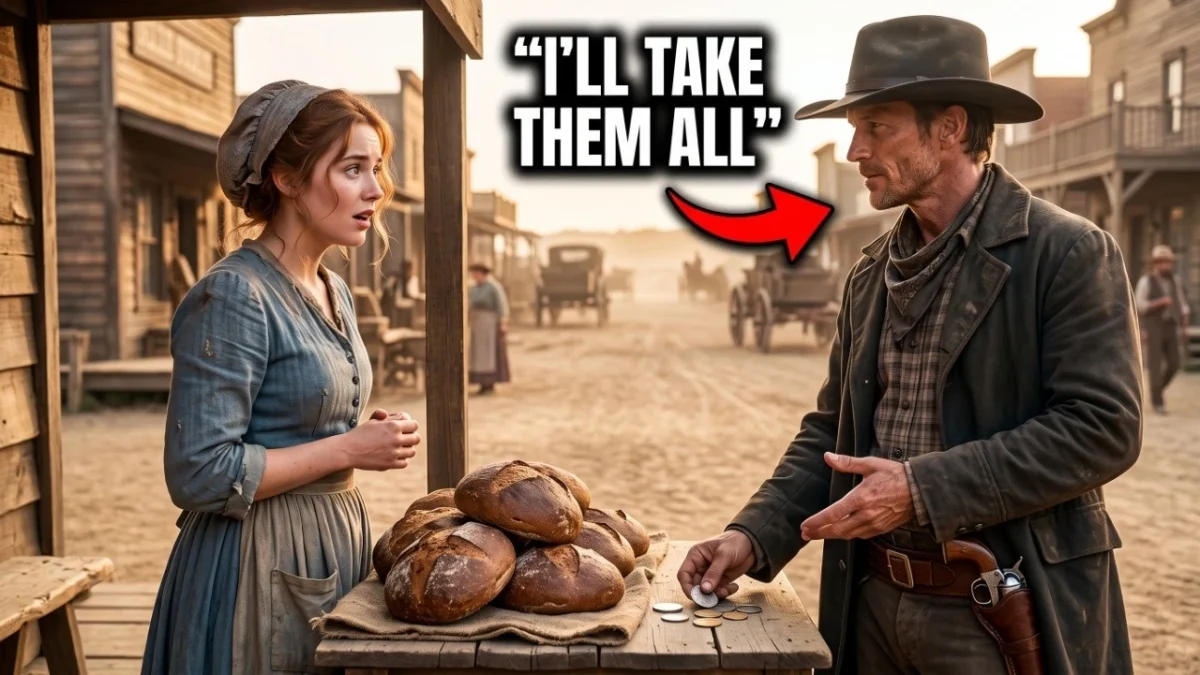
🔥 PART 2 — The Gunslinger Who Bought Every Loaf
By the following Wednesday, Clara Whitmore was beginning to understand that Silas Ror was not like the other men in Dry Creek.
He did not come to her stall looking for conversation, and he never asked personal questions unless she volunteered the answer herself. He simply arrived around noon, tied his gray gelding beneath the cottonwood tree, and studied the bread she had baked that morning.
Sometimes he bought two loaves.
Sometimes six.
Once, when Clara made small honey rolls, he bought twelve and carried them all the way to the Harper Ranch.
He never explained why.
Clara eventually learned that Silas lived alone on an old property west of town, where he repaired fences, cared for a handful of horses and cattle, and spent his evenings reading newspapers beside an oil lamp. She also heard the stories people told about him.
They said he had once been a dangerous gunslinger.
They said he had killed men.
They said nobody knew what he had done before settling near Dry Creek.
Clara believed very little of what people said.
She had learned that lesson from her father.
After her father died in Missouri, Clara had traveled west with relatives, carrying seventeen dollars, two dresses, a small trunk, and the wooden bread paddle her mother had once used. When her relatives continued south, Clara remained behind because she had nowhere else to go.
She rented a room behind Mrs. Doyle’s house and began baking bread in the old outdoor oven.
The problem was that Dry Creek already had a baker.
Ezra Pike owned the hotel dining room and supplied biscuits to the saloon and several local businesses. He did not appreciate Clara’s arrival.
He never directly ordered anyone to avoid her stall, but he made his opinion clear enough that people understood the message.
An unmarried woman from Missouri, he said, would not last through the winter.
People listened.
So Clara kept baking.
Every morning before sunrise, she mixed flour and water, kneaded dough until her hands ached, and carried each batch to the little stall beside the blacksmith shop.
And every Wednesday, Silas came.
One evening, Silas noticed a thin ten-year-old boy named Peter Cobb waiting behind the blacksmith shop.
Clara wrapped a small loaf in cloth and handed it to him.
Peter tried to offer a few coins.
Clara shook her head.
“Take it home to your mother.”
Silas watched from beside his horse but said nothing.
The following week, he brought Clara a sack of apples from his property.
She looked inside and frowned.
“These are good apples.”
“Too many for one man.”
“What do you want for them?”
“Nothing.”
Clara gave him the same suspicious look she had given him on the first day.
Silas sighed.
“Fine. Two loaves.”
“That isn’t a fair trade.”
“Neither is letting apples rot.”
Clara finally agreed.
The following Wednesday, one of the loaves he bought contained chopped apples baked into the crust.
Silas ate half of it before he reached home.
Autumn came slowly.
The heat weakened, the mornings became cooler, and the cattle began moving through the fields again.
People who had once ignored Clara’s stall slowly began stopping.
Mrs. Kesler bought rolls because her oven had broken.
The blacksmith bought bread because his wife was away visiting family.
Even Sheriff Mallerie began buying Clara’s bread occasionally.
Clara never reminded them that they had once ignored her.
She simply wrapped the loaves, accepted their coins, and thanked them.
Silas noticed.
He also noticed that Clara always seemed to have something for someone who could not afford it.
Then one Wednesday, she noticed that one of the buttons on his shirt was hanging by a thread.
“Hold still.”
Silas looked down.
“It is fine.”
“It is not.”
Before he could object, Clara came around the stall with a needle and brown thread.
She fixed the button while he stood beneath the cottonwood tree.
Neither of them spoke.
When she finished, she stepped back.
“There.”
Silas touched the button.
“How much?”
Clara stared at him.
“One apple.”
The following Wednesday, Silas brought her six.
By October, Clara’s little stall had become part of Dry Creek.
She sold bread, biscuits, apple cakes, and hand pies. The blacksmith helped her repair the cart, a carpenter built shelves in exchange for several weeks of bread, and Mrs. Doyle allowed her to use the outdoor oven without charging rent.
Silas kept coming.
Sometimes he bought nothing.
He simply tied his horse nearby and drank coffee from the enamel cup Clara kept beneath the counter.
Eventually, Clara began making two cups every Wednesday morning.
Neither of them mentioned it.
Some things had become too natural to explain.
Then the rain finally came.
It began before dawn one October morning and turned Main Street into mud.
Silas found Clara beneath the canvas roof, wrapping thirty-one loaves in cloth while rain hammered against the stall.
“No customers today,” he said.
“So it appears.”
“You could have stayed home.”
“I baked them.”
Silas looked at the bread.
“How much for everything?”
Clara’s expression changed.
“Don’t start that again.”
“I have men repairing my south fence.”
“You do not have thirty men repairing your fence.”
Silas almost smiled.
“I never said how many.”
She looked at him for a long moment.
“Silas.”
It was the first time she had used his first name.
He noticed.
So did she.
Then Clara quietly told him that people had begun talking.
Mrs. Pike, Ezra’s wife, had warned her that people were saying Clara had some kind of arrangement with Silas.
The words were ugly enough that Clara’s face tightened when she repeated them.
Silas looked toward the hotel.
Ezra Pike stood beneath the porch, watching them.
“Do you want me to stop coming?” Silas asked.
Clara looked surprised.
“No.”
“Then I won’t.”
He took the bread and carried it through the rain.
That night, Silas sat alone in his dark kitchen.
For years, he had convinced himself that solitude was safer than attachment.
He had been wrong.
Solitude was not something a man chose once.
It was a choice he made every day.
He remembered his younger brother, Caleb, and the winter when Caleb trusted the wrong man.
A dispute over stolen horses had ended with three graves beside a frozen road.
Caleb had been one of them.
Silas spent the next five years hunting the man responsible.
Eventually, he found him.
But vengeance had not brought his brother back.
It had only left Silas with another empty chair at his table.
So he abandoned that life, bought the old stone house west of Dry Creek, and taught himself how to live quietly.
Then Clara arrived.
She had somehow made his silence feel different.
And that was when Vernon Shaw stepped off the stage.
Silas knew him immediately.
Tall.
Gray coat.
Narrow face.
A scar running through his left eyebrow.
Vernon had ridden with Silas years earlier, back when both men accepted dangerous work without asking too many questions.
Vernon saw Clara’s bread stall and smiled.
“That yours?”
Silas turned.
“What?”
“The woman.”
Silas’s expression hardened.
“No.”
Vernon laughed softly.
“Still touchy, Ror?”
Silas stepped closer.
“You’re passing through.”
“Maybe.”
“Then pass faster.”
Vernon’s smile never disappeared.
By evening, half the town knew someone from Silas’s past had arrived.
By morning, everyone knew a different version of Silas’s history.
Some stories were true.
Others were not.
Dry Creek never bothered separating them.
And Clara’s customers disappeared again.
Mrs. Kesler stopped coming.
Bellamy avoided Clara’s eyes.
Sheriff Mallerie bought bread once, then stayed away.
People were afraid of Vernon.
But they were even more afraid of what might happen if they became involved.
Three days later, someone threw a stone through the window of Mrs. Doyle’s kitchen.
A note was wrapped around it.
Tell Ror to settle his business somewhere else.
Silas read the note twice.
Then he folded it carefully.
“I am leaving town tomorrow,” he said.
Clara stared at him.
“No.”
“They’ll leave you alone.”
“No, Clara.”
She took the note from his hand.
“You think this is because you buy bread?”
Silas said nothing.
“It is because Shaw wants me.”
“Then why am I the one losing customers?”
Silas had no answer.
Clara placed the note on the table.
“You walking away teaches them it worked.”
Silas looked toward the broken window.
“I’ve seen what men like him do.”
“So have I.”
He turned toward her.
Clara’s voice softened.
“My father owed money.”
Silas listened.
“He borrowed after my mother died. Then again when the farm failed. Men came to our house and stood on the porch reminding him what he owed. Every month, they stood a little closer to the door.”
Her fingers tightened around the edge of the table.
“My father spent his final years afraid of footsteps.”
Silas understood more than she realized.
“I told myself I would never live that way.”
“You won’t.”
Clara looked directly into his eyes.
“Shaw isn’t the only thing you’re fighting anymore.”
Silas lowered his gaze.
“You don’t know who I was.”
“No.”
“I wasn’t a good man.”
Clara waited.
“I hurt people.”
“Did you enjoy it?”
“No.”
“Do you now?”
“No.”
She nodded.
“Then I know the man standing in this kitchen.”
Silas looked up.
Clara pushed the folded note toward him.
“Deal with the man you were. Don’t punish me with the man you’ve become.”
For a long moment, Silas said nothing.
Then he picked up the note.
The next morning, Clara opened her stall.
There were forty loaves on the table.
More than she had ever baked before.
The street was almost empty.
People watched from windows.
Vernon Shaw sat outside the saloon.
Silas arrived shortly after nine.
He tied his horse, walked toward the stall, and placed money on the counter.
Clara looked at it.
“What is this?”
“Forty loaves.”
“You are impossible.”
“I’ve been told.”
“I don’t want you buying them because people are scared.”
“I’m not.”
“Then why?”
Silas looked at the bread.
“Because I remember the first day.”
Clara became still.
“The whole town walked past you,” he continued. “You kept standing here.”
Her eyes glistened.
Silas placed another coin on the counter.
“You gave me somewhere to stop coming into town and somewhere to start coming to.”
Clara slowly exhaled.
“Is that all?”
Silas almost smiled.
“No.”
He looked toward Vernon.
“Need breakfast?”
For the first time, Clara laughed openly.
The sound carried across Main Street.
Vernon stood.
Silas picked up one loaf, broke it in half, and walked toward the center of town.
Sheriff Mallerie stepped out of his office.
Vernon watched Silas approach.
“You planning to shoot me, Ror?”
“No.”
“You used to be more interesting.”
“I used to be younger.”
“You owe me.”
“No.”
“We had an agreement twenty years ago.”
“Still counts?”
Silas took a bite of bread.
“No.”
Vernon’s expression hardened.
“You think these people are going to stand behind you?”
Silas looked around Main Street.
“No.”
The answer surprised everyone.
“They don’t need to.”
Vernon’s hand moved toward his coat.
Sheriff Mallerie’s voice cut through the street.
“Don’t.”
Vernon glanced at him.
The sheriff had not drawn his weapon.
Neither had Silas.
That made the moment heavier.
Then a door opened.
Bellamy stepped onto the mercantile porch.
The blacksmith came out of his shop.
Mrs. Kesler appeared beside the hotel.
Nobody moved toward Silas.
They simply remained where Vernon could see them.
Dry Creek had spent years learning how to mind its own business.
That morning, the town learned that silence could also mean standing together.
Vernon slowly looked around.
His expression changed.
Not fear.
Calculation.
He had expected the old Silas Ror, a man who would draw first and give everyone a reason to blame him afterward.
Instead, Silas stood in the street eating bread.
Vernon spat into the mud.
“This town isn’t worth it.”
Silas nodded.
“Probably not.”
By noon, Vernon Shaw was gone.
No gunshots.
No blood in the street.
No dramatic showdown.
Just a stage disappearing south beneath the winter sky.
Of course, the stories grew afterward.
Some claimed Silas had faced six men.
Others swore Vernon had drawn first.
One rancher insisted Silas had shot the buckle from Vernon’s belt without touching the man.
Silas never corrected anyone.
Clara’s stall sold out that afternoon.
Every loaf.
Every roll.
Even the two apple cakes she had intended to take home.
Winter arrived in December.
Cold winds replaced the summer dust, and ice formed around the horse troughs each morning.
Clara moved her stall closer to the blacksmith shop, where the building blocked the northern wind.
Silas built wooden shutters for her.
The blacksmith repaired the oven.
Mrs. Doyle brought curtains.
Peter Cobb washed the windows in exchange for two cinnamon rolls.
Slowly, the little bread stall became something more.
By Christmas, Clara had saved enough money to rent the empty storefront beside Bellamy’s.
The building had a cracked window, a crooked door, and an old oven that had not been used in years.
Silas repaired the door.
The blacksmith repaired the oven.
Mrs. Doyle helped hang the curtains.
Clara painted the sign herself.
WHITMORE BREAD & KITCHEN
On the first morning she opened, snow had fallen during the night.
Silas arrived before sunrise.
Warm yellow light shone through the front window.
He opened the door.
A small bell rang above him.
Clara stood behind the counter.
Neither spoke at first.
Then she pointed toward a small table near the stove.
Two cups of coffee waited there.
Silas looked at her.
“You expected somebody?”
“Maybe.”
He hung his coat by the door.
Outside, people were already gathering in the snow.
Mrs. Kesler.
Bellamy.
Two Harper ranch hands.
Peter Cobb and his mother.
A line was forming.
Silas looked through the window.
“Looks busy.”
Clara smiled.
“It does.”
“You won’t need me buying everything anymore.”
“No.”
Something in the simple word made Silas look at her.
Clara’s fingers brushed his hand.
This time, they stayed there.
“But you could still come on Wednesdays,” she said.
Silas smiled.
“I could.”
“And Thursdays.”
“Maybe Fridays, too.”
Clara laughed softly.
Outside, the town waited for bread.
Inside, the oven filled the room with warmth.
Silas sat at the small table.
Clara sat across from him.
For the first time in years, he did not feel the need to move the second chair against the wall.
On the wall behind him hung the old wooden bread paddle that had traveled with Clara from Missouri.
Beside the stove rested the flower sack he had used on the very first day.
It had been washed clean and folded carefully.
Silas noticed it.
Clara followed his eyes.
“I kept it.”
“Why?”
She lifted her coffee cup.
“Because it was the first empty thing in Dry Creek that felt like good news.”
Silas understood.
Outside, snow continued falling.
The door opened.
The bell rang.
Clara rose to greet the first customer.
Before Silas could reach for his coat, she placed a fresh loaf in front of him.
He looked up.
“I didn’t order this.”
“I know.”
He rested his hand on the warm crust.
Then, instead of leaving, Silas slowly took off his coat and hung it back on the chair.
Across the table stood the second chair.
This time, it was not against the wall.
And for a man who had spent years believing that being alone was the safest way to live, that small change meant everything.
Sometimes, love does not arrive with grand promises or perfect timing.
Sometimes it arrives as a woman standing behind an empty bread stall, refusing to give up, and a lonely man who buys every loaf simply because he recognizes what it means to be left behind.
Sometimes the person who saves us is not the person who rescues us.
Sometimes they are simply the person who stays.








