🚨 I Came Home From Church and Found My Suitcases Soaking in the Rain, My Son-in-Law Smiling Beside a “SOLD” Sign on My Own Gate. What Was Hidden Under My Bedroom Floor for 12 Years Made Him Stop Smiling 😱
🚨 I Came Home From Church and Found My Suitcases Soaking in the Rain, My Son-in-Law Smiling Beside a “SOLD” Sign on My Own Gate. What Was Hidden Under My Bedroom Floor for 12 Years Made Him Stop Smiling 😱
Part 1
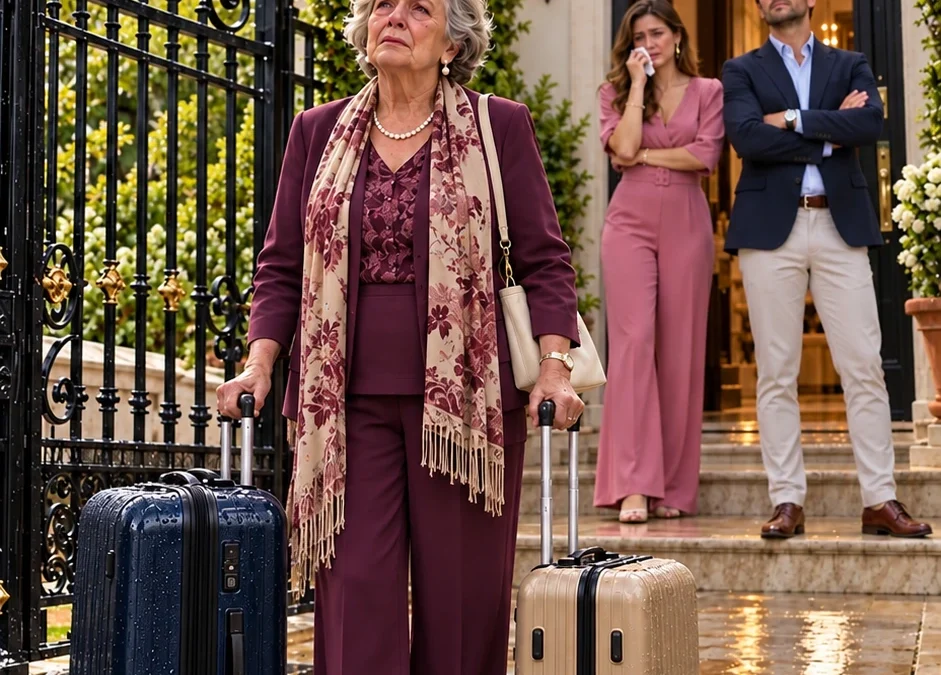
When Amalia Ferrer came home from Mass and saw her two suitcases soaking in the rain, she thought someone had broken into her house. 🌧️
Then she looked up.
A huge “SOLD” sign hung from the gate she had opened with her own hands for 38 years.
She stood perfectly still.
At 74, Amalia had learned that some misfortunes don’t arrive with noise. Sometimes they simply wait in silence, right outside your own front door.
The house stood in Rocafort, a few kilometers from Valencia, on a quiet street of old villas, tall cypress trees and pale facades. Here she had raised her only daughter, Clara. Here she had nursed her husband, Joaquín, through his final months. Here still sat her sewing machine, her family photographs, and the dishes that had once belonged to her mother.
And now her suitcases were on the sidewalk.
The front door opened.
Iván, her son-in-law, stepped onto the porch holding a cup of coffee. Expensive shirt. That satisfied expression Amalia knew far too well.
“You’re finally here.”
Clara appeared behind him. Her eyes were swollen. She was hugging her own arms. 💔
“What is the meaning of this?” Amalia asked.
Iván pointed at the sign.
“It means exactly what it says. The house is sold.”
Amalia looked at her daughter.
Clara lowered her eyes.
That hurt more than the words.
“Mamá, we needed to make a decision.”
“About my house?”
Iván let out a small laugh. “Don’t be dramatic. In thirty minutes, a nursing home is coming to pick you up. It’s a very good one. Garden, doctors, activities. You’ll be better off than alone here.”
Rainwater slid down the back of Amalia’s neck.
“And who gave you permission to sell?”
“You did.”
He pulled out some folded pages.
“You signed a power of attorney eight days ago.”
Then Amalia remembered. Clara walking into the kitchen with some papers.
“They’re insurance forms, Mamá. And a small authorization so we can handle a few things at the bank.”
She had signed.
Because it was her daughter.
Not because she couldn’t read. Not because her memory was failing.
She had signed because she had never imagined Clara could use her trust to throw her out of her own home.
“The buyer will be here soon,” Iván went on. “He’s already put down 65,000 euros. So try not to make a scene.”
Amalia studied her daughter.
“Did you pack my suitcases?”
Clara began to cry.
That was answer enough. 😢
Amalia reached for the gate.
Iván stepped in front of her. “You shouldn’t go in anymore.”
The old woman stared at him.
“Move.”
Maybe it was her tone. Maybe it was her eyes.
Iván moved.
Inside, Amalia crossed the hallway. Several photographs had been taken down. Boxes lined the staircase. Even her books had been wrapped.
She climbed to her bedroom, with Iván close behind.
“What are you looking for?”
Amalia opened a wardrobe, pulled out a box of blankets, and lifted a small board at the very back.
A black folder appeared. 🗂️
It had been hidden there for 12 years.
Iván smiled. “That’s it? I have your signature.”
Amalia ran her fingers across the cover.
“A signature only works for what truly belongs to the person who signs it.”
Then she took out her phone.
“Who are you calling?”
“First, the police.”
The smile slid off Iván’s face.
“Amalia, don’t do anything stupid.”
She opened the folder to the second page.
“The stupid thing was yours. You sold a house without finding out who could legally sell it.”
Downstairs, the doorbell rang.
The buyer had arrived. 😰
👇 Part 2 is waiting in the comments. Comment any word and I’ll send it to you privately. And trust me, what was on that second page was only the beginning.
Part 2
The doorbell rang again.
“The buyer has arrived,” Iván muttered, instantly recovering his confidence.
Sergio Blasco came in with a real estate agent at his side. He already held the new keys and was talking about renovating the pool before summer.
“Everything is sorted,” Iván said brightly.
“Not yet,” said Amalia.
She set the black folder on the table.
Clara went pale.
Twelve years earlier, shortly after Joaquín died, Amalia had visited a notary. She distrusted Iván’s obsession with quick deals, and she decided to protect the one thing she refused to lose.
She kept a lifetime usufruct, the legal right to live in the house for the rest of her life. And she transferred the bare ownership to a Valencian foundation that helped elderly women abandoned by their own families. 🏡
Everything was recorded in the Property Registry.
As long as Amalia lived, no one could force her out.
And she alone could not transfer full ownership either.
Sergio opened the deed.
He read the first page.
Then the second.
His smile vanished.
“Iván… what exactly did you sell me?”
“I have a notarized power of attorney.”
“A power of attorney doesn’t make you the owner.”
Clara began to tremble.
Iván lunged to snatch the papers from Sergio’s hands.
At that moment, a car stopped in front of the gate.
Then another.
Amalia looked out the window.
Two police officers stepped out into the rain. 🚔
But what Iván still didn’t know was that the second page wasn’t the only secret hidden in that black folder.
👇 Like and comment “REVEAL” to unlock Part 3. It will be posted once we reach enough comments. What the folder revealed about those mysterious phone calls will shock you, and so will the final words Amalia spoke to her daughter at the gate.
Part 3
The officers walked in to find a very different scene from the one Iván had imagined that morning.
The two suitcases were still outside.
The “SOLD” sign still hung on the gate.
In the living room, boxes of Amalia’s belongings sat stacked. Sergio gripped a deed with a look of disbelief. Clara couldn’t look at anyone.
Iván spoke first. “It’s a family conflict. My mother-in-law changed her mind.”
Amalia said nothing.
One officer asked to see the paperwork. Iván handed over the power of attorney at once.
“Here. Signed before a notary.”
The officer examined it. “Doña Amalia, do you recognize this signature?”
“The signature, yes.”
Iván smiled. “You see?”
“But I never knew my daughter would use those papers to try to sell my home.”
Silence fell over Clara.
“Mamá…”
“Not yet.”
Amalia placed in front of the officer the deed she had kept for twelve years. It stated clearly: Amalia held the lifetime usufruct. The Fundación Casa Serena held the bare ownership.
Sergio rubbed his forehead. “I’ve paid 65,000 euros.”
The officer turned to Iván. “Where is that money?”
“That has nothing to do with her.”
“You were just asked where it is.”
Iván didn’t answer.
Amalia opened another divider in the folder. Out came a copy of a land registry extract and several certified letters.
“What are these?” Sergio asked.
“Five months ago,” Amalia said, “I received a phone call from someone asking how much I would want for the house.”
Clara lifted her head.
Iván went rigid. 😶
At first Amalia thought it was real estate advertising. Then two more calls came. In one, a man mentioned details only someone close could know: the size of the plot, the renovations made after Joaquín’s death, even the fact that Amalia went to Mass every Sunday morning.
That unsettled her.
So she consulted Nuria Beltrán, a lawyer who had once been a client of her old sewing workshop. Nuria checked the registry and confirmed the property remained fully protected.
Amalia thought maybe she was overreacting.
She accused no one. She simply printed the documents and filed them in that folder.
“You suspected us?” Clara whispered.
Amalia looked at her with sorrow. “I suspected him.”
She pointed at Iván.
“I didn’t want to suspect you.”
Clara broke down in tears. 💧
Iván lost his patience. “This is absurd! The foundation can sign later. Sergio wants the house. We’ll return whatever we have to and it’s over.”
Sergio stared at him. “Return what? I want my 65,000 euros back.”
“You’ll get them.”
“When?”
Silence again.
Sergio opened his briefcase and pulled out transfer receipts. It hadn’t been one small deposit. First 15,000 euros. Then another 50,000.
Iván had promised him a fast deal at a price far below the real value. The villa was worth well over 700,000. He had negotiated 490,000. In exchange, Sergio would sign quickly and let Amalia be moved out before he ever visited in person.
“You told me your mother-in-law wanted to go to a nursing home,” Sergio said.
“And she does.”
Amalia looked at him. “Did you ever ask me?”
Sergio said nothing.
The question was meant for him, too. He had seen an opportunity too good to be true and decided not to ask too many questions.
One officer photographed the suitcases and asked everyone to leave the documents on the table.
Then Clara collapsed.
“I didn’t want it to end like this.”
Amalia turned slowly. “How did you want it to end?”
“Iván said you’d only be in the home for a few weeks. Until we solved the debts.”
“What debts?”
Clara looked at her husband.
“Don’t say anything,” Iván warned.
It was probably the worst thing he could have said.
Because for the first time, Clara didn’t obey.
“He owes a lot of money.”
“Clara.”
“I’m tired!” Her voice echoed through the house.
For three years, Iván had tried to build a renovation company. Then he began investing in acquaintances’ ventures. Then came the sports betting. First small losses. Then credit cards. Then loans.
Clara had even asked for money to cover some payments. When she could no longer hide the notices, Iván presented his solution.
Amalia’s house.
“He kept saying it was absurd for one person to live alone in such a big place,” Clara confessed. “That you had a good pension. That you’d get used to a nursing home.”
Amalia barely recognized her daughter.
“And you agreed?”
“I thought we could buy something small for you later.”
“With which part of my money?”
Clara didn’t answer.
Amalia felt a pang she couldn’t explain.
For years she had helped Clara without keeping count. She had paid part of her master’s degree. She had lent money when Iván opened his first company. She had let them live in the villa for almost two years after they sold their apartment. She cooked for them. Took in their packages. Listened to their problems.
She had never called any of it sacrifice.
It was simply what a mother did.
Until her generosity was mistaken for permanent availability. 🕯️
An officer asked who had requested the place at the nursing home.
Clara answered in a tiny voice. “Me.”
Amalia closed her eyes. “When?”
“Three weeks ago.”
The sale had begun long before those signatures eight days earlier. It hadn’t been impulsive. They had planned her exit. Chosen the residence. Spoken with a buyer. Calculated when she’d be at Mass.
They had even packed her suitcases while she prayed a few kilometers away.
Amalia stepped onto the porch. She needed air.
The rain had softened. Her blue suitcase lay on its side. The other had mud on its wheels.
Clara followed her out.
“Mamá.”
Amalia didn’t turn. “Did you put my clothes in there yourself?”
Clara took a few seconds. “Yes.”
That answer hurt more than any sum of money.
Amalia opened one of the suitcases. Inside were her medications, three dresses, underwear, a pair of slippers, and a photograph of Joaquín.
Clara had even packed the gray scarf Amalia wore the last time she went to the hospital with her husband.
All prepared. All chosen. As if the life of a 74-year-old woman could be reduced to two suitcases.
“You could have talked to me,” Amalia said.
“I was afraid.”
“I would have been afraid, too.”
Clara wept. “Iván said if we didn’t pay, we’d lose everything.”
Amalia finally turned.
“And you decided it was better that I lose it.”
There was no shouting. There was no need.
Soon Nuria arrived. Amalia had called her right after the police.
She examined the power of attorney, the contract with Sergio, and the sale documents. One detail stood out. The power Amalia signed allowed certain banking and administrative matters. But the copy shown to Sergio included an extra page granting authority to dispose of real estate.
Nuria compared the copies. “This page needs to be verified.”
Iván stepped back. “It came like that.”
“Then it will be very easy to check at the notary’s office.”
Clara stared at her husband. “You told me Mamá had signed everything.”
“And she did!”
“Did you add something afterward?”
“No.”
But no one seemed to believe him anymore. 😒
The police collected the documents and explained that they would need to determine how the operation had been prepared, what happened to the money, and who took part. Sergio announced he would claim every last euro.
Iván began talking about a misunderstanding. Then desperation. Then family.
“Amalia, we can solve this between us.”
She looked at him. Hours earlier, this man had laughed at her suitcases in the rain. Now he said the word family as if it were a life jacket.
“Family is no excuse for what you would never do to a stranger.”
Clara reached for her. “Mamá, can we stay tonight? We don’t know what will happen.”
Amalia gazed at the staircase, the living room full of boxes, the empty spaces where her photographs used to hang.
For a few seconds, she felt the old impulse to say yes.
That impulse had governed much of her life.
Just this once. Because she’s my daughter. Because they need help. Because tomorrow will be different.
Then she looked at the suitcases again.
“No.”
Clara’s eyes widened. “You’re throwing us out?”
Amalia answered calmly. “This morning you were ready to watch me leave without asking where I wanted to live. Tonight, you’ll have to figure out where you want to live.”
Nuria stayed silent.
Clara covered her mouth.
Iván started to protest. Amalia raised her hand.
“You may collect clothes and personal items. The rest will be done calmly and with witnesses. And Iván does not enter again without permission while this is sorted out.”
For the first time, her son-in-law had no answer ready.
That night, Amalia slept alone.
The house felt enormous. She heard every sound. The hallway floorboards. The wind through the cypresses. An old pipe.
At 3:20 a.m. she woke, expecting to hear Iván opening the fridge or talking on the phone.
She heard nothing.
Only silence.
And she discovered that silence can feel like freedom. 🌙
In the following weeks, the truth surfaced piece by piece.
A review of messages and documents showed Iván had been negotiating the sale for months. He had also spent a large part of the 65,000 euros on loans and betting debts.
The extra page of the power of attorney did not match the official copy held by the notary, so its origin became the subject of an investigation.
Clara had taken part in the conversations with the nursing home and knew the house would be sold. But she hadn’t been involved in preparing that page.
That didn’t erase what she had done.
But it drew a line Amalia needed to see.
The Fundación Casa Serena confirmed it had never authorized any sale. Its director visited Amalia in person.
“Your husband had a good idea when he insisted on that deed.”
Amalia smiled sadly.
Joaquín had distrusted Iván long before she did.
Twelve years earlier, at a family lunch, he had overheard his son-in-law joking that one day that land would “be worth a fortune.”
That very night, Joaquín spoke to his wife. He didn’t want his home to end up paying for other people’s mistakes.
Months later they arranged the notarial operation together.
Joaquín died without knowing how far that precaution would one day protect her. 🕊️
One month after the storm, Clara called.
Amalia took a while to answer.
“I’m at work,” her daughter said.
She had found an administrative job at a distribution company. She was renting a single room in Burjassot.
“I left Iván.”
Amalia stayed quiet.
“I’m not calling to ask to come back.”
That surprised her. “Then why are you calling?”
“To say something I should have said before.” Clara breathed deeply. “It wasn’t only him. I agreed. I convinced myself you’d be fine because I needed to believe it. It was easier to say you needed care than to admit we wanted your house.”
Amalia closed her eyes.
For the first time, she wasn’t hearing an excuse.
“I’m going to therapy,” Clara continued. “I don’t expect you to forgive me now.”
“Good.”
“Is that all?”
“For now, yes.”
Clara let out a small laugh mixed with tears. “I guess I deserve that.”
“I’m not trying to punish you. I’m learning not to rescue you from every consequence.”
Six more weeks passed.
One November morning, Clara appeared at the gate.
No suitcases. She didn’t ask to come in. She just held a small bag.
Amalia stepped into the garden.
Clara pulled out something carefully wrapped. It was the photograph of Joaquín she had packed that morning.
“I took it by mistake when I gathered my things.”
Amalia held the picture. “Thank you.”
Clara looked toward the house. “I don’t want your keys. I don’t want money. I don’t want to live here.”
Then she pointed at the gate.
“I only wanted to ask forgiveness for leaving you out there.”
Amalia understood immediately that her daughter finally understood.
Not because of the sale. Not because of the documents. Not because of the 65,000 euros.
Because of the suitcases.
Amalia opened the gate.
She did not yet open the door of the house.
They sat together on a garden bench for almost an hour. They talked. They didn’t resolve twenty years in sixty minutes. They didn’t magically rebuild trust.
But for the first time, Clara spoke without asking for anything, and Amalia listened without promising to save her. 💛
When her daughter left, Amalia returned to the porch.
There, leaning behind a flowerpot, was the “SOLD” sign.
She had never thrown it away.
She carried it to the room where she once sewed wedding dresses and set it behind the door.
She didn’t want to see it every day.
She didn’t want to forget it, either.
Months later, she began using that room again. She mended clothes for friends, altered curtains, and some afternoons taught two young neighbors to sew.
She no longer needed the work.
She did it because she loved the feel of fabric between her fingers.
In spring she planted lavender beside the gate. 💜
One morning, after watering it, she found herself looking at the wheels of her two suitcases, still faintly stained by that rain.
She could have cleaned them better.
She chose not to.
At 74, Amalia had discovered something no one had told her when she became a mother:
Loving a daughter did not mean handing her authority over your dignity.
Forgiving did not mean immediately returning the keys.
And growing old did not turn anyone into luggage that others could set beside a gate while deciding where she should spend the rest of her life.
Amalia closed the garden gate.
Then she walked into her home.
No nursing home waiting for her.
No son-in-law giving orders.
No asking permission.
And behind the door of the sewing room remained that “SOLD” sign, now a reminder of the morning they tried to take her home, and ended up giving back something she had spent far too long handing to others:
Her own voice. ✨
This story is entirely fictional and created for entertainment purposes only. It does not represent any organization or individual, nor does it encourage inappropriate behavior. The content was generated with AI assistance.








