28 People Burned in One Night, But One Woman Was Hiding in the Mud 12 Steps From the Man Who Gave the Order. Three Years Later, a Wanted Cowboy Heard Her Scream…
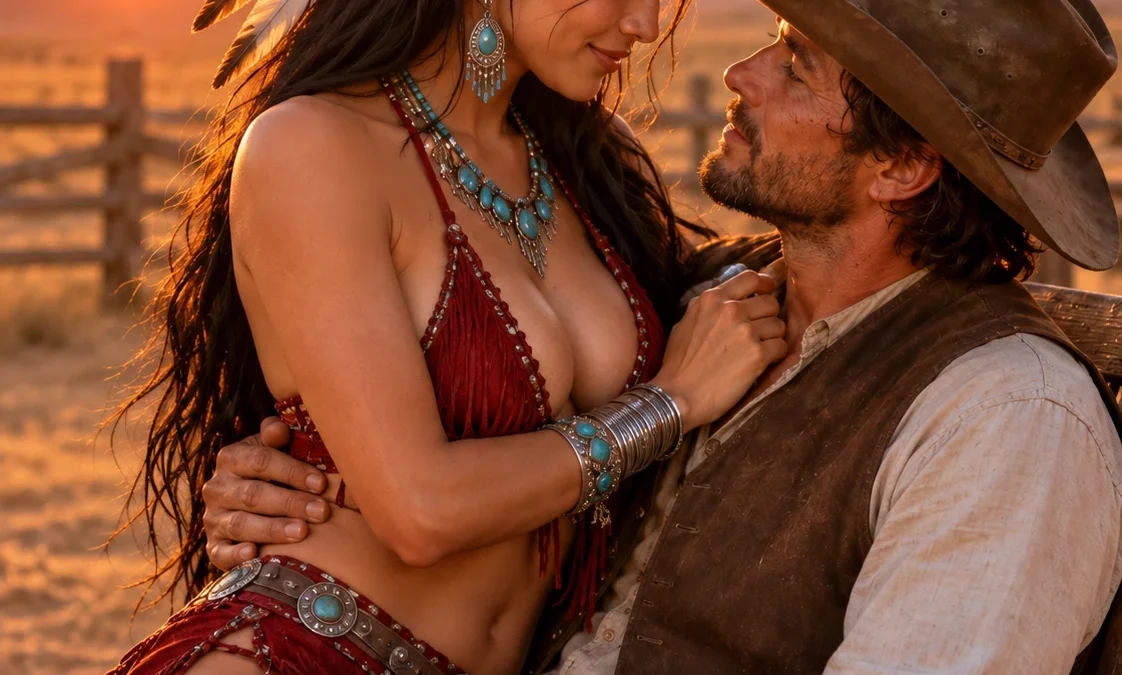
28 People Burned in One Night, But One Woman Was Hiding in the Mud 12 Steps From the Man Who Gave the Order. Three Years Later, a Wanted Cowboy Heard Her Scream… 😱
Part 1
A hand wearing a gold ring pulled a pocket watch from a vest.
He flipped it open. Checked the time.
Behind him, twenty-eight people were burning. 🔥
He did not turn around. He spoke one sentence, a sentence that three years later would be read word for word in a federal courtroom.
That night, only the fire heard it.
And one other living thing. Beneath the mud of a dry creek bed, exactly twelve steps from his boots, a pair of eyes stared out. Wide open. Unblinking.
The boots stopped.
One second.
Two.
Then they moved on.
The Arizona desert swallowed twenty-eight names that night. But it missed one.
And that one was still counting.
August, 1883. Arizona Territory.
The heat no longer felt like weather. Somewhere around July it had started to feel like a verdict. Red rock in every direction. Brittle scrub. The occasional skeleton of something that had run out of reasons to keep going.
Drayce Calloway rode alone through all of it.
Three days without real sleep. Six months without a home. The Winchester across his saddle was loaded. Always loaded now, because a hunted man could not afford the half second it took to chamber a round.
He was thirty-eight years old and moving like something that had already died. He just hadn’t figured out how to stop.
In his saddlebag lay a wanted poster he had memorized without trying.
Jacob Drayce Calloway. Murder of Sheriff Doyle Greer. $3,000, dead or alive. 💀
The woodcut looked like him if you squinted and hated him.
Which described most of the people trying to find him.
Every night, somewhere between two in the morning and first gray light, his mind went looking for the worst material it could find. Greer’s hand moving toward his holster. The shot. The sound a man makes going down.
Drayce had been faster. That was the problem.
Because Greer was supposed to stand trial. Supposed to answer for the Hartwell family. A father, a mother, and two sons who had broken that land from nothing and refused to sell it back for nothing.
But Judge Prentice Falk had declared Drayce guilty before the proceedings even opened.
Falk belonged to a man named Ezra Dunmore. And Dunmore wanted Drayce dead far more than he wanted due process.
So here he was. Six months of running. A price on his head. And a Texas Rangers badge sitting in a drawer in El Paso, waiting for a man who was not coming back to claim it.
He lifted his canteen. The warm water tasted of copper and everything he had lost.
That was when he heard the scream.
It cut through the afternoon like something sharp through something that had no business being cut. High. Raw. Bouncing off the canyon walls until direction meant nothing.
His hand found the Winchester before his mind caught up.
Six months of instinct screamed at him. Keep riding. Stay invisible. You are a wanted man in a territory full of people who would shoot you for far less than three thousand dollars.
He stopped his horse. Sat for three exact seconds, having an argument he already knew he’d lost.
Don’t.
Another scream. More desperate.
Absolutely do not.
Drayce swore at himself, at the horse, and at the general state of his life.
Then he turned hard left and rode toward the sound like a man who had learned absolutely nothing in six months.
The canyon called Red Jaw opened fast. A narrow fracture in the earth, red sandstone walls forty feet high on both sides. He burst into a clearing about thirty yards across and pulled up short.
He had expected a victim. Someone cornered and helpless.
What he found was a woman who had already killed one of them. 🐺
A gray wolf lay dead at her feet, its throat torn open by a hunting knife that had now snapped clean in half. She still gripped the broken handle like it was useful. Three more wolves circled her, slow and patient, running their own arithmetic.
She stood with her back against a boulder, chin level. Not cowering. Not crying. Not waiting to be rescued.
Twenty-five, maybe. Strong features. Dark eyes holding something colder than fury, the controlled kind that makes a person most dangerous when she looks most vulnerable.
She wore a dress and overshirt of soft tanned hide, the color of desert earth after rain. Fringe along the sleeves. Panels of tribal weaving in deep red and rust. A strand of turquoise at her throat. Two long black braids. Silver bands at both wrists, hand-hammered Chiricahua work, worn smooth.
Blood was already spreading dark through the hide at her shoulder.
Drayce had exactly one second to take it all in.
Then the first wolf lunged.
The Winchester came up on muscle memory alone. The shot cracked through the canyon and the wolf dropped mid-leap. The second charged and he worked the lever and fired. The third came low and fast from his left, where the boulder cut his sight line.
He heard it before he saw it. Claws on rock.
He was turning, but not fast enough.
Not even close.
Something struck the wolf’s skull with the sound of a hammer finding a nail.
She had thrown a rock the size of a man’s fist from fifteen feet away. While bleeding.
The wolf staggered. Drayce fired.
Silence. Three dead wolves. Two people breathing hard, with gunpowder and blood hanging in the heat between them.
She spoke first.
“You are either very brave or very stupid, white man.”
Her English was precise, each word placed exactly where it belonged.
“Six months on the run,” Drayce said. “Probably the second.”
Something moved across her face. Not quite a smile.
She did not thank him. He noticed. Filed it away.
Later, in a cave half a mile north, with her shoulder wrapped in crushed leaves and the afternoon light turning copper at the entrance, his saddlebag slipped open.
The poster slid out on its own.
Jacob Drayce Calloway. Murder. $3,000.
He watched her read it.
She did not reach for a weapon. She did not pull back.
She looked at the poster. Then at him.
“Did you do it?”
Flat. No judgment. Just a person who needed the truth.
“He drew first,” Drayce said. “But the man who owns the judge wanted me dead before the trial started.”
A long silence.
“I understand running from false justice,” she said, and set the poster aside like it was someone else’s problem. “My people do it too.”
That was all. No conditions.
“Who are you?” he asked.
“Wren Silverhawk. Chiricahua Apache.” Her eyes lifted. “This is my territory.”
Then, in a voice so level it had worn smooth from years of repeating in the dark, she told him what happened three years ago.
A small camp. Twenty-eight people. A hidden valley in the Dragoon Mountains. Her father, Red Wing, the elder who believed a good-faith argument could reach even people who did not want to listen.
A man came. Said there was copper beneath their land. Offered a price that meant nothing.
Her father refused. Offered him food and water for the night.
The man’s name was Ezra Dunmore.
He came back three nights later with sixteen armed men and torches. 🔥
Her father, shot at the negotiating table. Her mother and her twelve-year-old brother, dead in the fire.
Wren survived by lying submerged to the chin in a dry creek bed, in mud and cold water, absolutely still, for four hours.
“I heard Dunmore’s voice across the burning camp,” she said. “Burn them out. I want that land clear by morning.”
Drayce did not speak for a long time.
Then he closed his eyes.
“What was the date?”
“August fourteenth, 1880.”
His whole body went cold.
“Same date,” he whispered. “Twelve miles east. A homestead family named Hartwell. Father, mother, two grown sons. Burned out and shot the same night. Same efficiency. Same man giving the order.”
Wren stared at him.
The worst night of her life and the worst night of his were the same night.
Planned by the same man, for the same piece of ground.
And in a hidden ledger locked in a Tucson safe, there was something that could destroy Ezra Dunmore… if two broken people could get to it before his men, or the one man in the territory who knew every weakness Drayce Calloway had, got to them first. 😳
Part 2
Neither of them spoke for a long time.
There was only the cave, the cooling light, and two people sitting inside a shared wound.
“One person against Ezra Dunmore ends as a corpse,” Wren said at last, turning the broken knife handle in her hands. “I have tried for three years.”
“Two people against Dunmore is still dangerous,” Drayce said. “But different.”
She looked at him. The measuring expression again, but something had shifted behind it.
“You are a wanted man. This makes you more visible.”
“I’ve been invisible for six months,” he said. “I am extremely tired of it.”
At dawn they rode to the ranch of an old ex-Ranger named Fergus Holt, sixty years old and assembled from parts that had not all come from the same machinery. 🌄
Fergus looked at Wren and lowered his rifle. “I knew your father. Better man than this territory deserved. I was sorry about the camp.”
Inside the adobe house, smelling of coffee and gun oil, he laid a folder on the table.
“Twelve families. All within forty miles of Tucson. All sitting on copper or silver. All dead or gone inside five years.”
Wren’s finger moved across the map and stopped on a mark in the Dragoon foothills.
“The documents are solid,” Fergus said. “But a bought judge ignores documents. We need living witnesses. And we need Dunmore’s private ledger. Every deal, every payoff, every order. He is arrogant enough to write it all down.”
“Where?” Drayce asked.
“Tucson office. Locked safe. Guards day and night.”
“We do not go to the ledger,” Wren said quietly. “We make him bring it to us.”
Fergus studied her. Something younger came through his weathered face.
“You think like a warrior.”
“I am a warrior.”
Then his smile faded. He looked at Drayce.
“There is something else. The man Dunmore hired to track you is not just any bounty hunter.”
Drayce felt something specific and cold move through his chest.
“It’s Aldous.”
The name landed like a stone in still water. 😨
Aldous Calloway. Forty-five years old. Same father. Different mother. A childhood built around the belief that their father’s love was a finite resource, and that Drayce had taken the larger share.
Dunmore had not hired him because he was cheap or close. He had hired him because Aldous knew every weakness Drayce had. Every habit. Every tell.
Like the way he could never ride past a sound that needed answering.
Like turning toward a canyon full of wolves because he simply could not keep going.
“Your brother,” Wren said.
“Half brother.”
“Does that make it better or worse?”
Drayce finished his coffee in one swallow. “Worse. Considerably.”
That night he sat on the floor with his back against the wall and his rifle across his knees, and did not sleep.
He remembered their father’s funeral. Standing on opposite sides of the grave. Aldous looking at him with an expression that said, You got everything and I got nothing, and I intend to spend whatever time I have left making sure you understand that I am the better one.
Drayce had wanted to say, I never knew we were competing.
But you do not say that at a funeral.
A soft sound in the doorway. Wren.
She crossed the room and sat against the opposite wall, in the same posture, with the same rifle across her knees.
“What I know is that tomorrow we ride,” she said. “And the day after. And we do what needs doing. The rest, we meet when it comes.”
She had repaired her broken knife handle while he was not looking, wrapping it tight and even in leather.
A broken thing made useful again, he thought. She does that. Even when the break is permanent. Especially then.
“You rode toward the sound,” she said, watching the stars through the window. “When everything sensible said to keep going. That was the first thing I noticed about you. Before the rifle. Before anything.”
For the first time in six months, he slept without dreaming of the man he had shot. 💛
The plan took shape over the next days.
Wren rode north to the hidden valley to ask an elder named Tall Smoke for warriors. Drayce rode south with a scarred Apache named Red Scar to Fort Cullom, to ask Major Clifton Ware for a federal inquiry.
“If you use her trust carelessly,” Red Scar said on the trail, flat as stone, “I will put an arrow through you. I want that understood before we reach a place where I cannot do it discreetly.”
“Noted,” Drayce said.
Major Ware could not harbor a fugitive. But he could convene a formal federal inquiry, with a federal marshal, military protection for every witness, and Apache testimony fully accepted. If it exposed the corruption, the warrant on Drayce’s head would become void.
“Don’t make me regret this, Calloway.”
“I’ll do my best, sir.”
“Your best had better be considerably better than your last six months.”
Entirely fair.
In the hidden valley, Wren’s people tested him. Tall Smoke ordered him to race a young warrior named Flint Hawk to the top of a mesa, then fight him.
It was terrible. 😅
Flint Hawk ran as if elevation were optional. Drayce ran like a man who had spent six months on horseback and was discovering muscles he had forgotten owning. He took a blow to the jaw that made actual stars appear in the afternoon sky. He hit the ground.
He got back up.
Because he had been losing for six months, and he was done with it.
They ended swaying on the mesa top, both bloodied, both laughing.
“You are better,” Drayce admitted.
“Yes,” said Flint Hawk. “But you do not quit when you are losing. That is something.”
“Courage without pride,” Tall Smoke said from below. “That is rarer than fast hands.”
He would send only volunteers. Seven stepped forward, Flint Hawk first.
On the second evening, Wren sat beside him as the sunset took the sky apart color by color.
“What do you see?” he asked, more directly than he intended.
She watched the last gold fade.
“Someone who is tired of running but has not forgotten why he started. Someone who sees me as a person. Not a problem to solve. Not a cause to attach himself to.” A pause. “That is rarer than you think.”
He almost spoke. Stopped.
It was enough.
By the time they reached Fergus’s ranch again, thirty people filled the property. Settlers with old rifles and faces shaped by loss. Vaqueros from town. Apache warriors moving carefully among white homesteaders who had every reason to distrust each other, and were choosing something different today.
And a US Marshal named Tobias Greer, reading from a leather folder, who shook Wren’s hand with exactly the same firmness he gave Drayce’s.
“One week,” he said. “Dunmore has been formally subpoenaed. He will come. Men like that always do when their reputation is on the table.”
Then, on the fourth night, an absence of sound woke Drayce.
He came out of his bedroll with the rifle already in his hands.
On the western ridge sat a single rider against the stars. Broad-shouldered. Looking down at the camp through what was almost certainly a scope.
Drayce went completely still.
He knew that silhouette.
Aldous. 😨
He has the angle. He has the distance. The firelight is enough. He has made harder shots than this.
Drayce counted his heartbeats. One. Two. Three.
The figure did not move.
Four. Five.
Slowly, so slowly it was barely visible, the rifle lowered.
The rider turned his horse and vanished into the dark. Drayce stood frozen, his heart pounding, asking the one question that made no sense at all: Why hadn’t his brother pulled the trigger? 🔥
Part 3
Wren appeared at his shoulder, silent as smoke, knife drawn.
She looked at the ridge. Then at his face.
“Your brother.”
“Yes.”
“He had you.”
“Yes.”
“And did not.”
“No.”
“What does that mean?”
Drayce thought about a whole life built around a competition only one of them knew was happening. A wound that had been bleeding since childhood.
“I don’t know yet,” he said. “But it changes something.”
She slid the knife away.
“Come,” she said. “Two days until we ride. You should sleep.”
“I don’t think I can.”
“I know.” A brief sideways glance. “Come anyway.”
They sat side by side at the edge of the dying firelight, the way they had sat in the cave that first night.
“I will speak third,” she said quietly. “After Mabel. After Harmon Bledsoe. I have thought about the words for three years. I only need to say them in a room where someone writes them down.”
Drayce looked at her. The firelight in her braids. The turquoise at her throat.
“Wren, if this goes wrong, I need to—”
“I know what you need to say.” Quiet. Certain. “Say it after. When Dunmore is in custody and the warrant is void and my people’s testimony is entered into a federal record. Say it then, when the words have room to mean something.”
Something warm and forward-facing bloomed in his chest. Something with a future tense in it.
“After,” he said.
“After,” she agreed. 💛
They rode through the night, forty people moving through the Arizona dark like something the land itself had decided to send. Apache warriors, white settlers, one federal marshal, and a widow named Mabel Orrin carrying a metal box of evidence in her lap as if it were sacred.
Somewhere around the third hour, in the darkness before dawn, Wren’s hand found his in the space between their horses.
Just for a moment. Then gone.
Neither of them said a word.
Fort Cullom rose from the gray like a stage set that had been waiting for this occasion. Major Ware met them at the gate in full dress uniform.
“Every person entering this installation is under federal military protection,” he told the column. “No one intimidates a witness before, during, or after testimony. The law applies here. All of it. To everyone.”
At ten o’clock sharp, Ezra Dunmore rode through the gate with twenty-eight armed men behind him.
Gray wool suit. Silver hair. A watch chain catching the morning light. A man who had spent fifteen years believing enough money could buy a reality to replace the real one.
His eyes passed across the witnesses. They landed on Wren for one second. Two.
Then moved on. Like she was furniture.
Drayce felt something in him go very cold and very steady. He had arrested a lot of men wearing that look. He intended to make sure this one answered for it.
“Sit down, Mr. Dunmore,” Marshal Greer said pleasantly. “We will tell you when to speak.”
Mabel Orrin went first.
She set her documents on the table one at a time, like stones building a wall. A land deed signed under duress. A payment from a copper trust to Judge Falk’s office, dated four days before Drayce’s trial. Letters from Dunmore’s office directing the sheriff to “resolve the Hartwell situation by whatever means necessary.”
Her voice shook on the first document. By the fifth, it was level as creek water.
Dunmore’s lawyer objected six times in twenty minutes. Greer overruled him six times without looking up.
Harmon Bledsoe followed, a homesteader who had lost his wife and daughter in a fire set by men paid forty dollars apiece. He brought no papers. He spoke quietly, in the flat voice of a man who had exhausted every tear.
Then Wren walked to the witness chair.
She wore the yellow earth dress. Of course she did. She had not changed for anyone else’s idea of what credible looked like.
She sat with her back straight and looked at Ezra Dunmore directly. Not for performance. Like he was a fact she had waited three years to address.
“August fourteenth, 1880,” she said. “My father, Red Wing, explained that the land was not ours to sell. He offered food and water and asked the man to return when he was prepared to discuss something other than purchase.”
Her voice did not waver.
“The man returned three nights later with sixteen armed men and torches. I was in a dry creek bed, covered in mud and stones. I heard my father. I heard my mother. I heard my brother. He was twelve years old.”
She did not look away.
“You gave the order. You said, Burn them out. I want that land clear by morning. Those were your exact words.”
Silence.
“I have heard them every night for three years. I will hear them for the rest of my life.” A long pause. “But now they are in a federal record. And that is the difference.” 💔
She rose and walked back to her seat.
The room stayed silent for a full ten seconds.
Dunmore’s lawyer fought for two more hours. He attacked document provenance. He questioned credibility. He noted that Apache testimony had not historically carried equal weight in territorial courts.
Greer overruled him four times.
By the third, Dunmore had stopped writing notes. By the fourth, he was very still. The stillness of a man who had spent years in absolute control and was discovering, for the first time, that control had edges.
Marshal Greer stood and opened his folder.
“Mr. Dunmore, I have federal warrants for your arrest on charges of murder in the first degree, conspiracy to commit murder, fraud, bribery of a federal judicial officer, and theft of federal protected land. How do you plead?”
For three seconds, maybe four, Dunmore looked like a man who was going to be smart about this.
Then he turned and looked at Wren.
And something he had held carefully through the entire proceeding came apart.
“You should have stayed in that creek bed,” he said, flat, carrying across the silent yard. “You and every last one of your kind.”
The room stopped.
Dunmore’s lawyer closed his eyes and left them closed. The expression of a man who had watched his client dismantle everything in eleven words.
Drayce did not move. There was nothing left to do. Wren had said what she had carried for three years, and Dunmore had just confirmed every word in front of a federal marshal and forty witnesses.
Wren was looking at Dunmore. Not with triumph. Not with grief. With something quieter than both.
The look of someone who has waited for a fact to be acknowledged by the world, and has just watched it happen. Complete. Irreversible. On record. 🕊️
“Bailiff,” Major Ware said quietly, “please restrain the defendant.”
Afterward, Mabel Orrin sat on a bench outside, the empty metal box in her lap, her hands folded on top of it. Eyes closed. Not crying. Something past crying. Something that had finally cleared.
Marshal Greer found Drayce at the edge of the parade ground and handed him a document.
“The warrant is void, as of today. Judge Falk was arrested this morning in Tucson, trying to board a westbound train with two bags of Dunmore’s money.”
Drayce read his own name. And beneath it, one word. Vacated.
He had expected to feel something enormous. Instead he felt very quiet. Like the morning after a storm, when the air is washed clean and the world looks exactly like itself.
Then a young soldier handed him an envelope.
“Delivered this morning, sir. From Yuma.”
The handwriting was slightly cramped, pressing hard into the paper. The body recognized it before the mind did.
Aldous.
Inside were two pages of signed, notarized testimony. Every contract Dunmore had offered Aldous over two years. Every name in Dunmore’s operation. Three property transactions that appeared nowhere in Fergus’s documents.
Folded inside was a smaller piece of paper.
Saw you standing on that rock three nights ago. Had you in the scope twice. Clean shot both times. Couldn’t do it. Spent a long time figuring out why.
I’ve been running a race against you in my head since we were boys. You didn’t know it was happening. That’s on me, not you.
Watched you from that ridge for about an hour. The camp you’d built. Apache and whites around the same fire, the marshal, the widow with her box. And you in the middle of it. Not the center. Just part of it. Which is what Pa always tried to teach us both, and which I spent forty years deciding was the wrong lesson. It wasn’t the wrong lesson.
I’m in Yuma. Turned myself in. The testimony in this envelope is my contribution. Use it.
When the child comes, be the father Pa wanted us both to be. You can do it. I know, because you already are.
Some chains we choose. Some we break. Glad you broke yours.
Aldous. 💔
Drayce stood with the letter in his hand for a long time while the parade ground moved around him.
Fergus appeared at his elbow. Looked at the letter. Did not ask.
“You all right?”
“Yes.” Drayce folded the letter and put it in his shirt pocket, against his chest, where the wanted poster used to live. “I think I genuinely am.”
He looked for Wren. Found her immediately. He always found her immediately now.
She stood near the flag, talking with Tall Smoke, who had come himself in the end. Drayce walked toward her. The old elder saw him coming, said something quietly, and walked away, deliberately leaving them alone.
“You said after,” Drayce said.
“I did.”
“This is after.”
“Yes,” she said. “It is.”
He thought of everything he had carried. Six months of running. The shooting. The warrant. All of it collapsing into the moment in Red Jaw Canyon when he had heard a scream and turned his horse toward it instead of away.
“I don’t know what I’m doing,” he said. “With any of this. I know that I want to figure it out here. In this territory. Near the people I—”
He stopped. Because she was looking at him with the look that said she had understood the sentence before he finished it.
“Near you,” he said.
She was quiet for exactly the right amount of time.
“I told you once,” she said at last. “You are my man. Not because you rode into that canyon. Because you stayed.” She held his gaze. “Stay.”
One word. Enough. 💛
He reached for her hand. She let him. His fingers laced through hers, and she held on the way people hold on when they have learned that things worth having require being held.
Behind them, Fergus was loudly and unsuccessfully pretending not to notice. Red Scar was looking in an extremely deliberate direction that was not at them. Flint Hawk was not pretending at all.
“Partners,” Drayce said.
“Partners,” she agreed.
And then she smiled. Not small. Not careful. Real.
Eight months later.
Spring came to the Dragoon Mountains quietly at first, then all at once. The gray slopes went green overnight. The creek ran full and cold with snowmelt.
The hidden valley was still hidden. But its vigilance had changed. Less desperate. More chosen. The difference between fear and watchfulness, which turned out to be considerable.
At the upper edge of the valley stood a house built over the winter. Timber from the mountains, walls of packed earth, a porch facing east toward the sunrise, because Wren had decided that was the direction to face in the morning, and Drayce had not argued.
He was standing on that porch in the early light when she came out.
Eight months, and he still did the thing where she appeared and he updated his assessment of everything, the way a room updates when the light changes.
She wore the yellow earth dress, a newer one, made by her own hands. The turquoise at her throat. The silver at her wrists. Her hair loose this morning, dark over her shoulders.
Her hands rested on the rounding of her belly, considerable now.
She settled beside him on the step with the careful negotiation of someone in her final weeks. 🌅
“You’re up early.”
“Couldn’t sleep.”
“Again.”
Below them, the valley was waking. Cook fires starting. Children at doorways. Flint Hawk on his morning circuit with the fervor of the converted. Red Scar near the horses, doing whatever Red Scar did with horses, which seemed to involve mostly standing near them and thinking private thoughts.
At the lower edge of the valley stood a tent. Fergus had arrived six weeks ago “for a short visit,” which everyone understood to mean he was not going back. He was currently teaching three children to tie Ranger knots, a process going poorly but with great enthusiasm.
“Tall Smoke is coming today,” Wren said. “He has been asking about names.”
“Have you decided?”
She looked down at the valley, the children, the smoke, the mountains holding all of it like cupped hands.
“My father’s name in Chiricahua means something close to red wing. The bird.” A pause. “Your father. What was his name?”
“William. He went by Will.”
She considered it the way she considered everything. Fully.
“Something with wings,” she said finally. “And something of yours.”
“We will decide when we see the face.”
He put his arm around her. She leaned into it like someone who had decided this was a weight she was willing to carry.
Below them, a child shrieked with laughter. One of Fergus’s rope tricks going spectacularly wrong, from the sound of it.
The sun came fully over the Dragoon Mountains. Gold light. Not the copper of mine shafts. Not the red of blood and fire. Just gold, the unhurried gold of morning in a place where something terrible had happened, and something else had been built in its place.
Not instead of. On top of. Acknowledging the foundation, and building anyway.
Somewhere in a Yuma cell, Aldous was working on whatever chain he had decided to break. Somewhere in a Santa Fe courthouse, Ezra Dunmore was learning how thoroughly federal proceedings worked when the man running them could not be bought.
And here, in a valley in the Dragoon Mountains, two people sat on a porch in the morning light, waiting for a child who would know both worlds. A child who would carry both names, hear two languages and two kinds of song, and learn what children raised well always learn.
That carrying two worlds does not divide you.
It makes you larger. 💛
The desert does not care about your reasons. But the people in it do. And that, in the end, has always been the whole difference.
The one that remains when the running stops and the reckoning is done, and what is left is simply this.
Two people, choosing toward each other, again and again and again.
This story is entirely fictional and created for entertainment purposes only. It does not represent any organization or individual, nor does it encourage inappropriate behavior. The content was generated with AI assistance.








