A BAREFOOT BOY BEGGED FOR WORK TO BUY HIS GRANDMOTHER’S MEDICINE—THE RANCHER SENT HIM AWAY, THEN SUDDENLY REOPENED THE GATE
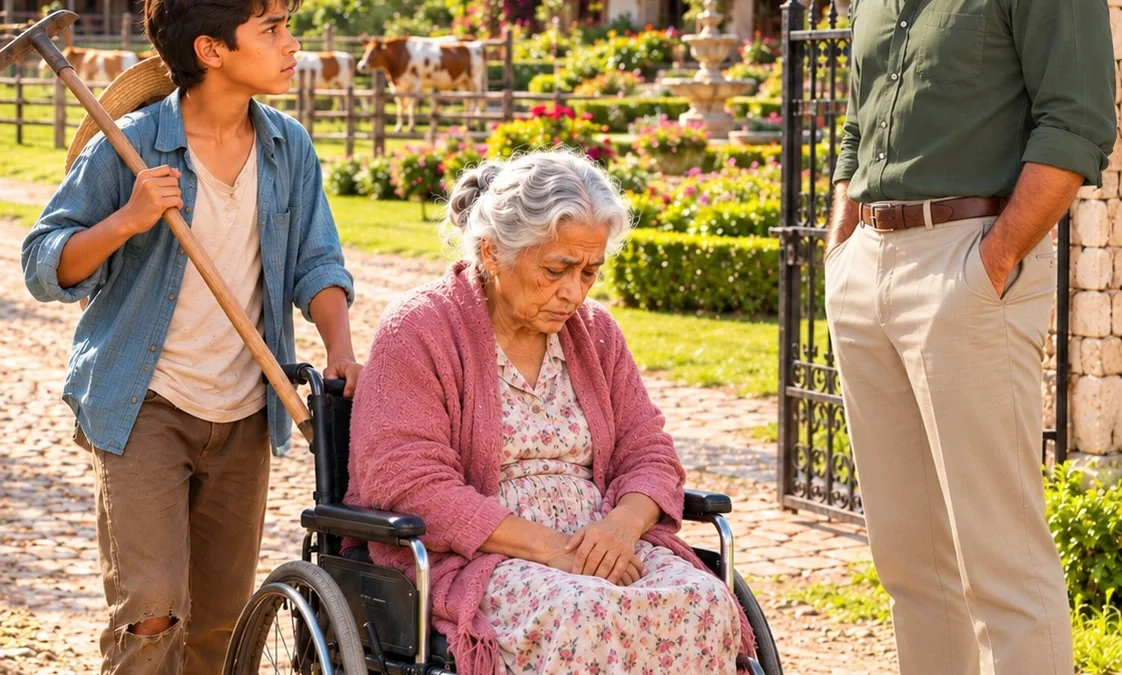
A BAREFOOT BOY BEGGED FOR WORK TO BUY HIS GRANDMOTHER’S MEDICINE—THE RANCHER SENT HIM AWAY, THEN SUDDENLY REOPENED THE GATE
Part 1
“I’m not asking for charity, sir. Let me work. You can pay me with my grandmother’s medicine.”
Those were the words I said to Don Isaías Robledo the afternoon I arrived at Hacienda El Retiro pushing a rusty wheelchair over a road covered in stones.
I was eleven.
Maybe twelve.
I honestly wasn’t sure anymore.
My shoes had fallen apart three villages earlier, so strips of cloth were wrapped around my bleeding feet.
Behind me, my grandmother Práxedes struggled for every breath.
She was all I had left.
And I was terrified she was going to die.
Don Isaías stood behind a huge iron gate.
He was around sixty, broad-shouldered, gray-haired, with the weathered face of a man who had spent most of his life beneath the sun.
Behind him stretched more land than I had ever seen.
Cattle.
Stables.
Fields.
A beautiful old house.
He had everything.
We had almost nothing.
He studied me for a few seconds.
Then said:
“There’s no work here.”
My heart sank.
“Please, sir. I can clean. Carry things. Feed animals. Fix fences. Anything.”
“There’s no work.”
He looked toward the road.
“Leave before dark.”
I felt something inside me collapse.
We had been walking from Santa Rita, knocking on doors along the way.
Every answer was the same.
No work.
No room.
No money.
No.
My grandmother needed heart medication.
After my parents died in an accident when I was seven, Práxedes had raised me alone.
She washed other people’s clothes.
Made tortillas.
Worked a tiny piece of land.
When her legs stopped working properly and her heart began failing, I started selling everything we owned.
First the chickens.
Then the pig.
Then our donkey.
Finally, our little house.
I could survive being homeless.
I could survive hunger.
I could survive walking barefoot.
But I couldn’t lose her too.
I tightened my hands around the wheelchair.
“Come on, Grandma.”
She looked up at me.
“Where are we going?”
“Somewhere else.”
I forced myself to smile.
“We’ll find something.”
I turned the wheelchair around.
One wheel squealed with every rotation.
We had almost reached the road when I heard a voice behind us.
“Boy!”
I stopped.
“Wait.”
The iron gate opened.
Don Isaías stood there.
His voice was still hard.
His eyes weren’t.
“I don’t have work for you today,” he said. “But I’m not sending an old woman and a child into the countryside at night.”
I stared at him.
“There’s a room beside the barn. You can sleep there.”
He hesitated.
“Tomorrow we’ll see.”
I couldn’t understand.
Minutes earlier, he had sent us away.
“Why did you change your mind?”
Don Isaías looked at me for a long time.
Then he said something I would remember for the rest of my life.
“Because I know what it costs to close a door.”
That night he brought beans, tortillas, dried meat, hot water, and a thick wool blanket.
I gave the bed to Grandma and slept on the floor.
Before leaving, Don Isaías pointed toward the enormous main house.
“You can use the yard and the barn.”
Then his expression changed.
“But don’t enter the main house without permission.”
“Why?”
“There are rooms in there that stay closed.”
Something about the way he said it frightened me.
Not anger.
Pain.
The following morning, I woke before sunrise.
Nobody had hired me.
So I hired myself.
I swept the yard.
Stacked firewood.
Carried water.
Then I heard shouting from the cattle pen.
A newborn calf was lying in the straw.
Weak.
Everyone had apparently decided it wouldn’t survive.
I knelt beside it.
“Come on.”
I warmed some milk.
Rubbed the calf’s neck.
Touched a little milk against its mouth.
Nothing.
I tried again.
And again.
Eventually, its tongue moved.
Then it began to suck.
I laughed.
“That’s it!”
When I looked up, Don Isaías was standing beneath the shade watching me.
“Who taught you that?”
“My grandmother.”
He glanced toward Práxedes, who was sitting in the morning sun.
“What else did she teach you?”
I smiled.
“That when nobody believes in someone, you have to believe twice as hard.”
For some reason, Don Isaías looked away.
By afternoon, he had found jobs for me.
Nothing dangerous.
Sweeping.
Feeding chickens.
Carrying small tools.
Helping around the stables.
I worked until my hands hurt.
That evening he placed some money in my palm.
I shook my head.
“Medicine.”
“What?”
“I said you could pay me with Grandma’s medicine.”
His face changed.
“Right.”
He closed my fingers around the money.
“Tomorrow we’ll go into town.”
I ran to tell Práxedes.
But she wasn’t smiling.
She was watching Don Isaías.
And he was watching her.
It was the strangest look I had ever seen between two people.
Not recognition exactly.
Something older.
Something heavier.
That night, Grandma asked me a question.
“Do you know why I brought you to this ranch?”
I shrugged.
“You said maybe they would have work.”
“No.”
My smile disappeared.
“What do you mean?”
She looked toward the big house.
“I knew this place.”
My skin prickled.
“You’ve been here?”
“Not inside.”
“Then how?”
She didn’t answer.
The following afternoon, I found Don Isaías and my grandmother beneath an ash tree.
I was repairing a section of fence nearby.
They probably thought I couldn’t hear them.
Don Isaías spoke first.
“You’ve been staring at me since you arrived.”
Grandma remained calm.
“Because I remember you.”
He frowned.
“I don’t remember you.”
“No.”
She nodded.
“It’s been forty years.”
His face changed.
Grandma continued.
“I lived in Santa Rita.”
The tool in my hand stopped moving.
“I was a neighbor of a young seamstress.”
Don Isaías went completely still.
Grandma said her name.
“Amparo.”
The color disappeared from his face.
He slowly sat down.
“That was forty years ago.”
“I know.”
“You knew her?”
“Very well.”
Don Isaías stared at the ground.
Then his voice hardened.
“She betrayed me.”
Grandma shook her head.
“No, Isaías.”
He looked up.
And my grandmother said the words that seemed to break something inside him.
“That is the lie you have been using to punish yourself for forty years.”
I stopped breathing.
Grandma told him what had really happened.
Amparo had been poor.
A seamstress.
And desperately in love with Isaías, the young son of the wealthy ranch owner.
Someone wanted them separated.
So a rumor was created.
Isaías was told Amparo had another man.
Young, proud, furious—he believed it.
He never allowed her to explain.
Then Amparo became sick.
Very sick.
Her family came to Hacienda El Retiro.
They stood outside that same iron gate.
They begged Isaías for money for a doctor.
For medicine.
And Isaías refused.
He closed the gate.
Amparo died shortly afterward.
Don Isaías covered his face.
“I had the money.”
My grandmother reached out and placed one hand on his shoulder.
“Yes.”
“I could have paid for everything.”
“Yes.”
His shoulders shook.
“Did she hate me?”
Grandma’s eyes filled with tears.
“No.”
He looked at her.
“Her final words were that you had never failed her.”
Don Isaías stared at her in disbelief.
“She said she hoped that one day you would learn to forgive yourself.”
That was when I understood.
The empty house.
The locked rooms.
The man who had never married.
The gate he almost closed on us.
But Grandma wasn’t finished.
She looked toward me.
Then said quietly:
“I didn’t come here to collect an old debt, Isaías.”
He wiped his face.
“Then why did you come?”
My grandmother struggled to breathe.
Her next words changed my life.
“Because I am dying.”
I dropped the tool.
Don Isaías stared at her.
“My grandson is going to be alone,” she continued. “And if there is one man in this world who understands the price of closing a door when someone needs help…”
She looked straight into his eyes.
“…it’s you.”
Don Isaías turned toward me.
His face was wet with tears.
And I realized Grandma had not brought me to El Retiro because she hoped to find work.
She had brought me there because forty years earlier, Don Isaías had closed that gate on a dying woman.
Now she was asking him whether he would make the same choice twice.
Find Part 2 in the comments—or leave ANY WORD below and I’ll send it to you privately. 👇
Part 2
Find Part 2 in the comments—or leave ANY WORD below and I’ll send it to you privately. 👇
Don Isaías looked at me from beneath that tree and made a promise I wouldn’t fully understand until years later.
“That boy will never be left outside another door while I’m alive.”
The following morning, Grandma woke struggling to breathe.
Her lips were turning blue.
“Don Isaías!”
I ran to the main house and pounded on the door.
“My grandmother can’t breathe!”
He came running with his shirt half-buttoned.
“What medicine does she take?”
“The prescription is at the pharmacy in Santa Rita, but it costs—”
“Stop counting pennies.”
He looked at me sharply.
“Your grandmother is alive. That’s what matters.”
He sent his foreman, Genaro, to get both the medicine and a doctor.
Don Isaías paid for everything.
The doctor eventually pulled me aside.
“The medicine can stabilize her. It can reduce her pain.”
“How long?”
He hesitated.
“Weeks. Perhaps months.”
I looked down.
“Then make sure it doesn’t hurt.”
Behind me, Don Isaías turned away so I wouldn’t see him cry.
The next weeks changed El Retiro.
Grandma ate with us.
I worked on the ranch.
And Don Isaías began teaching me.
How to shoe animals.
Treat cattle.
Read approaching weather in the clouds.
Keep accounts.
He even enrolled me in school.
One afternoon I asked him why he had never married.
His answer was simple.
“I made one decision in a minute and spent forty years paying for it.”
I repeated something Grandma always said.
“Regret without changing is just crying for yourself.”
Don Isaías said nothing.
That afternoon, he unlocked one of the rooms in the main house.
The room he had kept closed for decades.
I stayed in the hallway.
Inside, I saw a photograph of a beautiful young woman.
A candle.
And a box filled with letters.
Amparo.
It seemed as if the entire house had finally started breathing.
Then everything nearly collapsed.
One morning, money disappeared from Don Isaías’s desk.
Genaro immediately pointed at me.
“I warned you, boss. That kid came from nowhere.”
He searched our room.
Then reached beneath my mattress.
And pulled out a bundle of cash.
My face burned.
“I didn’t take it!”
Genaro smiled.
“Of course.”
“I swear on my parents!”
Don Isaías looked at the money.
Then at me.
For several terrible seconds, he said nothing.
I thought it was over.
The ranch.
School.
Grandma’s medicine.
Everything.
Then Don Isaías crouched until his eyes were level with mine.
“Look at me.”
I did.
“Did you take that money?”
“No.”
He studied my face.
Then stood.
“I believe you.”
Genaro exploded.
“Patrón, it was underneath his mattress!”
Don Isaías raised one hand.
“A clever thief doesn’t hide stolen money beneath his own mattress.”
Genaro stopped.
“And whoever planted it knew exactly how much was missing, had access to my desk…”
Don Isaías stared directly at him.
“…and somehow knew exactly where we should search.”
Genaro’s face went white.
He eventually confessed.
He feared I would replace him.
He thought Don Isaías would someday leave the ranch to me and throw him out.
So he framed me.
Don Isaías fired him.
But still paid every peso Genaro was legally owed.
Then he turned toward me.
“Forty years ago, I condemned someone without listening to her.”
He placed one hand on my shoulder.
“I will not make that mistake twice.”
I threw my arms around him.
It was the first time I hugged Don Isaías.
And for the first time since losing my parents, I wondered if I might someday have a home again.
But Grandma was getting weaker.
A few days later, she called Don Isaías to her bedside.
She handed him an old wooden rosary.
“This belonged to my mother.”
Don Isaías took it carefully.
“Why are you giving it to me?”
“Don’t give it to the boy at my funeral.”
He frowned.
“Then when?”
Grandma looked toward me.
“Give it to him the day he wants to give up.”
My throat tightened.
Then she asked me for one final thing.
“When I’m gone, plant a tree beside the garden wall.”
“Grandma…”
“Use your father’s hoe.”
“Stop talking like that.”
She smiled.
“Poor people don’t need statues.”
Her weak fingers touched my cheek.
“A tree gives shade. It gives fruit. It keeps serving after we’re gone.”
That night, I fell asleep beside her wheelchair while she stroked my hair.
The next morning, sunlight entered through the little barn-room window.
I opened my eyes.
“Grandma?”
She didn’t answer.
“Grandma?”
I touched her hand.
It was cold.
And in that moment, the last person in the world who had belonged to me was gone.
💔 LIKE this story or COMMENT “GATE” if you want Part 3. Once there are enough comments, I’ll post the complete ending.
Part 3
For days after Grandma died, I barely spoke.
People came.
They brought food.
They said things children are supposed to find comforting.
“She’s with your parents now.”
“She isn’t suffering.”
“She lived a good life.”
None of it helped.
I didn’t want heaven.
I wanted my grandmother.
I wanted to hear her complain that I hadn’t washed properly before dinner.
I wanted to hear her cough from the other side of the room.
I wanted her to tell me everything would be fine even when both of us knew she couldn’t possibly know that.
Instead, her chair sat empty.
I stopped eating properly.
Stopped doing my chores.
Stopped going to school.
Every afternoon, I sat beside the garden wall holding the old hoe that had belonged to my father.
But I never dug.
Don Isaías gave me space.
Until one afternoon, I finally said what had been growing inside me.
“Everyone I love dies.”
He sat beside me.
I stared at the ground.
“My parents died.”
Silence.
“Grandma died.”
My fingers tightened around the wooden handle.
“So I’m finished.”
“With what?”
“Loving people.”
Don Isaías turned toward me.
“If I don’t love anybody else, it won’t hurt when they leave.”
He closed his eyes.
For a moment, I thought he might argue.
Instead, he reached into his pocket.
And pulled out a wooden rosary.
I recognized it instantly.
“Grandma’s.”
“She gave it to me.”
“When?”
“Before she died.”
I took it.
My hands started shaking.
“She told me not to give it to you at her funeral.”
I looked at him.
“She said to wait until the day you wanted to give up.”
I began crying.
Then Don Isaías delivered her message.
“While these hands can still hold on.”
I broke.
When my parents died, Grandma had taken my little hands between hers.
She had told me the same thing.
As long as these hands could work…
help someone…
plant something…
hold someone…
or push me back onto my feet…
I was not lost.
I cried against Don Isaías’s chest until I had no strength left.
He didn’t tell me to stop.
He simply held me.
Eventually, I wiped my face.
Then looked at the hoe.
“We forgot something.”
“What?”
“The tree.”
For the first time in days, Don Isaías smiled.
“I already bought it.”
It was a young avocado tree.
We carried it to the wall.
I dug with my father’s hoe.
Don Isaías finished the hole with his bare hands.
Together, we lowered the tree into the earth.
Pressed the soil around its roots.
Watered it.
I placed one palm against the thin trunk.
“Here it is, Grandma.”
My voice shook.
“I’m not giving up.”
But before that tree could become our new beginning, Don Isaías had one more place to take me.
Santa Rita.
The cemetery.
Grandma had recently been buried there.
But we did not stop first at her grave.
Don Isaías pushed open a small iron gate and walked slowly between the headstones.
Then he stopped.
A simple stone stood before us.
One name was carved into it.
AMPARO.
I looked at him.
“So she’s here.”
“Yes.”
He stood in silence.
Then told me the whole story himself.
Forty years earlier, Amparo’s family had come to El Retiro.
She was desperately ill.
They asked him for money.
He had more than enough.
But he was angry.
Proud.
Convinced she had betrayed him.
So he sent them away.
“They begged me for medicine.”
His voice cracked.
“And I closed the gate.”
He stared at the grave.
“She died before I discovered the truth.”
I didn’t know what to say.
“I thought I deserved to be alone after that,” he continued. “So I closed the house. Closed those rooms. Closed myself.”
Grandma had come with us to the cemetery once before she died, when she still had enough strength.
I remembered what she had told him beside Amparo’s grave.
“Punishing yourself doesn’t bring the dead back.”
Don Isaías nodded.
“But doing good with whatever life you have left can still save the living.”
He knelt.
For a long time, he said nothing.
Then:
“Forgive me, Amparo.”
His hand touched the gravestone.
“I’m forty years late.”
When he stood, he placed a hand on my shoulder.
“But I won’t be late for this boy.”
At the time, I had no idea how much those words would shape both our lives.
Years passed.
The little avocado tree beside the garden wall grew taller.
So did I.
Its branches eventually became wide enough to cast shade.
Then came the first fruit.
I did my homework beneath it.
Sometimes, when I missed Grandma, I spoke to her there.
I told her about school.
The ranch.
Girls.
Arguments.
Mistakes.
Everything.
Don Isaías kept his promise.
But he did something more important than simply give me money.
He raised me without making me feel purchased by his kindness.
He expected me to study.
Work.
Tell the truth.
Accept consequences.
He taught me agriculture.
Accounts.
Livestock.
Negotiation.
How to recognize when rain was coming.
How to know when an animal was frightened rather than aggressive.
How to shake a man’s hand while looking him in the eye.
And whenever I became too confident, he reminded me:
“A ranch can teach you many things, but don’t let owning land convince you that you own people.”
I finished school.
Then studied agricultural management.
After graduating, I returned to El Retiro.
Not because I had nowhere else to go.
Because I wanted to.
Don Isaías never asked me to call him Father.
For years, I simply called him Don Isaías.
Then one ordinary afternoon, we were working when I saw a damaged fence in the northern pasture.
I called toward the house without thinking.
“Dad! The fence in the north pasture is down!”
Silence.
I turned.
Don Isaías stood in the doorway.
His eyes were wet.
I suddenly realized what I had said.
Neither of us mentioned it.
He wiped his face with the back of his hand.
Then grabbed his tools.
“Then let’s fix it, son.”
From the day Grandma died, the huge iron gate at El Retiro was never closed during daylight again.
Don Isaías refused.
“A closed gate cost me forty years,” he used to say. “I don’t need to learn that lesson twice.”
Slowly, people began calling El Retiro something else.
The Ranch of the Open Gate.
A traveler could get water.
A worker looking for employment would at least be heard.
An elderly person needing transportation to town got a ride if we could provide one.
A hungry person was given a meal.
We did not pretend we could solve every problem.
We didn’t give away money we didn’t have.
We didn’t promise work when there was none.
But nobody was dismissed without being heard.
That distinction mattered to Don Isaías.
“Opening the gate doesn’t mean saying yes to everything,” he told me.
“It means remembering there’s a human being standing on the other side.”
He grew old.
Then older.
The powerful rancher who had frightened me when I was a barefoot boy eventually needed a cane.
I began handling more of El Retiro.
He complained about it.
“You think because I walk slowly, I can’t inspect cattle?”
“You almost fell into a water trough yesterday.”
“The trough was badly placed.”
“It hasn’t moved in fifty years.”
“Exactly. About time someone moved it.”
I laughed.
Those were good years.
Not perfect.
But good.
Eventually, the day came when Don Isaías did not get out of bed.
I sat beside him.
The window was open.
From where he lay, he could see the branches of Grandma’s avocado tree moving in the wind.
“Look at that thing,” he whispered.
“What?”
“That tree.”
He smiled weakly.
“Your grandmother is still ordering us around.”
I laughed despite the tears in my eyes.
“She’d say you need a haircut.”
“She always said that.”
His breathing grew shallow.
Then he looked at me.
“Is the gate open?”
I nodded.
“Yes.”
“Good.”
His eyes closed.
Then opened again.
“Don’t close it because I’m gone.”
“I won’t.”
“Promise.”
“I promise.”
He squeezed my hand.
The same hand that had once been wrapped in dirty cloth because I had no shoes.
“Good.”
Don Isaías died an old man.
I buried him in Santa Rita.
Beside Amparo.
People asked what I wanted engraved on his headstone.
I considered long descriptions.
His name.
His businesses.
The size of the ranch.
The people he had helped.
None felt right.
So I chose one sentence:
HERE RESTS A MAN WHO LEARNED TO OPEN A DOOR.
That afternoon, I returned to El Retiro alone.
The sun turned the road gold.
The iron gate stood open.
Near the garden wall, Grandma’s avocado tree had grown enormous.
I walked beneath it.
Reached up.
Picked one ripe fruit.
For a while, I simply held it.
I thought about my parents.
Grandma.
Amparo.
Don Isaías.
Four people whose lives had somehow led me to that exact place.
Then I heard footsteps.
A boy was standing outside the gate.
Maybe fourteen.
Maybe younger.
He carried an old backpack.
His clothes were dusty.
His face had the exhausted look I remembered from mirrors when I was a child.
“Sir?”
I looked at him.
“Can I ask you something?”
“Go ahead.”
“Is there any work?”
For a moment, forty years collapsed into one second.
I saw myself.
Bare feet.
Cloth around my wounds.
Both hands gripping Grandma’s wheelchair.
I’m not asking for charity, sir. Let me work.
I looked down at my hands.
They were older now.
Calloused.
Strong.
Still capable of holding on.
I remembered Grandma’s words.
While these hands can still hold on.
Then I looked at the boy.
“Come in.”
His shoulders relaxed slightly.
“Does that mean you have work?”
“We’ll talk about that.”
I pointed toward the house.
“First, you’re going to eat.”
He hesitated.
“I don’t have money.”
“I didn’t ask whether you did.”
The boy stepped through the gate.
I followed him.
Then stopped.
For a second, I looked back at the old iron doors.
Forty years earlier, pride had closed them on Amparo.
Decades later, regret had almost closed them on my grandmother and me.
But Don Isaías had opened them again.
That single decision did not erase his past.
It could never bring Amparo back.
It could not restore the forty years he spent punishing himself.
But it changed what happened next.
It gave Grandma peace during her final weeks.
It gave a barefoot orphan a home.
It gave Don Isaías a family.
It planted a tree.
And eventually, it taught another frightened boy that being poor did not mean he had to remain outside.
Some mistakes can never be undone.
Some people cannot be brought back.
Some apologies arrive too late for the person who deserved to hear them.
But remorse does not have to become a prison.
If we are still here, we can choose what we do with the years that remain.
We can listen before judging.
Help without humiliating.
Love despite knowing that love eventually brings grief.
And when someone exhausted reaches our door asking only for the chance to keep going…
we can open it.
I walked toward the house.
Behind me, the gate remained open.
And beneath the avocado tree, the afternoon wind moved gently through leaves that had once been nothing more than a dying grandmother’s final request. ❤️
Disclaimer: This story is entirely fictional and created for entertainment purposes only. It does not represent any organization or individual, nor does it encourage inappropriate behavior. The content was generated with AI assistance.








